
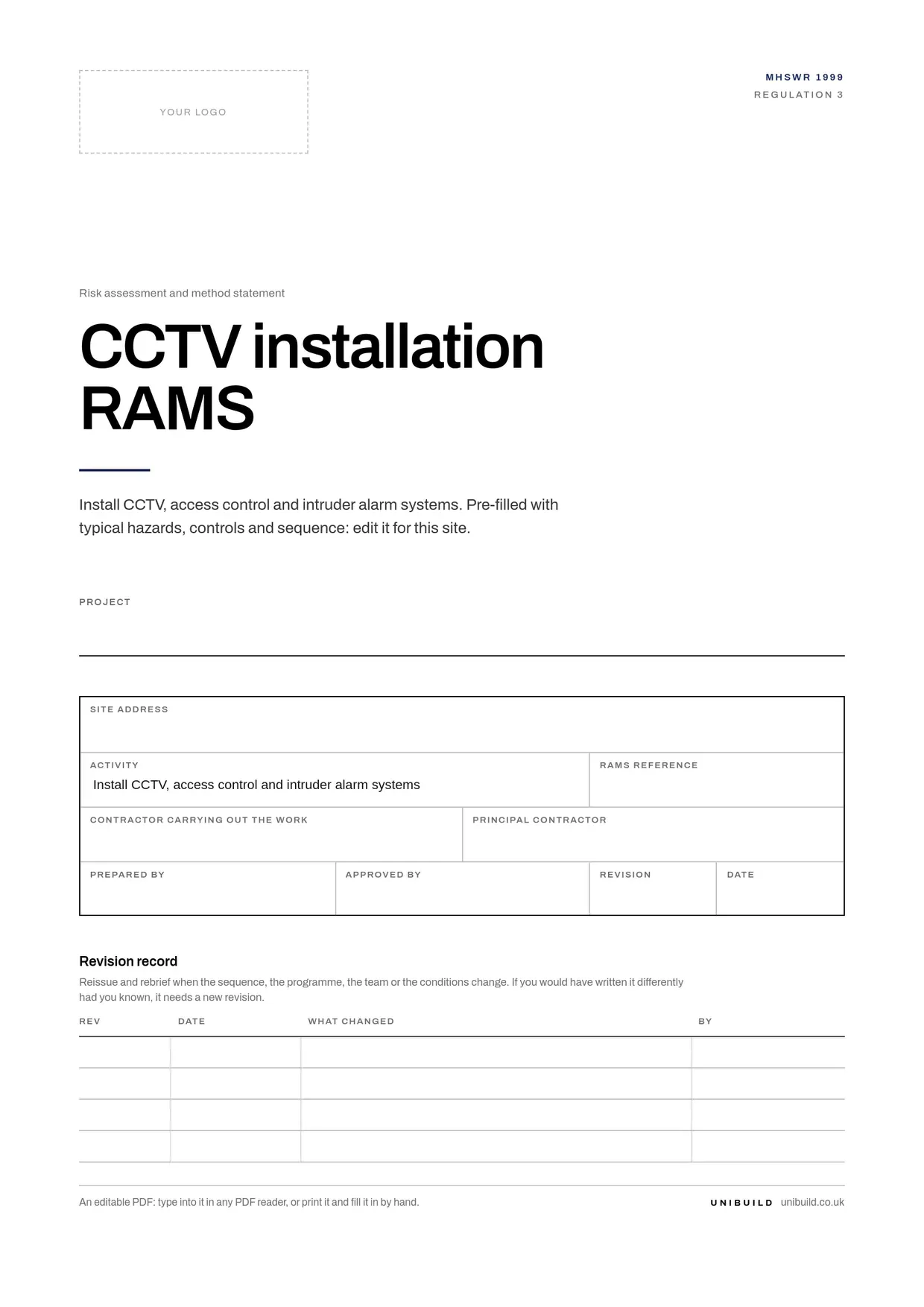
CCTV risk assessment and method statement template
A CCTV installation risk assessment and method statement, already filled in with the hazards, controls and sequence for cameras, access control and intruder alarms. Edit it for the job, then brief it.
- Law
- Work at Height 2005 and EAWR 1989
- Covers
- CCTV, access control and intruder alarms
- Format
- Editable PDF and Word
- Cost
- Free, always
Do you need a risk assessment for CCTV installation?
Yes. Every CCTV installation needs a risk assessment, and most clients and principal contractors will ask for a CCTV risk assessment and method statement before an installer starts. This CCTV risk assessment template covers cameras, access control and intruder alarms, because the same team, ladders and cable routes are usually involved in all three.
The risk assessment is the legal duty, under regulation 3 of the Management of Health and Safety at Work Regulations 1999. The CCTV installation method statement shows how the job is done: how cameras and devices are reached at height, where cables run, how the mains supply is isolated, and how the system is tested without false alarms.
Write it for the premises in front of you. Whether the building is occupied, its age and asbestos information, the walls and poles the cameras go on, overhead lines and buried services, escape doors fitted with locks, and who receives the alarm signals are what make it suitable.
Checked against legislation.gov.uk and HSE guidance on .
CCTV and security systems hazards and controls
19 hazards, rated before and after controlsThe significant hazards on a typical CCTV, access control or intruder alarm installation, inside and outside, new or occupied, with the controls a reviewer expects to see. Delete what does not apply and add what your job has.
Falls from ladders fixing cameras and devices
Installers fixing cameras, detectors, sounders, readers and cable clips on walls, soffits and ceilings.
- Ladders only for low-risk, short-duration tasks, as Schedule 6 of the Work at Height Regulations allows, with a tower, podium or MEWP chosen for anything longer or higher.
- Ladder checked before use, footed or tied on firm level ground, with a secure handhold kept throughout.
- Cables pulled and pre-terminated from the ground, so the work at the top of the ladder is a fixing, not a cable run.
BeforeHigh 15AfterMedium 10
Falls from towers, podiums and MEWPs
Installers working on high elevations, warehouse ceilings and car park soffits.
- PASMA training for anyone erecting a tower and IPAF for MEWP operators, with the cards checked at briefing.
- Tower built to the maker's instructions with outriggers and guard-rails; MEWP ground and overhead hazards checked before setting up.
- Rescue plan for a MEWP in place before work starts, with a ground person who can lower the platform.
BeforeHigh 15AfterMedium 5
Ceiling voids, roof spaces and fragile roofs
Installers running cables above suspended ceilings, in lofts and over rooflights or sheeted roofs.
- Nobody stands on ceiling tiles, grid or plasterboard; crawl boards across joists in roof spaces.
- Fragile roofs and rooflights identified in the survey; no access onto them without a separate plan for the roof work.
- Temporary lighting in voids before work starts.
BeforeHigh 15AfterMedium 5
Falling tools, brackets and cameras
The public, staff and other trades below external walls, poles and high-level work.
- Area below the work barriered and signed, with a second person keeping it clear on busy routes.
- Tools on lanyards at height; brackets and cameras lifted in a bag, not carried up a ladder in one hand.
BeforeMedium 12AfterLow 4
Electric shock at the mains connection
Installers and electricians connecting recorders, panels, door controllers, power supplies and lock supplies.
- Supply isolated at a lockable device, locked off and proved dead before work, following HSE guidance on EAWR regulations 12 and 13.
- Mains connection made and tested by a competent electrician to BS 7671.
- Covers kept on panels and power supplies whenever they are powered.
BeforeHigh 15AfterMedium 5
Hidden cables and services when drilling
Installers drilling walls, soffits and ceilings for fixings and cable entries.
- Existing services checked against the drawings and the building manager; cables in voids treated as live until proved dead.
- Cable detector used before drilling. Non-contact detectors help find cables but are never used to prove dead.
BeforeHigh 15AfterMedium 10
Overhead power lines near poles and walls
Installers raising columns, ladders or MEWPs near overhead lines, and service cables at the eaves.
- Lines identified in the survey; the line owner contacted to divert or switch off where work is close, following HSE GS6.
- Where lines stay live, barriers and warning notices keep plant and ladders clear, as CDM regulation 25 requires.
- Long ladders and poles carried horizontally and never raised under a line.
BeforeMedium 10AfterMedium 5
Buried services at pole bases and ducts
Installers digging pole foundations and cable trenches, and anyone nearby.
- Service plans obtained and the area scanned with a cable locator before digging, following HSE HSG47.
- Hand dig near located services; mechanical excavation only once services are exposed or confirmed clear.
- Permit to dig where the site or client uses one.
BeforeHigh 15AfterMedium 5
Lifting and raising CCTV columns
Installers raising, hinging or lowering columns, and people near the lift.
- Column lifted by crane or lorry loader under a lift plan, or raised as the maker's instructions direct for hinged columns.
- Exclusion zone around the lift; nobody under a suspended or partly raised column.
- Foundation and bolts checked as the design requires before the column is released.
BeforeMedium 10AfterMedium 5
Asbestos in older buildings
Installers drilling or lifting ceiling tiles in buildings built or refurbished before 2000.
- Asbestos register or refurbishment survey checked before work; materials it does not cover are presumed to contain asbestos until sampled.
- Work stops and the area is left if suspect material is found or disturbed.
- Asbestos awareness training for everyone liable to disturb it.
BeforeHigh 15AfterMedium 5
Breaching fire separation
Building occupants, if holes for cables through fire-resisting walls and floors are left open.
- Penetrations recorded as they are made and sealed with the fire-stopping product specified, to its tested detail.
- Fire stopping checked and photographed before ceilings are closed.
- Fire doors never wedged open for cable runs.
BeforeHigh 15AfterMedium 5
Locks on escape routes and fire doors
Occupants unable to escape, if access control locks a door on an escape route or damages a fire door.
- Locking on escape routes agreed with the client and the fire strategy, with release on fire alarm and on power failure where it requires.
- Fire doors cut or drilled only within the door and hardware certification, and closers left working.
- Release tested at commissioning with the fire alarm installer and the responsible person.
BeforeMedium 10AfterMedium 5
Vehicles in car parks, yards and roads
Installers on ladders, towers and MEWPs in car parks, service yards and beside roads, and drivers passing.
- Work area coned and barriered so vehicles cannot reach the ladder, tower or MEWP, with high-visibility clothing worn.
- Work in car parks and yards timed for quiet periods with the site manager, with a banksman where vehicles must pass close.
- Work from a road or footway only as the highway authority agrees, with signing to its requirements.
BeforeHigh 15AfterMedium 5
Working in occupied premises
Staff, residents, pupils, customers and the public near ladders, open ceilings and trailing cables.
- Work area barriered, ceilings closed and tools cleared at the end of each day.
- Work in sensitive areas, such as schools, care homes and shops, timed with the building manager.
- Escape routes and fire doors kept clear at all times.
BeforeMedium 12AfterLow 4
False alarms and unplanned evacuations
Occupants, keyholders and the alarm receiving centre, from alarm tests or a fire alarm set off by dust.
- Alarm receiving centre told before work or tests on a monitored system, the signal put on test, and told again when it is back in service.
- Fire detectors near dusty work covered or isolated only as agreed with the responsible person, and restored each shift.
BeforeMedium 12AfterLow 3
Dust from drilling
Installers drilling masonry and concrete for fixings and cable entries, and people nearby.
- Drills with on-tool extraction suited to the dust.
- FFP3 or other suitable RPE, face-fit tested, where extraction alone does not control the dust.
BeforeMedium 12AfterMedium 6
Standby batteries and noise from sounders
Installers handling panel batteries, and anyone close to sounders during tests.
- Batteries connected last and disconnected first, with terminals covered and insulated tools used.
- Sounder tests kept short, occupants warned, and hearing protection worn close to external sounders.
BeforeMedium 9AfterLow 3
Manual handling of drums, ladders and columns
Installers moving cable drums, ladders, panels and poles through buildings and across sites.
- Cable drums run out from drum stands; panels and batteries moved on trolleys.
- Long ladders and columns carried by two people on routes kept clear.
BeforeMedium 9AfterMedium 6
Lone and out-of-hours working
Installers working alone in empty premises at night or weekends to avoid disturbing occupants.
- Someone in the office knows where each lone worker is, with agreed check-in times and an escalation if a call is missed.
- Work from towers, MEWPs or long ladders, and work near live mains, not done alone.
BeforeMedium 12AfterMedium 8
Scores are likelihood times severity on the five by five matrix in the template. They are typical ratings for this work, a starting point for your own assessment of your site.
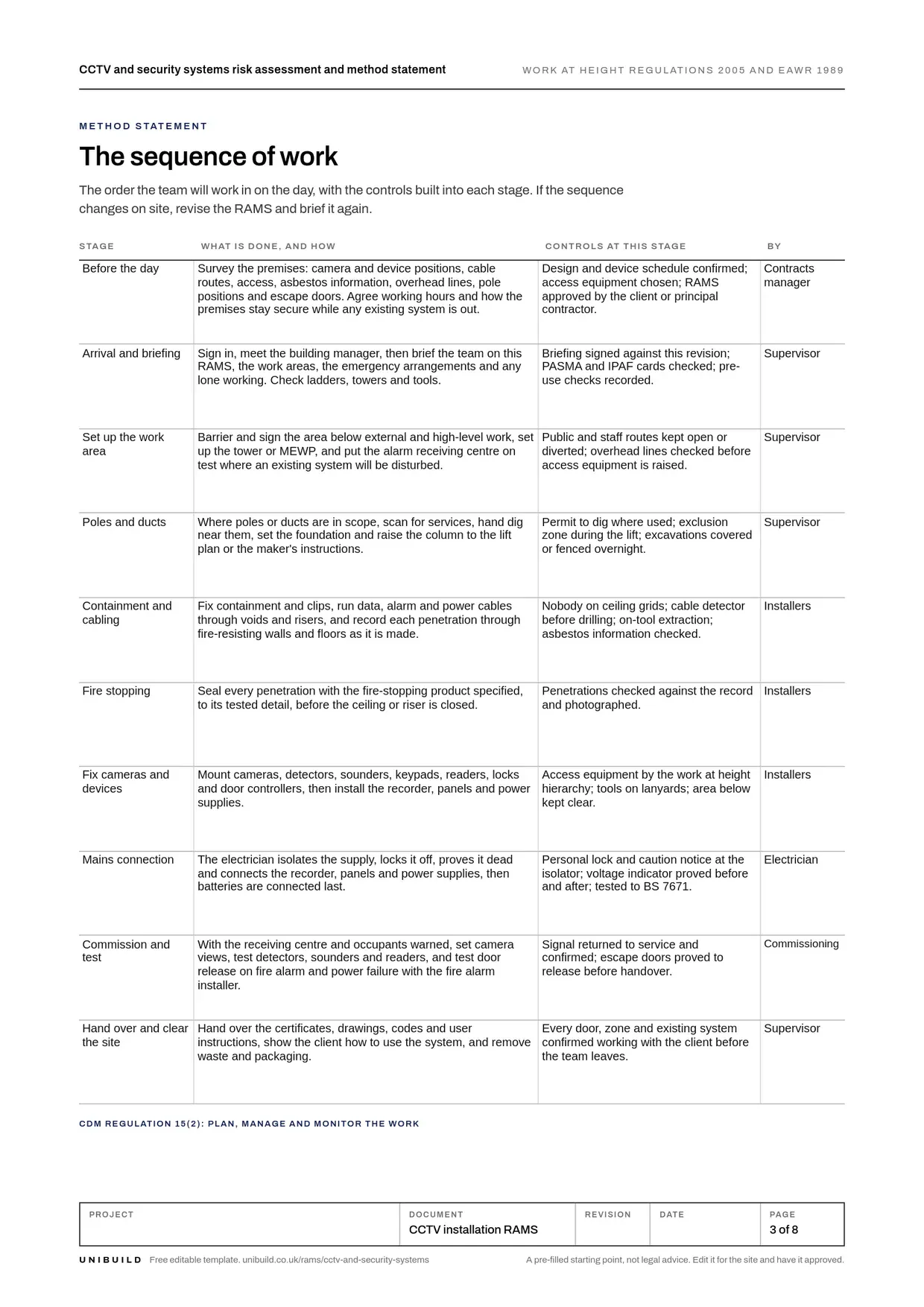
CCTV installation method statement: the sequence of work
The order of work, with the controls at each stageThe order the team works in, with the controls built into each stage. If the sequence changes on site, revise the RAMS and brief it again.
Before the day
Survey the premises: camera and device positions, cable routes, access, asbestos information, overhead lines, pole positions and escape doors. Agree working hours and how the premises stay secure while any existing system is out.
ControlsDesign and device schedule confirmed; access equipment chosen; RAMS approved by the client or principal contractor.
Arrival and briefing
Sign in, meet the building manager, then brief the team on this RAMS, the work areas, the emergency arrangements and any lone working. Check ladders, towers and tools.
ControlsBriefing signed against this revision; PASMA and IPAF cards checked; pre-use checks recorded.
Set up the work area
Barrier and sign the area below external and high-level work, set up the tower or MEWP, and put the alarm receiving centre on test where an existing system will be disturbed.
ControlsPublic and staff routes kept open or diverted; overhead lines checked before access equipment is raised.
Poles and ducts
Where poles or ducts are in scope, scan for services, hand dig near them, set the foundation and raise the column to the lift plan or the maker's instructions.
ControlsPermit to dig where used; exclusion zone during the lift; excavations covered or fenced overnight.
Containment and cabling
Fix containment and clips, run data, alarm and power cables through voids and risers, and record each penetration through fire-resisting walls and floors as it is made.
ControlsNobody on ceiling grids; cable detector before drilling; on-tool extraction; asbestos information checked.
Fire stopping
Seal every penetration with the fire-stopping product specified, to its tested detail, before the ceiling or riser is closed.
ControlsPenetrations checked against the record and photographed.
Fix cameras and devices
Mount cameras, detectors, sounders, keypads, readers, locks and door controllers, then install the recorder, panels and power supplies.
ControlsAccess equipment by the work at height hierarchy; tools on lanyards; area below kept clear.
Mains connection
The electrician isolates the supply, locks it off, proves it dead and connects the recorder, panels and power supplies, then batteries are connected last.
ControlsPersonal lock and caution notice at the isolator; voltage indicator proved before and after; tested to BS 7671.
Commission and test
With the receiving centre and occupants warned, set camera views, test detectors, sounders and readers, and test door release on fire alarm and power failure with the fire alarm installer.
ControlsSignal returned to service and confirmed; escape doors proved to release before handover.
Hand over and clear the site
Hand over the certificates, drawings, codes and user instructions, show the client how to use the system, and remove waste and packaging.
ControlsEvery door, zone and existing system confirmed working with the client before the team leaves.
What the law asks for CCTV and security installation
Checked against the sourceAvoid, prevent, minimise
Do not work at height where the work can safely be done otherwise. Where it cannot, prevent a fall from an existing safe place or with suitable equipment. Where a fall remains possible, minimise its distance and consequences.
Work at Height Regulations 2005, regulation 6When a ladder is allowed
A ladder is used for work at height only where a risk assessment shows more suitable equipment is not justified, because the risk is low and either the use is short or site features cannot be altered. It stands on a firm surface, is kept from slipping, and a secure handhold is always available.
Work at Height Regulations 2005, Schedule 6Isolation
Where necessary to prevent danger, suitable means must be available to cut off the supply and isolate equipment. Isolation means disconnection and separation from every source of electrical energy, in a way that is secure.
Electricity at Work Regulations 1989, regulation 12Competence
Work that needs technical knowledge or experience to prevent danger is done only by people who have it. Anyone else works under the supervision the task needs.
Electricity at Work Regulations 1989, regulation 16Overhead and buried cables
Overhead power cables that create a risk are directed away or isolated; where that is not reasonably practicable, warning notices and barriers are used. Work liable to create a risk from an underground service starts only once suitable steps have been taken to prevent it.
Construction (Design and Management) Regulations 2015, regulation 25Asbestos
Maintenance or other work liable to disturb asbestos does not start until someone has assessed whether asbestos is present. If in doubt, it is presumed present and the regulations are followed.
Control of Asbestos Regulations 2012, regulation 5Competence, equipment and PPE
Competence and cards
- Installers Trained and experienced in the systems being fitted, with trainees supervised.
- The company NSI or SSAIB certification where the client, insurer or police response needs it.
- Electrical connection A competent electrician working to BS 7671.
- Access equipment PASMA training for mobile towers and IPAF for MEWPs.
- Asbestos Asbestos awareness training for everyone liable to disturb it.
- Screening Staff screened to BS 7858 where the client or certification scheme asks for it.
Plant and equipment
- Ladders and podium steps Pre-use check each day; ladder inspection record kept.
- Mobile towers and MEWPs Towers inspected after erection; MEWP pre-use checks and LOLER report in date.
- Voltage indicator and proving unit Indicator proved before and after each test.
- Cable locator and signal generator Checked before use; operator trained.
- Drill with dust extraction Checked before use; extraction suited to the dust.
- Cable drum stand and trolleys Checked before use.
PPE
- Safety helmet on construction sites, and a bump cap in ceiling voids.
- Eye protection for overhead drilling and work in ceiling voids.
- RPE FFP3 mask, face-fit tested, for drilling dust and dusty voids.
- Gloves cut-resistant, for containment, brackets and fixings.
- Safety boots with toe protection.
- High-visibility clothing to the site standard, and for external work near traffic.
Permits and plans
A permit to work where the client or principal contractor requires one, for example on roofs, in plant rooms or near live services. A permit to dig for pole foundations and ducts. A lift plan for any column lifted by crane or lorry loader. Access permits for risers and roof spaces where the site uses them.
Emergency and rescue
Rescue plan for anyone stranded on a MEWP or tower, with a trained ground person on site. For an electric shock, switch off before touching the casualty and call 999. First aider and kit on site, the nearest accident and emergency department named on the briefing, and the building fire procedure followed for any other incident.
Toolbox talk: CCTV and security installation safety
Read this to the team before work starts, tick each point as it is covered, and record who attended.
- Ladders are for short, light jobs. If the camera needs more than a quick fixing, use the tower, podium or MEWP.
- Pull and terminate cables from the ground. The only job at the top of the ladder is the fixing.
- Keep the area below clear and barriered. Tools on lanyards, brackets up in a bag.
- No cover comes off a mains panel or power supply until the electrician has locked it off and proved it dead.
- Nobody stands on a ceiling grid or plasterboard. Every hole through a fire wall is recorded and sealed.
- No escape door is left locked without a working release. If in doubt, leave it on free exit and tell the supervisor.
Ask the team
- Where are the overhead lines and fragile roofs on this job?
- Who do we tell before we test, and how do we put the receiving centre on test?
- Where is the asbestos information for the ceilings and walls we are drilling today?
What is in the CCTV installation RAMS template
8 pages, pre-filled and editableThe work, pre-filled
Scope, location and access, interfaces with the client, the receiving centre, the fire alarm installer and other trades, the documents the RAMS relies on, and the team.
The sequence of work
Ten stages from survey to handover, with the controls and the person responsible at each one.
Hazards and controls
Nineteen CCTV, access control and intruder alarm hazards rated before and after controls on a five by five matrix, with room for your own.
Plant, PPE and permits
Access and test equipment with their checks, PPE by type, the substances used, and the permits the job needs.
Emergency and rescue
Rescue from towers and MEWPs, electric shock, first aid and the environment section.
Briefing record
Twenty signatures against the revision, taken on the day before the work starts.
Brief it, and get it signed on the phone
On Unibuild a RAMS is written from a template, approved, then read by each operative on their phone in their own language and signed. Subcontract and agency workers sign through a link, with no app to install.
Every signature carries its date and time and prints as the last page of the RAMS PDF. Change the RAMS and it has to be signed again.
How RAMS work on UnibuildCCTV and security systems RAMS questions
Is this CCTV risk assessment template free?
What should a CCTV installation method statement include?
Is a CCTV risk assessment a legal requirement?
Does it cover access control and intruder alarms?
Can you use a ladder to install CCTV cameras?
Does the method statement cover CCTV poles?
Do CCTV installers need NSI or SSAIB approval?
Does a CCTV risk assessment cover data protection?
RAMS templates for other trades and hazards
All free, pre-filled and editableBy trade
- Air conditioning and HVAC RAMS
- Bricklaying RAMS
- Carpentry and joinery RAMS
- CCTV installation RAMS
- Cleaning risk assessment
- Concrete works RAMS
- Demolition RAMS
- Drylining RAMS
- Electrical RAMS
- Facilities maintenance RAMS
- Fire alarm installation RAMS
- Glazing and window RAMS
- Groundworks RAMS
- Hot works and welding RAMS
- Insulation RAMS
- Landscaping and fencing RAMS
- Painting and decorating RAMS
- Pest control risk assessment
- Plastering and rendering RAMS
- Plumbing and heating RAMS
- Rail RAMS
- Refurbishment RAMS
- Roofing RAMS
- Rope access risk assessment
- Scaffolding RAMS
- Solar PV installation RAMS
- Steel erection RAMS
- Temporary works RAMS
- Tiling and flooring RAMS
- Tree surgery RAMS
By hazard
- Asbestos risk assessment
- Confined space risk assessment
- COSHH risk assessment
- Dust risk assessment
- Forklift and telehandler risk assessment
- Housekeeping risk assessment
- Lifting operations risk assessment
- Lone working risk assessment
- Manual handling risk assessment
- MEWP risk assessment
- Noise and vibration risk assessment
- Plant and excavator risk assessment
- Power tools risk assessment
- Traffic management risk assessment
- Working at height risk assessment
The blank RAMS template, the RAMS review checklist and every other free form are on Free downloads.
The RAMS, read and signed
before the work starts.
Unibuild keeps every RAMS with its versions, its approvals and each operative’s signature against the revision they read, for seven years, ready for the principal contractor or an auditor.