
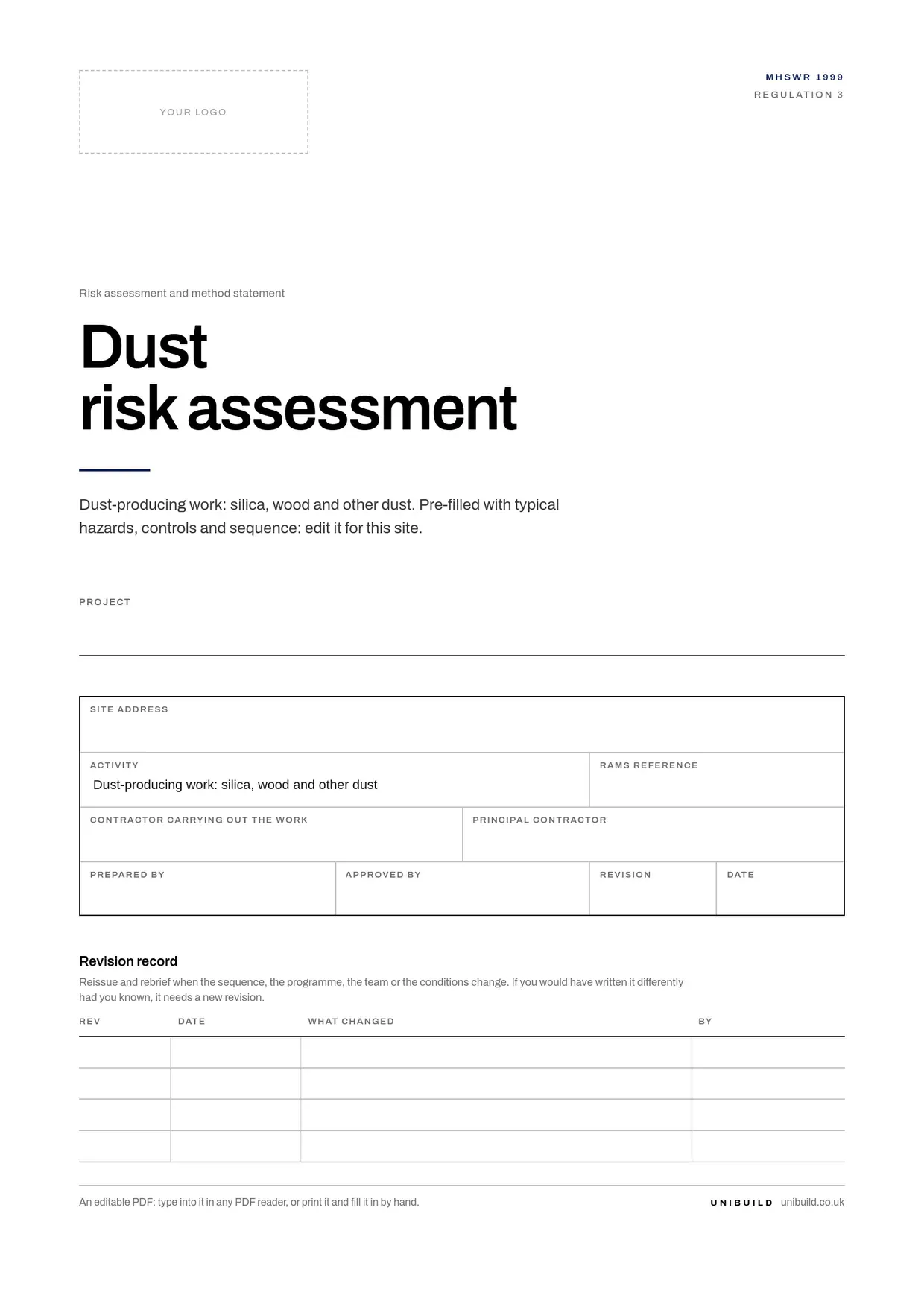
Construction dust risk assessment template
A dust risk assessment already filled in for cutting, chasing, drilling, breaking, sanding and clean-up, with a task by task dust control page. Edit it for your job, then brief it.
- Law
- COSHH Regulations 2002
- RPE for construction dust
- APF 20, face-fit tested
- Format
- Editable PDF and Word
- Cost
- Free, always
What is a dust risk assessment?
A dust risk assessment looks at each task that cuts, chases, drills, breaks, sands or sweeps, and sets how the dust will be stopped or kept out of the air. On site it covers three kinds of dust: silica dust from concrete, brick, mortar and stone, wood dust, and lower toxicity dust such as gypsum from plasterboard.
HSE names four things that drive the dust level: the energy of the tool, how enclosed the work area is, how long the task lasts and how often it is repeated. A cut-off saw outdoors can still give a very high exposure in minutes. That is why a silica dust risk assessment is written task by task, not as one line for the whole job.
It is a COSHH assessment focused on dust. Employers with five or more employees record the significant findings. The order of control is fixed: stop or reduce the dust first, then water or on-tool extraction, and RPE on top where those are not enough on their own.
Checked against legislation.gov.uk and HSE guidance on .
Dust and silica hazards and controls
16 hazards, rated before and after controlsThe dusty tasks most trades meet, with the controls HSE sets out for each and a reviewer expects to see. Delete what does not apply and add the tasks your job has.
Cutting blocks, kerbs and paving
Operatives using cut-off saws on concrete and stone, and anyone in the dust cloud nearby.
- Cuts limited at layout stage, materials cut off site, or a block splitter used in place of a saw.
- Water suppression on the saw, with enough water at the blade for the whole cut. Wetting the material first does not work.
- RPE with an APF of 20, such as an FFP3 mask, face-fit tested; others kept out of the cutting area.
BeforeHigh 25AfterMedium 10
Chasing walls and raking out mortar
Electricians, plumbers and bricklayers chasing or raking out masonry, often indoors.
- Chasing designed out where possible, for example by surface-run or over-covered cables.
- On-tool extraction to an H or M class unit, with the hood close to the wall.
- RPE with an APF of 20; powered RPE considered where the work runs for more than an hour without a break.
BeforeHigh 25AfterMedium 10
Drilling and coring concrete and masonry
Fixers and services trades drilling holes or coring openings, often overhead or in enclosed rooms.
- Number of holes cut at the design stage; direct fastening or screws where they do the job.
- For small holes, a dust collector or cordless extraction on the drill; for main-activity drilling and dry coring, an H or M class unit.
- Wet coring where practicable; RPE with an APF of 20 for main-activity drilling and longer coring.
BeforeHigh 16AfterMedium 8
Breaking out in enclosed spaces
Operatives using hand-held breakers in rooms, basements and plant areas with limited ventilation.
- Bursting, crushing, sawing or remote-controlled demolition used in place of hand breaking where possible.
- On-tool extraction to an H or M class unit, with general mechanical ventilation in enclosed rooms.
- RPE with an APF of 20 and the number of people in the room kept to those doing the work.
BeforeHigh 20AfterMedium 10
Scabbling and grinding concrete
Operatives preparing or removing concrete surfaces with hand-held scabblers and grinders.
- Finishes specified that do not need scabbling, or water jetting and retarders used instead.
- On-tool extraction to an H or M class unit wherever the tool allows.
- RPE with an APF of 20, with powered RPE considered for longer runs.
BeforeHigh 20AfterMedium 10
Cutting roof tiles and slates
Roofers cutting concrete and clay tiles with cut-off saws at height.
- Natural and fibre cement slates cut by hand; half and tile-and-a-half units and correct setting out to cut fewer tiles.
- Water suppression in a dedicated cutting area protected with scaffold boards.
- RPE with an APF of 20 for anyone cutting.
BeforeHigh 20AfterMedium 10
Engineered stone worktops
Worktop fitters cutting and finishing resin-based stone, which can hold very high levels of silica.
- Cutting, shaping and polishing done by the fabricator off site, with only minor adjustment on site.
- Any site cutting done wet or with on-tool extraction to an H or M class unit, never dry and unextracted.
- RPE with an APF of at least 20; HSE G404 says health surveillance must be considered for worktop installers.
BeforeHigh 20AfterMedium 10
Cutting and sanding wood and MDF
Joiners, carpenters and shopfitters using saws, routers and sanders, mostly indoors.
- Pre-cut and pre-finished materials ordered; a dedicated cutting area set up to contain the dust.
- On-tool extraction to an H or M class unit, at the flow rate the tool needs.
- RPE with an APF of 20 for sanding and for cutting beyond about 15 to 30 minutes of trigger time a day.
BeforeHigh 16AfterMedium 8
Sanding plasterboard joints
Tapers and dryliners sanding jointing compound, often for long periods.
- Tapered-edge boards and finishes chosen that need less sanding.
- Extracted sanders on an H, M or L class unit; L class is suitable only for lower toxicity dust such as gypsum.
- RPE where extraction alone does not keep the dust down, with the room ventilated.
BeforeMedium 9AfterMedium 6
Dry sweeping and clean-up
Labourers clearing rubble, dust and debris, and anyone working nearby.
- Small amounts damped down, then cleared with a brush, shovel and bucket.
- Fine dust vacuumed with an H or M class unit; no dry sweeping and no compressed air lines.
- Covered chutes and skips; RPE with an APF of 20 depending on the location, time and material.
BeforeHigh 16AfterMedium 8
Dust spreading to others
Other trades, occupants and the public near dusty work, who have no RPE.
- Dusty work sheeted or screened off, with doors and openings sealed.
- Work timed for when the area is clear, and the number of people near the work kept down.
- General mechanical ventilation in enclosed areas, drawing air away from others.
BeforeMedium 12AfterMedium 8
Extraction not doing its job
Operatives relying on on-tool extraction with a blocked filter, split hose or wrong unit.
- Pre-use check of hood, hose and low-flow indicator; hose fitted with an adaptor, not tape.
- Formal maintenance check at least weekly, and a thorough examination and test at least every 14 months, or proof from the hire firm.
- Work stopped if the low-flow warning shows or dust escapes.
BeforeHigh 15AfterMedium 5
Emptying extractors and changing filters
Operatives emptying units or changing filters, who can be exposed to the collected dust.
- Units fitted with the maker's disposable bags, sealed and placed in the waste container, never emptied for reuse.
- Filters changed as the maker directs, with RPE worn while doing it.
- Units wiped down daily so dust does not build up on working parts.
BeforeMedium 12AfterMedium 8
RPE that does not protect
Wearers with the wrong mask, a poor seal, stubble or a mask worn for too long.
- Tight-fitting masks face-fit tested for each wearer on each make, model and size, and wearers clean-shaven where it seals.
- Loose-fitting powered hoods for anyone who cannot be clean-shaven, and for long or hot work.
- Disposable masks replaced as the maker recommends; reusable RPE cleaned, stored and examined at suitable intervals.
BeforeHigh 15AfterMedium 5
Dust carried on clothing
Operatives and their families, when dust is carried into welfare, vans and homes.
- Work clothing chosen that does not hold dust, or disposable coveralls for the dustiest tasks.
- Clothing vacuumed, never blown down with an air line, and changed before entering the welfare cabin.
BeforeMedium 9AfterMedium 6
Lung disease not picked up early
Operatives regularly exposed to silica or wood dust, where silicosis or asthma could develop.
- Health surveillance by a competent occupational health provider for anyone regularly exposed to silica dust or wood dust.
- Baseline check before exposure or as soon as possible after it starts, then repeat checks at the interval advised.
- Coughs, wheeze and breathlessness reported between checks, and the task reviewed.
BeforeHigh 15AfterMedium 10
Scores are likelihood times severity on the five by five matrix in the template. They are typical ratings for this work, a starting point for your own assessment of your site.
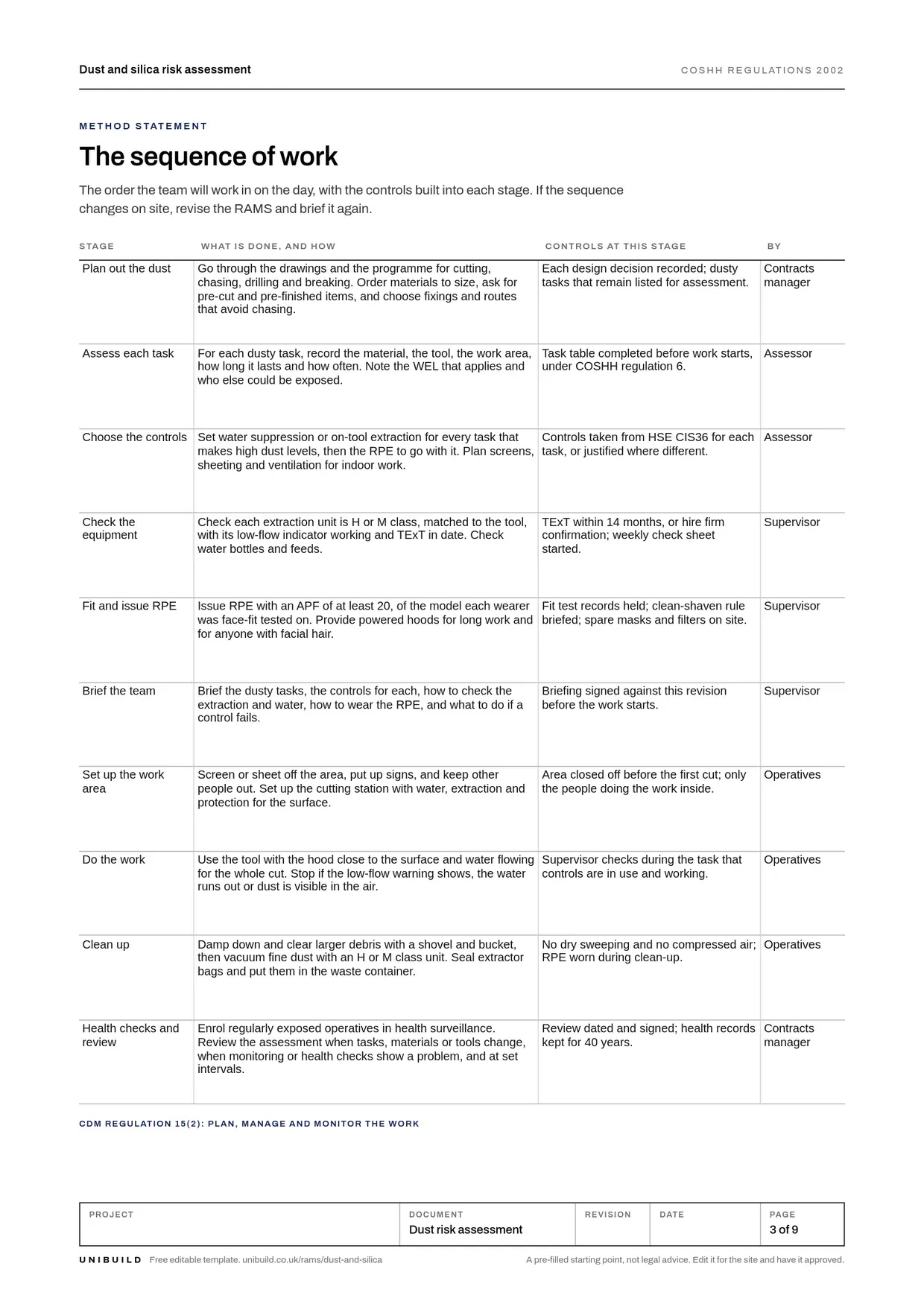
Dust control method statement: the sequence of work
The order of work, with the controls at each stageHow dusty work is planned, controlled and checked on the job, with the controls at each stage. If a task, material or tool changes, revise the assessment and brief it again.
Plan out the dust
Go through the drawings and the programme for cutting, chasing, drilling and breaking. Order materials to size, ask for pre-cut and pre-finished items, and choose fixings and routes that avoid chasing.
ControlsEach design decision recorded; dusty tasks that remain listed for assessment.
Assess each task
For each dusty task, record the material, the tool, the work area, how long it lasts and how often. Note the WEL that applies and who else could be exposed.
ControlsTask table completed before work starts, under COSHH regulation 6.
Choose the controls
Set water suppression or on-tool extraction for every task that makes high dust levels, then the RPE to go with it. Plan screens, sheeting and ventilation for indoor work.
ControlsControls taken from HSE CIS36 for each task, or justified where different.
Check the equipment
Check each extraction unit is H or M class, matched to the tool, with its low-flow indicator working and TExT in date. Check water bottles and feeds.
ControlsTExT within 14 months, or hire firm confirmation; weekly check sheet started.
Fit and issue RPE
Issue RPE with an APF of at least 20, of the model each wearer was face-fit tested on. Provide powered hoods for long work and for anyone with facial hair.
ControlsFit test records held; clean-shaven rule briefed; spare masks and filters on site.
Brief the team
Brief the dusty tasks, the controls for each, how to check the extraction and water, how to wear the RPE, and what to do if a control fails.
ControlsBriefing signed against this revision before the work starts.
Set up the work area
Screen or sheet off the area, put up signs, and keep other people out. Set up the cutting station with water, extraction and protection for the surface.
ControlsArea closed off before the first cut; only the people doing the work inside.
Do the work
Use the tool with the hood close to the surface and water flowing for the whole cut. Stop if the low-flow warning shows, the water runs out or dust is visible in the air.
ControlsSupervisor checks during the task that controls are in use and working.
Clean up
Damp down and clear larger debris with a shovel and bucket, then vacuum fine dust with an H or M class unit. Seal extractor bags and put them in the waste container.
ControlsNo dry sweeping and no compressed air; RPE worn during clean-up.
Health checks and review
Enrol regularly exposed operatives in health surveillance. Review the assessment when tasks, materials or tools change, when monitoring or health checks show a problem, and at set intervals.
ControlsReview dated and signed; health records kept for 40 years.
What the law asks for dust and silica
Checked against the sourceWhen dust is covered
Any dust counts as a substance hazardous to health at 10 mg/m³ of inhalable dust or 4 mg/m³ of respirable dust, as 8-hour averages. Dusts with their own WEL, such as silica and wood dust, are covered at any level, and their limits are far lower.
COSHH Regulations 2002, regulation 2Prevent, then control in order
Exposure is prevented or, where that is not reasonably practicable, adequately controlled: process and engineering controls first, then control at source, then RPE. For a listed carcinogen such as hardwood dust, or an asthma cause such as wood dust, exposure is cut as low as reasonably practicable.
COSHH Regulations 2002, regulation 7Silica and wood dust limits
EH40 sets 0.1 mg/m³ for respirable crystalline silica, 3 mg/m³ for hardwood dust and 5 mg/m³ for softwood dust, as 8-hour averages. In a mix of hardwood and softwood dust, the hardwood limit applies to all of it. The lower EU hardwood limit does not apply in GB.
HSE EH40/2005 Workplace exposure limits (fourth edition, 2020)Extraction is examined
On-tool extraction is a form of LEV. It is kept in efficient working order and given a thorough examination and test at least once every 14 months. Reusable RPE is examined at suitable intervals. Records are kept for at least 5 years.
COSHH Regulations 2002, regulation 9Health surveillance
Employees exposed to a substance hazardous to health are under suitable health surveillance where it is appropriate. HSE says it must be provided for regular silica exposure where silicosis is reasonably likely. Health records are kept for at least 40 years.
COSHH Regulations 2002, regulation 11Reporting asthma and cancer
A diagnosis of occupational asthma is reportable where the work involves significant or regular exposure to a known respiratory sensitiser, and EH40 marks wood dust as one. A cancer attributed to work exposure to a known human carcinogen is reportable too.
RIDDOR 2013, regulations 8 and 9Competence, equipment and PPE
Competence and cards
- Assessor Knows the tasks, the materials and the HSE task controls in CIS36, and gets help with exposure monitoring where needed.
- Supervisor Checks extraction, water and RPE before and during each dusty task, and stops work when a control fails.
- Operatives Trained in the dust risks, how to use and check the controls, and how to wear and look after their RPE.
- Fit tester Trained, qualified and experienced; HSE names the Fit2Fit scheme as one way to show competence.
- Extraction examiner Competent to carry out the thorough examination and test of on-tool extraction.
- Occupational health A doctor or nurse competent in lung health surveillance for silica and wood dust.
Plant and equipment
- On-tool extraction unit, H or M class Low-flow indicator, hose and filter checked before use; formal check weekly.
- Water suppression kit Bottle or supply full; water reaching the blade for the whole cut.
- Cut-off saw Blade suited to the material; guard and water feed fitted and working.
- Vacuum for clean-up, H or M class Bags, filters and hose in good order; not a general commercial vacuum.
- Powered RPE Battery charged, airflow checked, filter in date before each use.
- Screens and sheeting Intact and sealed at the edges; no dust escaping to other areas.
PPE
- Respiratory protection APF 20 for most construction dust: FFP3 or a half mask with a P3 filter, or a powered hood.
- Eye protection for cutting, chasing, drilling and breaking.
- Coveralls disposable or of a fabric that does not hold dust, taken off before welfare.
- Gloves for handling cut material and wet slurry.
- Hearing protection where cut-off saws, breakers and grinders are in use.
Permits and plans
A permit to work where the principal contractor requires one for dusty work in occupied buildings or near live air handling. A hot work permit where the principal contractor treats disc cutting and grinding as hot work. Areas screened and signed before the work starts.
Emergency and rescue
Dust in the eyes is washed out with clean water or eyewash. Anyone who has breathed heavy dust after a control failed moves to fresh air and reports it. Coughs, wheeze or breathlessness are reported to the supervisor and referred to occupational health. A diagnosis of occupational asthma is reportable under RIDDOR regulation 8.
Toolbox talk: dust and silica
Read this to the team before work starts, tick each point as it is covered, and record who attended.
- Silica dust from concrete, brick and stone scars the lungs for good. The damage builds up for years before you notice it.
- Every cut goes wet or through the extractor. If the water runs out or the low-flow warning shows, stop and tell the supervisor.
- Keep the extractor hood tight to the work. Dust escapes through any gap.
- Your mask only works if it seals. Be clean-shaven, and wear the model you were fit-tested on.
- No dry sweeping and no blowing down with an air line. Damp it down or vacuum it.
- Report a cough, wheeze or breathlessness early, and go to your health checks.
Ask the team
- Which task today makes the most dust, and how is it controlled?
- How do you know the extractor is pulling properly?
- When were you last face-fit tested, and on which mask?
What is in the dust risk assessment template
9 pages, pre-filled and editableThe work, pre-filled
Scope, location and access, interfaces with other trades and occupants, the documents the assessment relies on, and the dusts with their controls.
The sequence of work
Ten stages from planning out the dust to health checks and review, with the controls and the person responsible at each one.
Hazards and controls
Sixteen dust and silica hazards rated before and after controls on a five by five matrix, with room for your own.
Dust control by task
A page for each dusty task: how to stop the dust, the control at source, the RPE and the checks, with seven worked examples.
Equipment, PPE and permits
Extraction, water and RPE with their checks, PPE by type, and the permits the job needs.
Briefing record
Twenty signatures against the revision, taken on the day before the work starts.
Brief it, and get it signed on the phone
On Unibuild a RAMS is written from a template, approved, then read by each operative on their phone in their own language and signed. Subcontract and agency workers sign through a link, with no app to install.
Every signature carries its date and time and prints as the last page of the RAMS PDF. Change the RAMS and it has to be signed again.
How RAMS work on UnibuildDust risk assessment questions
Is this dust risk assessment template free?
Do I need a risk assessment for dust?
What is the exposure limit for silica dust?
What mask do you need for silica dust?
Do I need an H class or M class extractor?
What is the workplace exposure limit for wood dust?
Is health surveillance needed for silica dust?
Is a dust risk assessment the same as a COSHH assessment?
RAMS templates for other trades and hazards
All free, pre-filled and editableBy trade
- Air conditioning and HVAC RAMS
- Bricklaying RAMS
- Carpentry and joinery RAMS
- CCTV installation RAMS
- Cleaning risk assessment
- Concrete works RAMS
- Demolition RAMS
- Drylining RAMS
- Electrical RAMS
- Facilities maintenance RAMS
- Fire alarm installation RAMS
- Glazing and window RAMS
- Groundworks RAMS
- Hot works and welding RAMS
- Insulation RAMS
- Landscaping and fencing RAMS
- Painting and decorating RAMS
- Pest control risk assessment
- Plastering and rendering RAMS
- Plumbing and heating RAMS
- Rail RAMS
- Refurbishment RAMS
- Roofing RAMS
- Rope access risk assessment
- Scaffolding RAMS
- Solar PV installation RAMS
- Steel erection RAMS
- Temporary works RAMS
- Tiling and flooring RAMS
- Tree surgery RAMS
By hazard
- Asbestos risk assessment
- Confined space risk assessment
- COSHH risk assessment
- Dust risk assessment
- Forklift and telehandler risk assessment
- Housekeeping risk assessment
- Lifting operations risk assessment
- Lone working risk assessment
- Manual handling risk assessment
- MEWP risk assessment
- Noise and vibration risk assessment
- Plant and excavator risk assessment
- Power tools risk assessment
- Traffic management risk assessment
- Working at height risk assessment
The blank RAMS template, the RAMS review checklist and every other free form are on Free downloads.
The RAMS, read and signed
before the work starts.
Unibuild keeps every RAMS with its versions, its approvals and each operative’s signature against the revision they read, for seven years, ready for the principal contractor or an auditor.