Free toolbox talk · Hand arm vibration

Hand arm vibration toolbox talk

A toolbox talk on hand arm vibration (HAVS), written to be read aloud in about six minutes: the early signs, the tools and trigger times that matter, the two levels in the law, lower vibration ways of working, keeping warm and reporting symptoms early. The last page is the attendance record.

PDF · 3 pages · 209 KB · Word 41 KB · Free to use and reuse · Terms

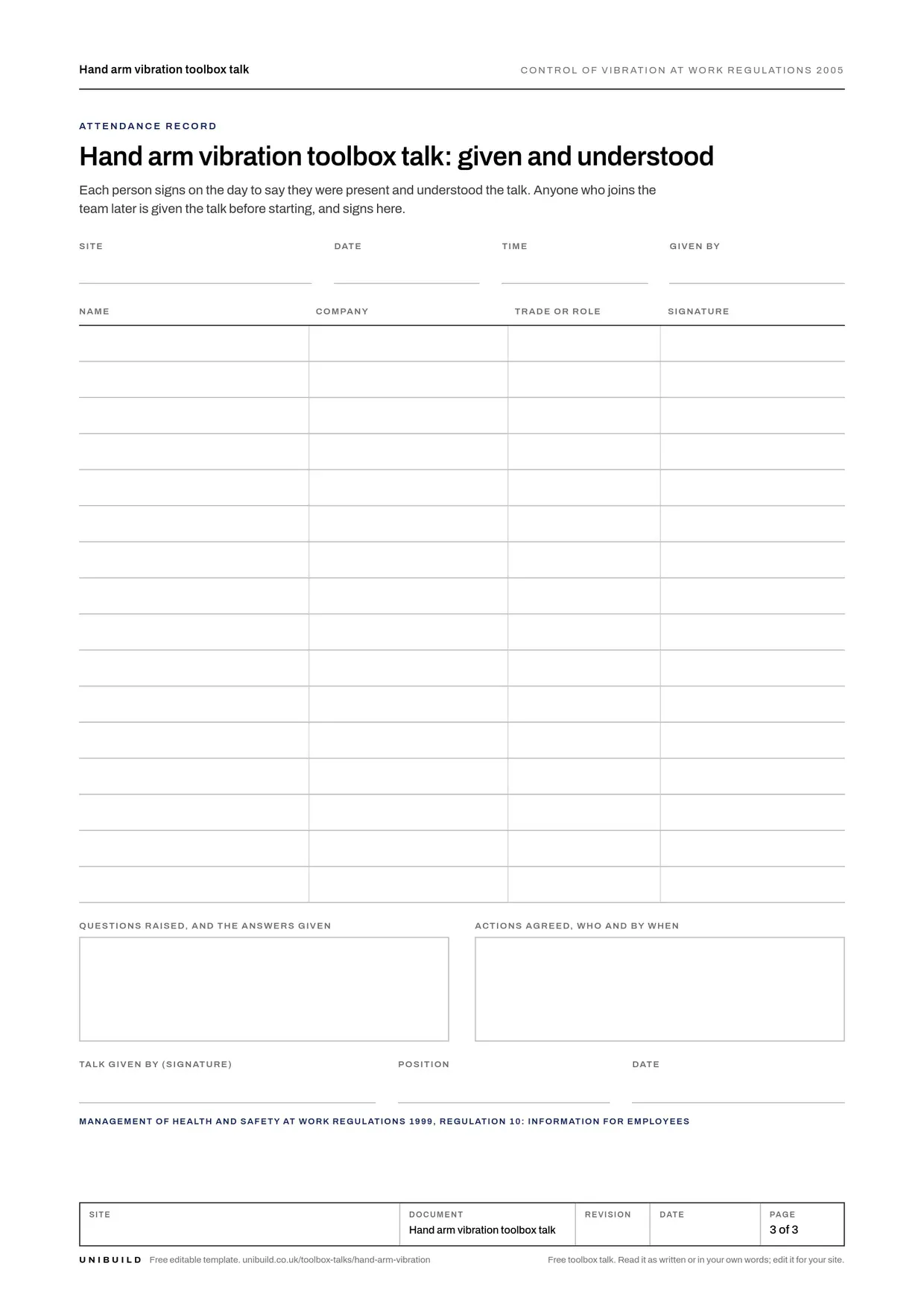
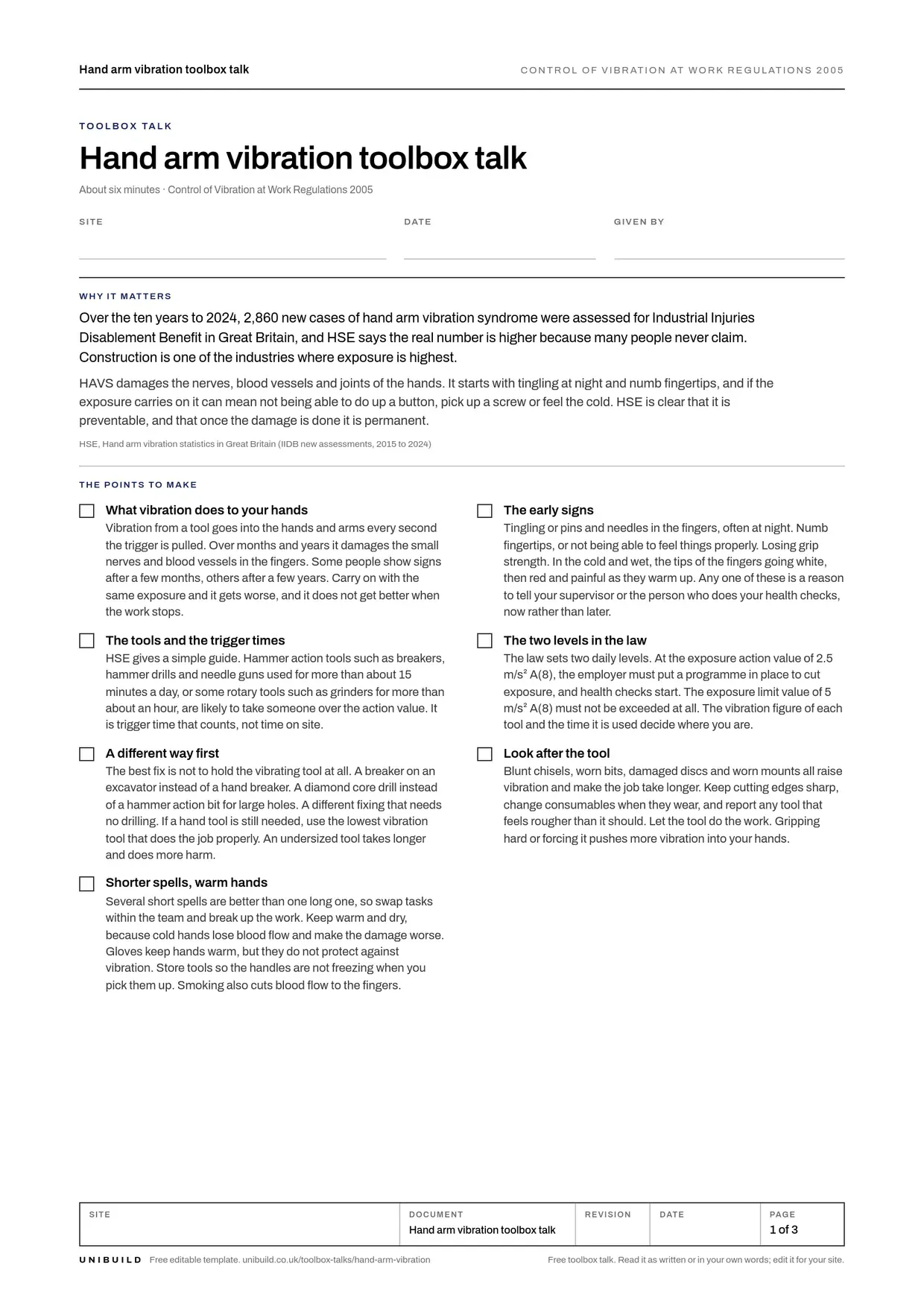
Attendance record page of the free hand arm vibration toolbox talk from Unibuild, where each person signs to say they were given the talk and understood itFront page of the free hand arm vibration toolbox talk from Unibuild
Law
Control of Vibration at Work Regulations 2005
Time to deliver
About six minutes
Format
PDF and Word, with a sign-off sheet
Cost
Free, always

What this toolbox talk covers

This talk is for anyone who uses vibrating tools regularly: breakers, hammer drills, SDS drills, needle guns, grinders, disc cutters, compactor plates, scabblers and chasers. It takes about six minutes to give and covers how hand arm vibration damages the nerves and blood vessels in the hands, the early signs to report, the trigger times that put someone over the line, and what the team can do to cut their exposure.

It is written to be read aloud, with the points in the order a supervisor makes them, short lists of do and do not, and questions that get the team talking about the tools they actually use. The last page is the record: who gave it, who heard it and what was raised.

Vibration and noise usually come from the same tools. The noise and vibration risk assessment holds the full hazards and controls for both, and the noise toolbox talk covers hearing.

Checked against HSE guidance and legislation.gov.uk on .

Toolbox talk · About six minutes

Hand arm vibration: the talk

Read it as written or in your own words. Tick each point as you make it. Stop for the questions.

Why it matters

Over the ten years to 2024, 2,860 new cases of hand arm vibration syndrome were assessed for Industrial Injuries Disablement Benefit in Great Britain, and HSE says the real number is higher because many people never claim. Construction is one of the industries where exposure is highest.

HAVS damages the nerves, blood vessels and joints of the hands. It starts with tingling at night and numb fingertips, and if the exposure carries on it can mean not being able to do up a button, pick up a screw or feel the cold. HSE is clear that it is preventable, and that once the damage is done it is permanent.

HSE, Hand arm vibration statistics in Great Britain (IIDB new assessments, 2015 to 2024)

The points to make

What vibration does to your hands

Vibration from a tool goes into the hands and arms every second the trigger is pulled. Over months and years it damages the small nerves and blood vessels in the fingers. Some people show signs after a few months, others after a few years. Carry on with the same exposure and it gets worse, and it does not get better when the work stops.

The early signs

Tingling or pins and needles in the fingers, often at night. Numb fingertips, or not being able to feel things properly. Losing grip strength. In the cold and wet, the tips of the fingers going white, then red and painful as they warm up. Any one of these is a reason to tell your supervisor or the person who does your health checks, now rather than later.

The tools and the trigger times

HSE gives a simple guide. Hammer action tools such as breakers, hammer drills and needle guns used for more than about 15 minutes a day, or some rotary tools such as grinders for more than about an hour, are likely to take someone over the action value. It is trigger time that counts, not time on site.

The two levels in the law

The law sets two daily levels. At the exposure action value of 2.5 m/s² A(8), the employer must put a programme in place to cut exposure, and health checks start. The exposure limit value of 5 m/s² A(8) must not be exceeded at all. The vibration figure of each tool and the time it is used decide where you are.

A different way first

The best fix is not to hold the vibrating tool at all. A breaker on an excavator instead of a hand breaker. A diamond core drill instead of a hammer action bit for large holes. A different fixing that needs no drilling. If a hand tool is still needed, use the lowest vibration tool that does the job properly. An undersized tool takes longer and does more harm.

Look after the tool

Blunt chisels, worn bits, damaged discs and worn mounts all raise vibration and make the job take longer. Keep cutting edges sharp, change consumables when they wear, and report any tool that feels rougher than it should. Let the tool do the work. Gripping hard or forcing it pushes more vibration into your hands.

Shorter spells, warm hands

Several short spells are better than one long one, so swap tasks within the team and break up the work. Keep warm and dry, because cold hands lose blood flow and make the damage worse. Gloves keep hands warm, but they do not protect against vibration. Store tools so the handles are not freezing when you pick them up. Smoking also cuts blood flow to the fingers.

Do

  • Ask whether the job can be done without a hand-held vibrating tool.
  • Use the lowest vibration tool that is right for the job, and keep bits, chisels and discs sharp.
  • Keep to the trigger times on the risk assessment and swap tasks to share the work.
  • Keep your hands and body warm and dry, and massage your fingers in breaks.
  • Report tingling, numbness or white fingers straight away, and report tools that feel rough.
  • Go to your health checks when they are booked.

Do not

  • Do not grip or force a tool harder than you need to. Let the tool do the work.
  • Do not use blunt bits, worn chisels or damaged discs.
  • Do not rely on gloves to stop vibration. They keep hands warm and that is all.
  • Do not run one person on a breaker all day when the work can be shared.
  • Do not keep quiet about symptoms. Early reporting is what stops it getting worse.

Ask the team

  • Which tools on this job vibrate the most, and how long does each of us use them in a day?
  • Is there a way to do this task without a hand-held breaker or hammer drill?
  • Has anyone had tingling, numbness or white fingers after work or at night?
  • Which tools need a new bit, chisel or disc, or feel rougher than they should?
  • How do we keep hands warm and dry on this site, especially first thing in the morning?

To close

Hand arm vibration does its damage quietly, a little every day, and by the time fingers go white in the cold it has been going on for a while. It is preventable and it is permanent, so the work happens now, before the symptoms. Find a way to do the job without the vibrating tool if you can, use the right tool when you cannot, keep it sharp, share the work and keep your hands warm. And tell us the first time your fingers tingle.

Record it. Who gave the talk, where, when, who was there and what was raised. The last page of the sheet is the record.

In Unibuild a talk is read in each operative’s own language and signed on the phone. How toolbox talks work

The law behind this talk

Checked against the source

Action value and limit value

For hand arm vibration the daily exposure limit value is 5 m/s² A(8) and the daily exposure action value is 2.5 m/s² A(8), with daily exposure worked out on the basis set out in Schedule 1.

Control of Vibration at Work Regulations 2005, regulation 4

Eliminate or reduce the risk

The employer eliminates the risk from vibration at source or, where that is not reasonably practicable, reduces it to as low a level as is reasonably practicable. Where an action value is likely to be reached, a programme of organisational and technical measures is put in place, considering other working methods, lower vibration equipment, maintenance, limiting duration, work schedules with rest periods, and clothing to protect from cold and damp. Employees must not be exposed above the limit value.

Control of Vibration at Work Regulations 2005, regulation 6

Health surveillance

Employees whom the risk assessment shows are at risk, or who are likely to be exposed at or above an action value, are placed under suitable health surveillance, and a health record is kept for each of them. The employee may see their own record on reasonable notice and, when required, attends the health surveillance during working hours at the employer’s cost.

Control of Vibration at Work Regulations 2005, regulation 7

Information, instruction and training

Employees at risk receive suitable and sufficient information, instruction and training, including the measures taken, the action and limit values, the significant findings of the risk assessment, why and how to detect and report signs of injury, their entitlement to health surveillance, and safe working practices to minimise exposure.

Control of Vibration at Work Regulations 2005, regulation 8

What is on the sheet

3 pages, the talk and the record

The talk, over two pages

Why it matters, the points to make, do and do not, and the questions to ask, laid out to read from in the cabin or at the workface. Space at the top for the site, the date and who is giving it.

The last page, the record

The attendance record: each person's name, company and signature, the questions raised and any actions, signed off by the person who gave the talk. Type into it or print it and pass it round.

The Word version

The same talk as a Word document, so you can put your own letterhead on it, add a site photograph or change a point to match how your job is set up.

Download the talk as PDF Word versionPDF · 3 pages · 209 KB
After it is given

Delivered on the phone, signed in the room

On Unibuild a toolbox talk is picked from the library, read by each operative on their own phone in their own language and signed there and then. The record is filed against the operative, the site and the date.

A site manager sees who has had which talk, and who has not, without a sheet going round on Thursday.

How toolbox talks work on Unibuild
How long should a hand arm vibration toolbox talk be?
About five to ten minutes. This one reads in about six if you make every point and stop for the questions. A toolbox talk is a short briefing, not the full information, instruction and training the Vibration Regulations require, which is wider and is recorded in the training matrix.
What are the first signs of HAVS?
Tingling and numbness in the fingers, which can wake people at night, not being able to feel things with the fingertips, loss of grip strength, and in the cold and wet the fingertips going white and then red and painful as they recover. Anyone with these signs should report them to their employer or the person who does their health checks.
Which tools cause hand arm vibration?
Any hand-held or hand-guided power tool that vibrates: breakers, hammer drills, SDS drills, needle guns, scabblers, chipping hammers, grinders, disc cutters, compactor plates, chainsaws and strimmers. Holding a workpiece against a pedestal grinder counts too. HSE says occasional use is unlikely to cause harm; regular and frequent use is what does.
What are the HAVS action and limit values?
The daily exposure action value is 2.5 m/s² A(8). At or above it the employer must put a programme in place to reduce exposure and provide health surveillance. The daily exposure limit value is 5 m/s² A(8), which must not be exceeded.
How long can you use a vibrating tool?
It depends on the tool’s vibration level, so the risk assessment gives the time for each tool. As a simple guide, HSE says hammer action tools for more than about 15 minutes a day, or some rotary tools for more than about an hour, are likely to be above the action value.
Do anti-vibration gloves stop HAVS?
No. HSE says gloves can keep hands warm, which helps blood flow, but they should not be relied on to protect from vibration. Reducing exposure comes from the method, the tool, its condition and the time it is used.
Do we have to log every worker’s trigger time?
HSE says routine, continual monitoring or logging is not required. The employer surveys the work, finds out who is exposed and to which tools, and plans the controls from that. Many firms still record tool times on high exposure work to check the plan is working.
Is HAVS reportable under RIDDOR?
Yes, when a doctor diagnoses it in writing and the person’s work involves regular use of percussive or vibrating tools. Carpal tunnel syndrome linked to hand-held vibrating tools is reportable in the same way. The employer reports it to HSE.
Do we have to keep a record of the talk?
There is no regulation that names toolbox talk records, but the Vibration Regulations require information, instruction and training, and most principal contractors and auditors ask for the evidence. A signed attendance record with the date and the topic is that evidence. The last page of the sheet is the record.
Is this hand arm vibration toolbox talk free?
Yes. Download it, print it, give it, edit it and put your own name on it, including on paid work and for clients, with no sign-up and no email address.
Next step

The talk given, understood
and on record.

Unibuild keeps every toolbox talk against the operative who signed it, the site and the date, for seven years, ready for the principal contractor or an auditor.

Get a quote
One figure per firm · For UK firms

Right, let’s talk numbers.

Five things about your business. We work your fee out properly and put it in writing the same working day.

What we build for you

  • Your own portalIn the browser, built around your firm
  • Your own appiOS and Android, under your name
  • Everyday AI includedHeavier AI at cost, nothing added
  • One platformEverything in one place, set up by us

Would you rather see it running first? Book a 30-minute demo

Quotation request