Free toolbox talk · Power tools

Power tools toolbox talk

A toolbox talk on hand-held power tools, written to be read aloud in about six minutes: the right tool for the job, the check before use, guards, leads, 110V and batteries, kickback and pinching, isolating before changing a blade, and the dust, noise and vibration that come with the cut. The last page is the attendance record.

PDF · 3 pages · 209 KB · Word 41 KB · Free to use and reuse · Terms

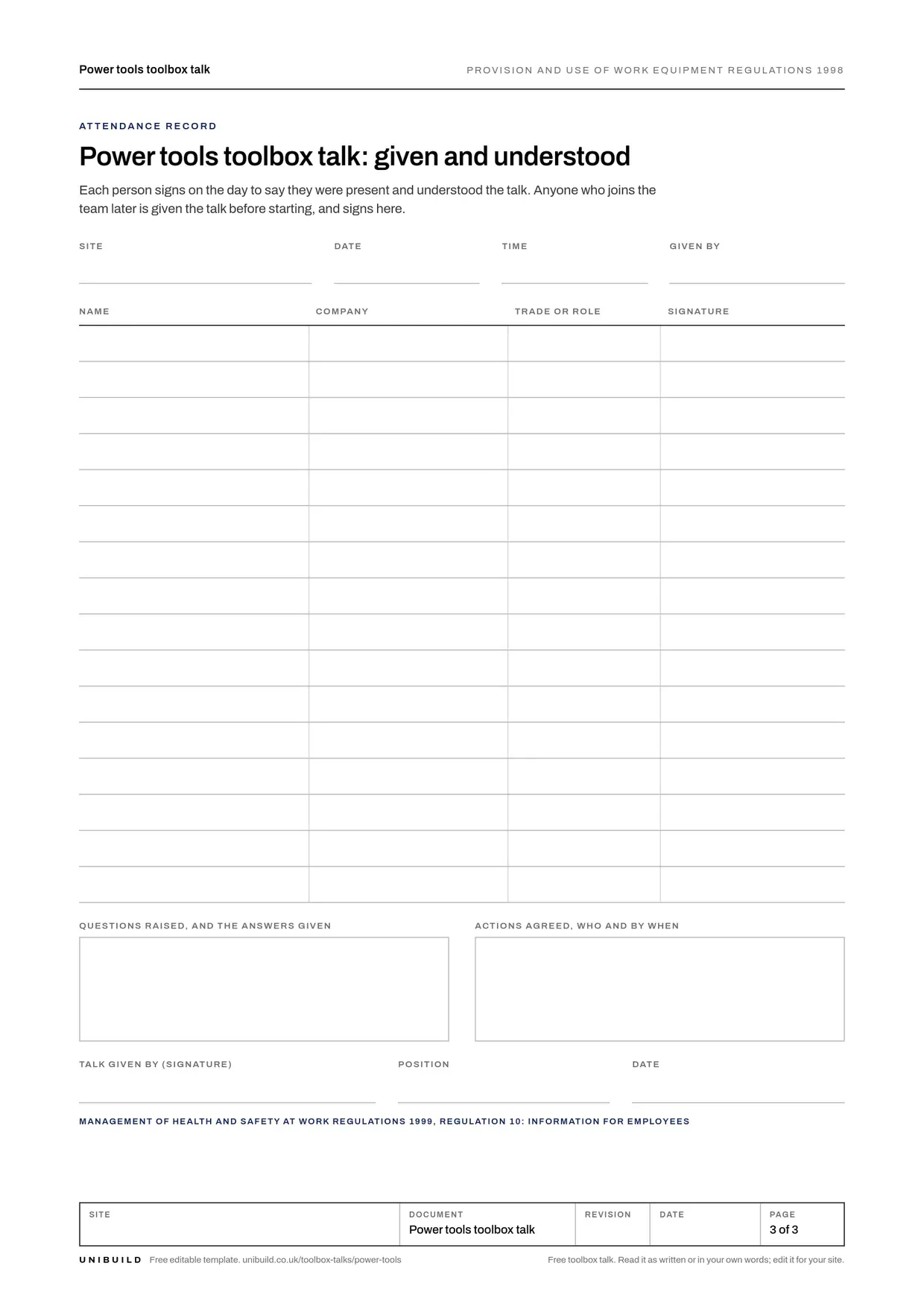
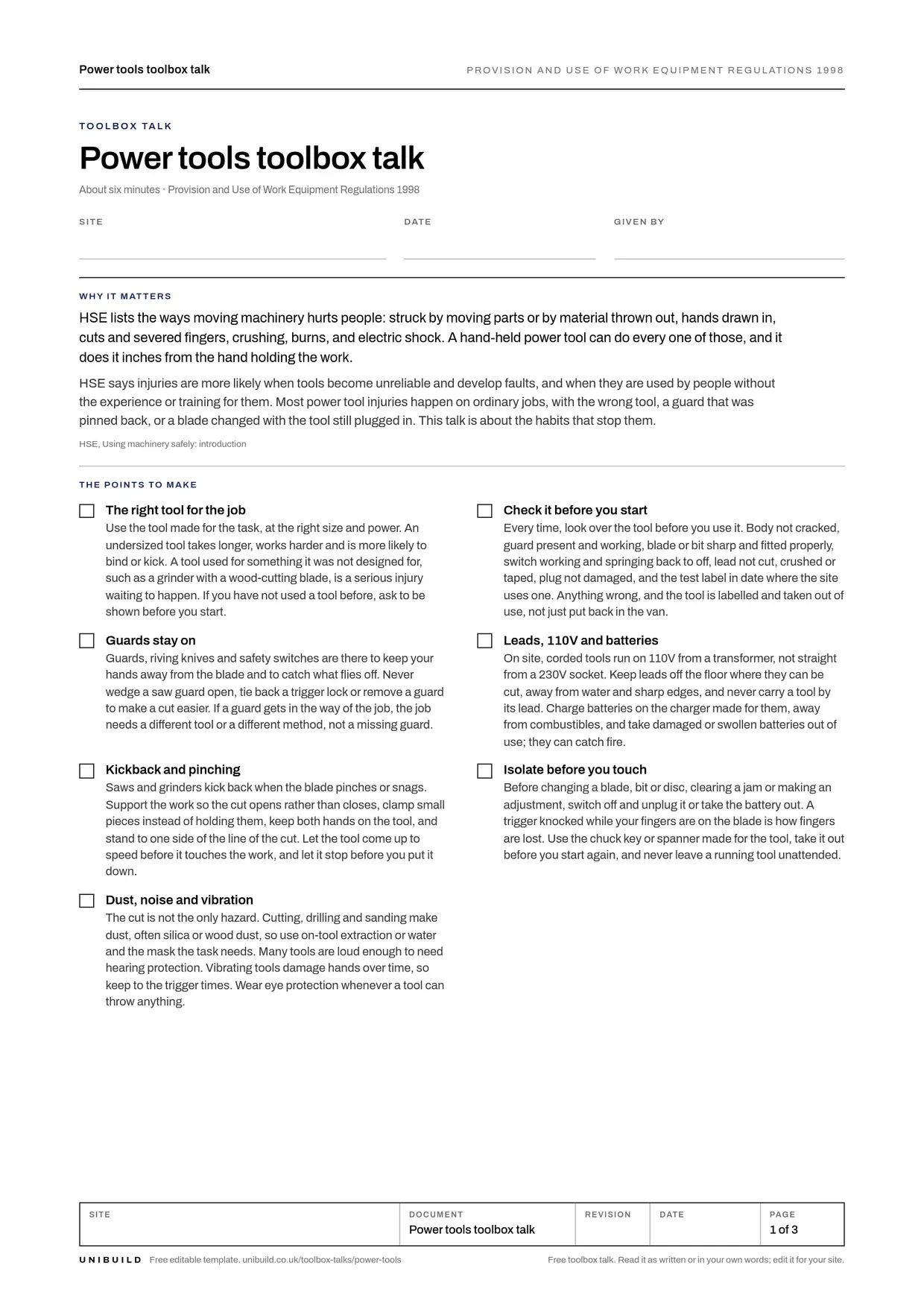
Attendance record page of the free power tools toolbox talk from Unibuild, where each person signs to say they were given the talk and understood itFront page of the free power tools toolbox talk from Unibuild
Law
PUWER 1998
Time to deliver
About six minutes
Format
PDF and Word, with a sign-off sheet
Cost
Free, always

What this toolbox talk covers

This talk is for anyone who uses a hand-held power tool on site: drills, circular saws, reciprocating saws, jigsaws, grinders, nail guns, routers, planers, chasers, breakers and the battery versions of all of them. It takes about six minutes to give and covers choosing the right tool, checking it, guards, leads and batteries, kickback, isolating before changing a blade or clearing a jam, and the health risks from the cut.

It is written to be read aloud, with the points in the order a supervisor makes them, short lists of do and do not, and questions about the tools on this job. The last page is the record: who gave it, who heard it and what was raised.

Discs have a talk of their own, the abrasive wheels toolbox talk. The power tools risk assessment holds the full hazards and controls.

Checked against HSE guidance and legislation.gov.uk on .

Toolbox talk · About six minutes

Power tools: the talk

Read it as written or in your own words. Tick each point as you make it. Stop for the questions.

Why it matters

HSE lists the ways moving machinery hurts people: struck by moving parts or by material thrown out, hands drawn in, cuts and severed fingers, crushing, burns, and electric shock. A hand-held power tool can do every one of those, and it does it inches from the hand holding the work.

HSE says injuries are more likely when tools become unreliable and develop faults, and when they are used by people without the experience or training for them. Most power tool injuries happen on ordinary jobs, with the wrong tool, a guard that was pinned back, or a blade changed with the tool still plugged in. This talk is about the habits that stop them.

HSE, Using machinery safely: introduction

The points to make

The right tool for the job

Use the tool made for the task, at the right size and power. An undersized tool takes longer, works harder and is more likely to bind or kick. A tool used for something it was not designed for, such as a grinder with a wood-cutting blade, is a serious injury waiting to happen. If you have not used a tool before, ask to be shown before you start.

Check it before you start

Every time, look over the tool before you use it. Body not cracked, guard present and working, blade or bit sharp and fitted properly, switch working and springing back to off, lead not cut, crushed or taped, plug not damaged, and the test label in date where the site uses one. Anything wrong, and the tool is labelled and taken out of use, not just put back in the van.

Guards stay on

Guards, riving knives and safety switches are there to keep your hands away from the blade and to catch what flies off. Never wedge a saw guard open, tie back a trigger lock or remove a guard to make a cut easier. If a guard gets in the way of the job, the job needs a different tool or a different method, not a missing guard.

Leads, 110V and batteries

On site, corded tools run on 110V from a transformer, not straight from a 230V socket. Keep leads off the floor where they can be cut, away from water and sharp edges, and never carry a tool by its lead. Charge batteries on the charger made for them, away from combustibles, and take damaged or swollen batteries out of use; they can catch fire.

Kickback and pinching

Saws and grinders kick back when the blade pinches or snags. Support the work so the cut opens rather than closes, clamp small pieces instead of holding them, keep both hands on the tool, and stand to one side of the line of the cut. Let the tool come up to speed before it touches the work, and let it stop before you put it down.

Isolate before you touch

Before changing a blade, bit or disc, clearing a jam or making an adjustment, switch off and unplug it or take the battery out. A trigger knocked while your fingers are on the blade is how fingers are lost. Use the chuck key or spanner made for the tool, take it out before you start again, and never leave a running tool unattended.

Dust, noise and vibration

The cut is not the only hazard. Cutting, drilling and sanding make dust, often silica or wood dust, so use on-tool extraction or water and the mask the task needs. Many tools are loud enough to need hearing protection. Vibrating tools damage hands over time, so keep to the trigger times. Wear eye protection whenever a tool can throw anything.

Do

  • Pick the right tool for the job, and ask to be shown if it is new to you.
  • Check the tool, guard, lead or battery and the blade before every use.
  • Use 110V tools on site and keep leads off the floor and away from water.
  • Clamp or support the work and keep both hands on the tool.
  • Unplug or remove the battery before changing a blade or clearing a jam.
  • Use the extraction, eye protection and hearing protection the job needs.

Do not

  • Do not remove, wedge or tie back a guard, or override a safety switch.
  • Do not use a tool with a damaged lead, plug, body or battery.
  • Do not carry a tool by its lead or yank the plug out by the cable.
  • Do not hold small work in your hand while you cut or drill it.
  • Do not put a tool down while it is still running.
  • Do not fit a blade or disc the tool was not designed for.

Ask the team

  • Which power tools are we using on this job, and has everyone been shown how to use them?
  • When did you last check the lead and plug on the tool you use most?
  • Has anyone seen a guard taped, wedged or missing on site?
  • Where do we charge batteries, and what do we do with a damaged one?
  • How are we controlling the dust from cutting and drilling here?

To close

Power tools are so much a part of the job that it is easy to forget how fast they hurt people. Most injuries come from a few shortcuts: the wrong tool, a guard pinned back, a lead that should have been binned, a blade changed with the power still on. So pick the right tool, check it every time, keep the guards on, isolate before you touch the blade, and deal with the dust and noise. If a tool is damaged, label it and tell us. We will replace it.

Record it. Who gave the talk, where, when, who was there and what was raised. The last page of the sheet is the record.

In Unibuild a talk is read in each operative’s own language and signed on the phone. How toolbox talks work

The law behind this talk

Checked against the source

Suitable for the job

Work equipment is constructed or adapted to be suitable for the purpose for which it is used or provided, chosen with regard to the working conditions and risks, and used only for operations and under conditions for which it is suitable. HSE says work equipment covers any machinery, appliance, apparatus, tool or installation for use at work.

PUWER 1998, regulation 4

Maintained in good repair

Work equipment is maintained in an efficient state, in efficient working order and in good repair, and where machinery has a maintenance log the log is kept up to date. HSE’s guidance includes quick checks before use, such as the condition of the cable on a hand-held power tool.

PUWER 1998, regulation 5

Training

Everyone who uses work equipment has received adequate training for health and safety, including the methods of use, the risks and the precautions, and so has anyone who supervises or manages its use.

PUWER 1998, regulation 9

Dangerous parts guarded

Effective measures prevent access to any dangerous part of machinery, or stop its movement before any part of a person enters the danger zone: fixed guards where practicable, then other guards or protection devices, then jigs, holders and push sticks, with information, instruction, training and supervision. Guards must not be easily bypassed or disabled.

PUWER 1998, regulation 11

What is on the sheet

3 pages, the talk and the record

The talk, over two pages

Why it matters, the points to make, do and do not, and the questions to ask, laid out to read from in the cabin or at the workface. Space at the top for the site, the date and who is giving it.

The last page, the record

The attendance record: each person's name, company and signature, the questions raised and any actions, signed off by the person who gave the talk. Type into it or print it and pass it round.

The Word version

The same talk as a Word document, so you can put your own letterhead on it, add a site photograph or change a point to match how your job is set up.

Download the talk as PDF Word versionPDF · 3 pages · 209 KB
After it is given

Delivered on the phone, signed in the room

On Unibuild a toolbox talk is picked from the library, read by each operative on their own phone in their own language and signed there and then. The record is filed against the operative, the site and the date.

A site manager sees who has had which talk, and who has not, without a sheet going round on Thursday.

How toolbox talks work on Unibuild
How long should a power tools toolbox talk be?
About five to ten minutes. This one reads in about six if you make every point and stop for the questions. A toolbox talk is a briefing, not the training PUWER requires for each tool, which depends on the tool and the person and is recorded in the training matrix.
Do you need training to use power tools?
Yes. PUWER requires everyone who uses work equipment to have adequate training, including the methods of use, the risks and the precautions. For simple tools that can be on-the-job training backed by a simple record; some tools, such as cartridge tools and abrasive wheels, have recognised courses.
Why are 110V tools used on building sites?
Because a fault or a cut lead on a 110V centre-tapped supply gives a much smaller shock than on a 230V supply. HSE’s construction guidance has long recommended 110V for portable tools on site, with battery tools as a lower risk still.
How often should power tools be checked?
HSE describes quick checks by the user before each use, regular checks such as the guards and safety devices, and more thorough examination every few months or longer, at intervals set by risk assessment and the manufacturer’s advice. Tools used hard on site usually need checking more often.
Do power tools need PAT testing?
The law requires equipment to be maintained in a safe condition rather than naming PAT testing. HSE’s guidance lists portable appliance testing among the more thorough checks done every few months or longer, on top of the user’s check before each use. Many principal contractors require an in-date test label.
Can a guard be removed if it gets in the way?
No. PUWER requires guards to prevent access to dangerous parts and says they must not be easily bypassed or disabled. If a guard stops the job being done, use a different tool or method, and ask the supervisor.
What causes kickback on a saw?
Kickback happens when the blade pinches or snags in the cut, and the tool is thrown back towards the user. Supporting the work so the cut opens, keeping the riving knife and guard in place, using a sharp blade, and standing to one side of the line of cut all reduce it.
Do we have to keep a record of the talk?
There is no regulation that names toolbox talk records, but PUWER requires training, and most principal contractors and auditors ask for the evidence. A signed attendance record with the date and the topic is that evidence. The last page of the sheet is the record.
Is this power tools toolbox talk free?
Yes. Download it, print it, give it, edit it and put your own name on it, including on paid work and for clients, with no sign-up and no email address.
Next step

The talk given, understood
and on record.

Unibuild keeps every toolbox talk against the operative who signed it, the site and the date, for seven years, ready for the principal contractor or an auditor.

Get a quote
One figure per firm · For UK firms

Right, let’s talk numbers.

Five things about your business. We work your fee out properly and put it in writing the same working day.

What we build for you

  • Your own portalIn the browser, built around your firm
  • Your own appiOS and Android, under your name
  • Everyday AI includedHeavier AI at cost, nothing added
  • One platformEverything in one place, set up by us

Would you rather see it running first? Book a 30-minute demo

Quotation request