Form · MHSWR regulation 3
RAMS template
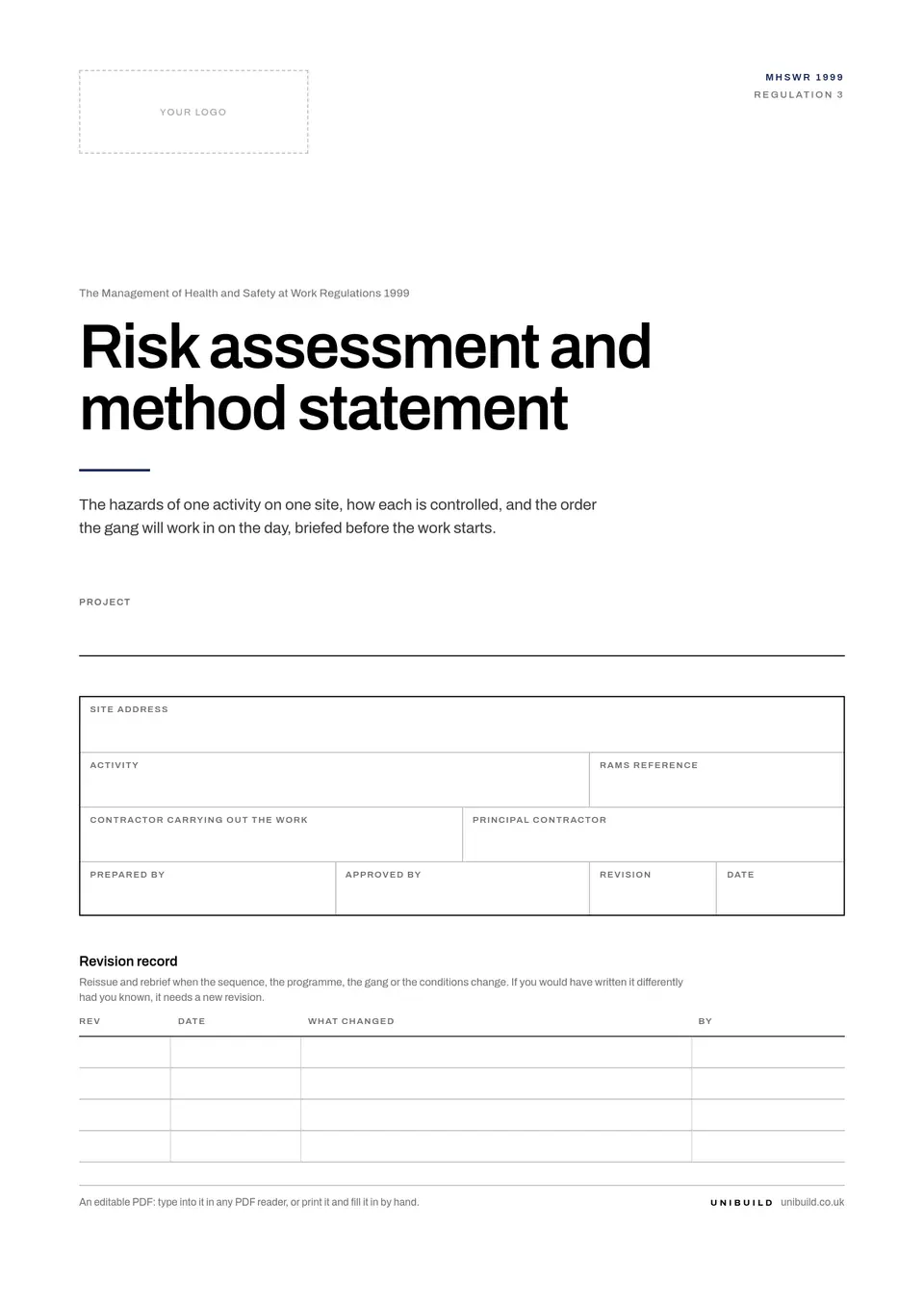
Risk assessment and method statement for one activity: the sequence of work, a five by five risk matrix, PPE, permits, rescue, and a briefing record signed against the revision.

UK-built · CDM · CIS · MTD
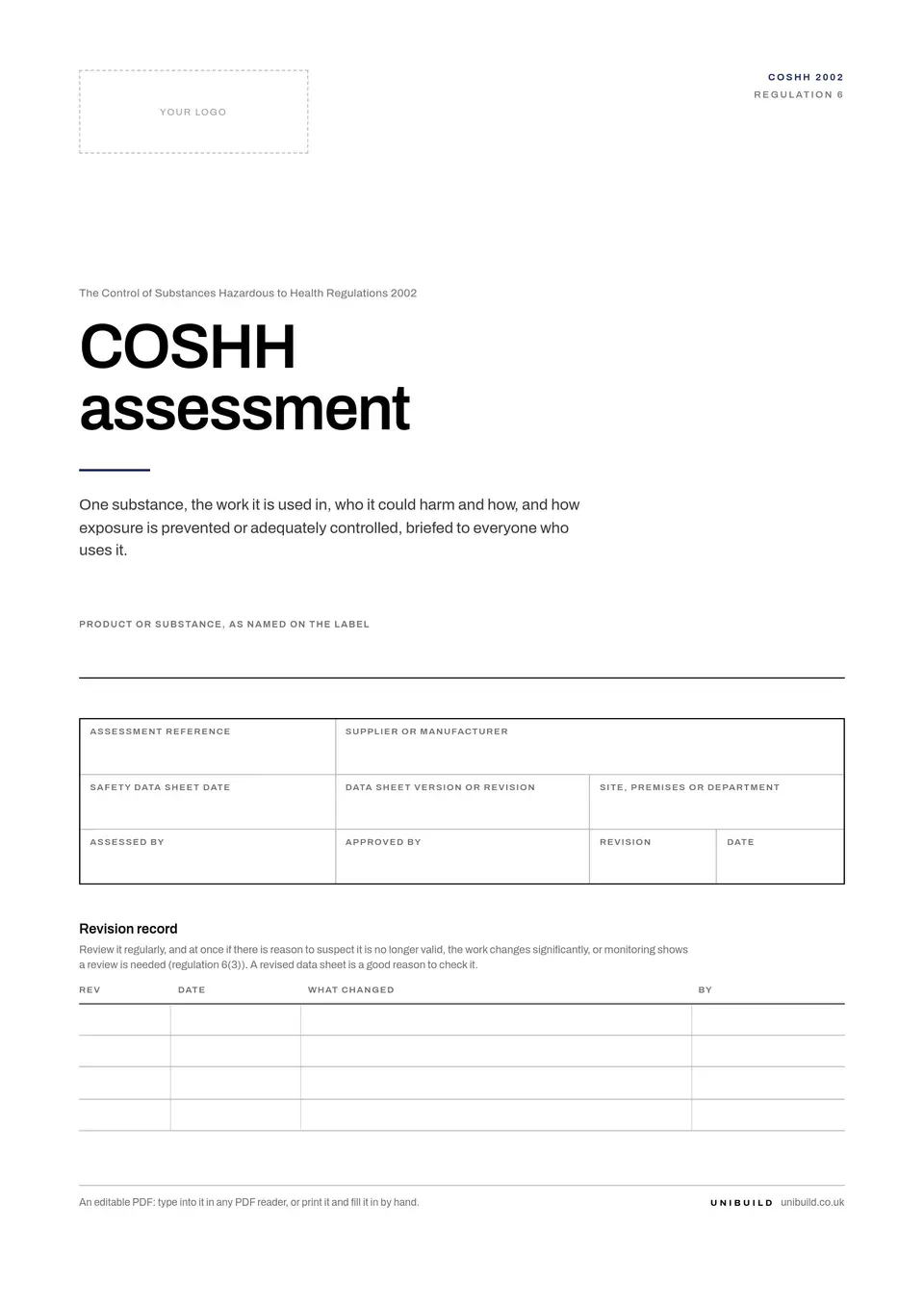
A COSHH assessment records the risk to health from one hazardous substance in your work, and how exposure is prevented or adequately controlled. This one is an editable PDF and a Word document, ten pages, free to use and reuse.
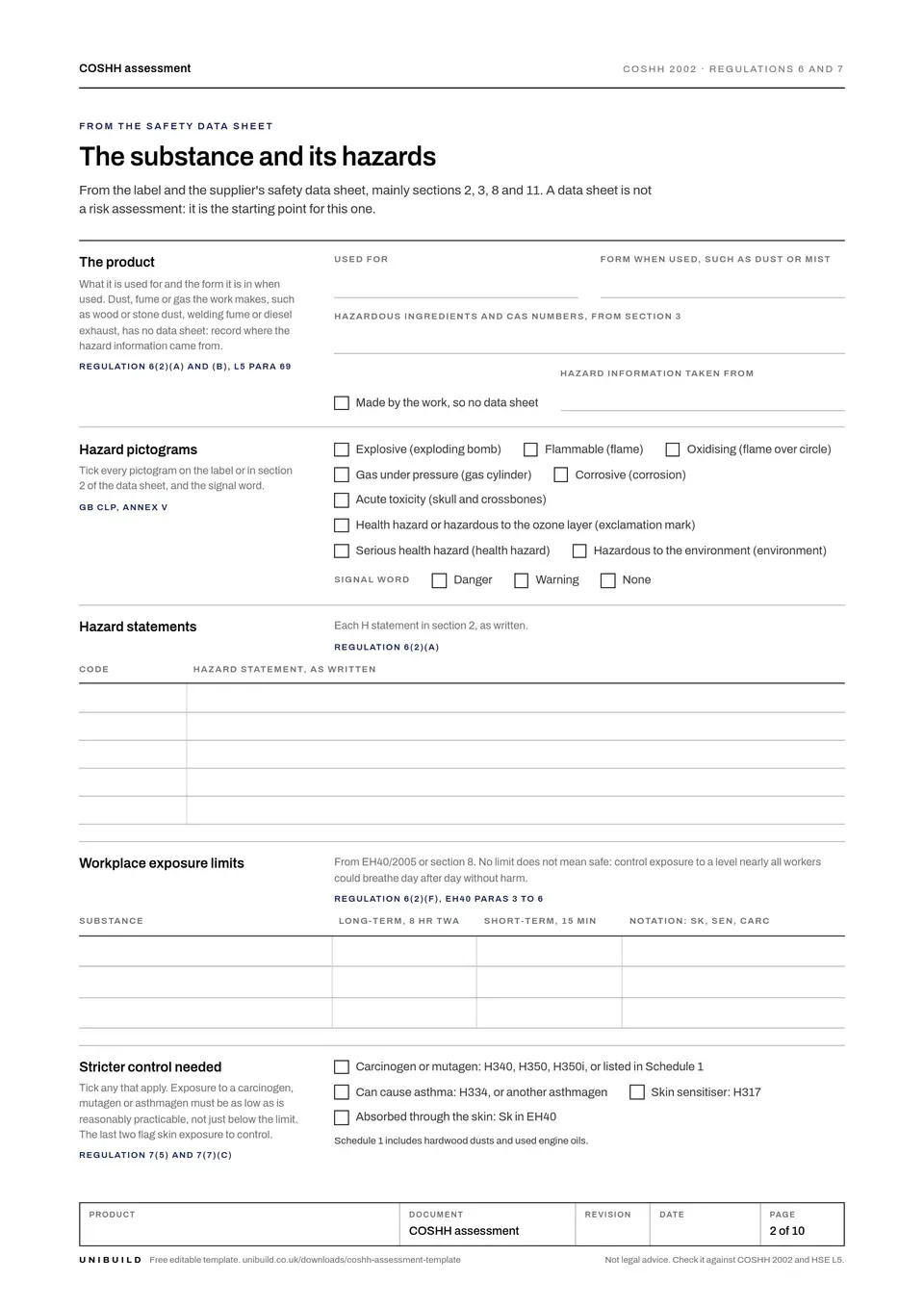
The product, supplier and data sheet date and version, the nine hazard pictograms by name, the signal word, hazard statements, workplace exposure limits from EH40, and whether stricter control applies.
What is done, how much, how often and for how long, each route of exposure, who could be exposed, people at increased risk, and how serious the harm could be.
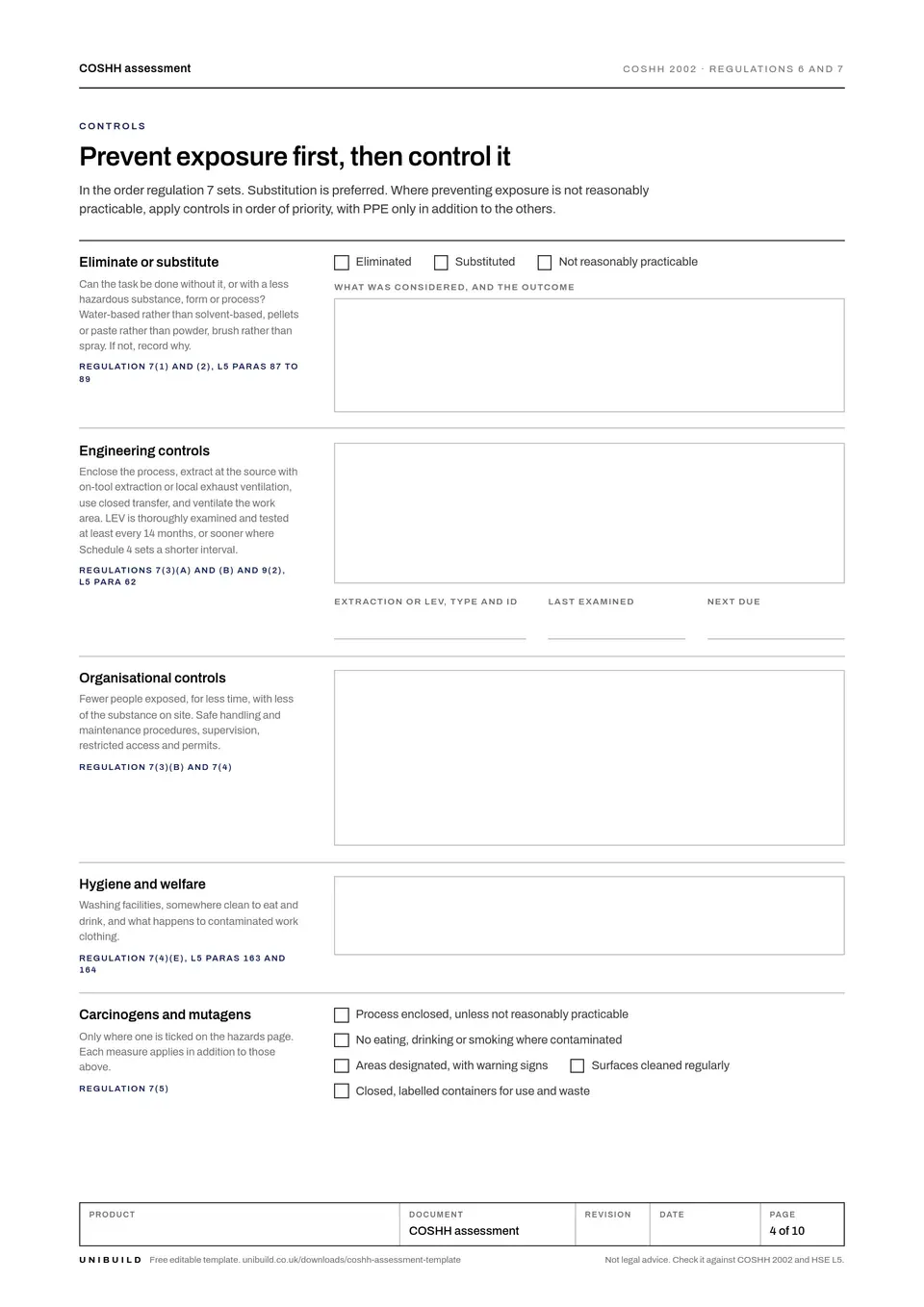
Elimination or substitution first, then engineering controls such as extraction, then organisational controls and hygiene, with the extra measures for carcinogens and mutagens.
Each item by type, material and standard, a face fit test record for tight-fitting masks, and who checks each control and how often.
Where it is kept, the spill kit, waste, fire, first aid by route and the emergency arrangements, drawn from the data sheet.
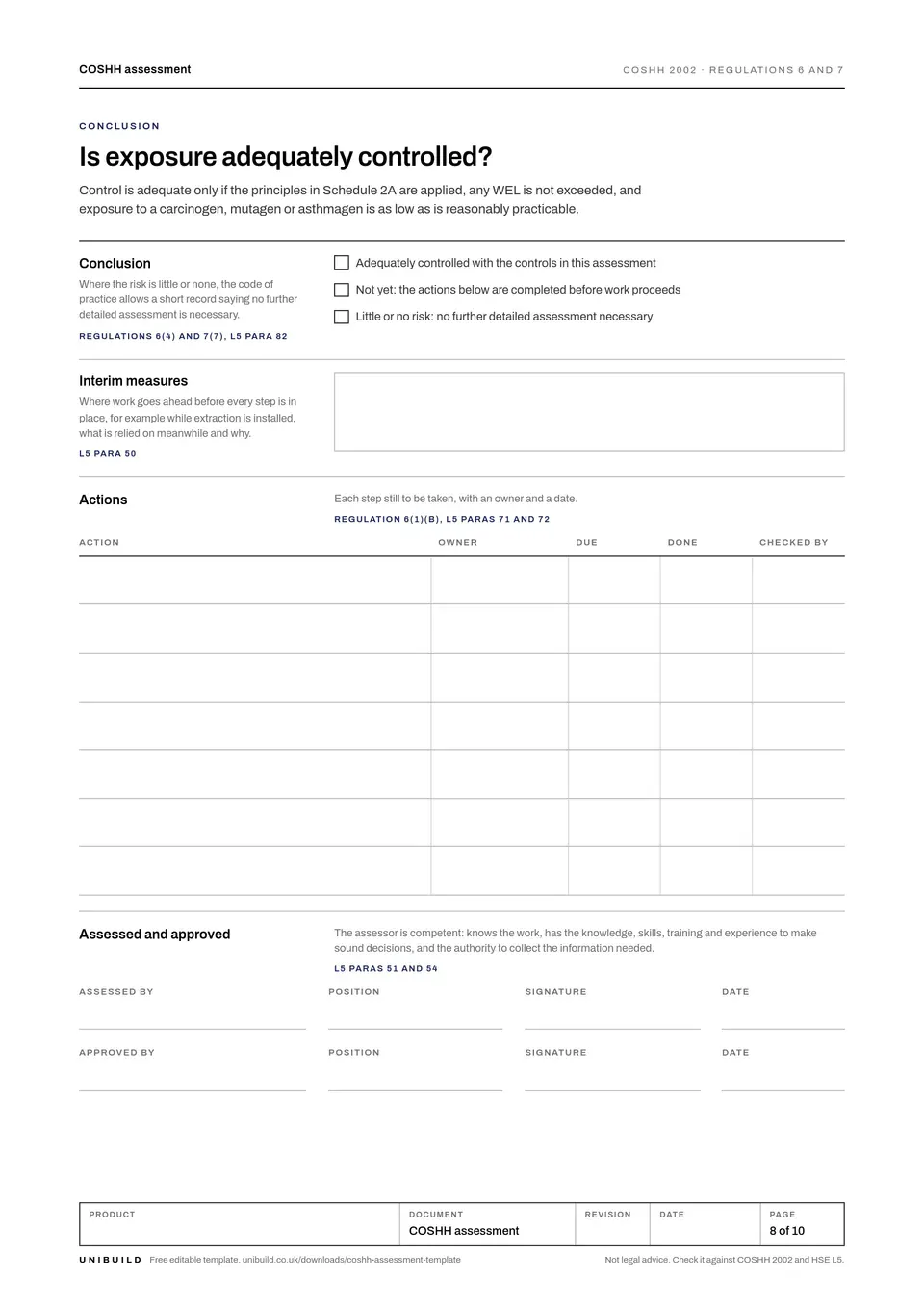
Exposure monitoring and health surveillance decisions, whether control is adequate, actions with owners and dates, sign-off, review triggers, a review record and a briefing record.
An employer must not carry out work liable to expose employees to a substance hazardous to health until a suitable and sufficient assessment of the risk has been made. The steps it identifies must also be in place.
Control of Substances Hazardous to Health Regulations 2002, regulation 6(1)Among other things: the hazardous properties and the supplier information, including the safety data sheet. The level, type and duration of exposure, and the amount used. Maintenance and other high exposure activities, any workplace exposure limit, the controls, and the results of monitoring and health surveillance.
Regulation 6(2)An employer with five or more employees must record the significant findings as soon as practicable, and the steps taken to meet regulation 7.
Regulation 6(4)Exposure must be prevented or, where that is not reasonably practicable, adequately controlled. Substitution is preferred. Controls then follow an order of priority, with personal protective equipment only where other means cannot achieve adequate control, and in addition to them.
Regulation 7(1) to (3)The principles of good practice in Schedule 2A are applied, and any workplace exposure limit is not exceeded. Exposure to a carcinogen, mutagen or asthmagen is reduced to as low a level as is reasonably practicable.
Regulation 7(7)The assessment must be reviewed regularly. It must be reviewed at once if there is reason to suspect it is no longer valid, the work has changed significantly, or monitoring shows it is necessary. The law sets no fixed interval.
Regulation 6(3)The 2002 Regulations apply in England, Wales and Scotland. Northern Ireland has its own Control of Substances Hazardous to Health Regulations (Northern Ireland) 2003, whose regulation 6 sets the same assessment duty.
SI 2002/2677, and SR 2003/34, regulations 1 and 6Fill it in for the product and the way your team uses it, not for the product in general. The data sheet gives the hazards; only you know the task, the quantities and the people.
Ask first whether the substance can be removed or swapped for something safer, and record why not. PPE comes last, and only alongside the other controls.
Everyone who uses the substance signs against the revision. Review it when the data sheet is revised, the task changes, a control fails or someone reports symptoms. List every assessment in the COSHH register template.
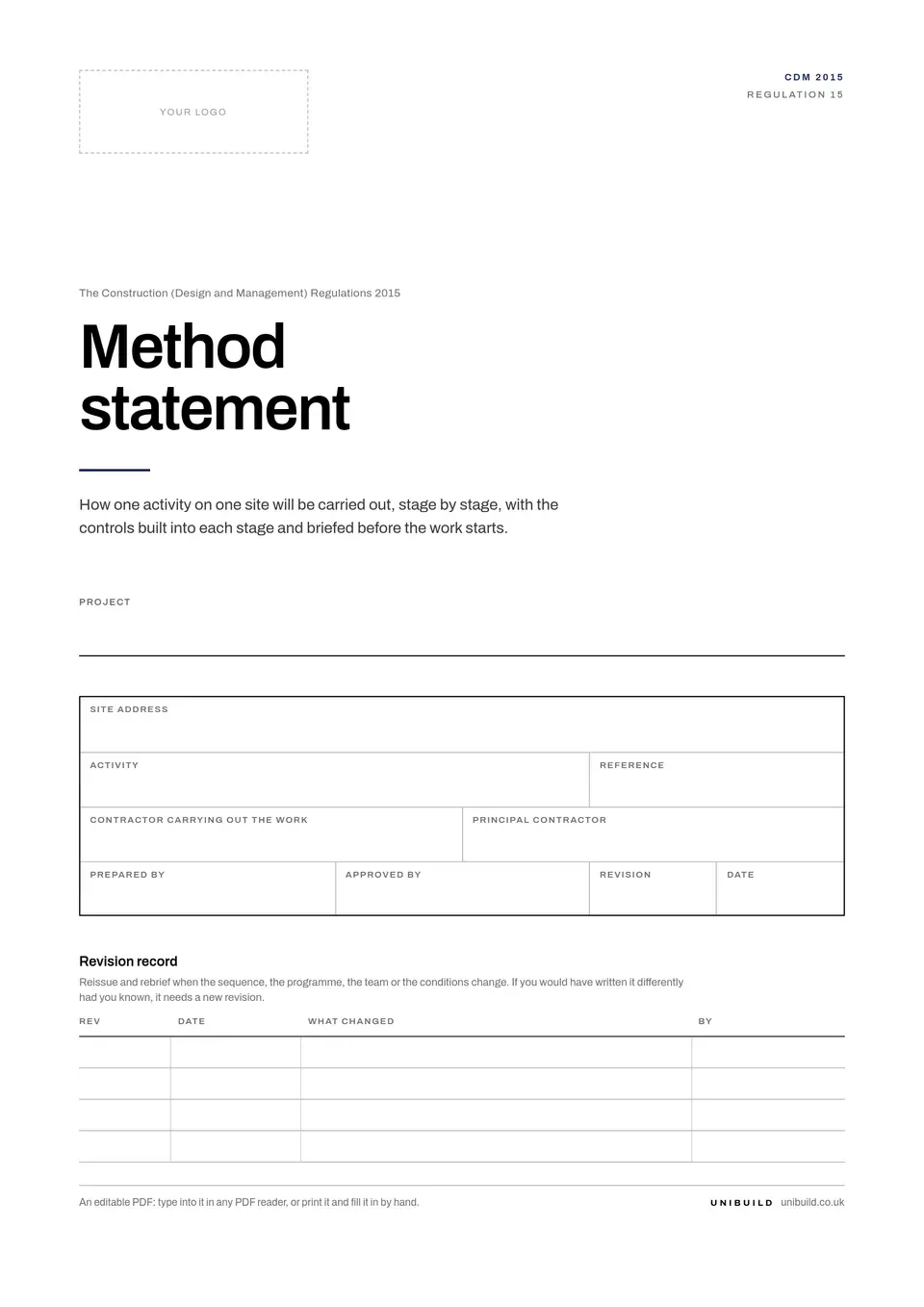
Risk assessment and method statement for one activity: the sequence of work, a five by five risk matrix, PPE, permits, rescue, and a briefing record signed against the revision.
How one activity on one site will be carried out. Two pages of sequence with the controls at each stage, then plant, PPE, permits, rescue and a briefing record.
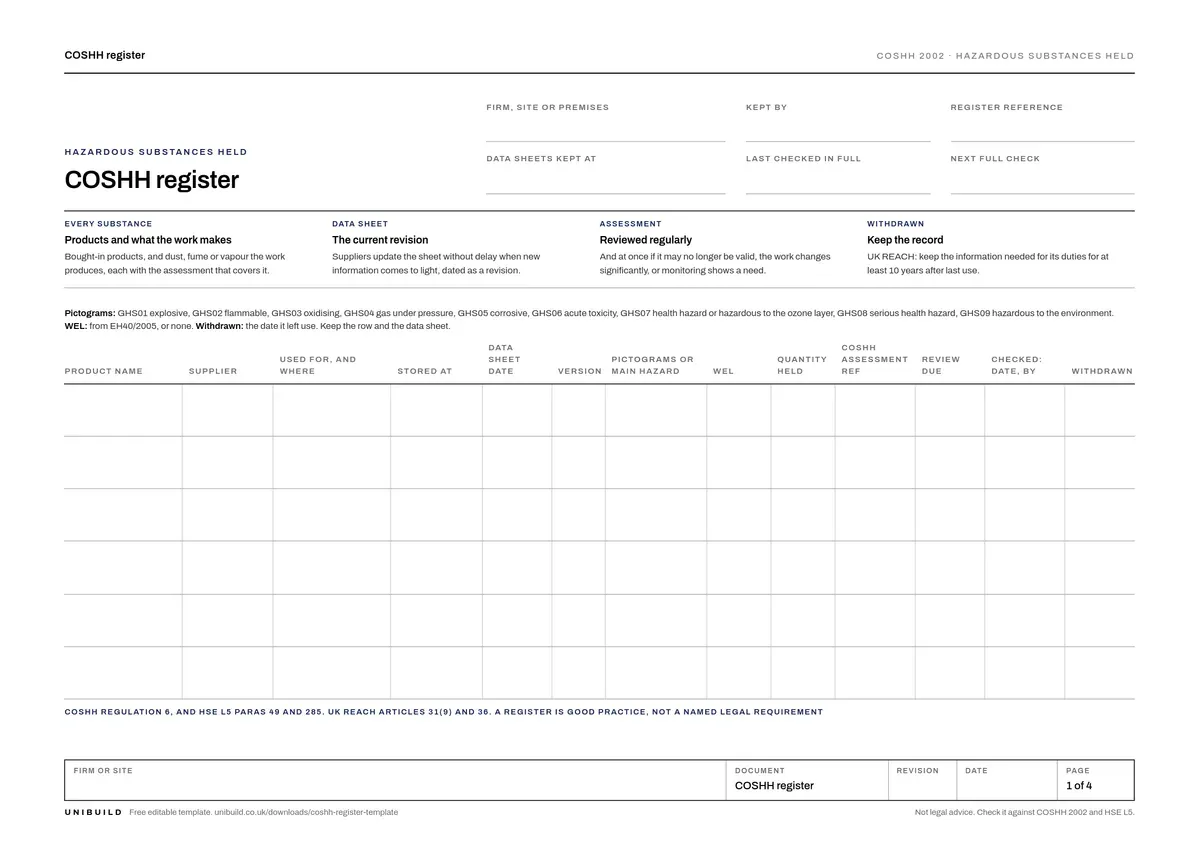
Every hazardous substance held, with its data sheet date, main hazard, WEL, storage, COSHH assessment and review date, plus update and review logs.
On the platform each hazardous substance holds its safety data sheet and supplier, linked to the jobs, materials and purchase orders that use it, with review dates tracked and every version kept.