
Manual handling risk assessment template
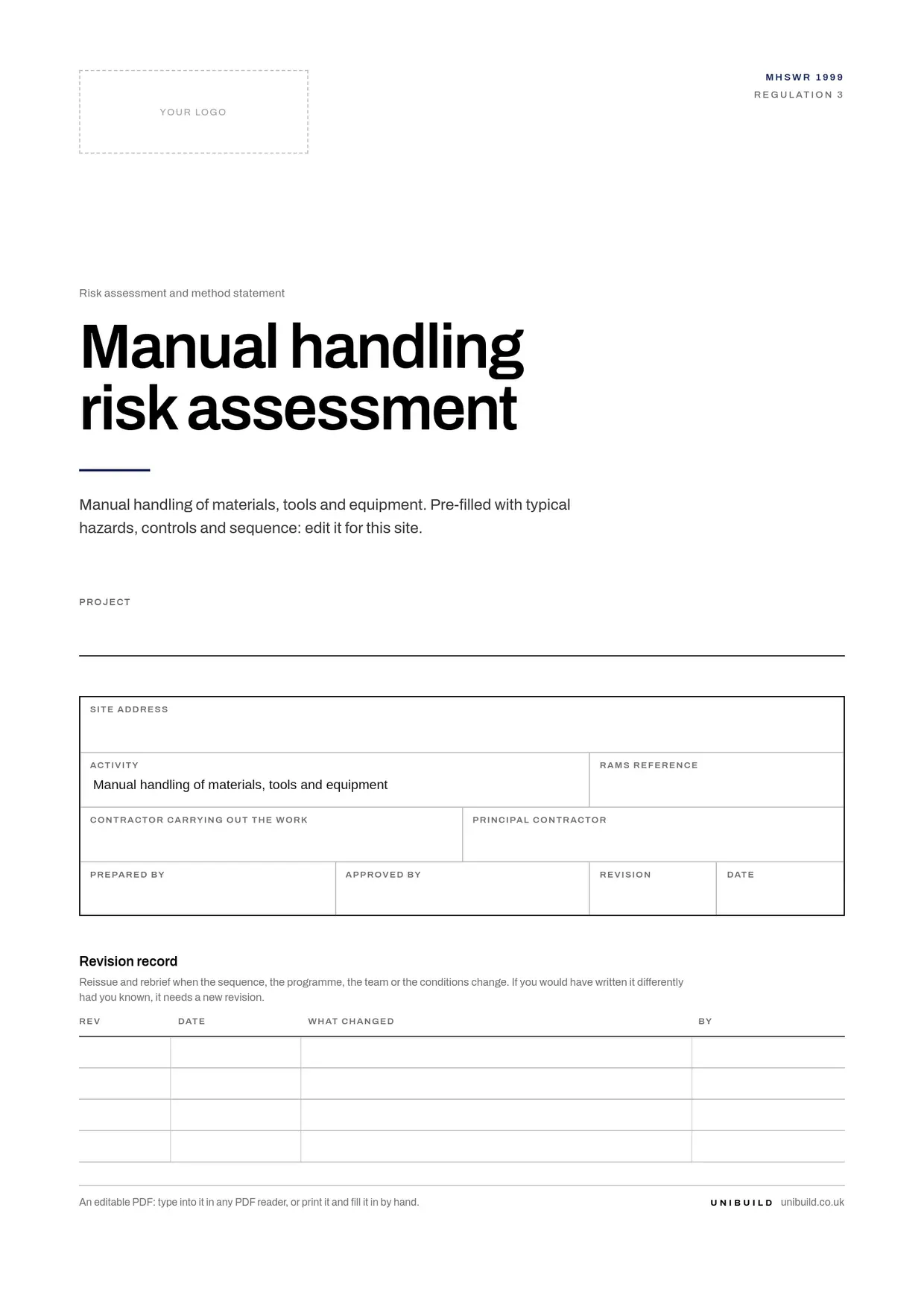
A manual handling risk assessment, already filled in for lifting, carrying, pushing and pulling on site and in stores and yards, with a TILE assessment page. Edit it for your job, then brief it.
- Law
- Manual Handling Operations Regulations 1992
- Order of duties
- Avoid, assess, then reduce
- Format
- Editable PDF and Word
- Cost
- Free, always
What is a manual handling risk assessment?
A manual handling risk assessment looks at a lifting, carrying, pushing or pulling task and decides how to avoid it or cut the risk of injury. Regulation 4 of the Manual Handling Operations Regulations 1992 requires one wherever hazardous handling cannot be avoided.
The law sets the order. First avoid the handling, for example by having materials placed by plant at the point of use. Then assess what is left against the factors in Schedule 1: the task, the individual, the load, the environment and other factors such as PPE. Trainers shorten these to TILE, or TILEO.
There are no legal weight limits. HSE publishes filter values that show which tasks are low risk. Tasks outside them get a closer look with the MAC tool for lifting and carrying, or the RAPP tool for pushing and pulling. The filter is a starting point, not a safe limit.
Manual handling hazards and controls
15 hazards, rated before and after controlsA worked example of the significant handling hazards for trades on site and in stores and yards, with the controls a reviewer expects to see. Delete what does not apply and add what your job has.
Heavy blocks and masonry units
Bricklayers and labourers lifting blocks repeatedly, often from low pallets up to high courses.
- The lightest block that meets the specification, agreed with the designer. HSE no longer recommends two people laying blocks over 20 kg.
- Mechanical handling for dense and specialist blocks, such as a block grab or vacuum lifter on suitable plant.
- Pallets raised and working platforms set so blocks are laid between knee and chest height.
BeforeMedium 12AfterMedium 6
Kerbs, flags and paving
Groundworkers and landscapers placing kerbs and stone paving. Single concrete kerbs can weigh over 70 kg.
- Kerbs and heavy flags placed with a vacuum lifter or mechanical grab, on plant or a wheeled unit for one operator.
- Manual laying kept to short sections where no mechanical method can be used, and assessed on its own.
- Hands and feet kept clear as the unit is lowered; gloves with a good grip.
BeforeMedium 12AfterMedium 6
Plasterboard and sheet materials
Dryliners and labourers carrying boards through buildings and fixing them to walls and ceilings.
- Boards delivered by plant into each floor before openings are closed, with the unit weight marked by the supplier.
- Board trolleys for moving, a foot-operated board lifter for low panels, and a ceiling lift for overhead boards.
- Boards carried by hand only as a two-person lift with carrying handles, where no aid can be used.
BeforeMedium 12AfterMedium 6
Cement, plaster and aggregate bags
Labourers and plasterers lifting bags from pallets, vans and floors, many times a shift.
- Pallets set down by the delivery vehicle or telehandler at the mixing point, not unloaded by hand from the lorry.
- Bags lifted from a pallet at about waist height, with lower layers raised on a stand.
- Smaller bags where the supplier offers them; silos or ready-mixed material on larger jobs.
BeforeMedium 8AfterLow 4
Boilers, cylinders and radiators
Heating engineers carrying units into homes and up stairs, often through tight turns.
- Unit weight taken from the manufacturer's data before the job, and the route walked for stairs, turns and obstructions.
- Stair-climbing trolley or strapped sack truck for heavy units; a planned two-person carry where no aid can be used.
- Units kept in their packaging, with its handles, until the point of fixing; brackets fitted before the lift.
BeforeMedium 9AfterMedium 6
Glass and glazed units
Glaziers and fitters handling panes and sealed units that are heavy, sharp and liable to break.
- Suction or vacuum lifters for large panes, checked before use and used within their safe working load.
- Glass moved on A-frames or glass trolleys along a planned, clear route.
- Cut-resistant gloves and arm protection; team lifts led by one person.
BeforeMedium 12AfterMedium 8
Cable drums, pipe and long lengths
Electricians and pipefitters moving drums and long lengths along corridors and up to height.
- Drums set on drum stands or jacks so cable is pulled off, never lifted with the drum.
- Drum trailers or skates to move full drums; long lengths carried by two people with one in charge.
- Enough people spaced along a cable pull, with rollers at bends.
BeforeMedium 9AfterMedium 6
Heavy tools and portable plant
Operatives lifting breakers, saws, generators and core drills into position and onto vehicles.
- Plant moved in and out of vans by tail lift or ramp, not lifted by hand from the van bed.
- Wheeled kits and trolleys for generators and heavy tools; weight considered when choosing the tool.
- Large core drills mounted on a rig, not held.
BeforeMedium 6AfterLow 4
Carrying on stairs, ladders and scaffold
Anyone carrying materials between levels, where a slip or lost grip leads to a fall.
- Materials raised by hoist, telehandler or crane to each level, with loading bays planned with the scaffold.
- Nothing carried up a ladder that needs both hands or blocks the view.
- Stairs kept clear and lit, with a handrail; loads small enough to see over.
BeforeMedium 12AfterLow 4
Pushing and pulling barrows and trolleys
Labourers moving barrows, pallet trucks and trolleys over boards, ramps and rough ground.
- Firm, even routes laid out, with gentle ramps and no steps.
- Wheels suited to the ground, inflated and running freely, and brakes checked.
- Powered barrows or pallet trucks for long runs and slopes; the RAPP tool used where force is high.
BeforeMedium 6AfterLow 4
Repetitive handling and awkward posture
Operatives lifting at floor level, overhead or with a twist, for long periods.
- Work set out so loads are handled between knee and shoulder height, close to the body, without twisting.
- Tasks rotated and breaks planned so the same muscles are not worked all shift.
- Early aches reported and acted on by changing the task.
BeforeMedium 8AfterLow 4
Team lifts
Two or more people lifting one load, where the least able member limits what the team can do.
- Team lifts used only where a handling aid is not practicable, planned with one person in charge.
- Team matched for height and capability, and the load treated as less than the sum of what each could lift alone.
- Route walked and cleared, and the calls agreed, before the load leaves the ground.
BeforeMedium 9AfterMedium 6
Uneven, wet or cluttered ground
Anyone carrying loads across site, through stores and yards, or over unfinished floors.
- Walkways and storage areas kept firm, level, lit and free of offcuts and packaging.
- Ice and mud dealt with before carrying starts, with grit and boards to hand.
- Sheet materials not carried by hand in high wind.
BeforeMedium 9AfterMedium 6
Workers at greater risk
New, young and older workers, new or expectant mothers, and anyone returning after an injury.
- Individual capability, health and training considered in the assessment, as regulation 4(3) requires, and the task adjusted.
- Young workers not given handling beyond their physical capacity, under regulation 19 of the Management Regulations.
- Occupational health advice sought for a health condition or a phased return to work.
BeforeMedium 9AfterLow 3
Sharp, hot or wet loads
Operatives handling cut steel, sheet metal, hot pipework, banding and wet mortar.
- Edges protected, and banding cut with the right tool while standing clear.
- Gloves chosen for the hazard, cut-resistant or waterproof, that still give a good grip.
- Wet cement and mortar washed off the skin at once, with washing facilities on site.
BeforeMedium 6AfterLow 4
Scores are likelihood times severity on the five by five matrix in the template. They are typical ratings for this work, a starting point for your own assessment of your site.
Manual handling method statement: the sequence of work
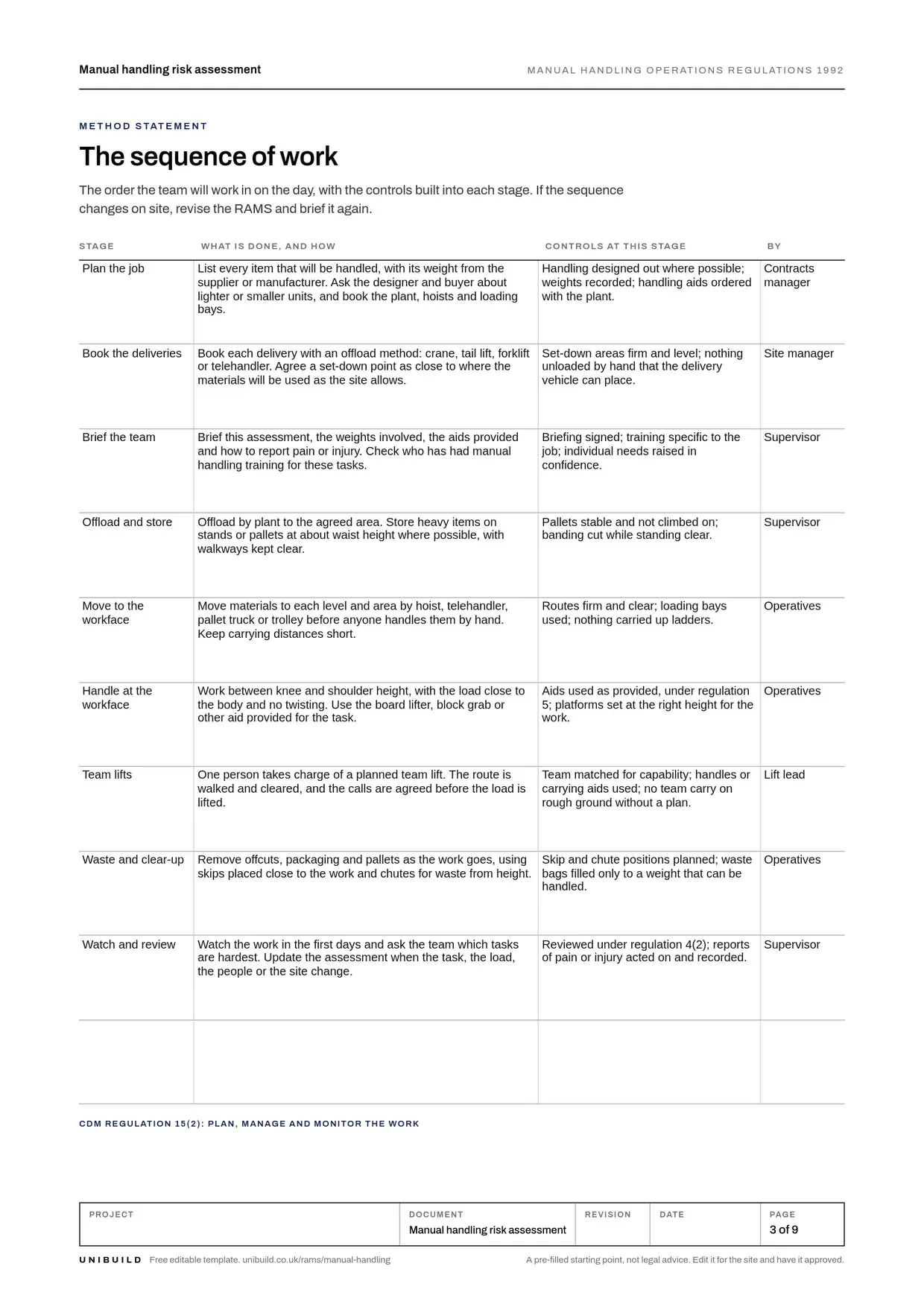
The order of work, with the controls at each stageHow materials reach the work with as little lifting by hand as possible, and the controls at each stage. If the plan changes on site, revise the assessment and brief it again.
Plan the job
List every item that will be handled, with its weight from the supplier or manufacturer. Ask the designer and buyer about lighter or smaller units, and book the plant, hoists and loading bays.
ControlsHandling designed out where possible; weights recorded; handling aids ordered with the plant.
Book the deliveries
Book each delivery with an offload method: crane, tail lift, forklift or telehandler. Agree a set-down point as close to where the materials will be used as the site allows.
ControlsSet-down areas firm and level; nothing unloaded by hand that the delivery vehicle can place.
Brief the team
Brief this assessment, the weights involved, the aids provided and how to report pain or injury. Check who has had manual handling training for these tasks.
ControlsBriefing signed; training specific to the job; individual needs raised in confidence.
Offload and store
Offload by plant to the agreed area. Store heavy items on stands or pallets at about waist height where possible, with walkways kept clear.
ControlsPallets stable and not climbed on; banding cut while standing clear.
Move to the workface
Move materials to each level and area by hoist, telehandler, pallet truck or trolley before anyone handles them by hand. Keep carrying distances short.
ControlsRoutes firm and clear; loading bays used; nothing carried up ladders.
Handle at the workface
Work between knee and shoulder height, with the load close to the body and no twisting. Use the board lifter, block grab or other aid provided for the task.
ControlsAids used as provided, under regulation 5; platforms set at the right height for the work.
Team lifts
One person takes charge of a planned team lift. The route is walked and cleared, and the calls are agreed before the load is lifted.
ControlsTeam matched for capability; handles or carrying aids used; no team carry on rough ground without a plan.
Waste and clear-up
Remove offcuts, packaging and pallets as the work goes, using skips placed close to the work and chutes for waste from height.
ControlsSkip and chute positions planned; waste bags filled only to a weight that can be handled.
Watch and review
Watch the work in the first days and ask the team which tasks are hardest. Update the assessment when the task, the load, the people or the site change.
ControlsReviewed under regulation 4(2); reports of pain or injury acted on and recorded.
What the law asks for manual handling
Checked against the sourceAvoid, assess, reduce
So far as is reasonably practicable, employers avoid manual handling that involves a risk of injury. Where it cannot be avoided, they make a suitable and sufficient assessment and reduce the risk to the lowest level reasonably practicable.
Manual Handling Operations Regulations 1992, regulation 4(1)What the assessment looks at
Schedule 1 lists the factors to assess: the tasks, the loads, the working environment, individual capability, and other factors such as restrictive PPE or clothing. TILE and TILEO are memory aids for these headings.
Manual Handling Operations Regulations 1992, Schedule 1The individual
In judging the risk, the employer considers the worker's physical suitability, clothing, footwear, knowledge and training. Health surveillance results count too, and whether the worker is in a group at particular risk.
Manual Handling Operations Regulations 1992, regulation 4(3)Information on the load
Workers are given general indications of the weight of each load and, where reasonably practicable, precise information. Where the centre of gravity is off centre, they are told which side is heaviest.
Manual Handling Operations Regulations 1992, regulation 4(1)(b)(iii)Employees' duty
Each employee makes full and proper use of any system of work provided to reduce the risk, which includes the handling aids. Section 7 of the Health and Safety at Work etc. Act 1974 adds a general duty of care.
Manual Handling Operations Regulations 1992, regulation 5Record and review
Employers with five or more employees record the significant findings. The manual handling assessment is reviewed when there is reason to think it is no longer valid, or when the handling has changed significantly.
Management of Health and Safety at Work Regulations 1999, regulation 3(6); MHOR 1992, regulation 4(2)Competence, equipment and PPE
Competence and cards
- Assessor Trained to assess manual handling with HSE L23, and to use the MAC and RAPP tools for tasks outside the filters.
- Supervisor Briefs the assessment, checks the aids are used, and acts on reports of pain or injury.
- Operatives Manual handling training specific to their tasks, with practical work, as HSE INDG143 describes.
- Plant operators CPCS, NPORS or an equivalent card for the telehandler or forklift used to place loads.
- Slinger or signaller Trained for any crane or telehandler lift that places heavy items.
Plant and equipment
- Telehandler or forklift Daily checks; thorough examination under LOLER in date.
- Pallet truck, sack truck and trolleys Wheels, brakes and handles checked before use; tyres inflated.
- Block grab or vacuum lifter Pads, seals and vacuum gauge checked before use; safe working load marked.
- Board trolley, board lifter and ceiling lift Checked before use and used within the manufacturer's load.
- Materials hoist Thorough examination under LOLER in date; gates and controls checked daily.
- Drum stands and drum trailer Rated for the drum weight; spindle and brakes checked.
PPE
- Gloves with a good grip, cut-resistant for glass, sheet and banding.
- Safety boots with toe protection and a grip sole.
- Safety helmet to the site standard, and wherever loads are lifted overhead.
- High-visibility clothing wherever plant moves materials around site.
- Work clothing that does not restrict movement, since PPE that hinders posture is a risk factor in itself.
Permits and plans
A lift plan for any crane or telehandler lift that places heavy items such as kerbs, boilers or glass units. Delivery bookings and set-down areas agreed with the site manager before the day.
Emergency and rescue
Any strain or injury is reported the same day and recorded in the accident book. First aider and first aid kit on site. A crush injury is treated as an emergency. An injury that keeps someone off their normal work for more than seven consecutive days, not counting the day it happened, is reportable under RIDDOR.
Toolbox talk: manual handling
Read this to the team before work starts, tick each point as it is covered, and record who attended.
- Before you lift anything, ask if it needs lifting at all. If plant, the hoist or a trolley can move it, use that.
- Check the weight. It is on the packaging or the delivery note. If you cannot find it, rock the load first to test it.
- Keep the load close to your waist, feet apart, and turn with your feet, not your back.
- Blocks, kerbs and boards have their own lifting aids on this job. They are there to be used every time.
- Team lift: one person in charge, the route cleared first, and nobody moves until the call.
- If something aches, tell the supervisor today. An early report gets the task changed before it becomes an injury.
Ask the team
- What is the heaviest item on this job, and how is it being moved?
- Where are the trolleys, lifters and grabs kept?
- What would you change about how materials reach your work area?
What is in the manual handling risk assessment template
9 pages, pre-filled and editableThe work, pre-filled
Scope, location and access, interfaces with other trades, the documents the assessment relies on, and the team.
The sequence of work
Nine stages from planning the job to review, with the controls and the person responsible at each one.
Hazards and controls
Fifteen manual handling hazards rated before and after controls on a five by five matrix, with room for your own.
Plant, PPE and permits
The handling aids and their checks, PPE by type, and the lift plan for heavy items placed by crane.
TILE assessment
A page for one handling task: task, individual, load, environment and other factors, with findings, risk and action.
Briefing record
Twenty signatures against the revision, taken on the day before the work starts.
Brief it, and get it signed on the phone
On Unibuild a RAMS is written from a template, approved, then read by each operative on their phone in their own language and signed. Subcontract and agency workers sign through a link, with no app to install.
Every signature carries its date and time and prints as the last page of the RAMS PDF. Change the RAMS and it has to be signed again.
How RAMS work on UnibuildManual handling risk assessment questions
Is this manual handling risk assessment template free?
What is the maximum weight a person can lift at work?
What does TILE stand for in manual handling?
Is a manual handling risk assessment a legal requirement?
When should I use the MAC tool or the RAPP tool?
Can two people lay blocks over 20 kg together?
Is manual handling training enough on its own?
Is a moving and handling risk assessment the same thing?
RAMS templates for other trades and hazards
All free, pre-filled and editableBy trade
- Electrical RAMSSafe isolation, live work, testing and inspection, and working near other trades.
- Scaffolding RAMSErecting, altering and dismantling tube and fitting and system scaffold, with handover and inspection.
- Roofing RAMSPitched and flat roofs, fragile surfaces, edge protection, hot work and getting materials up safely.
- Groundworks RAMSExcavations, buried services, plant, trench support and inspections at the start of each shift.
- Plumbing and heating RAMSSoldering and brazing, gas work, unvented systems, lofts and occupied homes.
- Painting and decorating RAMSAccess equipment, solvents and spray, old lead paint, dust from preparation and occupied buildings.
- Hot works and welding RAMSWelding, cutting, grinding and torch-on work: permits, fire watch, fume and gas cylinders.
By hazard
- COSHH risk assessmentHazardous substances on site: dusts, solvents, cement, resins and fume, assessed and controlled.
- Manual handling risk assessmentLifting, carrying, pushing and pulling, assessed by task, individual, load and environment.
- Working at height risk assessmentLadders, towers, MEWPs, scaffolds and roofs, chosen and controlled in the order the law sets.
- Lone working risk assessmentPeople working alone on site, in empty buildings and out of hours, with check-ins and a plan if they go quiet.
- Noise and vibration risk assessmentNoise exposure and hand-arm vibration from tools, measured against the action and limit values.
- Asbestos risk assessmentFinding asbestos before work starts, deciding whether work is licensed, and controlling non-licensed work.
- Confined space risk assessmentManholes, tanks, voids and chambers: avoiding entry, a safe system of work, gas testing and rescue.
The blank RAMS template, the RAMS review checklist and every other free form are on Free downloads.
The RAMS, read and signed
before the work starts.
Unibuild keeps every RAMS with its versions, its approvals and each operative’s signature against the revision they read, for seven years, ready for the principal contractor or an auditor.