
Plumbing and heating risk assessment template
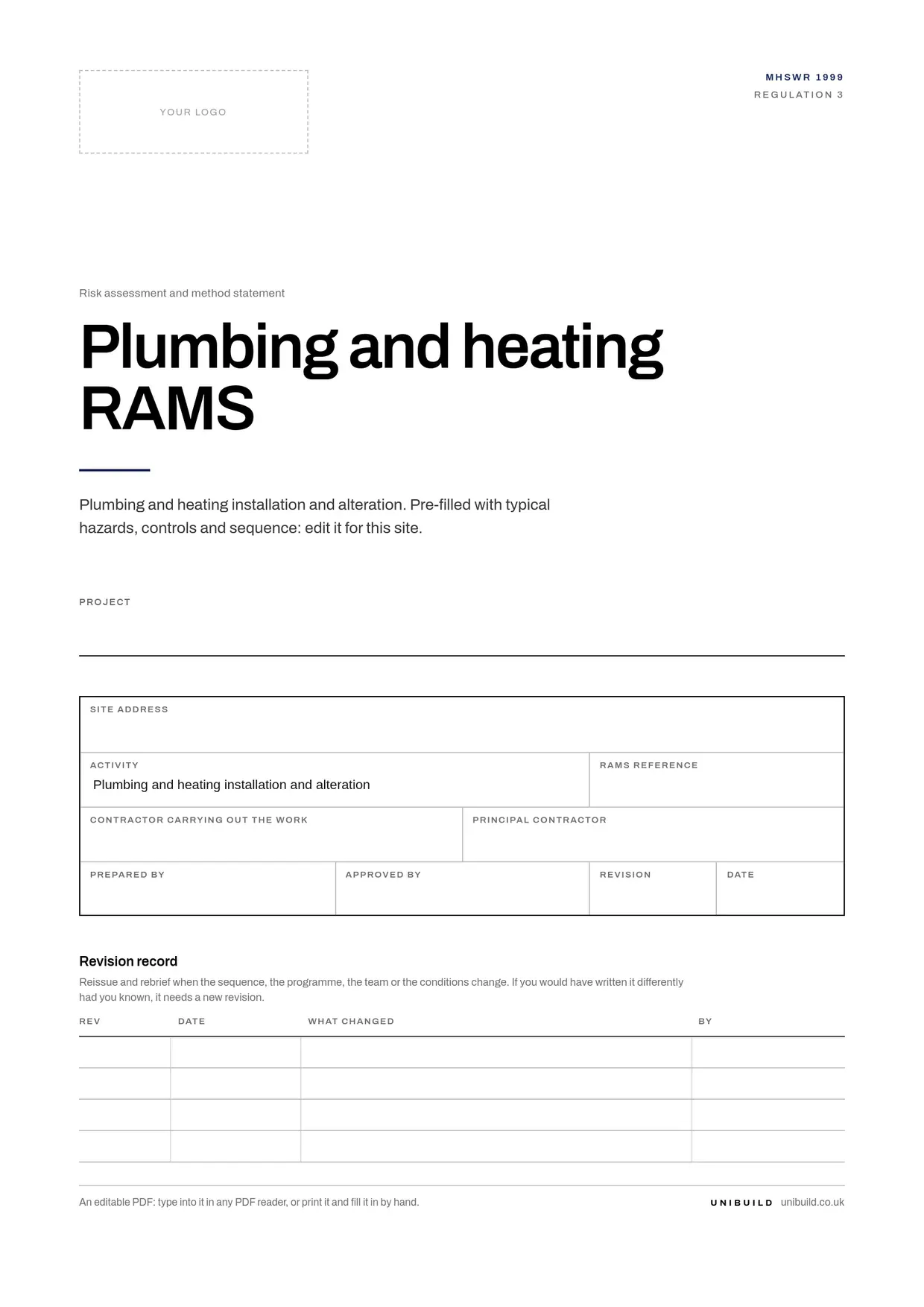
A plumbing and heating risk assessment and method statement, already filled in with the hazards, controls and sequence for pipework, boilers and hot water systems. Edit it for the job, then brief it.
- Law
- Gas Safety (Installation and Use) Regulations 1998
- Gas work
- Gas Safe registered only
- Format
- Editable PDF and Word
- Cost
- Free, always
Do you need a RAMS for plumbing work?
Yes, in practice. The law requires a risk assessment for the work, and a main contractor, housing provider or commercial client will usually ask for a RAMS before a plumber starts. For gas work, the law also controls who may do it.
The risk assessment is the legal duty, under regulation 3 of the Management of Health and Safety at Work Regulations 1999. The method statement shows how the job is done: isolating supplies, soldering safely, pressure testing, commissioning and handing back a safe system.
A plumbing RAMS should be written for the property in front of you. The age of the building, who lives or works there, access to lofts and voids, and whether gas or an unvented cylinder is involved make it suitable.
Plumbing and heating hazards and controls
15 hazards, rated before and after controlsThe significant hazards on a typical plumbing and heating job, from a bathroom refit to a boiler and cylinder swap, with the controls a reviewer expects to see. Delete what does not apply and add what your job has.
Fire from soldering and brazing
The plumber, occupants and the building, from blowlamp flame near timber, insulation and dust in voids.
- Press-fit or push-fit fittings used instead of soldering where practicable.
- Heat-resistant mat behind every joint, combustibles moved or protected, and an extinguisher within reach.
- Hot work permit where the site requires one, with the fire watch it sets.
- Area, void and the far side of the wall checked after the last joint, and again before leaving.
BeforeHigh 15AfterMedium 5
Gas escape, fire or explosion
Engineers, occupants and neighbours when gas pipework or appliances are opened up.
- Gas work only by Gas Safe registered engineers whose card covers the work, as GSIUR regulation 3 requires.
- Supply isolated, open ends sealed with the appropriate fitting, and no source of ignition near exposed gasways.
- Gas tightness test immediately after any work that could affect it.
BeforeHigh 15AfterMedium 5
Carbon monoxide from appliances and flues
Occupants and workers, from a blocked, disconnected or poorly installed flue or appliance.
- After work on an appliance, the flue, combustion air supply, operating pressure or heat input, and safe operation are checked.
- Any defect reported to the responsible person and the owner, as GSIUR regulation 26(9) requires, and unsafe appliances not left in use.
- Flues and appliances installed to the manufacturer's instructions.
BeforeMedium 10AfterMedium 5
Unvented hot water failure
Occupants and plumbers, from stored water overheating or an uncontrolled discharge.
- Installed only by someone with the skills for unvented systems, shown by competent person scheme registration or an unvented skills card.
- Factory-fitted temperature and pressure relief valve left in place, with the discharge piped to where it is visible but safe.
- Work notified to building control unless self-certified through a competent person scheme.
BeforeMedium 10AfterMedium 5
Electric shock from boilers, pumps and immersions
Plumbers disconnecting or reconnecting heating controls, pumps and immersion heaters.
- Electrical supply isolated, locked off and proved dead before work on any appliance or control.
- Temporary continuity bond across any cut in metal pipework, and bonding restored before handover.
- Electrical connections made by a competent person.
BeforeHigh 15AfterMedium 5
Scalds and burns
Plumbers draining hot systems, and occupants using outlets after commissioning.
- Systems isolated and left to cool before draining or opening up.
- In new dwellings, bath hot water limited to 48°C with a mixing valve, as Part G requires.
- Occupants told before hot water comes back on.
BeforeMedium 9AfterLow 3
Pressure testing
Plumbers and others nearby, if a joint or fitting fails under test pressure.
- Test pressure and method set by the Water Fittings Regulations and the manufacturer's instructions, never exceeded.
- Joints checked before pressurising, and others kept clear during the test.
- Pump and gauge checked before use; pressure released slowly at the end.
BeforeMedium 6AfterLow 3
Lifting boilers, cylinders and radiators
Plumbers carrying boilers, cylinders, radiators and baths up stairs and into lofts.
- Avoided where reasonably practicable, then assessed by task, individual, load and environment, as the Manual Handling Operations Regulations require.
- Cylinders, boilers and radiators drained before removal; two-person lifts, stair climbers or trolleys for heavy items.
- Route checked and cleared before lifting.
BeforeMedium 12AfterMedium 6
Falls in lofts and roof spaces
Plumbers working on joists, through hatches, and on ladders up to the hatch.
- Crawl boards or boarded walkways across joists; nobody stands on ceiling plasterboard.
- Loft ladder or a secured ladder at the hatch, with the opening guarded when people are below.
- Temporary lighting in the loft before work starts.
BeforeMedium 12AfterLow 4
Underfloor voids and confined spaces
Plumbers in underfloor voids, ducts, tanks and chambers with poor air or a difficult way out.
- Entry avoided where the work can be done from outside the space.
- Each space assessed; where it is a confined space, entry only under a safe system of work with gas testing and rescue arrangements.
- Someone outside always knows who is in the void.
BeforeMedium 10AfterMedium 5
Asbestos in older properties
Plumbers near pipe lagging, flue pipes, boiler cupboard boards, textured coatings and old cisterns.
- Asbestos register or refurbishment survey checked before work in buildings built or refurbished before 2000.
- Suspect materials presumed to contain asbestos and left undisturbed until sampled.
- Asbestos awareness training for every plumber, repeated at regular intervals.
BeforeHigh 15AfterMedium 5
Legionella in new and altered systems
Occupants and the public, from stagnant or lukewarm water in new, altered or idle pipework.
- No dead legs left in altered pipework; redundant branches cut back to the main run.
- Hot water stored at 60°C or above, and cold water kept below 20°C where possible.
- Systems flushed, and disinfected where the specification requires, before handover.
BeforeMedium 10AfterMedium 5
Dust from chasing, drilling and cutting
Plumbers chasing walls, core drilling and cutting masonry for pipe and flue runs, and occupants nearby.
- Pipe routes planned to avoid chasing where practicable, with surface runs or boxing instead.
- Chasers and core drills used with water suppression or on-tool extraction to an M or H class unit.
- FFP3 RPE, face-fit tested, for dusty work; clean-up by vacuum, never dry sweeping.
BeforeMedium 12AfterLow 4
Working in occupied homes
Residents, children and visitors in the property while the work is done.
- Water, heating and gas interruptions agreed with the occupier, with vulnerable residents identified first.
- Blowlamps, gas cartridges and tools never left unattended.
- Floors protected, and hoses and pipes kept out of walkways.
BeforeMedium 12AfterLow 4
Flooding and water damage
The property and its occupants, from a failed joint or a careless drain-down.
- Stopcock found and checked before work; system isolated and drained into suitable containers or to a drain.
- Joints checked under test before floors and boxing are closed up.
BeforeMedium 6AfterLow 2
Scores are likelihood times severity on the five by five matrix in the template. They are typical ratings for this work, a starting point for your own assessment of your site.
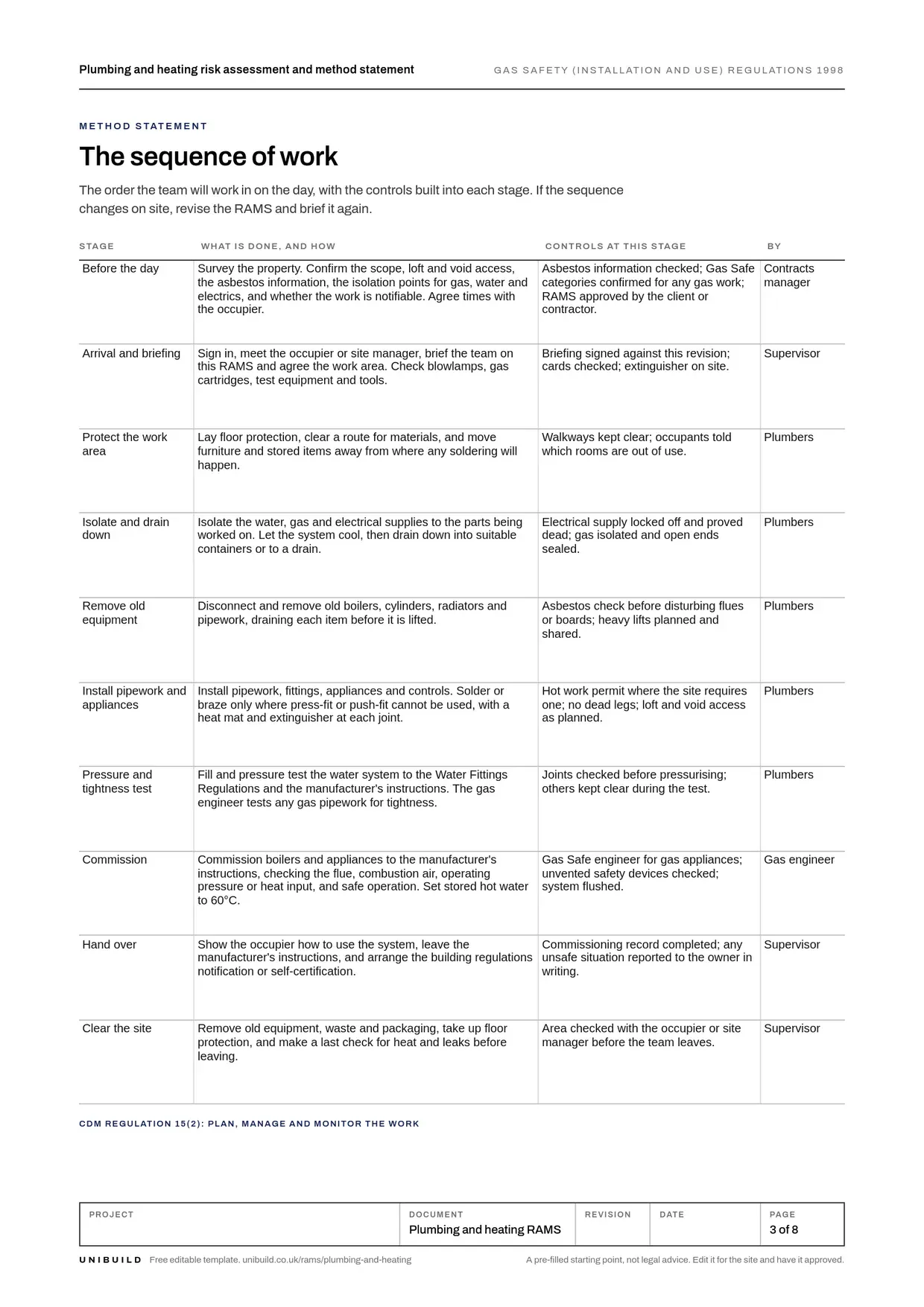
Plumbing method statement: the sequence of work
The order of work, with the controls at each stageThe order the team works in, with the controls built into each stage. If the sequence changes on the job, revise the RAMS and brief it again.
Before the day
Survey the property. Confirm the scope, loft and void access, the asbestos information, the isolation points for gas, water and electrics, and whether the work is notifiable. Agree times with the occupier.
ControlsAsbestos information checked; Gas Safe categories confirmed for any gas work; RAMS approved by the client or contractor.
Arrival and briefing
Sign in, meet the occupier or site manager, brief the team on this RAMS and agree the work area. Check blowlamps, gas cartridges, test equipment and tools.
ControlsBriefing signed against this revision; cards checked; extinguisher on site.
Protect the work area
Lay floor protection, clear a route for materials, and move furniture and stored items away from where any soldering will happen.
ControlsWalkways kept clear; occupants told which rooms are out of use.
Isolate and drain down
Isolate the water, gas and electrical supplies to the parts being worked on. Let the system cool, then drain down into suitable containers or to a drain.
ControlsElectrical supply locked off and proved dead; gas isolated and open ends sealed.
Remove old equipment
Disconnect and remove old boilers, cylinders, radiators and pipework, draining each item before it is lifted.
ControlsAsbestos check before disturbing flues or boards; heavy lifts planned and shared.
Install pipework and appliances
Install pipework, fittings, appliances and controls. Solder or braze only where press-fit or push-fit cannot be used, with a heat mat and extinguisher at each joint.
ControlsHot work permit where the site requires one; no dead legs; loft and void access as planned.
Pressure and tightness test
Fill and pressure test the water system to the Water Fittings Regulations and the manufacturer's instructions. The gas engineer tests any gas pipework for tightness.
ControlsJoints checked before pressurising; others kept clear during the test.
Commission
Commission boilers and appliances to the manufacturer's instructions, checking the flue, combustion air, operating pressure or heat input, and safe operation. Set stored hot water to 60°C.
ControlsGas Safe engineer for gas appliances; unvented safety devices checked; system flushed.
Hand over
Show the occupier how to use the system, leave the manufacturer's instructions, and arrange the building regulations notification or self-certification.
ControlsCommissioning record completed; any unsafe situation reported to the owner in writing.
Clear the site
Remove old equipment, waste and packaging, take up floor protection, and make a last check for heat and leaks before leaving.
ControlsArea checked with the occupier or site manager before the team leaves.
What the law asks for plumbing and heating
Checked against the sourceWho may do gas work
No one works on a gas fitting unless competent. An employer or self-employed person doing work on gas fittings or service pipework must be in the class approved by HSE, which is the Gas Safe Register.
Gas Safety (Installation and Use) Regulations 1998, regulation 3Safe gas working
No source of ignition near exposed gasways. Incomplete gasways are sealed before a fitting is left unattended, and the installation is tested for gas tightness after any work that might affect it.
Gas Safety (Installation and Use) Regulations 1998, regulation 6Unvented hot water
Stored hot water must be kept from exceeding 100°C, and discharge from safety devices must be visible but safe. In England, installing an unvented system is notifiable building work unless the installer self-certifies through a competent person scheme.
Building Regulations 2010, Schedule 1, requirement G3Pressure testing
A water system must withstand an internal pressure of at least 1.5 times the maximum it is designed to work at. The Schedule sets test procedures for systems with and without plastic pipes.
Water Supply (Water Fittings) Regulations 1999, Schedule 2, paragraph 12Asbestos
Maintenance or other work liable to disturb asbestos does not start until someone has assessed whether asbestos is present. If in doubt, it is presumed present and the regulations are followed.
Control of Asbestos Regulations 2012, regulation 5Manual handling
Hazardous manual handling is avoided so far as is reasonably practicable. Where it cannot be avoided, it is assessed and the risk of injury is reduced as far as reasonably practicable.
Manual Handling Operations Regulations 1992, regulation 4Competence, equipment and PPE
Competence and cards
- Gas engineers On the Gas Safe Register, with the categories on their ID card covering the appliances and the work.
- Unvented systems Competent person scheme registration, or a current skills card for unvented hot water systems.
- Plumbers Trained and experienced in the work, with apprentices and trainees supervised.
- Asbestos Asbestos awareness training, repeated at regular intervals.
- Confined spaces Training for the entry and rescue arrangements wherever a void is a confined space.
- Access equipment Trained in the safe use of ladders and steps, and PASMA for any mobile tower.
Plant and equipment
- Blowlamp and gas cartridges Hose, valve and nozzle checked; cartridges stored away from heat.
- Press-fit tool Jaws checked and the tool serviced to the maker's instructions.
- Pressure test pump and gauge Gauge readable and in good order; valves checked before use.
- Flue gas analyser and gas pressure gauge In calibration and checked before use.
- Stair climber or trolley Pre-use check; rated for the load.
- Ladders and crawl boards Pre-use check; ladder secured at the hatch.
PPE
- Gloves heat-resistant for soldering, cut-resistant for handling metal and sheet.
- Eye protection for soldering, cutting and work overhead.
- RPE FFP3 mask, face-fit tested, for chasing, drilling, dusty lofts and underfloor voids.
- Knee pads for floor, void and loft work.
- Safety boots with toe protection.
- Safety helmet and high-visibility clothing on construction sites, to the site standard.
Permits and plans
A hot work permit for soldering or brazing where the site or building owner requires one, with the fire watch it sets. A confined space entry permit for any void assessed as a confined space. A permit to work where the client's rules require one.
Emergency and rescue
For a smell of gas, turn off the supply at the emergency control, open doors and windows, and use no switches or flames. Call the gas emergency number, 0800 111 999 in Great Britain. For fire, raise the alarm and get out. First aider and kit on site, and the nearest accident and emergency department named on the briefing.
Toolbox talk: plumbing and heating safety
Read this to the team before work starts, tick each point as it is covered, and record who attended.
- Gas work is for Gas Safe engineers only, and only for the categories on their card.
- Press-fit or push-fit where we can. If we solder, the heat mat and extinguisher are in place before the blowlamp is lit.
- After the last joint, check the area, the void and the other side of the wall. Check again before we leave.
- In older properties, check the asbestos information before touching lagging, flues or boards. If in doubt, leave it.
- Drain cylinders and boilers before lifting. Two people, or the stair climber, for anything heavy.
- Tell the occupier before water, gas or heating goes off, and before hot water comes back on.
Ask the team
- Where are the gas emergency control, the stopcock and the electrical isolator in this property?
- Which jobs today involve soldering, and where is the extinguisher?
- Who checks that nobody is left alone in the loft or the underfloor void?
What is in the plumbing and heating RAMS template
8 pages, pre-filled and editableThe work, pre-filled
Scope, location and access, interfaces with other trades, the documents the RAMS relies on, and the team with their cards and registration.
The sequence of work
Ten stages from survey to clearing the site, with the controls and the person responsible at each one.
Hazards and controls
Fifteen plumbing and heating hazards rated before and after controls on a five by five matrix, with room for your own.
Plant, PPE and permits
The equipment and its checks, PPE by type, the substances used, and the permits the job needs.
Emergency arrangements
What to do for a smell of gas, a fire or an injury, and the environment section.
Briefing record
Twenty signatures against the revision, taken on the day before the work starts.
Brief it, and get it signed on the phone
On Unibuild a RAMS is written from a template, approved, then read by each operative on their phone in their own language and signed. Subcontract and agency workers sign through a link, with no app to install.
Every signature carries its date and time and prints as the last page of the RAMS PDF. Change the RAMS and it has to be signed again.
How RAMS work on UnibuildPlumbing RAMS questions
Is this plumbing and heating RAMS template free?
What should a plumbing RAMS include?
Is a plumbing risk assessment a legal requirement?
Can a plumber do gas work without Gas Safe registration?
Who can install an unvented hot water cylinder?
Is soldering classed as hot work?
Do plumbers need to think about legionella?
Who signs the plumbing RAMS?
RAMS templates for other trades and hazards
All free, pre-filled and editableBy trade
- Electrical RAMSSafe isolation, live work, testing and inspection, and working near other trades.
- Scaffolding RAMSErecting, altering and dismantling tube and fitting and system scaffold, with handover and inspection.
- Roofing RAMSPitched and flat roofs, fragile surfaces, edge protection, hot work and getting materials up safely.
- Groundworks RAMSExcavations, buried services, plant, trench support and inspections at the start of each shift.
- Plumbing and heating RAMSSoldering and brazing, gas work, unvented systems, lofts and occupied homes.
- Painting and decorating RAMSAccess equipment, solvents and spray, old lead paint, dust from preparation and occupied buildings.
- Hot works and welding RAMSWelding, cutting, grinding and torch-on work: permits, fire watch, fume and gas cylinders.
By hazard
- COSHH risk assessmentHazardous substances on site: dusts, solvents, cement, resins and fume, assessed and controlled.
- Manual handling risk assessmentLifting, carrying, pushing and pulling, assessed by task, individual, load and environment.
- Working at height risk assessmentLadders, towers, MEWPs, scaffolds and roofs, chosen and controlled in the order the law sets.
- Lone working risk assessmentPeople working alone on site, in empty buildings and out of hours, with check-ins and a plan if they go quiet.
- Noise and vibration risk assessmentNoise exposure and hand-arm vibration from tools, measured against the action and limit values.
- Asbestos risk assessmentFinding asbestos before work starts, deciding whether work is licensed, and controlling non-licensed work.
- Confined space risk assessmentManholes, tanks, voids and chambers: avoiding entry, a safe system of work, gas testing and rescue.
The blank RAMS template, the RAMS review checklist and every other free form are on Free downloads.
The RAMS, read and signed
before the work starts.
Unibuild keeps every RAMS with its versions, its approvals and each operative’s signature against the revision they read, for seven years, ready for the principal contractor or an auditor.