
Scaffolding risk assessment and RAMS template
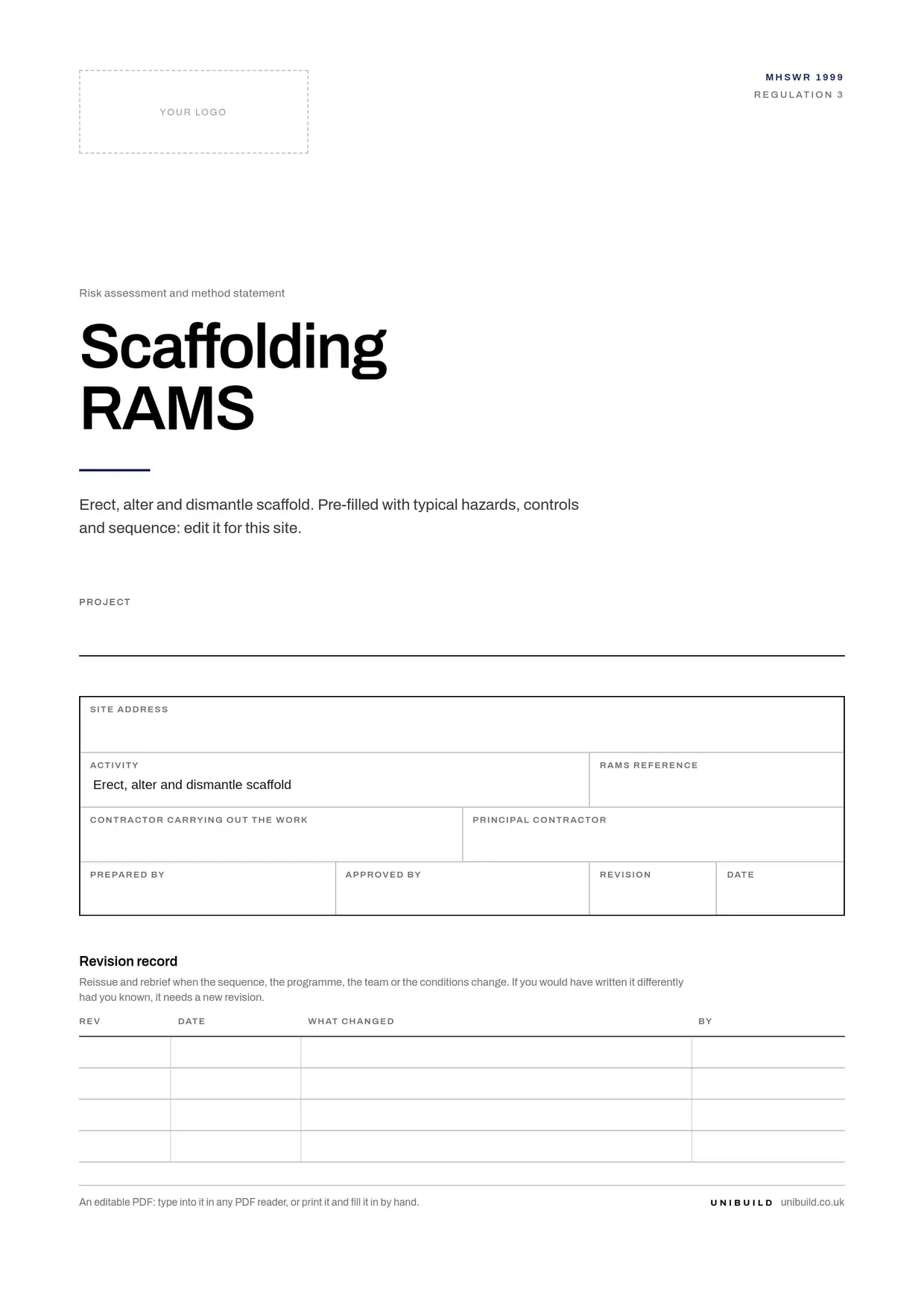
A scaffolding risk assessment and method statement, already filled in with the hazards, controls and sequence for erecting, altering and dismantling scaffold. Edit it for your site, then brief it.
- Law
- Work at Height Regulations 2005
- Inspection
- Before use, then every 7 days
- Format
- Editable PDF and Word
- Cost
- Free, always
Do you need a RAMS for scaffolding?
Yes, in practice every scaffolding job needs a RAMS before the first lift goes up. The law requires a risk assessment, and the Work at Height Regulations require scaffold to be erected, altered and dismantled by trained people under competent supervision. A principal contractor will expect to review the RAMS before work starts.
The risk assessment is the legal duty, under regulation 3 of the Management of Health and Safety at Work Regulations 1999. The method statement sets out the order the scaffold goes up, how the team stays protected at each lift, and how it is inspected and handed over. It can also serve as the assembly, use and dismantling plan that the Work at Height Regulations ask for.
A scaffolding RAMS should be written for the site in front of you. The ground, the ties, the loading, the public below and the trades who will use the scaffold are what make it suitable, and what a reviewer looks for first.
Scaffolding hazards and controls
15 hazards, rated before and after controlsThe significant hazards on a typical tube and fitting or system scaffold job, with the controls a reviewer expects to see. Delete what does not apply and add what your site has.
Falls while erecting or dismantling
Scaffolders working on lifts that are not yet fully boarded or guarded.
- Erect to NASC SG4:22, with an advance guard-rail system or a single guard-rail installed from the level below before each lift is stepped onto.
- Full harness with a twin-tail lanyard clipped to a suitable anchor wherever collective protection is not yet in place.
- Every scaffolder holds a CISRS card for the grade of work, with a supervisor on site throughout.
BeforeHigh 20AfterMedium 5
Falls from the finished scaffold
Anyone using the scaffold, through gaps in guard-rails, boards or at the ends.
- Main guard-rail at least 950mm high, an intermediate rail leaving no gap over 470mm, and toe boards, as WAHR Schedule 2 requires.
- Fully boarded platforms with no trap ends, and gaps at the building face kept within the design.
- Handover certificate issued and the scaffold tagged before anyone other than scaffolders goes on it.
BeforeHigh 15AfterMedium 5
Collapse of the scaffold
Users of the scaffold and people below, from overloading, poor foundations or missing ties.
- Built to a TG20:21 compliance sheet or to a design by a competent scaffold designer, kept on site.
- Sole boards and base plates on firm, level ground; ground checked for voids, drains and soft spots before the base is set out.
- Ties installed as the scaffold rises, at the pattern in the design, with tie tests carried out to NASC guidance.
- Load class shown on the tag, and no stacking of materials beyond it.
BeforeHigh 15AfterMedium 5
Falling materials and tools
The public, other trades and scaffolders below.
- Exclusion zone below the work, barriered and signed, with a banksman when the zone crosses a route.
- Tools on lanyards at height; fittings passed hand to hand or lifted in bags, never thrown.
- Brick guards, debris netting or fans where the scaffold faces a public route or an occupied area.
BeforeHigh 16AfterMedium 8
Lifting materials with a gin wheel or hoist
Scaffolders hauling and anyone below the lift.
- Gin wheel or hoist fixed to the design, and thoroughly examined under LOLER, with the report in date.
- Ropes and bags inspected before use and taken out of service if damaged.
- No one under the load; the lift zone is barriered.
BeforeMedium 12AfterLow 4
Overhead power lines and live services
Scaffolders handling long tubes near overhead lines or building services.
- Lines identified before work, and the network operator contacted to divert or switch them off where the scaffold is within the distance in HSE GS6.
- Where lines stay live, barriers and goal posts set the safe distance, and tube is handled horizontally under supervision.
BeforeMedium 10AfterMedium 5
Manual handling of tubes, boards and fittings
Scaffolders and labourers loading, carrying and passing materials.
- Deliveries placed as close to the work as possible, with materials moved by vehicle crane or hoist where practicable.
- Long tubes carried by two people on uneven ground; boards passed, not thrown.
- Team briefed on lifting technique, and gloves with good grip worn.
BeforeMedium 8AfterLow 4
Weather: wind, rain, ice and lightning
Scaffolders exposed at height, especially when sheeting.
- Forecast checked at the start of each day, with work stopped when wind makes handling unsafe.
- Sheeted or netted scaffolds built to a design that accounts for the extra wind load.
- Boards and platforms checked for ice and debris before use; the scaffold inspected after severe weather.
BeforeMedium 12AfterMedium 8
Unauthorised use and alteration
Other trades who remove ties, boards or rails to suit their work.
- Incomplete scaffold marked with a red tag or "Scaffold incomplete" sign and access points blocked off.
- Site rule briefed at induction: only the scaffolding contractor alters the scaffold.
- Weekly and after-event inspections pick up changes; anything found is reported and put right before use.
BeforeHigh 16AfterMedium 8
The public and passing traffic
Pedestrians, drivers and neighbours beside a scaffold on or near the highway.
- Highway licence from the highway authority under section 169 of the Highways Act 1980 before any scaffold goes on the highway.
- Lighting at night, padded or marked standards at pedestrian level, and a safe walkway kept open or diverted.
- Deliveries timed outside busy periods, with a banksman for vehicle movements.
BeforeMedium 12AfterLow 4
Fragile surfaces and openings
Scaffolders working from or over roofs, rooflights and floor openings.
- Fragile surfaces identified in the survey and covered or protected before work near them.
- Openings guarded or covered with fixed, marked covers.
BeforeHigh 15AfterMedium 5
Hand tools and impact wrenches
Scaffolders using podgers, spanners and power tools.
- Tools in good condition and on lanyards at height.
- Battery impact wrenches where possible, with trigger time planned so vibration exposure stays as low as reasonably practicable.
BeforeMedium 6AfterLow 4
Slips and trips on platforms
Scaffolders and users on boarded lifts and loading bays.
- Platforms kept clear of offcuts, fittings and stacked materials.
- Boards checked for splits and laid flush; loading bay gates kept closed when not in use.
BeforeMedium 9AfterMedium 6
Loading and unloading scaffold wagons
Drivers and scaffolders on the wagon bed, and people near the vehicle while it is loaded or unloaded.
- Wagon unloaded from the ground or by its loader crane where practicable, so nobody needs to work on the bed.
- Where work on the bed cannot be avoided, edge protection or a restraint system fitted to the wagon, and loads checked as stable before straps are released.
- Loading area away from the public, barriered, with a banksman for reversing.
BeforeMedium 12AfterLow 4
Rescue after a fall arrest
A scaffolder left suspended in a harness.
- Written rescue plan before work starts, with the equipment on site and the team briefed on it.
- Never working alone at height; rescue started at once, without waiting for the emergency services.
BeforeMedium 10AfterMedium 5
Scores are likelihood times severity on the five by five matrix in the template. They are typical ratings for this work, a starting point for your own assessment of your site.
Scaffolding method statement: the sequence of work
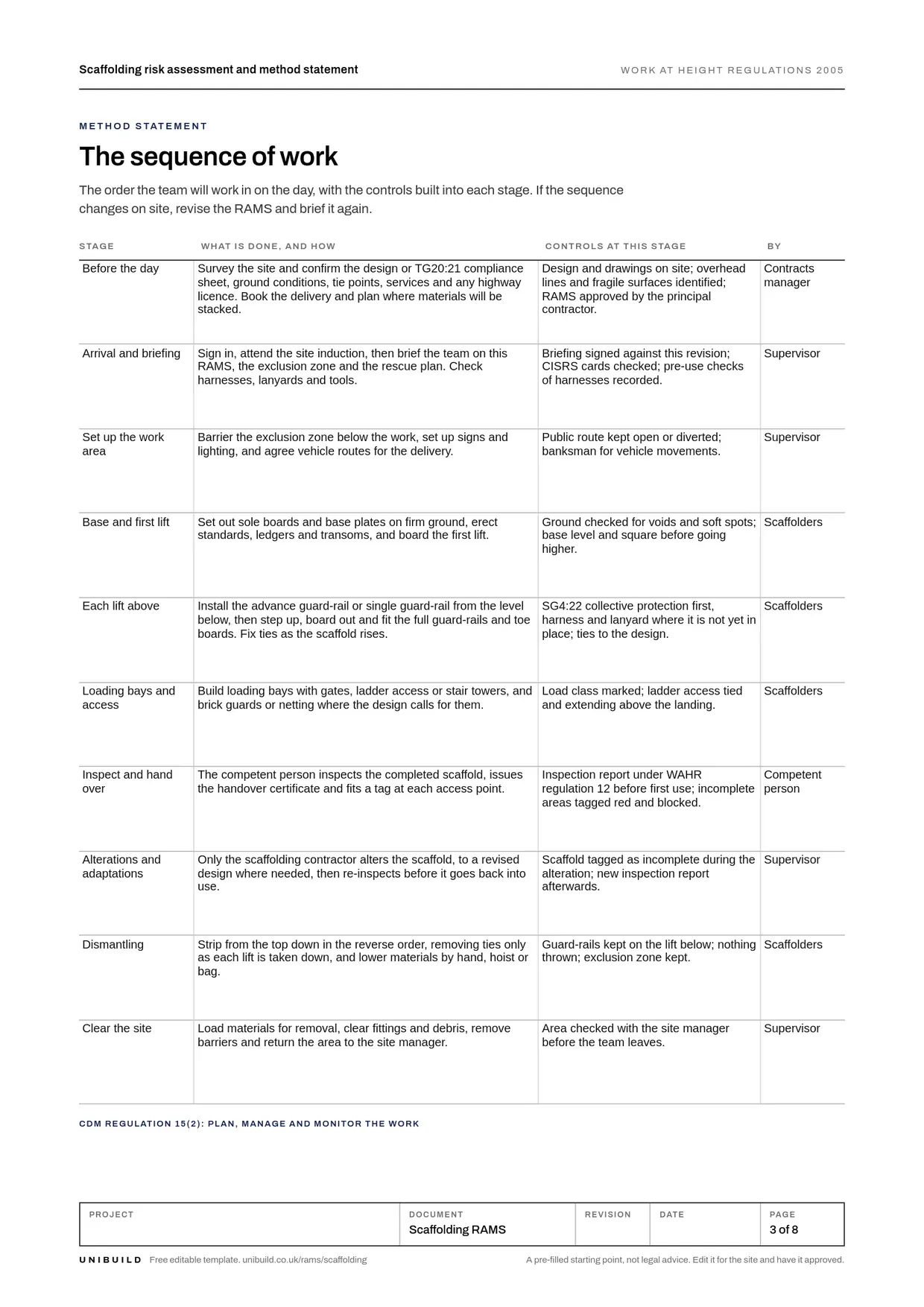
The order of work, with the controls at each stageThe order the team works in on the day, with the controls built into each stage. If the sequence changes on site, revise the RAMS and brief it again.
Before the day
Survey the site and confirm the design or TG20:21 compliance sheet, ground conditions, tie points, services and any highway licence. Book the delivery and plan where materials will be stacked.
ControlsDesign and drawings on site; overhead lines and fragile surfaces identified; RAMS approved by the principal contractor.
Arrival and briefing
Sign in, attend the site induction, then brief the team on this RAMS, the exclusion zone and the rescue plan. Check harnesses, lanyards and tools.
ControlsBriefing signed against this revision; CISRS cards checked; pre-use checks of harnesses recorded.
Set up the work area
Barrier the exclusion zone below the work, set up signs and lighting, and agree vehicle routes for the delivery.
ControlsPublic route kept open or diverted; banksman for vehicle movements.
Base and first lift
Set out sole boards and base plates on firm ground, erect standards, ledgers and transoms, and board the first lift.
ControlsGround checked for voids and soft spots; base level and square before going higher.
Each lift above
Install the advance guard-rail or single guard-rail from the level below, then step up, board out and fit the full guard-rails and toe boards. Fix ties as the scaffold rises.
ControlsSG4:22 collective protection first, harness and lanyard where it is not yet in place; ties to the design.
Loading bays and access
Build loading bays with gates, ladder access or stair towers, and brick guards or netting where the design calls for them.
ControlsLoad class marked; ladder access tied and extending above the landing.
Inspect and hand over
The competent person inspects the completed scaffold, issues the handover certificate and fits a tag at each access point.
ControlsInspection report under WAHR regulation 12 before first use; incomplete areas tagged red and blocked.
Alterations and adaptations
Only the scaffolding contractor alters the scaffold, to a revised design where needed, then re-inspects before it goes back into use.
ControlsScaffold tagged as incomplete during the alteration; new inspection report afterwards.
Dismantling
Strip from the top down in the reverse order, removing ties only as each lift is taken down, and lower materials by hand, hoist or bag.
ControlsGuard-rails kept on the lift below; nothing thrown; exclusion zone kept.
Clear the site
Load materials for removal, clear fittings and debris, remove barriers and return the area to the site manager.
ControlsArea checked with the site manager before the team leaves.
What the law asks for scaffolding
Checked against the sourcePlan, supervise and train
Work at height must be properly planned, supervised and carried out safely. Schedule 3 adds an assembly, use and dismantling plan suited to the scaffold's complexity. Scaffold is put up, altered or taken down only under a competent person's supervision, by people trained for it.
Work at Height Regulations 2005, regulation 4 and Schedule 3Strength and stability
Unless a scaffold is built to a generally recognised standard configuration, strength and stability calculations must be carried out. TG20:21 compliance sheets are how most standard scaffolds meet this.
Work at Height Regulations 2005, Schedule 3, Part 2Guard-rails and toe boards
For construction work the top guard-rail is at least 950mm high, with an intermediate rail so no unprotected gap exceeds 470mm, and a suitable toe board.
Work at Height Regulations 2005, Schedule 2Inspection and reports
A scaffold is inspected after it is put up and before first use. Where a person could fall 2 metres or more, it is inspected again at least every seven days, and after anything liable to affect its safety. Each inspection is written up.
Work at Height Regulations 2005, regulation 12 and Schedule 7Risk assessment
Every employer must make a suitable and sufficient assessment of the risks, and record the significant findings if they employ five or more people.
Management of Health and Safety at Work Regulations 1999, regulation 3Scaffolds on the highway
Scaffolding or any other structure that obstructs a highway needs a written licence from the highway authority. It must be lit from half an hour after sunset to half an hour before sunrise, and kept to the licence conditions.
Highways Act 1980, section 169Competence, equipment and PPE
Competence and cards
- Scaffolders CISRS Scaffolder or Advanced Scaffolder card for the work, with trainees supervised.
- Supervisor CISRS card plus supervisory training, on site throughout.
- Inspector CISRS scaffold inspection training for the type of scaffold.
- Designer A competent scaffold designer for anything outside TG20:21 compliance.
- Mobile towers PASMA training for anyone erecting an aluminium tower.
Plant and equipment
- Tube, fittings and boards Inspected on delivery; damaged items quarantined.
- System scaffold components Erected to the manufacturer's instructions.
- Gin wheel or materials hoist LOLER thorough examination in date; rope inspected daily.
- Harnesses and lanyards Pre-use check each day and detailed inspection at least every six months.
- Impact wrench and hand tools Checked before use; tool lanyards at height.
PPE
- Safety helmet with chin strap, worn at all times on the scaffold.
- Full body harness with twin-tail lanyard, where collective protection is not in place.
- Safety boots with ankle support and a grip sole.
- Gloves with good grip, for handling tube and fittings.
- High-visibility clothing to the site standard.
Permits and plans
A highway licence where the scaffold is on the highway. A permit to work where the principal contractor's rules require one, for example near live services or over an occupied area. A lift plan for any lift by vehicle crane.
Emergency and rescue
Rescue plan for a scaffolder suspended after a fall, with the equipment on site and practised. First aider and first aid kit on site, the nearest accident and emergency department named on the briefing, and the site emergency procedure followed for any other incident.
Toolbox talk: scaffolding safety
Read this to the team before work starts, tick each point as it is covered, and record who attended.
- We erect to SG4:22. The guard-rail goes in from the level below before anyone steps up.
- Where there is no guard-rail yet, you are clipped on. No exceptions for "just one fitting".
- Ties go in as we go up, to the drawing. Nobody removes a tie, a board or a rail to suit themselves.
- Nothing is thrown. Fittings go hand to hand or in a bag, and tools are on lanyards.
- The exclusion zone stays up until the last fitting is down. If someone walks into it, stop and tell the supervisor.
- If you see damage, missing ties or a scaffold someone else has altered, tag it and report it before anyone uses it.
Ask the team
- Where is the rescue kit, and who has been shown how to use it?
- Where are the overhead lines and fragile surfaces on this job?
- What wind would make us stop work today?
What is in the scaffolding RAMS template
8 pages, pre-filled and editableThe work, pre-filled
Scope, location and access, interfaces with other trades, the documents the RAMS relies on, and the team with their CISRS cards.
The sequence of work
Ten stages from survey to clearing the site, with the controls and the person responsible at each one.
Hazards and controls
Fifteen scaffolding hazards rated before and after controls on a five by five matrix, with room for your own.
Plant, PPE and permits
The equipment and its checks, PPE by type, and the permits and plans the job needs.
Emergency and rescue
The rescue plan for a suspended scaffolder, first aid and the environment section.
Briefing record
Twenty signatures against the revision, taken on the day before the work starts.
Brief it, and get it signed on the phone
On Unibuild a RAMS is written from a template, approved, then read by each operative on their phone in their own language and signed. Subcontract and agency workers sign through a link, with no app to install.
Every signature carries its date and time and prints as the last page of the RAMS PDF. Change the RAMS and it has to be signed again.
How RAMS work on UnibuildScaffolding RAMS questions
Is this scaffolding RAMS template free?
What should a scaffolding RAMS include?
Is a scaffold risk assessment a legal requirement?
How often does a scaffold need inspecting?
Does every scaffold need a design?
What is SG4 and does my RAMS need to mention it?
Do I need a RAMS for a mobile tower scaffold?
Who signs the scaffolding RAMS?
RAMS templates for other trades and hazards
All free, pre-filled and editableBy trade
- Electrical RAMSSafe isolation, live work, testing and inspection, and working near other trades.
- Scaffolding RAMSErecting, altering and dismantling tube and fitting and system scaffold, with handover and inspection.
- Roofing RAMSPitched and flat roofs, fragile surfaces, edge protection, hot work and getting materials up safely.
- Groundworks RAMSExcavations, buried services, plant, trench support and inspections at the start of each shift.
- Plumbing and heating RAMSSoldering and brazing, gas work, unvented systems, lofts and occupied homes.
- Painting and decorating RAMSAccess equipment, solvents and spray, old lead paint, dust from preparation and occupied buildings.
- Hot works and welding RAMSWelding, cutting, grinding and torch-on work: permits, fire watch, fume and gas cylinders.
By hazard
- COSHH risk assessmentHazardous substances on site: dusts, solvents, cement, resins and fume, assessed and controlled.
- Manual handling risk assessmentLifting, carrying, pushing and pulling, assessed by task, individual, load and environment.
- Working at height risk assessmentLadders, towers, MEWPs, scaffolds and roofs, chosen and controlled in the order the law sets.
- Lone working risk assessmentPeople working alone on site, in empty buildings and out of hours, with check-ins and a plan if they go quiet.
- Noise and vibration risk assessmentNoise exposure and hand-arm vibration from tools, measured against the action and limit values.
- Asbestos risk assessmentFinding asbestos before work starts, deciding whether work is licensed, and controlling non-licensed work.
- Confined space risk assessmentManholes, tanks, voids and chambers: avoiding entry, a safe system of work, gas testing and rescue.
The blank RAMS template, the RAMS review checklist and every other free form are on Free downloads.
The RAMS, read and signed
before the work starts.
Unibuild keeps every RAMS with its versions, its approvals and each operative’s signature against the revision they read, for seven years, ready for the principal contractor or an auditor.