

For HVAC and air conditioning contractors

Charged, logged,
and checked on its date.

HVAC contractor software that holds every system as an asset with its refrigerant, its charge and the CO2 equivalent that sets its leak check interval. Handling qualifications held against each engineer. Installation, commissioning and the maintenance book on one account, and an air conditioning firm turns on the modules it needs.

An HVAC engineer with a tablet beside rooftop condensing units
The office side

From the pressure test to
the fortieth service visit.

VRF and split systems, chillers, air handling units, ventilation or a book of maintenance contracts: the plant differs, the record around it does not.

  1. Getting a system in, pressure tested, evacuated and charged is the part an HVAC firm already has right. The money sits in what follows: the gas added on the day, a leak check interval set by the charge, and a contract whose visits land every quarter for years.

  2. Unibuild is bespoke construction management software for UK contractors: a platform in daily production since 2016, shaped to the way each firm already works. One account carries the labour run, the asset register with its F-Gas records, competence, documents, variations and applications for payment. One of the firms running on it today is an M&E and air conditioning contractor in Croydon.

Built for HVAC

What air conditioning work requires,
and what Unibuild provides.

A cassette in an office and a chiller on a roof look alike in a job list. They stop looking alike when somebody asks what the charge is, when it was last leak checked, and who was qualified to recover the gas. Each requirement is followed by what the platform does about it.

Set by the charge, not the calendar

The leak check interval follows the gas in the system

In Great Britain, a system holding five tonnes of CO2 equivalent or more is leak checked at least every twelve months. From fifty tonnes it is every six months, and from five hundred tonnes every three.

  • CO2 equivalent is the charge in kilograms multiplied by the refrigerant's global warming potential
  • Automatic leak detection doubles the interval, and is mandatory from five hundred tonnes
  • Gas installed, added and recovered, and every check, is recorded and kept for five years
  • The same charge of R410A and R32 can fall either side of the five tonne line
The CO2 equivalent, worked out on each asset

Maintained assets holds refrigerant, charge weight and GWP against each system and calculates the CO2 equivalent, with the five tonne reference charge shown for that refrigerant. Leak checks are recorded per system with the engineer's ACRIB card number, and each next due date is flagged thirty days ahead. The logbook prints in REFCOM presentation.
Two certificates, one of them personal

The firm is certified, and so is each engineer

A business that installs, services or decommissions stationary air conditioning, refrigeration or heat pump equipment containing F gas needs a company certificate. REFCOM, Quidos and Bureau Veritas issue them. Each engineer doing the work needs a handling qualification of the right category.

  • Category I covers the full scope on a system of any size
  • Card schemes, IPAF and PASMA renew on their own dates
  • Rooftop plant adds working at height and permits to the day
  • Who may recover gas on Thursday is a question with a legal answer
One grid, every qualification, warned before a card lapses

The training matrix holds each qualification, card and ticket against the person with the certificate attached and its own expiry where it has one, banded amber inside ninety days. Who can take next week's chiller service is a filter, not a phone round.

Installed once, maintained for years

The installation becomes a maintenance contract

The system is commissioned, handed over with its O&M information, and then serviced to a schedule. Filters quarterly, coils and drains on their own pattern, and the SFG20 task list behind every visit.

  • The contract side runs on programme, variations, retention and applications
  • The service side runs on assets, frequencies and visit records
  • The same engineers move between both in the same week
  • The renewal meeting asks for proof that every visit happened
Both sides on one account, sharing the same people

Maintained assets holds the register with a twelve month PPM pattern per asset, SFG20 schedules and every visit in date order with photographs. Applications for payment runs the installation side, so a week split between a fit-out and a service round still reconciles.

Found on the visit, priced on the visit

The remedial is where the margin is

A quarterly visit finds a failed condensate pump, a noisy fan motor or oil at a flare joint. Priced and agreed while the engineer is standing there, it is work. Written in a notebook, it is usually nothing.

  • Remedials are found by the engineer, not by the office
  • The client wants a price before approving it
  • A breakdown in a comms room is an emergency with a clock on it
  • Every call-out needs one record from the phone call to the invoice
Priced and signed on the phone, against the asset

Onsite quotes and variations are raised, priced, photographed and signed on site, with your costs and margin kept off the client's copy. Call-outs carry one numbered record from the first phone call to the invoice.

Dates that belong to the building

Some inspections are the owner's duty and your diary

An air conditioning system with an effective rated output over 12kW needs an inspection by an accredited energy assessor at least every five years. Larger refrigeration plant sits under the Pressure Systems Safety Regulations, with a written scheme of examination.

  • TM44 is the method the five yearly inspection follows
  • The owner carries the duty and usually expects the contractor to say when it is due
  • A pressure system has its own examination intervals, set in the written scheme
  • Kitchen extract and ductwork hygiene run to TR19 on their own frequency
The report on the asset, the visit on its pattern

Inspection reports and written schemes attach to the asset, so the paperwork travels with the plant. Planned visits show as maintenance due on the expiry page, beside calibration and every other watched register.

Cylinders, not boxes

Refrigerant moves in serial numbered cylinders

Virgin gas arrives in cylinders that go back to the supplier. Recovered gas leaves site in recovery cylinders that must be accounted for. Both live in vans, and both carry a number that belongs on the record.

  • A recovery cylinder with gas in it is not stock, it is a liability
  • Recovery machines, vacuum pumps and gauges need their own service record
  • Outdoor units and indoor units carry serials the warranty depends on
  • A van is a store that drives home every night
Serials, bin locations and an append only ledger

Assets and inventory holds stock, cylinders and equipment by item with serial numbers and bin locations, and every movement is an entry rather than an edit. Vehicles and fleet carries the vans, their MOT and service dates and the daily walk-round.

The week

An ordinary week in an air conditioning firm,
and the record it leaves.

Six entries from an HVAC contractor's day book, each ending in the record rather than the reminder.

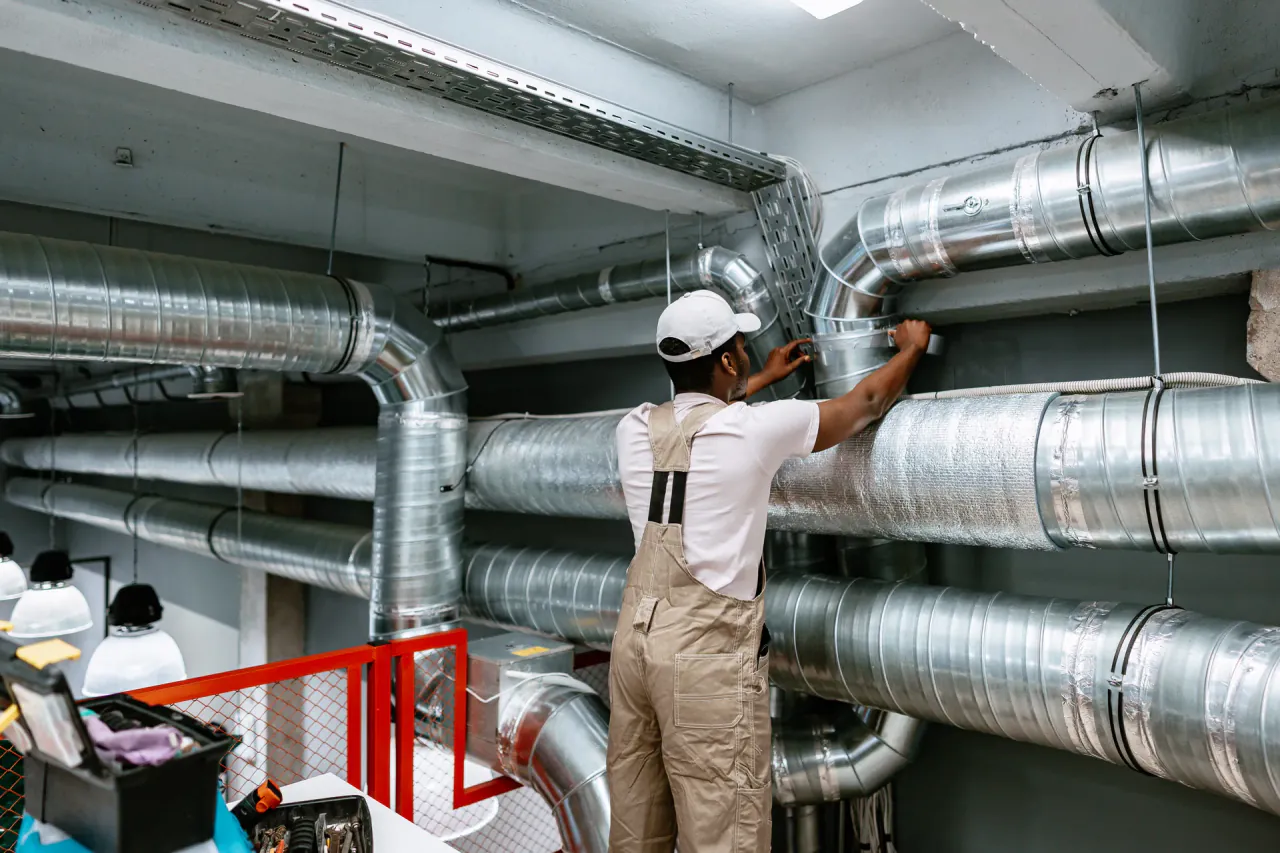
An engineer fitting spiral ductwork in a commercial ceiling void
Monday, the roof

A VRF system is commissioned. The additional charge, the pressure test and a photograph of the data plate are entered against the outdoor unit on the phone before the engineer comes down.

Charge on the asset
Tuesday, the office

Next month's quarterly visits to a client's forty cassettes go on the labour run. The matrix answers who holds the right category and a current IPAF card.

Allocated on competence
Wednesday, the plant room

A chiller is leak checked. The result, the engineer's card number and the next date are recorded against the asset, and the interval follows from its CO2 equivalent.

Next check dated
Thursday, the call-out

A comms room unit trips. The engineer scans the QR label on the indoor unit and reads its history and last gas added before opening a panel.

Arrived knowing
Friday, the remedial

A condensate pump found failing on Thursday is priced on the phone, signed by the facilities manager, and converted into an order without being retyped.

Signed before it was fitted
Eleven months later

The chiller's annual service shows as maintenance due ahead of its month, with last year's leak check result and gas record already on the asset.

Booked before it lapsed
Your system, your app

Shaped to your firm,
published under your name

Anything a firm needs is built for it, and changes asked for after go-live are included in the monthly fee. See how bespoke construction software works at Unibuild.

  • Your contract formsYour PPM checklist, your commissioning sheet and your F-Gas report layout are set up as your firm already uses them. Nobody relearns the job to suit the software.
  • A working startThe build starts from a working platform rather than an empty screen. A firm gets the fit of a bespoke system without the cost, the timescale or the risk of commissioning one from scratch.
  • Your app on the storesYour staff app is published on the App Store and Google Play under your company's own name and icon. The engineer on the roof opens your firm's app, not ours. How the branded staff app works.
  • Your letterheadThe office portal carries your name, logo and colours, and fifty-eight document types generate on your own letterhead, from the service report to the F-Gas record.
The stores

What an HVAC and air
conditioning firm holds

The stores, the vans and the plant you maintain for clients, and the quirk in each line that breaks ordinary inventory software.

What a UK HVAC and air conditioning contractor holds, and the tracking quirk in each line
CategoryTypical itemsThe tracking quirk
Units and plantOutdoor condensing units, cassettes and wall units, VRF branch boxes, chillers, air handling units, fan coilsEach carries a serial and a warranty that starts on commissioning, and the F-Gas record follows the unit rather than the job
RefrigerantVirgin gas cylinders by refrigerant, recovery cylinders, oilCylinders are returnable and serial numbered, and recovered gas is a record in its own right rather than a stock movement
Pipe and insulationCopper coil and lengths, flare and brazed fittings, lagging, trunking, condensate pipe and pumpsSold by the metre and used by the offcut, and the coil on the van is never the length the system says it is
VentilationDuctwork, spiral and flexible duct, grilles, dampers, filters by size and gradeFilters are consumed on a schedule, so the stock you need next quarter is set by the PPM contracts rather than by the last order
InstrumentsGauge manifolds, electronic leak detectors, micron gauges, charging scales, recovery machines, vacuum pumpsA leak detector or scale out of calibration produces figures that look exactly like good ones, and every record it touched inherits that
AccessMEWPs, towers, podiums, ladders, roof edge protectionHired for a week, kept for a month, and the operator needs a card that expires on its own date
VansPanel vans with racking, brazing kit, nitrogenThe van is a stock location and a place gas cylinders are carried, so what is on it matters for more than cost
Client plant you maintainSystems under contract, their F-Gas logbooks, O&M files and SFG20 schedulesNot your stock and not your site, but your record, and every system has a leak check date whether the contract renewed or not
Regulations

The regimes an HVAC and air
conditioning firm works under

Most of the load is about the gas, the person handling it and the record left behind. The reference version, kept factual.

What each regime asks of an HVAC and air conditioning contractor
RegimeWhat it requires
GB F-Gas Regulation and the Fluorinated Greenhouse Gases Regulations 2015A company certificate for firms installing, servicing or decommissioning stationary air conditioning, refrigeration and heat pump equipment, and a handling qualification for each engineer. Leak checks at least every twelve, six or three months from five, fifty and five hundred tonnes of CO2 equivalent, doubled with automatic leak detection.
F-Gas recordsRecords cover equipment from five tonnes of CO2 equivalent. They hold the gas installed and added, the date and result of every leak check, and what was recovered and where it went. They name the company that did the work and are kept for five years.
Air conditioning inspections (TM44)Under the energy performance of buildings regulations, a system with an effective rated output over 12kW is inspected by an accredited energy assessor at least every five years. The report covers efficiency, maintenance, sizing and faults.
Pressure Systems Safety Regulations 2000Refrigeration and air conditioning plant with installed power over 25kW is a pressure system. It needs a written scheme of examination drawn up or certified by a competent person, with examinations at the intervals the scheme sets.
Building Regulations Parts F and LVentilation rates, and the energy efficiency of fixed building services, including commissioning them and handing the owner the information needed to run them efficiently.
SFG20 and TR19SFG20 is the industry maintenance specification, setting tasks and frequencies per asset type. TR19 is the BESA guide to ductwork and kitchen extract hygiene, and sets the cleaning record insurers commonly ask to see for kitchen extract.
CDM 2015, CIS and the VAT reverse chargeInstallation on a construction project sits under CDM. Payments between contractors fall under the Construction Industry Scheme, and the domestic reverse charge for VAT applies to most business to business construction supplies.
On the record

Questions HVAC and air
conditioning firms ask

The questions air conditioning contractors raise on a demonstration, answered on the record.

The marketWhat is the best software for a UK HVAC contractor?
The right system holds the F-Gas record per asset, the engineer's qualifications, the maintenance contract and the installation contract on one account. Unibuild does all four. Each system carries its refrigerant, charge and CO2 equivalent, with dated leak checks. The same engineers, timesheets and costs feed both the service book and the applications for payment.
F-GasDoes it keep F-Gas records and leak check dates for each system?
Yes. Refrigerant, charge weight and GWP are entered against the asset and the CO2 equivalent is calculated. Every leak check is recorded per system with its result and the engineer's card number, and the next due date is flagged thirty days ahead. Gas added or recovered goes into a dated logbook. The logbook prints in REFCOM presentation for the client or the auditor.
CompetenceCan it hold our engineers' F-Gas qualifications and cards?
Yes. Each qualification and card sits against the person with the certificate attached, and anything with an expiry date is banded amber inside ninety days and red once passed. IPAF, PASMA, card schemes and manufacturer training sit on the same grid, so allocating a job becomes a filter.
MaintenanceCan it run planned maintenance contracts to SFG20?
Yes. Each asset carries a twelve month PPM pattern as month columns, with its SFG20 schedules attached. Completing a visit records it against the asset with photographs, and the next due date follows. Quarterly filter changes and an annual service on the same unit sit in one register.
ClientsCan our clients see their own asset register and F-Gas records?
Yes, through the client portal, read only and scoped to their own contracts. A facilities manager opens the service history with photographs, downloads the F-Gas record and the SFG20 schedules, and sees the qualifications of the engineer who attended.
Call-outsHow are breakdown call-outs handled?
As one numbered record from the phone call to the invoice. The call is logged, allocated and attended, and the engineer opens the asset's history by scanning its QR label. Findings, photographs, parts and the customer's signature land on the same record, and any remedial is priced there as an onsite quote.
PricingHow is it priced, and do you charge per engineer?
No. One monthly figure covers everything, with unlimited users on every plan, and it is quoted in writing, usually the same working day. It is sized to the firm when quoted and fixed for three years, and taking on more people never changes the fee. Configuration, training and data migration are included, and most firms go live in about two weeks, in phases.
Neighbouring tradesHow does this page differ from your heating and M and E pages?
This page is refrigerant, air conditioning and ventilation. Heating and plumbing contractors covers the wet side and gas appliances. M and E and building services is the whole building services picture, including the electrical side. Many firms do all three on one account.
Other trades

Not quite your
line of work?

The same platform, written for the trade that runs it.
Each of these is a different set of modules
switched on rather than a different product.
Every one is shaped to the firm's own process,
with its own app under its own name.

Other trades
Return slip

Half an hour, on your own plant.

Bring one installation and one maintenance contract. We will set up a system with its charge and leak check date, and a quarterly visit against it, in front of you on the call.

Bring
One installation and one service contract
Takes
30 minutes
Phone, UK hours
+44 7587 557546