
Confined space risk assessment template
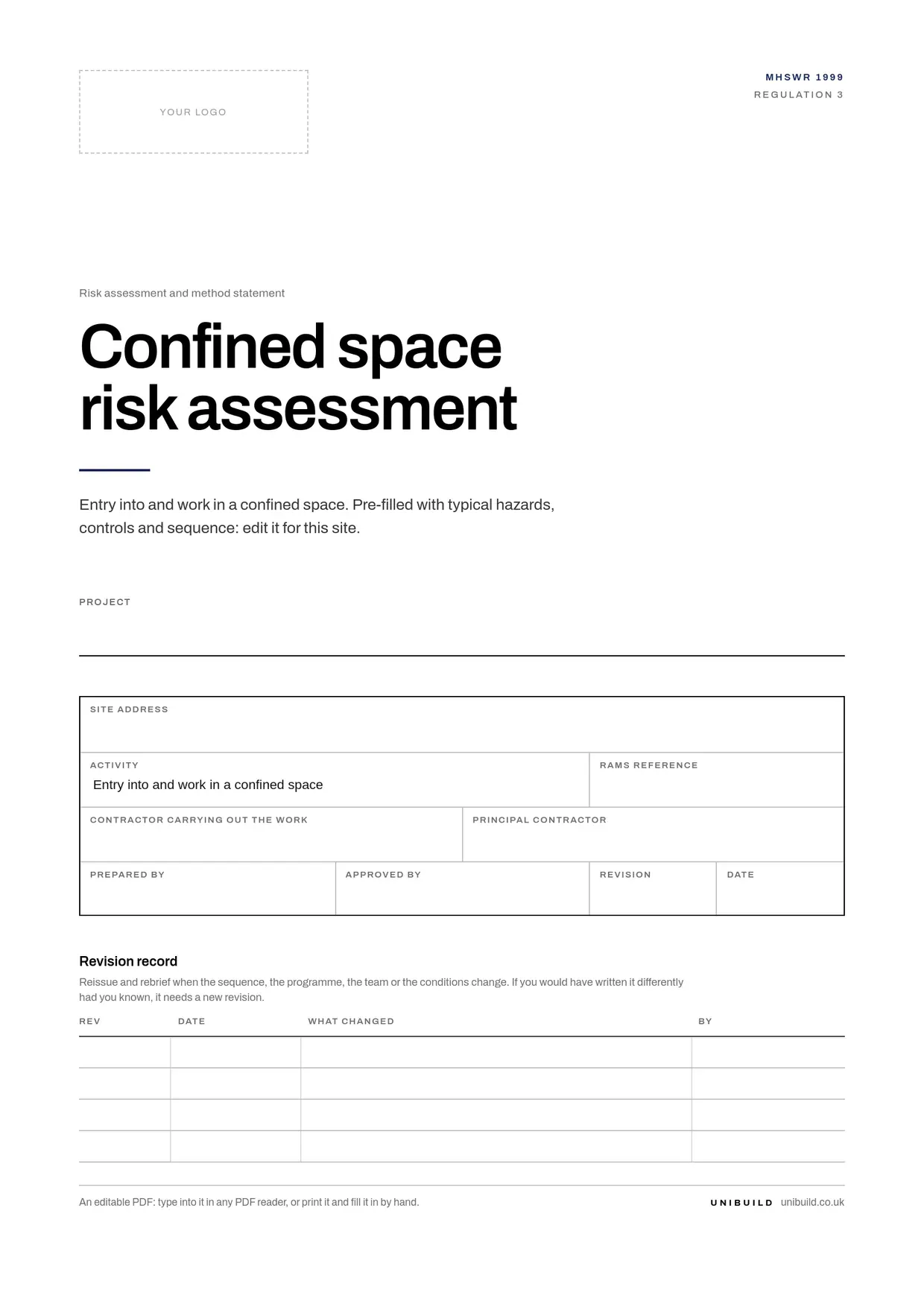
A confined space risk assessment, already filled in with the hazards, controls and entry sequence for manholes, chambers, tanks and voids, with a gas reading log. Edit it for your site, then brief it.
- Law
- Confined Spaces Regulations 1997
- Rescue
- In place before anyone enters
- Format
- Editable PDF and Word
- Cost
- Free, always
What is a confined space risk assessment?
A confined space risk assessment decides whether anyone needs to enter the space, and if so, how they go in, work and come out safely. It is the assessment required by regulation 3 of the Management of Health and Safety at Work Regulations 1999, applied to the space and the task.
A confined space is an enclosed or largely enclosed place with a reasonably foreseeable specified risk. Those risks are fire or explosion, loss of consciousness from heat, gas, fume, vapour or lack of oxygen, drowning, and entrapment by a free-flowing solid. A cramped void without them is not a confined space under the Regulations.
The Confined Spaces Regulations 1997 then set three duties in order. Avoid entry if the work can be done another way. If entry cannot be avoided, follow a safe system of work. Have rescue arrangements in place before anyone goes in, without relying on the emergency services alone.
Confined space hazards and controls
15 hazards, rated before and after controlsThe significant hazards when entering manholes, chambers, tanks, ducts, voids and deep excavations, with the controls a reviewer expects to see. Delete what does not apply and add what your site has.
Lack of oxygen
Entrants in chambers, tanks, sewers, ducts and deep excavations, often with no warning.
- Atmosphere tested from outside before entry with a calibrated detector, oxygen first, at the top, middle and bottom.
- Personal gas monitor worn by each entrant and the air monitored continuously while anyone is inside.
- Forced ventilation where needed; oxygen never added to "sweeten" the air.
BeforeHigh 15AfterMedium 5
Toxic gases
Entrants exposed to hydrogen sulphide in sewers and chambers, or carbon monoxide from engine exhaust.
- Toxic gases tested before entry and monitored throughout; everyone leaves at once if an alarm sounds.
- No petrol engines in the space; generators, pumps and plant exhaust kept well away from the entrance and downwind.
- Breathing apparatus where the air cannot be made safe to breathe, worn only by people trained in it.
BeforeHigh 15AfterMedium 5
Flammable gas, fire and explosion
Entrants and the top person, from methane, solvent vapour or leaking gas.
- Flammable gas tested as %LEL before entry and monitored throughout, with entry stopped on alarm.
- Lighting, radios and tools certified for explosive atmospheres where flammable gas is possible.
- No smoking or naked flames; no gas cylinders inside; hot work only under a hot work permit.
BeforeMedium 10AfterMedium 5
Gas released from residues and sludge
Entrants disturbing silt, sludge or residues that hold trapped gas.
- Residues removed or cleaned out before work where possible.
- Air retested during the work, and continuously monitored while residues are disturbed.
- Work stopped and the space left if readings change.
BeforeMedium 12AfterLow 4
Fume and vapour from the work itself
Entrants welding, cutting, painting, or using solvents, adhesives or cleaning chemicals inside the space.
- Hot work, solvents and cleaning chemicals kept out of the space where the task allows.
- Forced ventilation and continuous monitoring while the work runs; gas cylinders kept outside the space.
- Breathing apparatus where ventilation cannot keep the air safe to breathe.
BeforeHigh 15AfterMedium 5
Flooding and inflow
Entrants in sewers, chambers and tanks fed by pipes, rain or groundwater.
- Inflows isolated by blanks, stoppers or valves locked shut, and the isolation checked before entry.
- Weather and upstream flows checked before and during work; work stopped when heavy rain is forecast.
- Over-pumping arranged where flows cannot be stopped.
BeforeMedium 10AfterMedium 5
Machinery or services starting up
Entrants in plant rooms, tanks or chambers with pumps, agitators or live services.
- Electrical and mechanical isolation, locked off, with each entrant holding their own lock.
- Isolation proved before entry and stored energy released.
BeforeMedium 10AfterMedium 5
Electric shock in metal or wet spaces
Entrants using lights and tools inside metal tanks or wet chambers.
- Battery or extra low voltage lights and tools inside metal tanks and wet chambers.
- Residual current devices where needed; leads and tools checked before use.
BeforeMedium 10AfterMedium 5
Heat, exertion and fatigue
Entrants working in hot, humid or cramped spaces, or wearing breathing apparatus.
- Time inside limited and recorded on the permit, with breaks in fresh air.
- Ventilation used to cool the space; drinking water at the entrance.
- Entrants fit for the work and the equipment, with medical advice taken where needed.
BeforeMedium 9AfterMedium 6
Falls when entering or leaving
Entrants climbing ladders or step irons in shafts and manholes.
- Step irons or ladders checked before use; a secured ladder used where irons are missing or damaged.
- Entrants wear a harness on a lifeline from a tripod and winch over the opening.
BeforeMedium 12AfterLow 4
No way to raise the alarm
Entrants who cannot be seen or heard from the entrance.
- Top person at the entrance throughout, keeping watch and in contact with those inside.
- Agreed signals by voice, radio or lifeline, tested before entry; radios protected where flammable gas is possible.
- Nobody works in the space alone.
BeforeHigh 15AfterMedium 5
Rescuers overcome by the same conditions
Workmates who go in to help a collapsed entrant without protection.
- Rescue plan written and briefed before entry, with the kit set up at the entrance.
- Nobody enters to rescue without the training and breathing apparatus the plan names.
- Casualty raised by winch and lifeline from outside wherever possible.
BeforeHigh 15AfterMedium 5
Collapse of excavation sides
Entrants in deep excavations, trenches and shafts.
- Support designed and installed as the groundworks RAMS sets out, and inspected before entry.
- Spoil, plant and materials kept back from the edge.
BeforeMedium 10AfterMedium 5
Open entrance and falling objects
The public, other trades and entrants below the opening.
- Opening guarded with barriers and signs, with traffic management where it is in the road.
- Tools and materials lowered in a bag or bucket; nothing kept at the edge of the opening.
- Cover replaced or secured whenever nobody is working.
BeforeMedium 12AfterLow 4
Sewage and infection
Entrants in contact with sewage, sludge or contaminated water.
- Waterproof gloves and coveralls; cuts covered before work.
- Washing facilities at the work area; hands washed before eating, drinking or smoking.
- Anyone who feels unwell after the work tells their doctor about the sewage contact.
BeforeMedium 9AfterMedium 6
Scores are likelihood times severity on the five by five matrix in the template. They are typical ratings for this work, a starting point for your own assessment of your site.
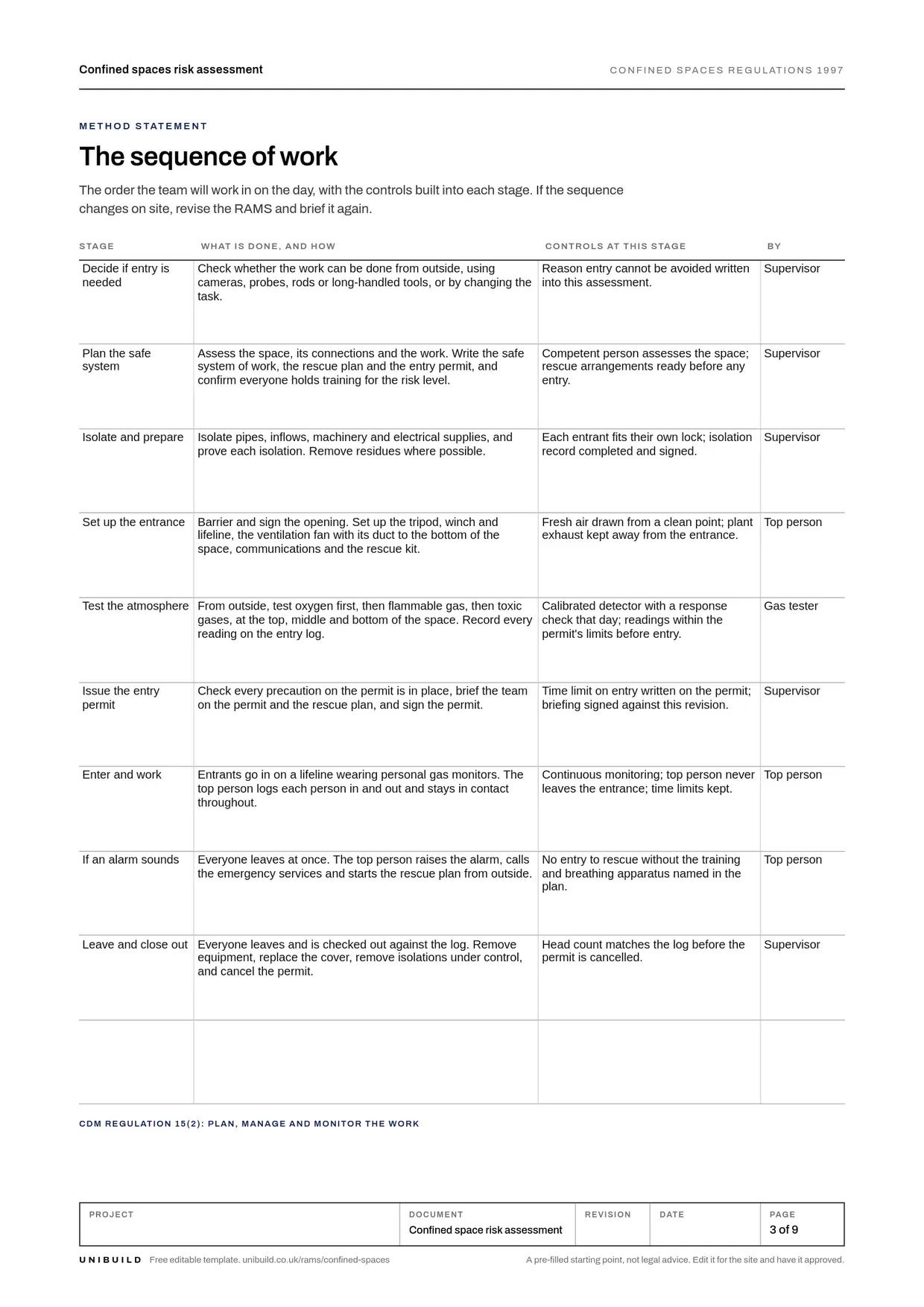
Confined space method statement: the sequence of entry
The order of work, with the controls at each stageThe order the team works in, with the controls built into each stage. If conditions or the task change, stop, revise the assessment and brief it again.
Decide if entry is needed
Check whether the work can be done from outside, using cameras, probes, rods or long-handled tools, or by changing the task.
ControlsReason entry cannot be avoided written into this assessment.
Plan the safe system
Assess the space, its connections and the work. Write the safe system of work, the rescue plan and the entry permit, and confirm everyone holds training for the risk level.
ControlsCompetent person assesses the space; rescue arrangements ready before any entry.
Isolate and prepare
Isolate pipes, inflows, machinery and electrical supplies, and prove each isolation. Remove residues where possible.
ControlsEach entrant fits their own lock; isolation record completed and signed.
Set up the entrance
Barrier and sign the opening. Set up the tripod, winch and lifeline, the ventilation fan with its duct to the bottom of the space, communications and the rescue kit.
ControlsFresh air drawn from a clean point; plant exhaust kept away from the entrance.
Test the atmosphere
From outside, test oxygen first, then flammable gas, then toxic gases, at the top, middle and bottom of the space. Record every reading on the entry log.
ControlsCalibrated detector with a response check that day; readings within the permit's limits before entry.
Issue the entry permit
Check every precaution on the permit is in place, brief the team on the permit and the rescue plan, and sign the permit.
ControlsTime limit on entry written on the permit; briefing signed against this revision.
Enter and work
Entrants go in on a lifeline wearing personal gas monitors. The top person logs each person in and out and stays in contact throughout.
ControlsContinuous monitoring; top person never leaves the entrance; time limits kept.
If an alarm sounds
Everyone leaves at once. The top person raises the alarm, calls the emergency services and starts the rescue plan from outside.
ControlsNo entry to rescue without the training and breathing apparatus named in the plan.
Leave and close out
Everyone leaves and is checked out against the log. Remove equipment, replace the cover, remove isolations under control, and cancel the permit.
ControlsHead count matches the log before the permit is cancelled.
What the law asks for confined spaces
Checked against the sourceWhat counts as a confined space
Any place, such as a chamber, tank, trench or sewer, whose enclosed nature gives a reasonably foreseeable specified risk. The risks are serious injury from fire or explosion, loss of consciousness from heat, gas, fume, vapour or lack of oxygen, drowning, and entrapment by a free-flowing solid.
Confined Spaces Regulations 1997, regulation 1Who holds the duty
Employers make sure the Regulations are met for work by their employees, and so far as reasonably practicable for others under their control. Self-employed people hold the same duty for their own work.
Confined Spaces Regulations 1997, regulation 3Avoid entry
No one enters a confined space to work unless it is not reasonably practicable to achieve the purpose without entering.
Confined Spaces Regulations 1997, regulation 4(1)A safe system of work
Where entry is necessary, people enter, work and leave only under a system of work that makes the work safe from the specified risks. L101 expects it in writing.
Confined Spaces Regulations 1997, regulation 4(2)Emergency arrangements
Suitable rescue arrangements are prepared before anyone enters, with resuscitation equipment where resuscitation is a likely need. L101 adds that relying on the emergency services alone will not be sufficient.
Confined Spaces Regulations 1997, regulation 5Risk assessment
Every employer must make a suitable and sufficient assessment of the risks, and record the significant findings if they employ five or more people.
Management of Health and Safety at Work Regulations 1999, regulation 3Competence, equipment and PPE
Competence and cards
- Entrants Confined space training for the risk level of the entry: low, medium or high risk.
- Top person Trained to control entry, keep the log, stay in contact, raise the alarm and start the rescue.
- Gas tester Competent to test, read the results and act on them, with the records kept.
- Supervisor Competent person who checks each precaution, issues the permit and may stay present throughout.
- Rescue team Trained for their rescue role and practised, with refresher training set by how recently they last did it.
- Qualifications City & Guilds 6160 is widely used; it replaced the 6150 series in December 2021.
Plant and equipment
- Multi-gas detector Calibrated in date; response check each day before use.
- Tripod, winch and lifeline LOLER thorough examination in date; checked before each use.
- Ventilation fan and ducting Duct reaches the bottom of the space; intake in clean air.
- Breathing apparatus and escape sets Suited to the hazard, checked before use and within shelf life.
- Lighting, radios and tools Certified for explosive atmospheres where flammable gas is possible.
PPE
- Rescue harness with a lifeline running back to the winch outside the space.
- Personal gas monitor worn by each entrant throughout.
- Safety helmet with chin strap.
- Waterproof gloves and coveralls where sewage, sludge or residues are present.
- Safety boots or safety wellingtons with a grip sole.
Permits and plans
An entry permit for each entry, recording the isolations, gas readings, time limits and authorisations, cancelled when the work ends. A permit to work for isolations where the principal contractor or client requires one. A hot work permit for any hot work in or near the space.
Emergency and rescue
Rescue plan in place before entry: tripod, winch and lifeline set up, breathing apparatus where the plan needs it, and trained rescuers at the entrance. Emergency services called at once and given what is known about the space. First aider trained in resuscitation on site, and the nearest accident and emergency department named.
Toolbox talk: confined spaces
Read this to the team before work starts, tick each point as it is covered, and record who attended.
- Nobody goes in until the gas test is done, the readings are logged and the permit is signed.
- Smell is not a test. Lack of oxygen gives no warning, and some gases have no smell. Trust the monitor.
- Wear your personal monitor the whole time. If it alarms, everyone gets out. Do not finish the job first.
- The top person stays at the entrance until the last person is out. They do not go off for materials.
- If someone collapses inside, do not go in after them. Raise the alarm and use the winch.
- Check the isolations are in place before entry, and never remove someone else's lock.
Ask the team
- What are the gas readings that would stop entry on this job?
- Who is the top person today, and how do we contact them from inside?
- What do you do if your monitor alarms while you are inside?
What is in the confined space risk assessment template
9 pages, pre-filled and editableThe work, pre-filled
Scope, location and access, isolations and interfaces, the documents the assessment relies on, and the team with their training.
The sequence of entry
Nine stages from deciding whether entry is needed to closing out, with the controls and the person responsible at each one.
Hazards and controls
Fifteen confined space hazards rated before and after controls on a five by five matrix, with room for your own.
Entry log with gas readings
A page for the time, each person in or out, oxygen, flammable gas, hydrogen sulphide and carbon monoxide, signed by the top person.
Plant, PPE, permits and rescue
The equipment and its checks, PPE by type, the entry permit, the rescue plan and the environment section.
Briefing record
Twenty signatures against the revision, taken on the day before the work starts.
Brief it, and get it signed on the phone
On Unibuild a RAMS is written from a template, approved, then read by each operative on their phone in their own language and signed. Subcontract and agency workers sign through a link, with no app to install.
Every signature carries its date and time and prints as the last page of the RAMS PDF. Change the RAMS and it has to be signed again.
How RAMS work on UnibuildConfined space risk assessment questions
Is this confined space risk assessment template free?
What counts as a confined space on a building site?
Do you need a permit to enter a confined space?
What gases should you test for before entering a confined space?
Can you rely on the fire service for confined space rescue?
What training do you need for confined space work?
Can you work alone in a confined space?
Is a trench a confined space?
RAMS templates for other trades and hazards
All free, pre-filled and editableBy trade
- Electrical RAMSSafe isolation, live work, testing and inspection, and working near other trades.
- Scaffolding RAMSErecting, altering and dismantling tube and fitting and system scaffold, with handover and inspection.
- Roofing RAMSPitched and flat roofs, fragile surfaces, edge protection, hot work and getting materials up safely.
- Groundworks RAMSExcavations, buried services, plant, trench support and inspections at the start of each shift.
- Plumbing and heating RAMSSoldering and brazing, gas work, unvented systems, lofts and occupied homes.
- Painting and decorating RAMSAccess equipment, solvents and spray, old lead paint, dust from preparation and occupied buildings.
- Hot works and welding RAMSWelding, cutting, grinding and torch-on work: permits, fire watch, fume and gas cylinders.
By hazard
- COSHH risk assessmentHazardous substances on site: dusts, solvents, cement, resins and fume, assessed and controlled.
- Manual handling risk assessmentLifting, carrying, pushing and pulling, assessed by task, individual, load and environment.
- Working at height risk assessmentLadders, towers, MEWPs, scaffolds and roofs, chosen and controlled in the order the law sets.
- Lone working risk assessmentPeople working alone on site, in empty buildings and out of hours, with check-ins and a plan if they go quiet.
- Noise and vibration risk assessmentNoise exposure and hand-arm vibration from tools, measured against the action and limit values.
- Asbestos risk assessmentFinding asbestos before work starts, deciding whether work is licensed, and controlling non-licensed work.
- Confined space risk assessmentManholes, tanks, voids and chambers: avoiding entry, a safe system of work, gas testing and rescue.
The blank RAMS template, the RAMS review checklist and every other free form are on Free downloads.
The RAMS, read and signed
before the work starts.
Unibuild keeps every RAMS with its versions, its approvals and each operative’s signature against the revision they read, for seven years, ready for the principal contractor or an auditor.