
Lone working risk assessment template
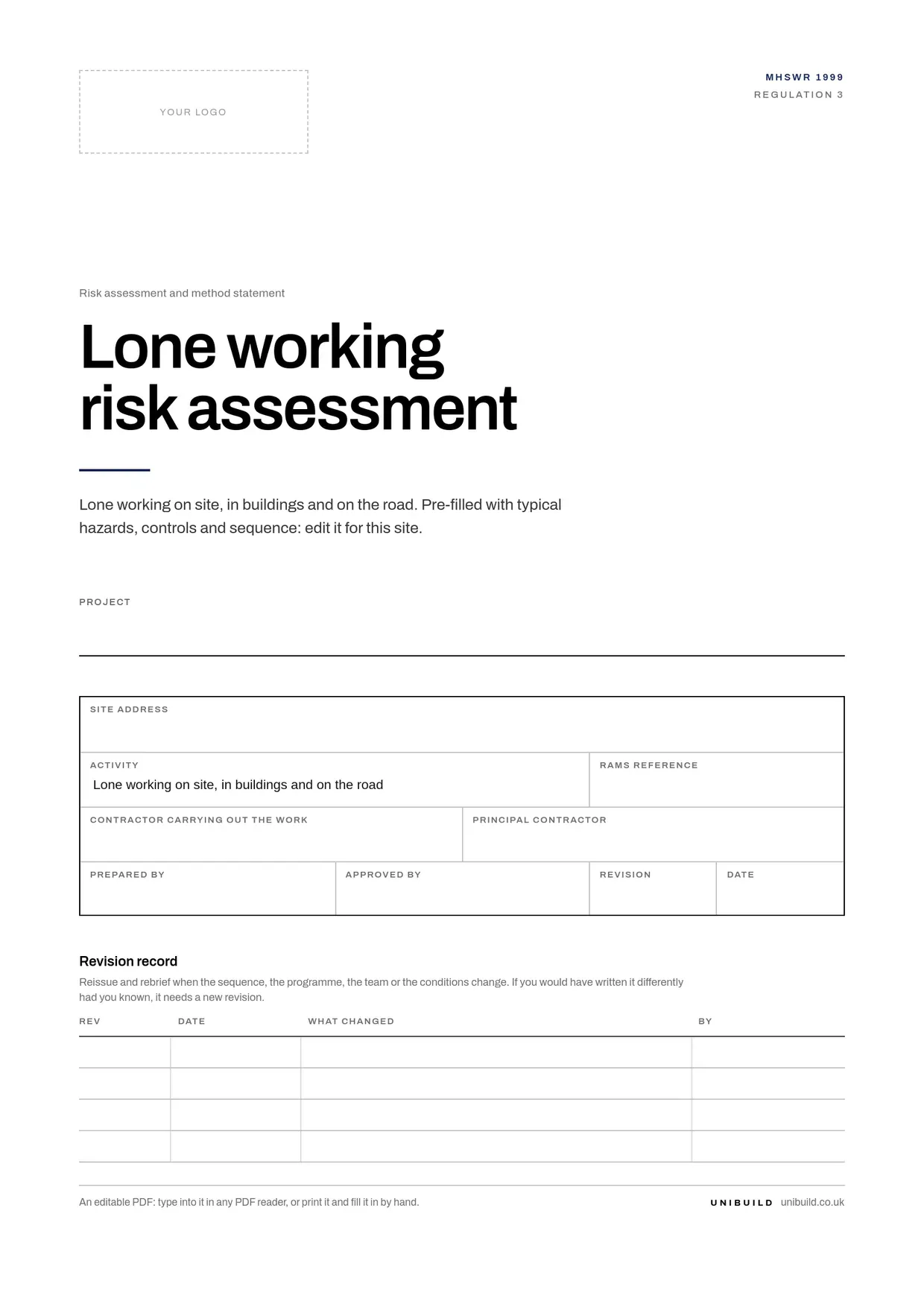
A lone working risk assessment, already filled in with the hazards, controls, check-in schedule and escalation plan for people working alone. Edit it for your job, then brief it.
- Law
- HSW Act 1974 and MHSWR 1999
- Check-ins
- Set by your risk assessment
- Format
- Editable PDF and Word
- Cost
- Free, always
What is a lone working risk assessment?
A lone working risk assessment looks at work done by someone without close or direct supervision, and sets the controls, check-ins and emergency plan that make it safe. HSE uses that definition of a lone worker in its leaflet INDG73.
Working alone is not illegal, and it will often be safe. The law requires the risks to be dealt with before anyone works alone. The duties come from section 2 of the Health and Safety at Work etc. Act 1974 and regulation 3 of the Management Regulations 1999. HSE says a separate lone working assessment is not a legal requirement, but lone working must be covered in your risk assessment.
Some work should not be done alone at all. HSE names confined spaces, work near exposed live conductors, diving, vehicles carrying explosives and fumigation. For everything else, the assessment sets the level of supervision and how often the worker checks in.
Lone working hazards and controls
15 hazards, rated before and after controlsThe main hazards for trades working alone on site, in empty or occupied buildings, out of hours and on the road, with the controls a reviewer expects to see. Delete what does not apply and add what your job has.
Sudden illness or injury
A worker alone who collapses, falls or is hurt and cannot raise the alarm.
- Check-ins at set times, with a named contact who acts at once on a missed one.
- A phone or lone worker device that raises the alarm by hand, or by itself after a fall or no movement.
- Site address, access details and keyholder given to the contact before work starts.
BeforeHigh 15AfterMedium 8
Falls from ladders and stepladders
Maintenance engineers and trades working at height alone, with nobody to call for help after a fall.
- Lone work at height limited to short tasks from stepladders, podiums or towers chosen under the Work at Height Regulations.
- No lone work where a fall arrest harness is the protection, since a rescue needs someone else there.
- A check-in before and after longer tasks at height.
BeforeHigh 15AfterMedium 10
Violence and aggression
Workers in occupied homes, empty buildings or out of hours who meet angry occupants, intruders or the public.
- Known risks at an address checked and shared before the visit, with two-person visits where there is a history.
- Personal safety and conflict resolution training; the worker leaves if a situation feels unsafe, and is backed for it.
- A discreet alarm on the phone or device; every incident reported and the worker supported afterwards.
BeforeMedium 12AfterMedium 8
Work near exposed live conductors
Electricians testing or fault finding on live equipment, where help may be needed at once.
- Dead working by default; live work only where the conditions in regulation 14 are met.
- A second person trained to recognise danger and give help, where their presence can prevent injury, as HSE HSR25 advises.
- Insulated tools, barriers and a controlled work area.
BeforeHigh 15AfterMedium 5
Confined spaces
Anyone entering a chamber, tank, void or manhole, where gas, fumes or a fall can overcome them.
- No lone entry. Entry avoided where the work can be done from outside.
- Where entry is needed, a safe system of work with a person outside, gas monitoring and rescue arrangements in place first.
BeforeHigh 15AfterMedium 5
Loads too heavy for one person
A lone worker lifting or carrying items that need a second pair of hands or a lifting aid.
- Heavy items moved when others are present, or with trolleys and lifting aids left on site.
- Weights known in advance, and the worker told not to attempt lifts outside the plan.
BeforeMedium 9AfterMedium 6
Machinery and power tools used alone
Operatives running saws, drills, mixers or other machinery with no one near to isolate it.
- Guards fitted and the stop control within reach; only tasks the assessment allows done alone.
- Machinery with an entanglement risk not operated alone.
- Shorter check-in intervals while powered tools are in use.
BeforeMedium 10AfterMedium 5
Fire, smoke or being shut in
Workers in empty buildings, plant rooms or out of hours, where alarms may be off or exits locked.
- Exit routes and the fire alarm checked on arrival; exits never locked with the worker inside.
- Hot work not done alone: only under a hot work permit, with the fire watch it requires.
- Keyholder and building contact known to the worker, with a way out if locked in.
BeforeMedium 10AfterMedium 5
Darkness and out-of-hours access
Workers arriving or leaving in the dark through car parks, compounds and unlit buildings.
- Lighting checked and a torch carried; parking close to the entrance.
- Arrival and departure reported to the contact; doors secured behind the worker.
BeforeMedium 9AfterMedium 6
No phone signal or a flat battery
Workers in basements, plant rooms, rural sites and steel-framed buildings.
- Signal checked on arrival, with another method agreed for the location, such as a landline, radio or satellite device.
- Phone charged at the start, with a charger in the vehicle.
- If contact cannot be made, higher-risk tasks do not start.
BeforeMedium 12AfterMedium 8
Driving and lone travel
Engineers, drivers and delivery drivers on the road alone, including breakdowns.
- Journeys planned with breaks and realistic times, following HSE INDG382 on driving at work.
- Breakdown details and a charged phone carried; arrival and return reported to the contact.
BeforeMedium 12AfterMedium 8
Fumes and solvents in small rooms
Workers using solvents, adhesives or fuel-powered tools in enclosed rooms with poor ventilation.
- COSHH assessment for each product, with ventilation in place before work starts.
- No petrol or diesel-powered equipment used indoors.
- Shorter check-in intervals while solvents are in use.
BeforeMedium 8AfterLow 4
Medical conditions
A worker with a condition that could cause sudden incapacity, such as epilepsy or diabetes.
- Medical suitability for lone work considered, with medical advice sought where needed and held in confidence.
- Adjustments agreed with the worker, including emergency information they choose to carry.
BeforeMedium 10AfterMedium 5
Young and inexperienced workers
Apprentices, trainees and workers new to the job or the site.
- Young persons not given lone work beyond their capacity or experience, under regulation 19 of the Management Regulations.
- New workers accompanied at first, as HSE advises, until they are competent in the task.
BeforeMedium 12AfterLow 4
Stress, fatigue and isolation
Workers alone for long periods, out of hours or on long drives.
- Regular contact with the manager, and lone workers included in team briefings and updates.
- Hours planned to avoid long shifts and late finishes; concerns raised and acted on.
BeforeMedium 9AfterMedium 6
Scores are likelihood times severity on the five by five matrix in the template. They are typical ratings for this work, a starting point for your own assessment of your site.
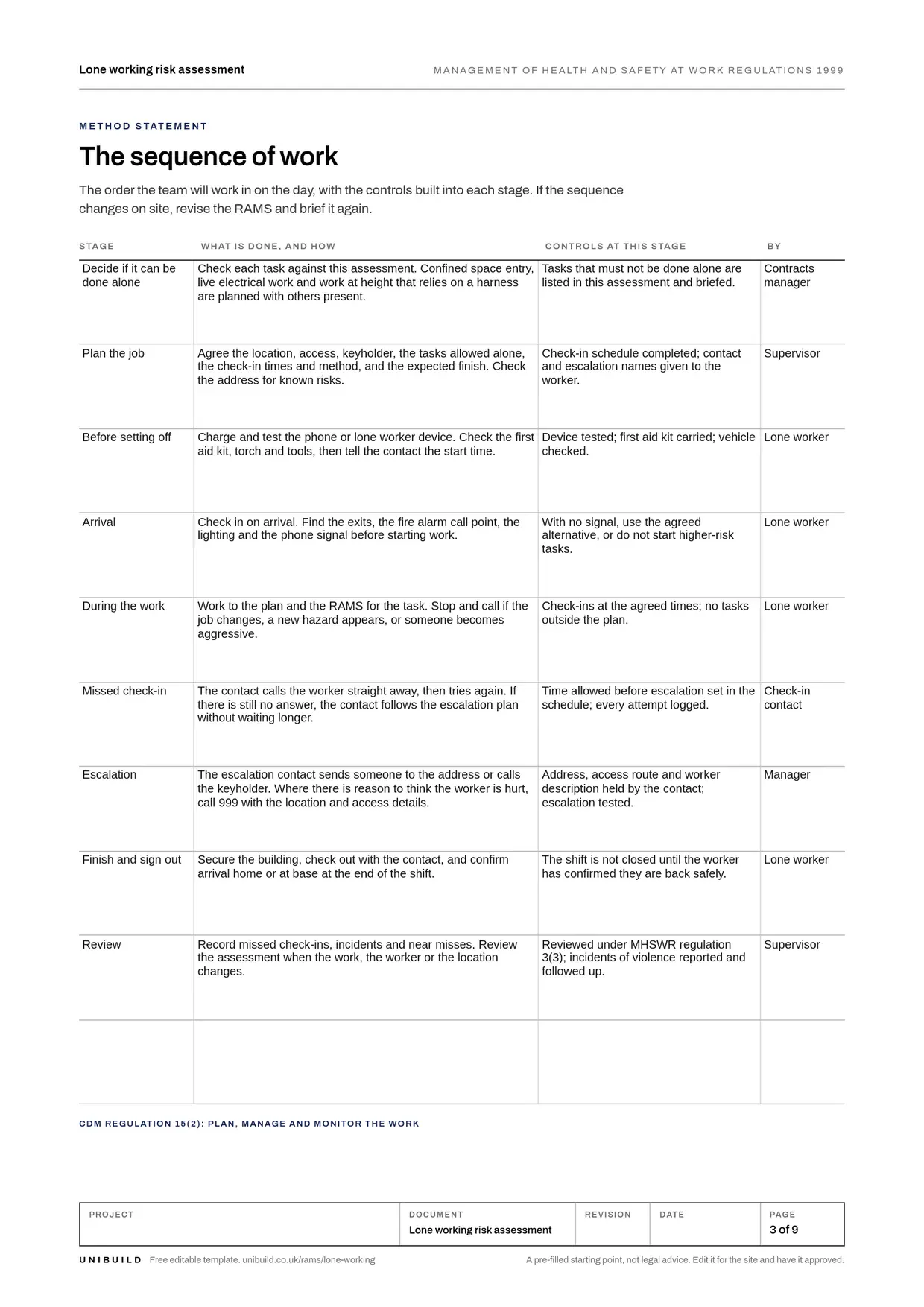
Lone working method statement: the sequence of work
The order of work, with the controls at each stageHow a lone job is planned, kept in contact and closed safely, with the controls at each stage. If the job changes on the day, stop, call and revise the plan before carrying on.
Decide if it can be done alone
Check each task against this assessment. Confined space entry, live electrical work and work at height that relies on a harness are planned with others present.
ControlsTasks that must not be done alone are listed in this assessment and briefed.
Plan the job
Agree the location, access, keyholder, the tasks allowed alone, the check-in times and method, and the expected finish. Check the address for known risks.
ControlsCheck-in schedule completed; contact and escalation names given to the worker.
Before setting off
Charge and test the phone or lone worker device. Check the first aid kit, torch and tools, then tell the contact the start time.
ControlsDevice tested; first aid kit carried; vehicle checked.
Arrival
Check in on arrival. Find the exits, the fire alarm call point, the lighting and the phone signal before starting work.
ControlsWith no signal, use the agreed alternative, or do not start higher-risk tasks.
During the work
Work to the plan and the RAMS for the task. Stop and call if the job changes, a new hazard appears, or someone becomes aggressive.
ControlsCheck-ins at the agreed times; no tasks outside the plan.
Missed check-in
The contact calls the worker straight away, then tries again. If there is still no answer, the contact follows the escalation plan without waiting longer.
ControlsTime allowed before escalation set in the schedule; every attempt logged.
Escalation
The escalation contact sends someone to the address or calls the keyholder. Where there is reason to think the worker is hurt, call 999 with the location and access details.
ControlsAddress, access route and worker description held by the contact; escalation tested.
Finish and sign out
Secure the building, check out with the contact, and confirm arrival home or at base at the end of the shift.
ControlsThe shift is not closed until the worker has confirmed they are back safely.
Review
Record missed check-ins, incidents and near misses. Review the assessment when the work, the worker or the location changes.
ControlsReviewed under MHSWR regulation 3(3); incidents of violence reported and followed up.
What the law asks for lone working
Checked against the sourceDuty to every employee
Employers ensure the health, safety and welfare of employees so far as is reasonably practicable. That includes safe systems of work, and the information, training and supervision needed. It applies to people working alone.
Health and Safety at Work etc. Act 1974, section 2Risk assessment
A suitable and sufficient assessment of the risks, with the significant findings recorded where there are five or more employees. HSE says lone working belongs in the general assessment rather than a separate one.
Management of Health and Safety at Work Regulations 1999, regulation 3Emergency procedures
Employers set up procedures for serious and imminent danger. For a lone worker, that means how they raise the alarm, and how the business responds when they do or when they go quiet.
Management of Health and Safety at Work Regulations 1999, regulation 8Young persons
A young person is not given work beyond their physical or psychological capacity, or with accident risks they cannot recognise through lack of experience. The exception is training under a competent person, with the risk reduced as far as reasonably practicable.
Management of Health and Safety at Work Regulations 1999, regulation 19Confined spaces
No one enters a confined space if the work can reasonably be done another way. Entry is under a safe system of work, with rescue arrangements prepared beforehand. HSE says a supervisor and someone dedicated to rescue may need to be there.
Confined Spaces Regulations 1997, regulations 4 and 5Live electrical work
Work on or near live conductors is allowed only when it is unreasonable for them to be dead and suitable precautions are taken. HSE guidance lists accompaniment by a trained person among those precautions.
Electricity at Work Regulations 1989, regulation 14Competence, equipment and PPE
Competence and cards
- Lone worker Experienced in the task and the location, trained in this procedure and any device used, and able to recognise when to stop.
- Check-in contact A named person who holds the schedule and the worker's location, and acts at once on a missed check-in.
- Escalation contact A manager able to send help or call the emergency services, available for the whole shift.
- First aid Lone workers trained in first aid where the assessment shows a need, including treating themselves.
- Personal safety Conflict resolution training for anyone visiting occupied homes or working where the public have access.
Plant and equipment
- Mobile phone Charged at the start of the shift; signal checked on arrival.
- Lone worker device or app Tested each shift; alarm, fall and no-movement alerts checked.
- Radio or satellite device For locations with no mobile signal; battery and channel checked.
- Personal first aid kit Carried by the worker; contents checked and restocked.
- Torch Carried and charged; site lighting checked on arrival.
- Vehicle Daily walk-round check; fuel, phone charger and breakdown details carried.
PPE
- Safety boots on site and in plant rooms.
- High-visibility clothing on site and at the roadside.
- Safety helmet on site and wherever there is a risk of head injury.
- Gloves suited to the task.
- Weather clothing for outdoor and rural work, so a delay in help does not lead to cold injury.
Permits and plans
A permit to work where the client or principal contractor requires one, for example in plant rooms or occupied premises. Confined space entry and live electrical work under their own permits, never alone. Keys and alarm codes agreed with the building manager in advance.
Emergency and rescue
A missed check-in is escalated within the time set in the schedule. If injury is likely, call 999 with the address, access route and keyholder. The worker carries a first aid kit. Physical violence that causes a reportable injury is reported under RIDDOR.
Toolbox talk: working alone
Read this to the team before work starts, tick each point as it is covered, and record who attended.
- Before you start, find the way out, the fire alarm and whether your phone has a signal.
- Check in at the times on the schedule. If you are running late, call before the time, not after.
- If you miss a check-in, your contact calls twice, then sends someone. Expect that every time.
- No confined spaces, no live working and no harness work on your own. Those need someone with you.
- If someone becomes aggressive, leave. The work can wait, and the decision will be backed.
- If the job turns out different from the plan, stop and call before carrying on.
Ask the team
- Who is your check-in contact today, and what is their number?
- What will you do if your phone has no signal when you arrive?
- Which tasks on this job are you not to do alone?
What is in the lone working risk assessment template
9 pages, pre-filled and editableThe work, pre-filled
Scope, location and access, interfaces with occupants and other trades, the documents relied on, and the worker.
The sequence of work
Nine stages from deciding whether the task can be done alone to signing out and review, with the person responsible.
Hazards and controls
Fifteen lone working hazards rated before and after controls on a five by five matrix, with room for your own.
Equipment, PPE and permits
Phones, devices, first aid kit and their checks, PPE by type, and the work that needs a permit and a second person.
Check-in schedule and contacts
A page for each shift: time, method, who checks, what happens if a check-in is missed, and who is called next.
Briefing record
Twenty signatures against the revision, taken on the day before the work starts.
Brief it, and get it signed on the phone
On Unibuild a RAMS is written from a template, approved, then read by each operative on their phone in their own language and signed. Subcontract and agency workers sign through a link, with no app to install.
Every signature carries its date and time and prints as the last page of the RAMS PDF. Change the RAMS and it has to be signed again.
How RAMS work on UnibuildLone working risk assessment questions
Is this lone working risk assessment template free?
Is lone working illegal?
Do I need a separate lone worker risk assessment?
What work should never be done alone?
How often should a lone worker check in?
What happens if a lone worker misses a check-in?
Can a young person work alone?
Do lone workers need first aid training?
RAMS templates for other trades and hazards
All free, pre-filled and editableBy trade
- Electrical RAMSSafe isolation, live work, testing and inspection, and working near other trades.
- Scaffolding RAMSErecting, altering and dismantling tube and fitting and system scaffold, with handover and inspection.
- Roofing RAMSPitched and flat roofs, fragile surfaces, edge protection, hot work and getting materials up safely.
- Groundworks RAMSExcavations, buried services, plant, trench support and inspections at the start of each shift.
- Plumbing and heating RAMSSoldering and brazing, gas work, unvented systems, lofts and occupied homes.
- Painting and decorating RAMSAccess equipment, solvents and spray, old lead paint, dust from preparation and occupied buildings.
- Hot works and welding RAMSWelding, cutting, grinding and torch-on work: permits, fire watch, fume and gas cylinders.
By hazard
- COSHH risk assessmentHazardous substances on site: dusts, solvents, cement, resins and fume, assessed and controlled.
- Manual handling risk assessmentLifting, carrying, pushing and pulling, assessed by task, individual, load and environment.
- Working at height risk assessmentLadders, towers, MEWPs, scaffolds and roofs, chosen and controlled in the order the law sets.
- Lone working risk assessmentPeople working alone on site, in empty buildings and out of hours, with check-ins and a plan if they go quiet.
- Noise and vibration risk assessmentNoise exposure and hand-arm vibration from tools, measured against the action and limit values.
- Asbestos risk assessmentFinding asbestos before work starts, deciding whether work is licensed, and controlling non-licensed work.
- Confined space risk assessmentManholes, tanks, voids and chambers: avoiding entry, a safe system of work, gas testing and rescue.
The blank RAMS template, the RAMS review checklist and every other free form are on Free downloads.
The RAMS, read and signed
before the work starts.
Unibuild keeps every RAMS with its versions, its approvals and each operative’s signature against the revision they read, for seven years, ready for the principal contractor or an auditor.