Form · MHSWR regulation 3
RAMS template
Risk assessment and method statement for one activity: the sequence of work, a five by five risk matrix, PPE, permits, rescue, and a briefing record signed against the revision.

UK-built · CDM · CIS · MTD
A vehicle check sheet records the driver’s walkaround check before each journey, and any defect found. This one covers a week per sheet for a van or company car, as an editable PDF and a Word document, free to use and reuse.
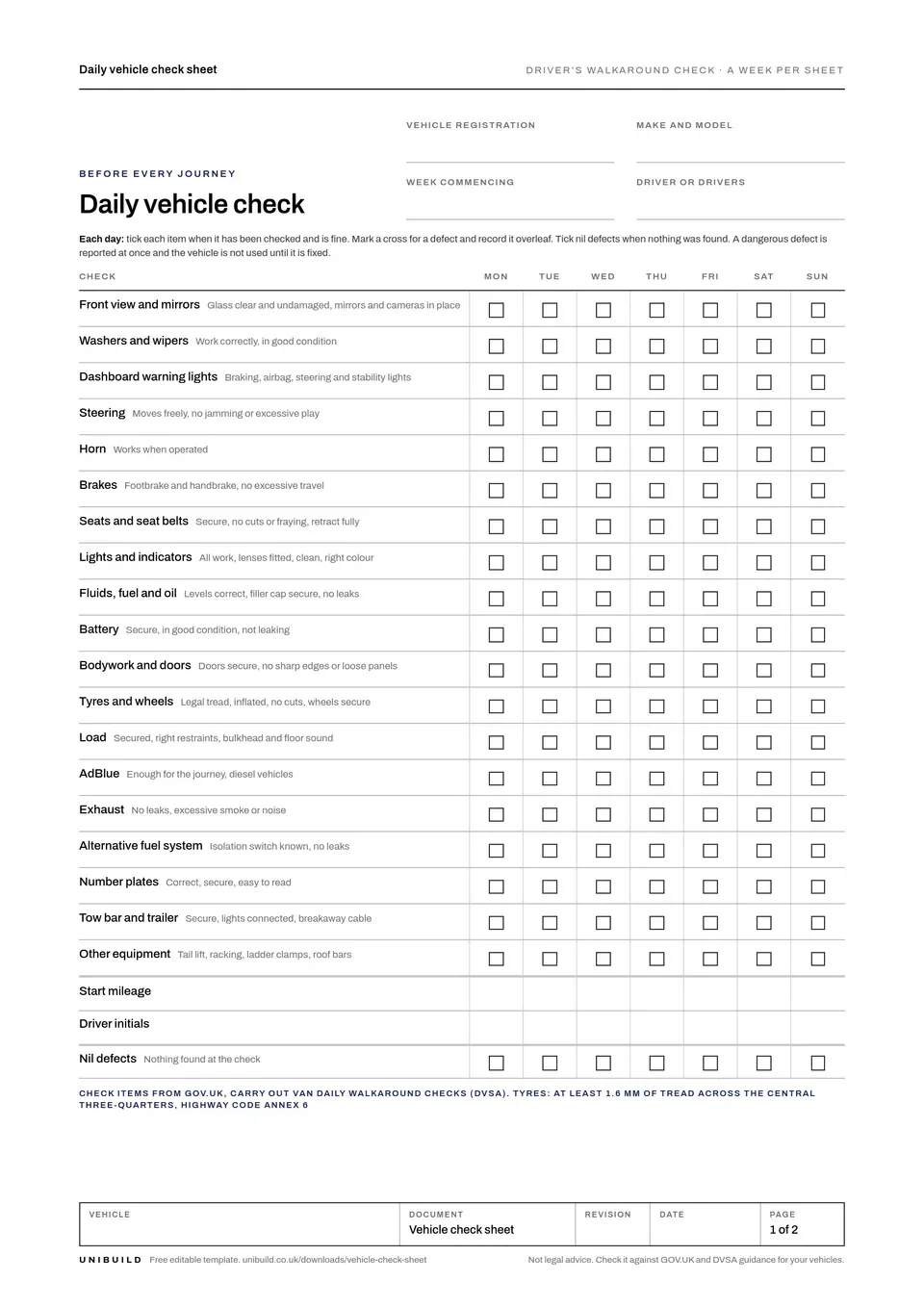
The items GOV.UK and DVSA list for a van walkaround check, with a column for each day. They run from mirrors, wipers and warning lights to tyres, load, AdBlue, number plates and any tow bar.
The start mileage and the driver’s initials each day, and a nil defects box, so the sheet shows the check was done even when nothing was wrong.
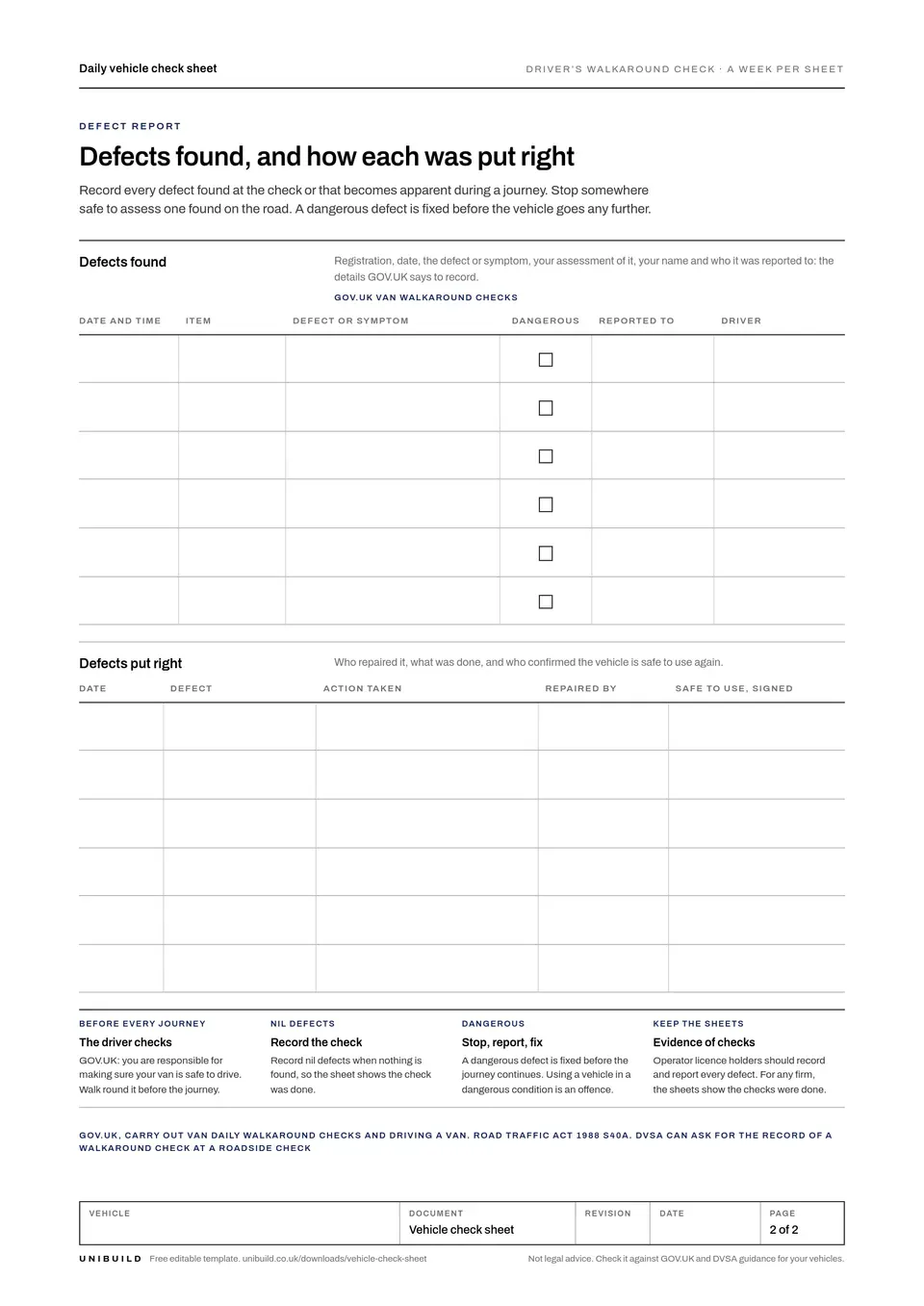
Each defect found at the check or on the road. It records the date and time, the item, the defect or symptom, whether it is dangerous, who it was told to and the driver.
What was done about each defect, who repaired it, and who signed the vehicle back as safe to use.
GOV.UK guidance tells van drivers they are responsible for making sure the van is safe to drive, and to carry out a walkaround check before the journey.
GOV.UK, Carry out van daily walkaround checksA driver for a business with a goods vehicle operator licence should record and report every defect found at the check or during the journey. Nil defects are recorded too. DVSA can ask for the record at a roadside check.
GOV.UK, Carry out van daily walkaround checksA dangerous defect must be fixed before the journey continues. Using a vehicle in a dangerous condition, or causing or permitting someone else to, is an offence. GOV.UK gives fines of up to £2,500 and 3 penalty points for a van.
Road Traffic Act 1988, section 40A, and GOV.UK, Driving a vanCars, light vans and light trailers must have at least 1.6 mm of tread across the central three-quarters of the tread and around the whole circumference. Each unsafe tyre can bring 3 penalty points.
The Highway Code, annex 6, and GOV.UKHealth and safety law applies to work on the road in the same way as it does on a fixed site. Employers must manage the risks to people who drive for work, including making sure vehicles are safe.
HSE, Driving and riding safely for workKeep it in the cab. The driver ticks each item before the first journey of the day, adds the mileage and initials, and ticks nil defects when nothing was found.
Anything marked as a defect goes on the back and is reported straight away. A dangerous defect means the vehicle stays put until it is fixed.
The repair and the sign-off go on the same sheet, so the record runs from fault to fix. The periodic office inspection is the vehicle inspection checklist, and services and repairs go in the vehicle maintenance log.
Risk assessment and method statement for one activity: the sequence of work, a five by five risk matrix, PPE, permits, rescue, and a briefing record signed against the revision.
How one activity on one site will be carried out. Two pages of sequence with the controls at each stage, then plant, PPE, permits, rescue and a briefing record.
One hazardous substance: its hazards from the data sheet, who is exposed and how, controls in regulation 7 order, PPE and RPE, storage, spills, first aid, monitoring and review.
In Unibuild’s fleet module, drivers do the daily check in your own staff app and the office inspects on the portal, each on its own tab. Defects arrive with photographs and video, and MOT, tax, insurance and service dates are reminded by email and app notification.