Free toolbox talk · Eye protection

Eye protection toolbox talk

A toolbox talk on eye protection, written to be read aloud in about six minutes: the jobs that throw things at eyes, glasses, goggles and face shields, the markings, wearing it with other PPE, looking after it, and first aid when something gets in an eye. The last page is the attendance record.

PDF · 3 pages · 209 KB · Word 41 KB · Free to use and reuse · Terms

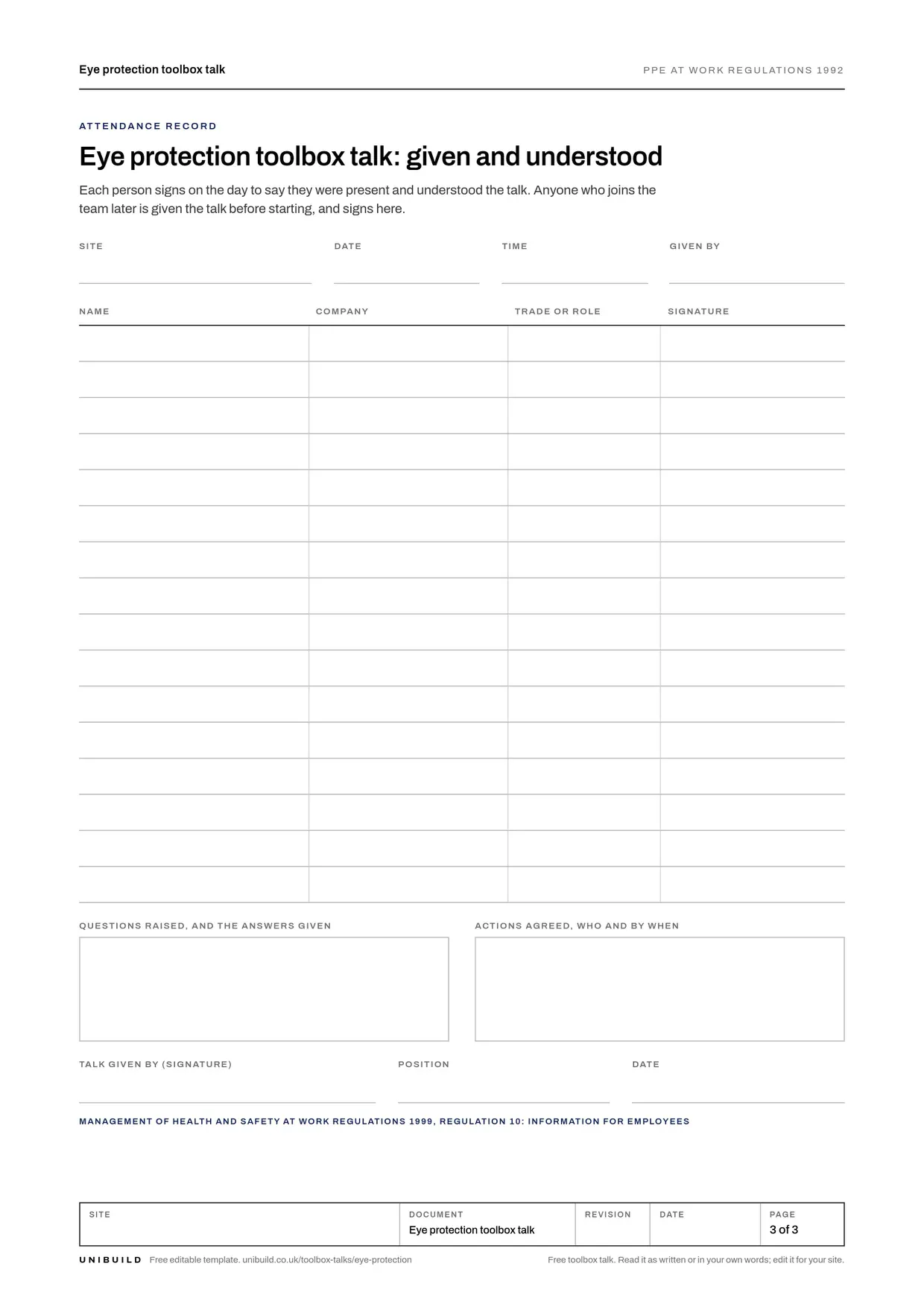
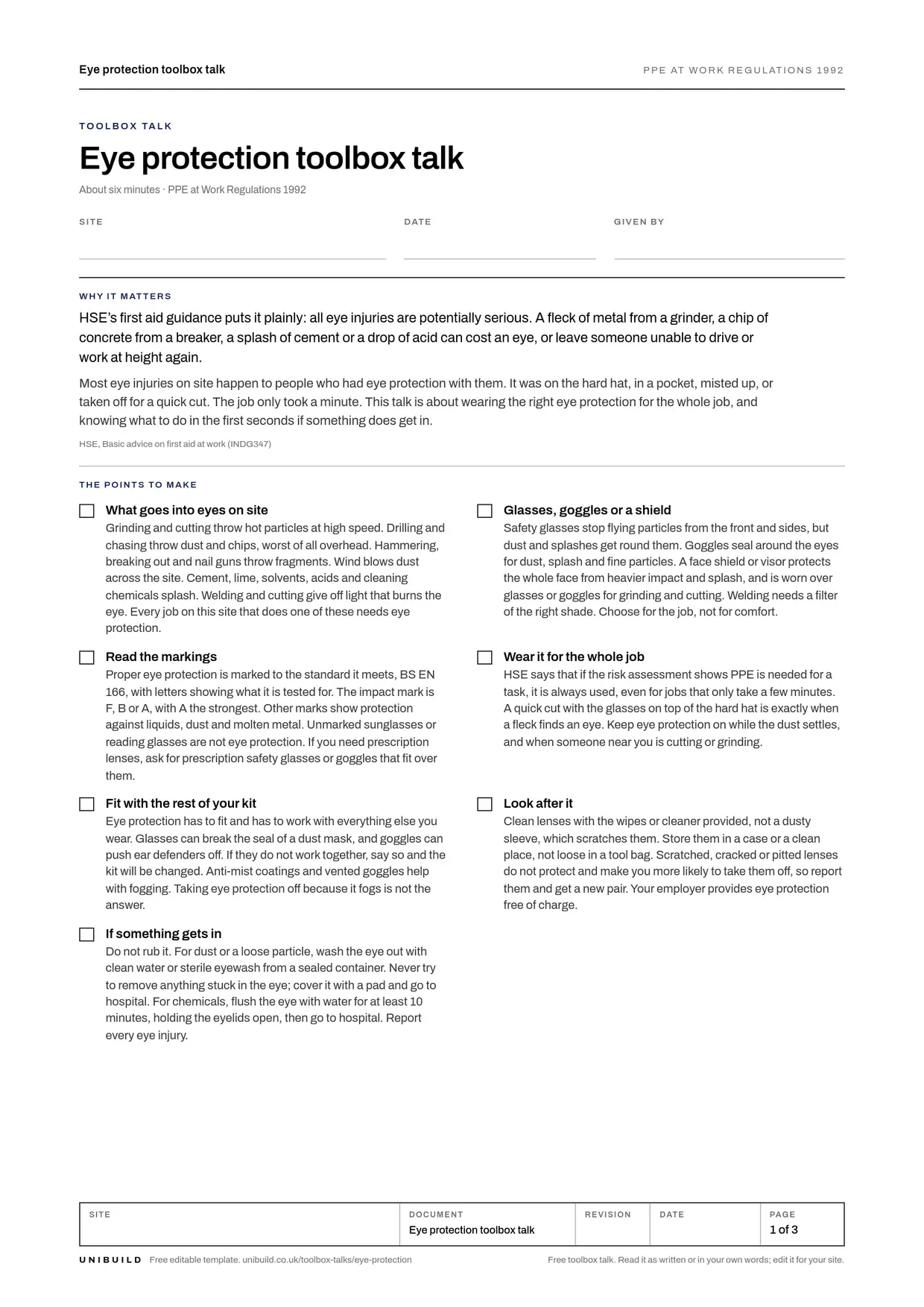
Attendance record page of the free eye protection toolbox talk from Unibuild, where each person signs to say they were given the talk and understood itFront page of the free eye protection toolbox talk from Unibuild
Law
PPE at Work Regulations 1992
Time to deliver
About six minutes
Format
PDF and Word, with a sign-off sheet
Cost
Free, always

What this toolbox talk covers

This talk is for anyone whose work can put something in an eye: cutting and grinding, drilling overhead, chasing and breaking out, hammering, nail guns, wire brushing, spraying, mixing cement and handling chemicals. It takes about six minutes to give and covers the hazards, which kind of eye protection suits which job, the markings, fit and wearing it with other kit, looking after it, and what to do when something does get in.

It is written to be read aloud, with the points in the order a supervisor makes them, short lists of do and do not, and questions about the jobs on this site. The last page is the record: who gave it, who heard it and what was raised.

The PPE toolbox talk covers the rest of the kit, and the power tools risk assessment holds the controls for the tools that throw the most.

Checked against HSE guidance and legislation.gov.uk on .

Toolbox talk · About six minutes

Eye protection: the talk

Read it as written or in your own words. Tick each point as you make it. Stop for the questions.

Why it matters

HSE’s first aid guidance puts it plainly: all eye injuries are potentially serious. A fleck of metal from a grinder, a chip of concrete from a breaker, a splash of cement or a drop of acid can cost an eye, or leave someone unable to drive or work at height again.

Most eye injuries on site happen to people who had eye protection with them. It was on the hard hat, in a pocket, misted up, or taken off for a quick cut. The job only took a minute. This talk is about wearing the right eye protection for the whole job, and knowing what to do in the first seconds if something does get in.

HSE, Basic advice on first aid at work (INDG347)

The points to make

What goes into eyes on site

Grinding and cutting throw hot particles at high speed. Drilling and chasing throw dust and chips, worst of all overhead. Hammering, breaking out and nail guns throw fragments. Wind blows dust across the site. Cement, lime, solvents, acids and cleaning chemicals splash. Welding and cutting give off light that burns the eye. Every job on this site that does one of these needs eye protection.

Glasses, goggles or a shield

Safety glasses stop flying particles from the front and sides, but dust and splashes get round them. Goggles seal around the eyes for dust, splash and fine particles. A face shield or visor protects the whole face from heavier impact and splash, and is worn over glasses or goggles for grinding and cutting. Welding needs a filter of the right shade. Choose for the job, not for comfort.

Read the markings

Proper eye protection is marked to the standard it meets, BS EN 166, with letters showing what it is tested for. The impact mark is F, B or A, with A the strongest. Other marks show protection against liquids, dust and molten metal. Unmarked sunglasses or reading glasses are not eye protection. If you need prescription lenses, ask for prescription safety glasses or goggles that fit over them.

Wear it for the whole job

HSE says that if the risk assessment shows PPE is needed for a task, it is always used, even for jobs that only take a few minutes. A quick cut with the glasses on top of the hard hat is exactly when a fleck finds an eye. Keep eye protection on while the dust settles, and when someone near you is cutting or grinding.

Fit with the rest of your kit

Eye protection has to fit and has to work with everything else you wear. Glasses can break the seal of a dust mask, and goggles can push ear defenders off. If they do not work together, say so and the kit will be changed. Anti-mist coatings and vented goggles help with fogging. Taking eye protection off because it fogs is not the answer.

Look after it

Clean lenses with the wipes or cleaner provided, not a dusty sleeve, which scratches them. Store them in a case or a clean place, not loose in a tool bag. Scratched, cracked or pitted lenses do not protect and make you more likely to take them off, so report them and get a new pair. Your employer provides eye protection free of charge.

If something gets in

Do not rub it. For dust or a loose particle, wash the eye out with clean water or sterile eyewash from a sealed container. Never try to remove anything stuck in the eye; cover it with a pad and go to hospital. For chemicals, flush the eye with water for at least 10 minutes, holding the eyelids open, then go to hospital. Report every eye injury.

Do

  • Wear the eye protection the job needs from the first cut to the last.
  • Use goggles for dust and splash, and a face shield over them for grinding and cutting.
  • Check it fits and works with your mask, hard hat and ear defenders.
  • Keep lenses clean and get scratched or damaged eye protection replaced.
  • Know where the eyewash is before you start, and check it is in date.
  • Wash out an eye with clean water straight away and report the injury.

Do not

  • Do not push eye protection up onto your hard hat for a quick job.
  • Do not rely on safety glasses against dust, cement or chemical splash.
  • Do not use sunglasses or ordinary glasses as eye protection.
  • Do not rub an eye with something in it, or try to remove anything stuck in it.
  • Do not cut or grind next to someone who is not wearing eye protection.

Ask the team

  • Which jobs on this site this week could put something in an eye?
  • Is the eye protection you have right for what you are doing today?
  • Does your eye protection mist up or clash with your mask? What would help?
  • Where is the nearest eyewash, and is it in date?
  • What would you do if a splash of cement went in your eye right now?

To close

Nobody plans to lose an eye. It happens in the second the glasses were off, the goggles were on the hard hat, or the job was too quick to bother. You only get two eyes and no second chance with either. So match the eye protection to the job, wear it for the whole job, keep it clean and get it replaced when it is scratched. And if something does get in, wash it out straight away and tell us. We will get you to hospital.

Record it. Who gave the talk, where, when, who was there and what was raised. The last page of the sheet is the record.

In Unibuild a talk is read in each operative’s own language and signed on the phone. How toolbox talks work

The law behind this talk

Checked against the source

Provision of suitable PPE

Every employer ensures that suitable personal protective equipment is provided to workers who may be exposed to a risk to their health or safety, except where the risk is adequately controlled by other means which are equally or more effective. It is suitable only if it is appropriate for the risk and the conditions, takes account of the wearer, fits correctly and is effective without increasing overall risk.

PPE at Work Regulations 1992, regulation 4

Information, instruction and training

Where PPE is provided, the worker is given adequate and appropriate information, instruction and training to know the risks it will avoid or limit, how and when to use it, and what to do to keep it in good working order, in a form they can understand.

PPE at Work Regulations 1992, regulation 9

Use of PPE

The employer takes all reasonable steps to ensure PPE is properly used. Every worker uses the PPE provided in line with their training and instructions, and returns it to its storage after use.

PPE at Work Regulations 1992, regulation 10

What is on the sheet

3 pages, the talk and the record

The talk, over two pages

Why it matters, the points to make, do and do not, and the questions to ask, laid out to read from in the cabin or at the workface. Space at the top for the site, the date and who is giving it.

The last page, the record

The attendance record: each person's name, company and signature, the questions raised and any actions, signed off by the person who gave the talk. Type into it or print it and pass it round.

The Word version

The same talk as a Word document, so you can put your own letterhead on it, add a site photograph or change a point to match how your job is set up.

Download the talk as PDF Word versionPDF · 3 pages · 209 KB
After it is given

Delivered on the phone, signed in the room

On Unibuild a toolbox talk is picked from the library, read by each operative on their own phone in their own language and signed there and then. The record is filed against the operative, the site and the date.

A site manager sees who has had which talk, and who has not, without a sheet going round on Thursday.

How toolbox talks work on Unibuild
How long should an eye protection toolbox talk be?
About five to ten minutes. This one reads in about six if you make every point and stop for the questions. A toolbox talk is a briefing. The information, instruction and training on PPE the regulations require is recorded in the training matrix.
When is eye protection required on site?
Whenever the risk assessment shows a risk to the eyes that other controls do not remove: cutting, grinding, drilling, chasing, breaking out, hammering, nail guns, spraying, mixing cement and handling chemicals. Many principal contractors also make eye protection a site rule at all times.
What is the difference between safety glasses and goggles?
Safety glasses protect against flying particles from the front and sides. Goggles seal around the eyes and also protect against dust, liquid splash and fine particles. HSE says to choose the right combination of protection for the hazards of impact, dust, splash or molten metal.
What do the markings on safety glasses mean?
Eye protection made to BS EN 166 is marked to show what it has been tested for. The impact rating is F for low energy, B for medium and A for high energy impact, and other marks cover liquids, dust, molten metal and optical class. Check the mark suits the job.
Is eye protection needed for angle grinding?
Yes. HSE’s guidance on abrasive wheels says eye protectors are worn for all dry grinding, and a face shield over goggles or glasses is common practice for disc cutting and heavy grinding because of the speed of the particles.
Does the employer have to provide prescription safety glasses?
The employer provides suitable PPE free of charge, and it must fit the wearer. Where someone needs a prescription, that means eye protection that works for them, such as prescription safety glasses or goggles designed to fit over their own glasses.
What first aid is given for an eye injury?
HSE’s first aid advice is to wash out loose material with clean water or sterile fluid from a sealed container, not to try to remove anything embedded, and for chemicals to flush the eye for at least 10 minutes while holding the eyelids open, then cover it with a pad and send the person to hospital.
Do we have to keep a record of the talk?
There is no regulation that names toolbox talk records, but the PPE Regulations require information, instruction and training, and most principal contractors and auditors ask for the evidence. A signed attendance record with the date and the topic is that evidence. The last page of the sheet is the record.
Is this eye protection toolbox talk free?
Yes. Download it, print it, give it, edit it and put your own name on it, including on paid work and for clients, with no sign-up and no email address.
Next step

The talk given, understood
and on record.

Unibuild keeps every toolbox talk against the operative who signed it, the site and the date, for seven years, ready for the principal contractor or an auditor.

Get a quote
One figure per firm · For UK firms

Right, let’s talk numbers.

Five things about your business. We work your fee out properly and put it in writing the same working day.

What we build for you

  • Your own portalIn the browser, built around your firm
  • Your own appiOS and Android, under your name
  • Everyday AI includedHeavier AI at cost, nothing added
  • One platformEverything in one place, set up by us

Would you rather see it running first? Book a 30-minute demo

Quotation request