Free toolbox talk · COSHH

COSHH toolbox talk

A toolbox talk on hazardous substances, written to be read aloud in about seven minutes: what COSHH covers, reading the label and the data sheet, the order of controls, skin, storage, spills and washing before you eat. The last page is the attendance record.

PDF · 3 pages · 212 KB · Word 42 KB · Free to use and reuse · Terms

Law
Control of Substances Hazardous to Health Regulations 2002
Time to deliver
About seven minutes
Format
PDF and Word, with a sign-off sheet
Cost
Free, always

What this toolbox talk covers

This talk is for anyone who handles a product with a hazard symbol on it, or whose work makes dust, fume, mist or vapour: cement and mortar, adhesives and sealants, solvents and paints, cleaning chemicals, fuels, foams, and the dust from cutting, grinding and sanding. It takes about seven minutes to give and covers what COSHH means for the person doing the job, where the information is, the order the law puts controls in, and the habits that keep substances off skin and out of lungs.

It is written to be read aloud, with the points a supervisor makes in the order they make them, two short lists of do and do not, and questions to put to the team so the talk is a conversation rather than a reading. The last page is the record: who gave it, who heard it and what was raised.

COSHH covers substances bought in a tin or a bag and substances the work itself produces, such as welding fume, wood dust and silica dust. Asbestos and lead have their own regulations. The COSHH risk assessment template holds the hazards and controls this talk briefs, and the COSHH guide explains the assessment itself. Silica and construction dust has its own talk at dust and silica; give that one where cutting and grinding is the main risk.

Checked against HSE guidance and legislation.gov.uk on .

Toolbox talk · About seven minutes

COSHH: the talk

Read it as written or in your own words. Tick each point as you make it. Stop for the questions.

Why it matters

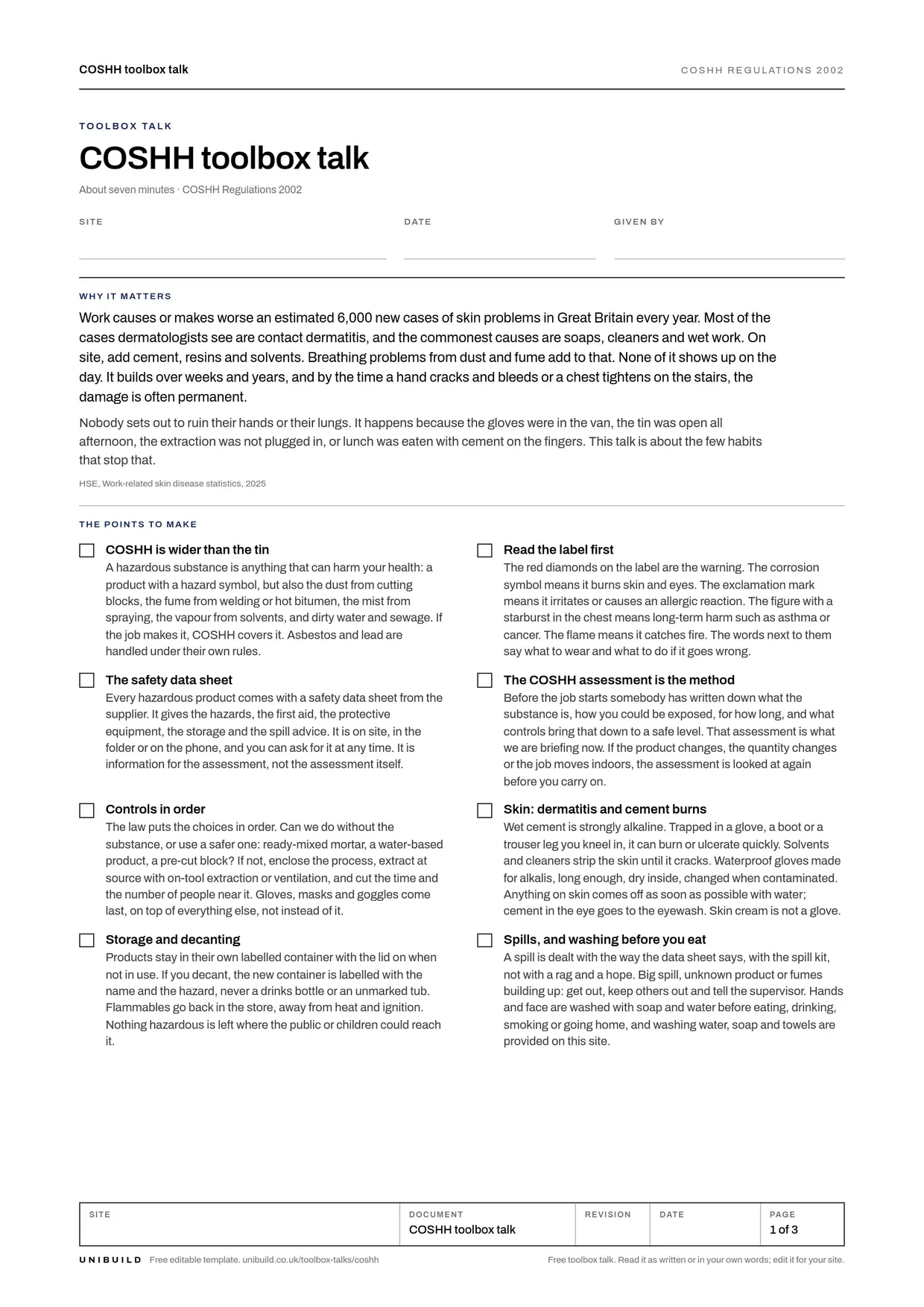
Work causes or makes worse an estimated 6,000 new cases of skin problems in Great Britain every year. Most of the cases dermatologists see are contact dermatitis, and the commonest causes are soaps, cleaners and wet work. On site, add cement, resins and solvents. Breathing problems from dust and fume add to that. None of it shows up on the day. It builds over weeks and years, and by the time a hand cracks and bleeds or a chest tightens on the stairs, the damage is often permanent.

Nobody sets out to ruin their hands or their lungs. It happens because the gloves were in the van, the tin was open all afternoon, the extraction was not plugged in, or lunch was eaten with cement on the fingers. This talk is about the few habits that stop that.

HSE, Work-related skin disease statistics, 2025

The points to make

COSHH is wider than the tin

A hazardous substance is anything that can harm your health: a product with a hazard symbol, but also the dust from cutting blocks, the fume from welding or hot bitumen, the mist from spraying, the vapour from solvents, and dirty water and sewage. If the job makes it, COSHH covers it. Asbestos and lead are handled under their own rules.

Read the label first

The red diamonds on the label are the warning. The corrosion symbol means it burns skin and eyes. The exclamation mark means it irritates or causes an allergic reaction. The figure with a starburst in the chest means long-term harm such as asthma or cancer. The flame means it catches fire. The words next to them say what to wear and what to do if it goes wrong.

The safety data sheet

Every hazardous product comes with a safety data sheet from the supplier. It gives the hazards, the first aid, the protective equipment, the storage and the spill advice. It is on site, in the folder or on the phone, and you can ask for it at any time. It is information for the assessment, not the assessment itself.

The COSHH assessment is the method

Before the job starts somebody has written down what the substance is, how you could be exposed, for how long, and what controls bring that down to a safe level. That assessment is what we are briefing now. If the product changes, the quantity changes or the job moves indoors, the assessment is looked at again before you carry on.

Controls in order

The law puts the choices in order. Can we do without the substance, or use a safer one: ready-mixed mortar, a water-based product, a pre-cut block? If not, enclose the process, extract at source with on-tool extraction or ventilation, and cut the time and the number of people near it. Gloves, masks and goggles come last, on top of everything else, not instead of it.

Skin: dermatitis and cement burns

Wet cement is strongly alkaline. Trapped in a glove, a boot or a trouser leg you kneel in, it can burn or ulcerate quickly. Solvents and cleaners strip the skin until it cracks. Waterproof gloves made for alkalis, long enough, dry inside, changed when contaminated. Anything on skin comes off as soon as possible with water; cement in the eye goes to the eyewash. Skin cream is not a glove.

Storage and decanting

Products stay in their own labelled container with the lid on when not in use. If you decant, the new container is labelled with the name and the hazard, never a drinks bottle or an unmarked tub. Flammables go back in the store, away from heat and ignition. Nothing hazardous is left where the public or children could reach it.

Spills, and washing before you eat

A spill is dealt with the way the data sheet says, with the spill kit, not with a rag and a hope. Big spill, unknown product or fumes building up: get out, keep others out and tell the supervisor. Hands and face are washed with soap and water before eating, drinking, smoking or going home, and washing water, soap and towels are provided on this site.

Do

  • Read the label and ask for the safety data sheet before using a product for the first time.
  • Use the safer product or the ready-made version where the method statement gives one.
  • Plug in and check the extraction before you start, and keep it running until the dust or fume has cleared.
  • Wear the gloves and mask named in the COSHH assessment, and change gloves that are wet or contaminated inside.
  • Wash cement, resin or chemical off skin straight away, and wash hands before eating, drinking or smoking.
  • Check your hands for redness, dryness or cracking and report it early.
  • Report leaking containers, missing labels, blocked extraction and spills the same day.

Do not

  • Do not pour any substance into a drinks bottle, food tub or unmarked container.
  • Do not kneel in wet concrete or mortar, or let it sit inside a glove or a boot.
  • Do not use solvent, thinners or diesel to clean your hands.
  • Do not eat, drink or smoke where substances are used or stored, or with unwashed hands.
  • Do not mix products together unless the data sheet and the assessment say you can.
  • Do not rely on a mask or gloves on their own when the method calls for extraction or a safer product.

Ask the team

  • Which products on this job today carry a hazard symbol, and what does each symbol mean?
  • Where are the safety data sheets and the COSHH assessments for this site?
  • What dust, fume or mist does our own work make, and what is taking it away?
  • What gloves does the assessment ask for on this task, and where are the spares?
  • If a tin went over in the store, what would you do first?

To close

Nobody wrecks their hands or their lungs on purpose. It happens because the tin was handy, the gloves were in the van, the extraction was in the other room, or lunch was eaten with cement on the fingers. The label tells you what the product does, the assessment tells you how we handle it, and washing is the last line every time. If you do not know what something is or what to wear for it, stop and ask, and we will find out together.

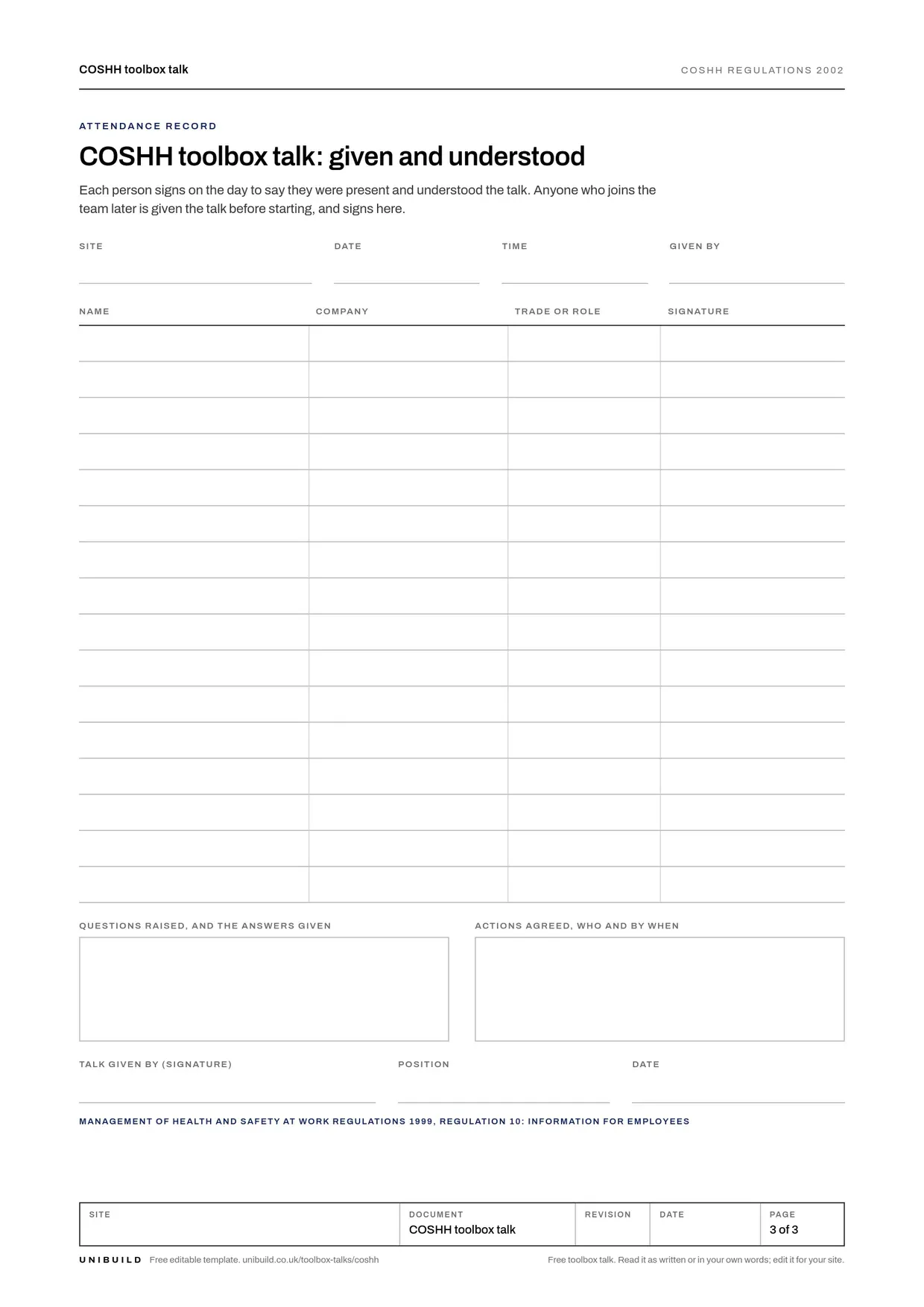
Record it. Who gave the talk, where, when, who was there and what was raised. The last page of the sheet is the record.

In Unibuild a talk is read in each operative’s own language and signed on the phone. How toolbox talks work

The law behind this talk

Checked against the source

Assess before the work starts

An employer must not carry out work liable to expose employees to a substance hazardous to health unless a suitable and sufficient assessment of the risk, and of the steps needed to meet the Regulations, has been made and those steps have been put in place. The assessment considers the hazardous properties of the substance, the supplier information including the safety data sheet, the level, type and duration of exposure, the amount involved, any workplace exposure limit and the effect of the control measures.

COSHH Regulations 2002, regulation 6

Prevent, or adequately control, in order

Exposure is prevented or, where that is not reasonably practicable, adequately controlled. Substitution is undertaken by preference, replacing the substance or process with one that eliminates or reduces the risk. Where exposure cannot be prevented, controls are applied in order of priority: the design of work processes, engineering controls and suitable equipment and materials; control at source including ventilation and organisational measures; and, where adequate control cannot be achieved by other means, suitable personal protective equipment in addition to those measures.

COSHH Regulations 2002, regulation 7

Information, instruction and training

Every employee liable to be exposed is given suitable and sufficient information, instruction and training, including the names of the substances and the risk they present, any workplace exposure limit, access to the relevant safety data sheet, the significant findings of the assessment and the precautions and actions to take. This talk is part of how that duty is met, and the record on the last page is the evidence.

COSHH Regulations 2002, regulation 12

Accidents, incidents and emergencies

Procedures, including first aid and safety drills, are prepared and tested so they can be put into effect when a spill, release or other emergency involving a hazardous substance happens. Information on the hazards and the emergency arrangements is available, and warning and communication systems are in place so that people can respond, make safe and rescue immediately.

COSHH Regulations 2002, regulation 13

What is on the sheet

3 pages, the talk and the record

The talk, over two pages

Why it matters, the points to make, do and do not, and the questions to ask, laid out to read from in the cabin or at the workface. Space at the top for the site, the date and who is giving it.

The last page, the record

The attendance record: each person's name, company and signature, the questions raised and any actions, signed off by the person who gave the talk. Type into it or print it and pass it round.

The Word version

The same talk as a Word document, so you can put your own letterhead on it, add a site photograph or change a point to match how your job is set up.

Download the talk as PDF Word versionPDF · 3 pages · 212 KB
After it is given

Delivered on the phone, signed in the room

On Unibuild a toolbox talk is picked from the library, read by each operative on their own phone in their own language and signed there and then. The record is filed against the operative, the site and the date.

A site manager sees who has had which talk, and who has not, without a sheet going round on Thursday.

How toolbox talks work on Unibuild
How long should a COSHH toolbox talk be?
About five to ten minutes. This one reads in about seven if you make every point and stop for the questions. It is a briefing on the substances on this job, not COSHH training. Training in how to use a product, a respirator or extraction is separate and is recorded in the training matrix.
What counts as a hazardous substance under COSHH?
Anything that can harm health by being breathed in, touched or swallowed: products with a hazard symbol, and also dust, fume, mist, vapour and biological agents the work produces, such as silica dust, wood dust, welding fume and sewage. Asbestos, lead and radioactive materials are covered by their own regulations, not COSHH.
Is a safety data sheet the same as a COSHH assessment?
No. The data sheet is the supplier’s information about the product. The COSHH assessment is yours: it takes that information and sets out how the product is used on this job, who could be exposed, for how long, and the controls. Regulation 6 requires the assessment before the work starts.
Why do gloves and masks come last?
Because regulation 7 puts them last. Protective equipment only protects the person wearing it, only while it fits and is worn, and fails quietly. Getting rid of the substance, swapping it, enclosing the work and extracting at source protect everyone nearby. PPE is added on top of those controls, not used instead of them.
How often should we give this talk?
The law does not set an interval. Give it when a team starts using a new product or a new process, when the COSHH assessment changes, after a spill, a skin complaint or a near miss, and as part of a rolling programme so the topic comes round every few months. Record each delivery.
Who can deliver a COSHH toolbox talk?
A supervisor, site manager or a competent member of the team who knows the products on the job and the controls in the assessment. The person giving it should be able to say where the data sheets and assessments are kept and what to do about a spill on this site. If not, they bring someone who can.
Do we have to keep a record of the talk?
There is no regulation that names toolbox talk records, but regulation 12 requires information, instruction and training, and most principal contractors and auditors ask for the evidence. A signed attendance record with the date and the topic is that evidence. The last page of the sheet is the record.
Should we give this talk or the dust and silica one?
Both, on different days. This talk covers hazardous substances in general: labels, data sheets, skin, storage and spills. The dust and silica talk goes deeper on cutting, grinding, on-tool extraction and masks. If the main risk on the job is construction dust, start with that one.
Is this COSHH toolbox talk free?
Yes. Download it, print it, give it, edit it and put your own name on it, including on paid work and for clients, with no sign-up and no email address.
Next step

The talk given, understood
and on record.

Unibuild keeps every toolbox talk against the operative who signed it, the site and the date, for seven years, ready for the principal contractor or an auditor.