
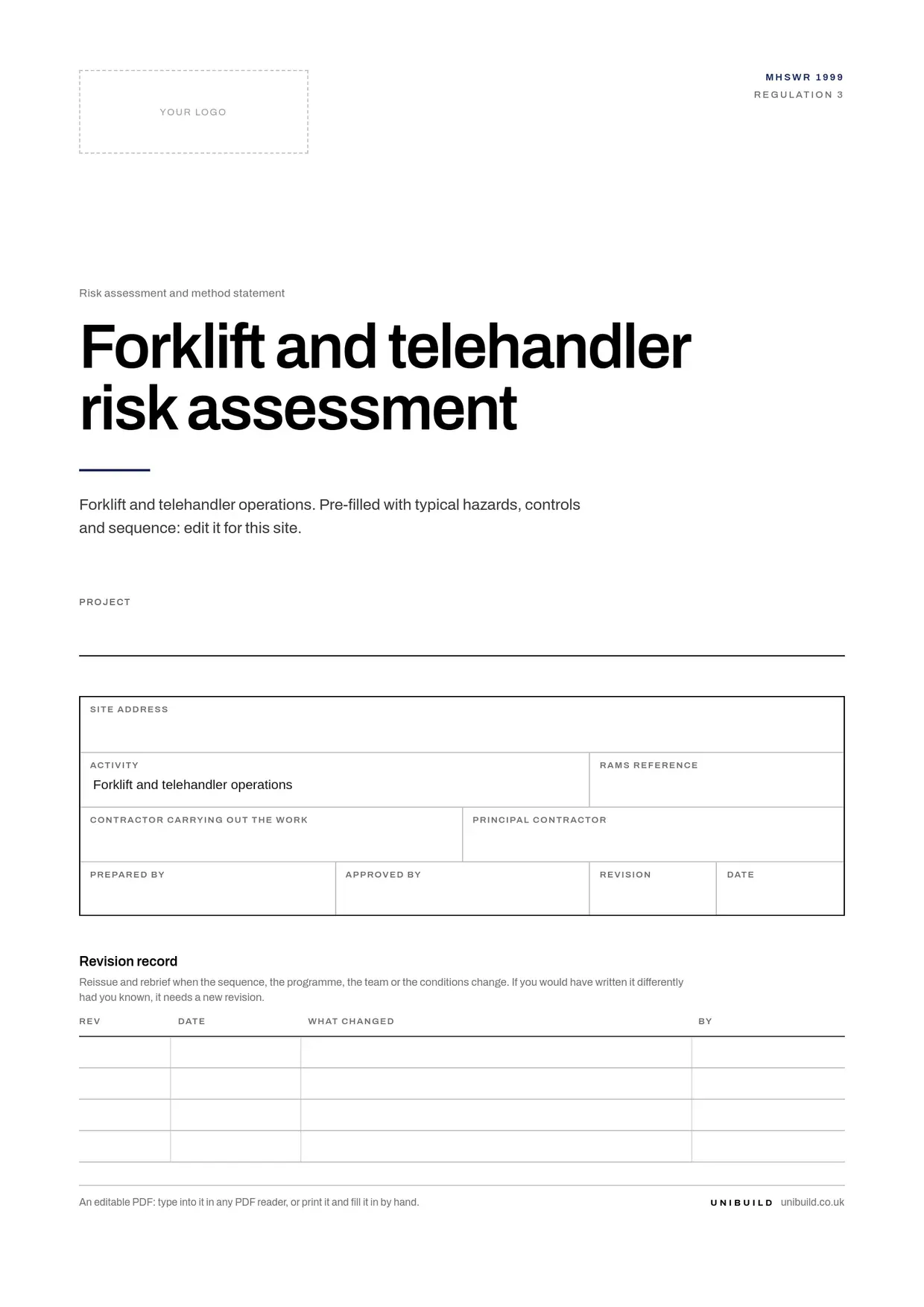
Forklift and telehandler risk assessment template
A forklift risk assessment, already filled in for forklifts and telehandlers on site and in yards, with a site route and pre-use check page. Edit it for your job, then brief it.
- Law
- PUWER 1998 and LOLER 1998
- Thorough examination
- 12 months, or 6 for people
- Format
- Editable PDF and Word
- Cost
- Free, always
What is a forklift risk assessment?
A forklift risk assessment looks at how forklifts and telehandlers are used on a site or in a yard and sets the controls that keep operators and people on foot safe. Regulation 3 of the Management Regulations 1999 requires it, and employers with five or more employees record the significant findings.
Most of the controls come from three places. PUWER 1998 requires adequate training, which HSE's L117 sets out as basic, specific job and familiarisation training. LOLER 1998 requires the lifting parts to be thoroughly examined. On construction sites, CDM 2015 requires a site organised so that, so far as is reasonably practicable, vehicles and pedestrians move without risk.
A telehandler is a lift truck with a boom, so the same assessment covers it, plus the extra risk of overturning as the boom extends. When a telehandler lifts a suspended load it is working like a crane, and that lift needs a lift plan of its own.
Checked against legislation.gov.uk and HSE guidance on .
Forklift and telehandler hazards and controls
16 hazards, rated before and after controlsA worked example of the significant hazards when forklifts and telehandlers move and place loads on site and in yards, with the controls a reviewer expects to see. Delete what does not apply and add what your job has.
Untrained or unauthorised operators
Anyone who drives a truck without training for that type, and the people around them.
- Basic, specific job and familiarisation training to HSE L117 for each truck type and attachment; conversion training for a new type.
- Written authorisation for each operator, naming the truck types; telehandler cards checked, such as CPCS A17 or NPORS N010.
- Keys or keypads controlled by the supervisor, so nobody else can start the truck.
BeforeHigh 15AfterMedium 5
People on foot struck by a truck
Operatives, visitors and delivery drivers walking where trucks work, load and turn.
- Pedestrians kept out of truck working areas where possible; physical barriers between walkways and routes.
- Marked crossing points, pedestrian gates set back from vehicle routes, and warning signs at every entrance.
- Operators stop when anyone on foot comes close, and nobody walks under a raised load or boom.
BeforeHigh 20AfterMedium 10
Reversing and blind spots
Anyone behind or beside a telehandler, whose boom and engine block the operator's view.
- Routes laid out to cut reversing, with one-way systems and turning areas.
- Mirrors, cameras, reversing alarms and beacons working, checked each shift.
- A trained signaller only where reversing cannot be avoided, standing in a safe place in the operator's view.
BeforeHigh 20AfterMedium 10
Sideways overturning
Operators thrown from the cab when a truck turns, crosses a slope or drops a wheel into a hole.
- No travelling or turning across a slope; gradients kept within the manufacturer's maximum.
- Loads carried low, boom retracted, and speed suited to the ground; potholes and trench edges barriered.
- Seat belt worn wherever one is fitted, so the operator stays inside the protective cab.
BeforeHigh 15AfterMedium 5
Forward tipping from overload or reach
Operators and people nearby when a telehandler lifts too much at too great a reach.
- Load weight known before the lift and checked against the load chart for the attachment, at the reach and height needed.
- Load moment indicator or control tested at the start of the shift and never overridden.
- Stabilisers set on firm ground where fitted; machine level before the boom is raised.
BeforeHigh 15AfterMedium 5
Falling loads
People near stacks, scaffold loading bays and set-down points when a load slips or is dropped.
- Loads banded, palletised and centred on the forks, with the forks spread to suit the pallet.
- Mast or forks tilted back to travel; loads raised only at the stack or landing point.
- Exclusion zone below loads being placed at height; loading bays with gates kept shut until the load lands.
BeforeMedium 12AfterMedium 8
Telehandler lifting suspended loads
Slingers and people nearby when a telehandler lifts on a hook, jib or slings.
- Only a designed, examined lifting attachment fitted to the machine, with its own load chart; never chains or slings over the forks or carriage.
- Lift planned under LOLER regulation 8; operator trained for suspended loads; trained slinger.
- Travel only where the maker allows it: load low, slow, and nobody walking in front to steady it.
BeforeHigh 15AfterMedium 5
Lifting people
Anyone lifted on the forks, on a pallet or in a cage on a forklift or telehandler.
- Nobody lifted on the forks or on a pallet, ever.
- MEWPs chosen for work at height; an integrated working platform only where the truck and platform are made for it.
- Non-integrated platforms kept to the exceptional, unplanned uses L117 describes, never routine work.
BeforeHigh 15AfterMedium 5
Overhead power lines and obstructions
Operators and slingers when a raised boom or mast touches a line, beam or doorway.
- Overhead lines identified at the planning stage; the network operator asked to divert or make them dead where work is close.
- Goal posts and signs on routes under lines; booms lowered before passing beneath.
- Height and clearance of doorways, beams and scaffold checked on the route survey.
BeforeMedium 10AfterMedium 5
Defects on the machine
Operators and others when brakes, tyres, forks, chains or hydraulics fail in use.
- Documented pre-use check at the start of each shift, following the handbook, with defects reported at once.
- Truck taken out of use and tagged until a defect that affects safety is put right.
- Planned maintenance by trained people; thorough examination report in date and kept on site.
BeforeMedium 12AfterLow 4
Loading and unloading lorries
Lorry drivers and operatives at the set-down point, and anyone on the lorry bed.
- Lorry parked on firm, level ground with brakes on; driver in a safe place in view, off the bed while loading.
- Loads checked for movement before straps are released, from the ground or a platform.
- Curtain-siders and trailers assessed for the truck going out of control, as L117 advises.
BeforeMedium 12AfterMedium 8
Soft ground, trenches and edges
Operators when a wheel sinks, an edge gives way or the truck runs into an excavation.
- Routes kept firm and maintained; soft spots, covers and voids marked or kept clear.
- Stop blocks or barriers at excavation and embankment edges where trucks tip or set down near them.
- Rough terrain machines only for unmade ground; industrial trucks kept to hard surfaces.
BeforeHigh 15AfterMedium 5
Passengers and riding on the truck
Anyone given a lift on the step, the forks or a load.
- Nobody rides on a truck except in a safe place provided for that purpose, as CDM regulation 28 requires.
- Rule briefed at induction and enforced by supervisors.
BeforeMedium 12AfterLow 4
Refuelling with diesel or LPG
Operators refuelling or changing gas cylinders, and anyone nearby if fuel catches fire.
- Refuelling outside, engine off, away from drains and pits, with no smoking and signs displayed.
- LPG cylinders changed outside, away from drains and ignition sources, with glasses, gloves and boots worn.
- Spill kit and fire extinguisher at the fuel point; fuel stored in a bunded, secure area.
BeforeMedium 8AfterLow 4
Battery charging
Operators charging electric trucks, from hydrogen gas and battery acid.
- Charging in a designated, well-ventilated area where smoking, naked flames and mobile phones are not allowed.
- Charger switched off before the lead is connected or removed; electrolyte topped up to the maker's level.
- Acid-proof apron, gloves and eye protection for battery care; eyewash to hand.
BeforeMedium 8AfterLow 4
Unattended trucks and exhaust fumes
Anyone near a truck left running, left raised, or used indoors with poor ventilation.
- Parked on level ground, parking brake on, forks or attachment lowered, engine off and keys returned.
- Engine trucks not used in confined spaces or poorly ventilated areas; electric trucks indoors where possible.
- Exhaust filters, where fitted, checked; ventilation kept as the main control.
BeforeMedium 9AfterLow 3
Scores are likelihood times severity on the five by five matrix in the template. They are typical ratings for this work, a starting point for your own assessment of your site.
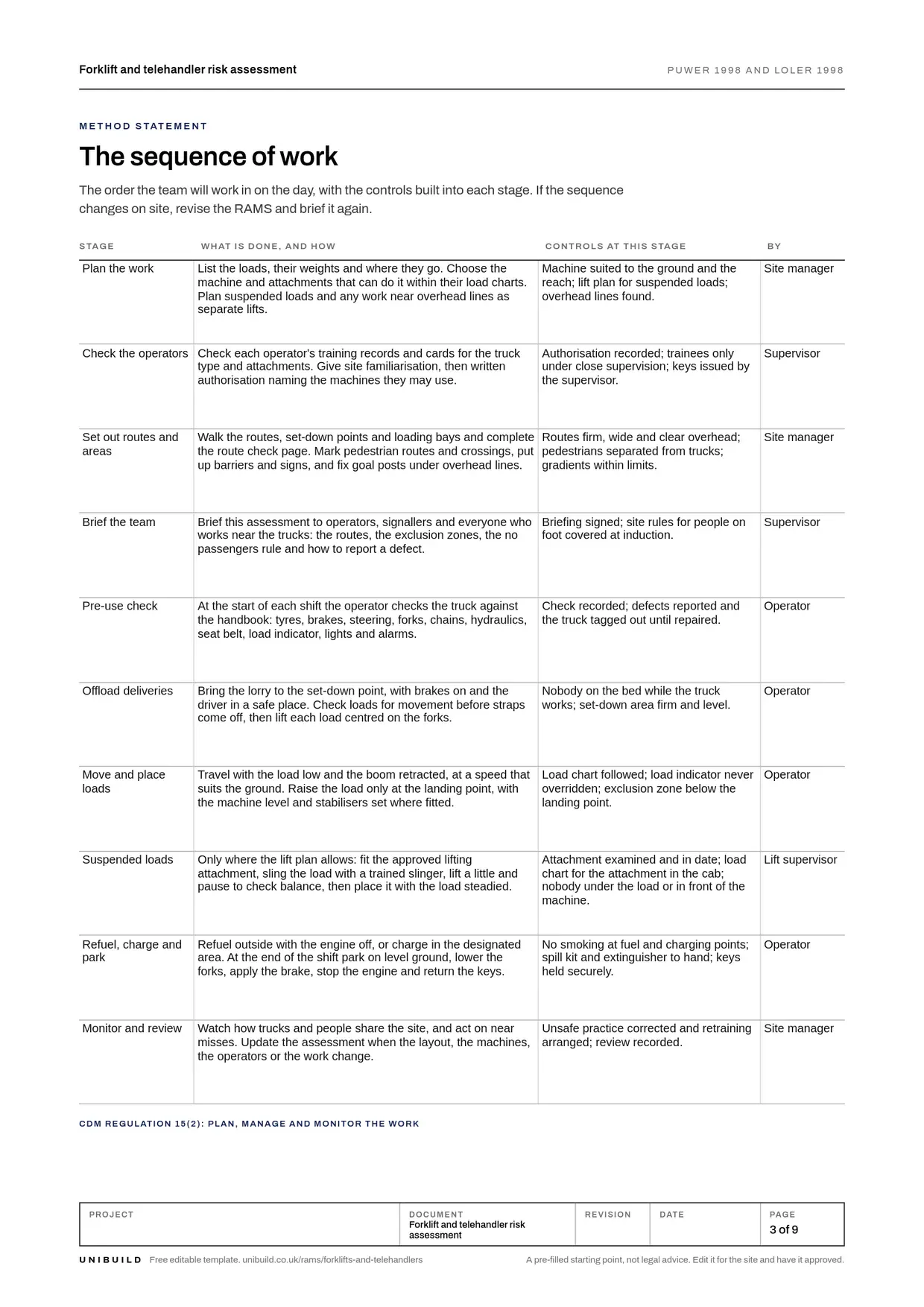
Forklift and telehandler method statement: the sequence of work
The order of work, with the controls at each stageHow trucks are planned, checked and used on the job, with the controls at each stage. If the plan changes on site, revise the assessment and brief it again.
Plan the work
List the loads, their weights and where they go. Choose the machine and attachments that can do it within their load charts. Plan suspended loads and any work near overhead lines as separate lifts.
ControlsMachine suited to the ground and the reach; lift plan for suspended loads; overhead lines found.
Check the operators
Check each operator's training records and cards for the truck type and attachments. Give site familiarisation, then written authorisation naming the machines they may use.
ControlsAuthorisation recorded; trainees only under close supervision; keys issued by the supervisor.
Set out routes and areas
Walk the routes, set-down points and loading bays and complete the route check page. Mark pedestrian routes and crossings, put up barriers and signs, and fix goal posts under overhead lines.
ControlsRoutes firm, wide and clear overhead; pedestrians separated from trucks; gradients within limits.
Brief the team
Brief this assessment to operators, signallers and everyone who works near the trucks: the routes, the exclusion zones, the no passengers rule and how to report a defect.
ControlsBriefing signed; site rules for people on foot covered at induction.
Pre-use check
At the start of each shift the operator checks the truck against the handbook: tyres, brakes, steering, forks, chains, hydraulics, seat belt, load indicator, lights and alarms.
ControlsCheck recorded; defects reported and the truck tagged out until repaired.
Offload deliveries
Bring the lorry to the set-down point, with brakes on and the driver in a safe place. Check loads for movement before straps come off, then lift each load centred on the forks.
ControlsNobody on the bed while the truck works; set-down area firm and level.
Move and place loads
Travel with the load low and the boom retracted, at a speed that suits the ground. Raise the load only at the landing point, with the machine level and stabilisers set where fitted.
ControlsLoad chart followed; load indicator never overridden; exclusion zone below the landing point.
Suspended loads
Only where the lift plan allows: fit the approved lifting attachment, sling the load with a trained slinger, lift a little and pause to check balance, then place it with the load steadied.
ControlsAttachment examined and in date; load chart for the attachment in the cab; nobody under the load or in front of the machine.
Refuel, charge and park
Refuel outside with the engine off, or charge in the designated area. At the end of the shift park on level ground, lower the forks, apply the brake, stop the engine and return the keys.
ControlsNo smoking at fuel and charging points; spill kit and extinguisher to hand; keys held securely.
Monitor and review
Watch how trucks and people share the site, and act on near misses. Update the assessment when the layout, the machines, the operators or the work change.
ControlsUnsafe practice corrected and retraining arranged; review recorded.
What the law asks for forklifts and telehandlers
Checked against the sourceTraining
Everyone who uses work equipment receives adequate training in how to use it, the risks and the precautions. Anyone who supervises or manages its use is trained too.
Provision and Use of Work Equipment Regulations 1998, regulation 9The code for lift truck training
The approved code of practice expects basic training and testing before anyone operates a stacking rider-operated lift truck. Its guidance adds specific job and familiarisation training, then written authorisation. Its safe use guidance covers telehandlers too.
HSE L117, Rider-operated lift trucks (2013), paragraphs 32, 55 and 67Thorough examination
Lifting equipment exposed to deterioration is thoroughly examined at least every 12 months, or every six months if it lifts people or is an accessory, or under an examination scheme. It is also examined after exceptional circumstances.
Lifting Operations and Lifting Equipment Regulations 1998, regulation 9(3)Planned lifting operations
Every lifting operation involving lifting equipment is properly planned by a competent person, appropriately supervised and carried out in a safe manner. That includes a telehandler placing loads or lifting on a hook.
Lifting Operations and Lifting Equipment Regulations 1998, regulation 8Rolling over and restraints
Where an employee riding on mobile work equipment is at risk from it rolling over, the risk is minimised, with a restraining system where anyone carried could be crushed. A fork-lift truck with a protective structure is adapted or equipped to reduce the risk from overturning.
Provision and Use of Work Equipment Regulations 1998, regulations 26 and 27Traffic routes on site
A construction site is organised so that, so far as is reasonably practicable, pedestrians and vehicles can move without risk. Routes are suitable and sufficient, signed where needed, and kept separate from people on foot where necessary.
Construction (Design and Management) Regulations 2015, regulation 27Competence, equipment and PPE
Competence and cards
- Operators Basic, specific job and familiarisation training for the truck type and attachments, with written authorisation.
- Telehandler operators A recognised card for the category, such as CPCS A17 or NPORS N010, familiarisation on the model, and further training before lifting suspended loads.
- Supervisor Trained to recognise safe and unsafe practice, as L117 expects, and to monitor operators.
- Lift planner Competent to plan lifts under LOLER regulation 8, including any suspended load lift.
- Slinger or signaller Trained for suspended loads and for directing reversing where a signaller is needed.
Plant and equipment
- Forklift or telehandler Pre-use check each shift; thorough examination at least every 12 months.
- Fork-mounted hook, jib or crane attachment Approved for the machine; load chart in the cab; examined under LOLER.
- Slings, chains and shackles Marked with safe working load; pre-use check; examined every 6 months.
- Integrated working platform Made for the machine; examined every 6 months; controls tested.
- Battery charger and charging area Ventilated; charger and leads checked; eyewash and PPE to hand.
- Fuel and LPG storage Bunded and secure; spill kit and extinguisher; signs displayed.
PPE
- High-visibility clothing for everyone on foot near trucks, and for operators whenever they leave the cab.
- Safety boots with toe protection and a grip sole.
- Safety helmet to the site standard, and wherever loads are lifted overhead.
- Gloves for slinging, refuelling and handling banding.
- Eye protection and acid-proof apron for battery care and changing gas cylinders.
Permits and plans
A lift plan for any suspended load lift and for work near overhead lines. Written agreement with the network operator where a line must be made dead or diverted. A permit to work where the principal contractor's rules require one, for example for a working platform on a truck.
Emergency and rescue
If a truck overturns, stay in the seat with the belt on and hold on. Call the first aider and emergency services, and isolate the machine. Overhead line contact: stay in the cab, warn others away, call the network operator. An overturn, failure of a load-bearing part, or contact with a bare line over 200 volts is a RIDDOR dangerous occurrence.
Toolbox talk: forklifts and telehandlers
Read this to the team before work starts, tick each point as it is covered, and record who attended.
- Only authorised operators drive. If you have not been trained and authorised on this machine, do not start it.
- Check the machine before every shift. If anything is wrong, tag it, park it and tell the supervisor.
- Seat belt on, every time. If the truck tips, stay in the seat and hold on. Do not jump.
- Boom down and retracted when you travel. Never cross a slope or turn on one.
- On foot, stay on the marked walkways and make eye contact before you pass a truck. Never walk under a raised load.
- No passengers, no lifting people on the forks, and no slings round the forks.
Ask the team
- Where are the pedestrian crossings and the exclusion zones on this site?
- What does the load indicator tell you, and what do you do when it warns?
- Who checks a lift before a telehandler lifts a suspended load?
What is in the forklift and telehandler risk assessment template
9 pages, pre-filled and editableThe work, pre-filled
Scope, location and access, interfaces with other trades, the documents the assessment relies on, and the team with their cards.
The sequence of work
Ten stages from planning the work to review, with the controls and the person responsible at each one.
Hazards and controls
Sixteen forklift and telehandler hazards rated before and after controls on a five by five matrix, with room for your own.
Plant, PPE and permits
The machines, attachments and accessories with their checks, PPE by type, and the lift plan for suspended loads.
Site route and pre-use check
A page that records the route survey and the machine checks, with findings, defects and the action taken.
Briefing record
Twenty signatures against the revision, taken on the day before the work starts.
Brief it, and get it signed on the phone
On Unibuild a RAMS is written from a template, approved, then read by each operative on their phone in their own language and signed. Subcontract and agency workers sign through a link, with no app to install.
Every signature carries its date and time and prints as the last page of the RAMS PDF. Change the RAMS and it has to be signed again.
How RAMS work on UnibuildForklift risk assessment questions
Is this forklift risk assessment template free?
Is a forklift risk assessment a legal requirement?
Do you need a licence to drive a forklift in the UK?
How often does a forklift need a thorough examination?
Do forklift and telehandler drivers have to wear a seat belt?
How often do forklift operators need refresher training?
Can you lift people on a forklift or telehandler?
Can a telehandler lift a suspended load?
RAMS templates for other trades and hazards
All free, pre-filled and editableBy trade
- Air conditioning and HVAC RAMS
- Bricklaying RAMS
- Carpentry and joinery RAMS
- CCTV installation RAMS
- Cleaning risk assessment
- Concrete works RAMS
- Demolition RAMS
- Drylining RAMS
- Electrical RAMS
- Facilities maintenance RAMS
- Fire alarm installation RAMS
- Glazing and window RAMS
- Groundworks RAMS
- Hot works and welding RAMS
- Insulation RAMS
- Landscaping and fencing RAMS
- Painting and decorating RAMS
- Pest control risk assessment
- Plastering and rendering RAMS
- Plumbing and heating RAMS
- Rail RAMS
- Refurbishment RAMS
- Roofing RAMS
- Rope access risk assessment
- Scaffolding RAMS
- Solar PV installation RAMS
- Steel erection RAMS
- Temporary works RAMS
- Tiling and flooring RAMS
- Tree surgery RAMS
By hazard
- Asbestos risk assessment
- Confined space risk assessment
- COSHH risk assessment
- Dust risk assessment
- Forklift and telehandler risk assessment
- Housekeeping risk assessment
- Lifting operations risk assessment
- Lone working risk assessment
- Manual handling risk assessment
- MEWP risk assessment
- Noise and vibration risk assessment
- Plant and excavator risk assessment
- Power tools risk assessment
- Traffic management risk assessment
- Working at height risk assessment
The blank RAMS template, the RAMS review checklist and every other free form are on Free downloads.
The RAMS, read and signed
before the work starts.
Unibuild keeps every RAMS with its versions, its approvals and each operative’s signature against the revision they read, for seven years, ready for the principal contractor or an auditor.