
Glazing risk assessment and method statement template
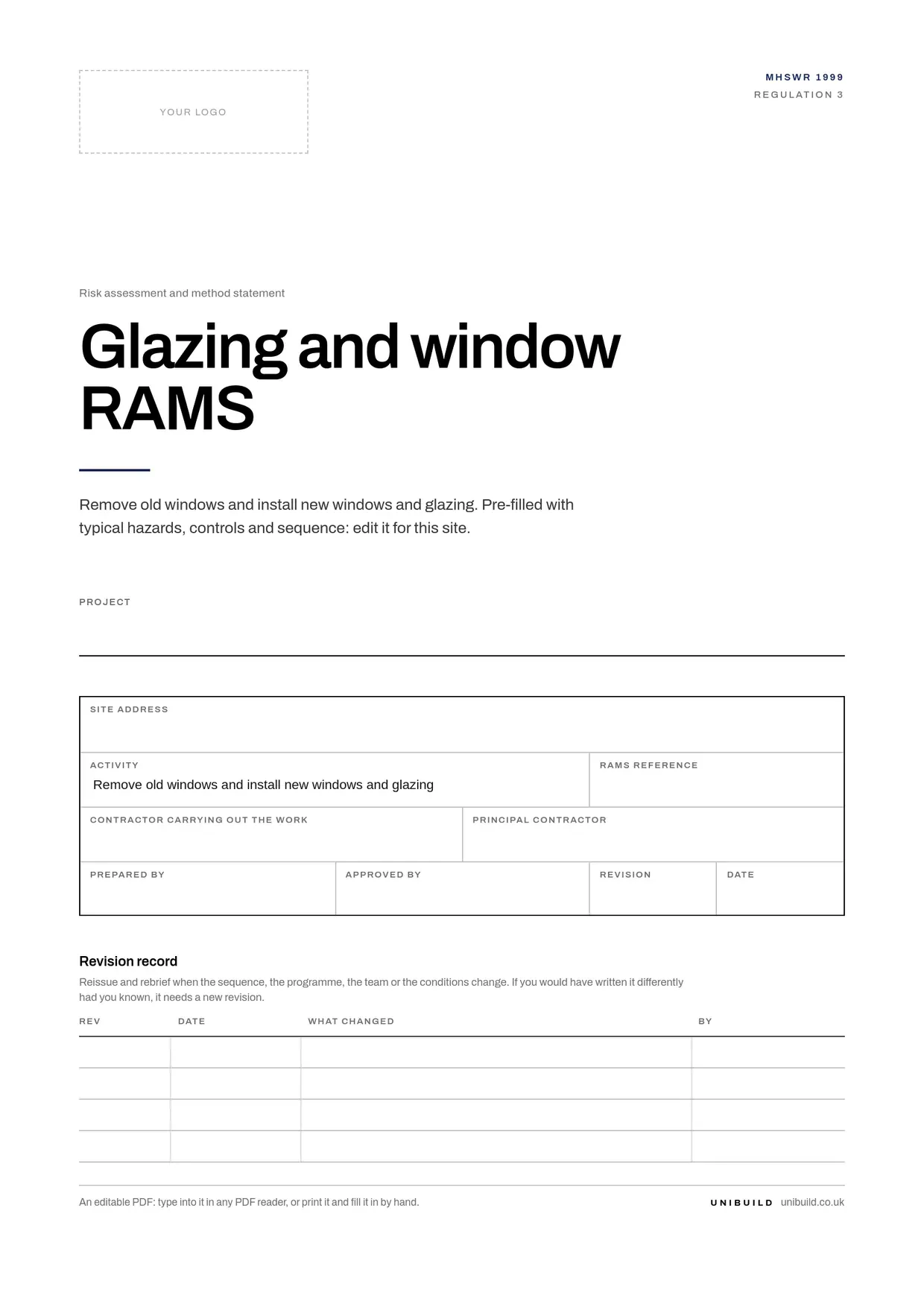
A glazing risk assessment and window installation method statement, already filled in with the hazards, controls and sequence for taking out old frames and fitting new windows and glass. Edit it for your job, then brief it.
- Law
- Work at Height Regulations 2005
- Old frames
- Check for asbestos first
- Format
- Editable PDF and Word
- Cost
- Free, always
Do you need a glazing risk assessment?
Yes. A glazing risk assessment is needed before any window or glass installation starts, and most clients and principal contractors will also ask for a window installation method statement. Together they make up the glazing RAMS, and this template gives you both, pre-filled, in PDF and Word.
The risk assessment is the legal duty, under regulation 3 of the Management of Health and Safety at Work Regulations 1999. The method statement shows how the job is done: how the old glass and frames come out, how heavy units are lifted and moved, and how people at height and below are protected.
A glazing RAMS should describe the job in front of you. The age of the frames, the size and weight of the units, the floor level, whether the building is occupied and what sits below the work decide the controls. They are what a reviewer reads first.
Checked against legislation.gov.uk and HSE guidance on .
Glazing and window installation hazards and controls
16 hazards, rated before and after controlsThe significant hazards on a typical window replacement or new glazing job, with the controls a reviewer expects to see. Delete what does not apply and add what your job has.
Falls from height while fitting
Installers working from ladders, towers, MEWPs or scaffold on upper floor windows.
- Frames fitted from inside wherever the design allows, so nobody works outside at height.
- Where outside work at height is needed, a tower, MEWP or scaffold with guard-rails, chosen for the job.
- Ladders only for low risk, short duration tasks where the risk assessment shows nothing more suitable is justified.
BeforeHigh 15AfterMedium 5
Falls through an open window opening
Installers, residents and other trades beside an opening on an upper floor once the old frame is out.
- Only take out as many frames as can be refitted and made safe the same day.
- A fixed barrier across any opening with a fall behind it whenever the opening is left, even briefly.
- Nobody leans out of an opening to fix or seal; outside work is done from the access equipment.
BeforeHigh 15AfterMedium 5
Asbestos in old frames, putty and panels
Installers removing old frames, sills, putty, mastic and panels beside or beneath windows.
- Asbestos survey checked before work; where there is doubt, suspect material is assumed to be asbestos and left until it is tested.
- Non-licensed tasks done only to the HSE Asbestos Essentials task sheet, by people trained for it.
- Work on asbestos insulating board is licensed work unless it is short duration: 2 hours in any 7 days, nobody over 1 hour. Licensed work is done by a licensed contractor first.
BeforeHigh 15AfterMedium 5
Glass breaking during removal
Installers taking out old panes and sealed units, and anyone nearby.
- Glass removed from the old frame before the frame is cut out, with beads and putty taken off first.
- Old panes crossed with tape or film where they may break, and the area inside and out kept clear.
- Cut-resistant gloves, arm protection and eye protection worn when removing and handling glass.
BeforeMedium 12AfterMedium 6
Manual handling of heavy glass units
Installers carrying sealed units, frames, doors and large panes, often up stairs or over uneven ground.
- Unit weights taken from the order or the supplier, and each lift planned before the delivery arrives.
- Large or heavy units moved by vacuum lifter, glass trolley or lifting equipment, not by hand.
- Team lifts with a named lead and a clear route, and units carried on edge with suction handles.
BeforeMedium 12AfterMedium 6
Vacuum lifter losing grip
The operator and anyone near a glass unit being lifted by vacuum.
- Lifter used within its rated load, with pads, seals and the low vacuum warning checked before use.
- Glass and pads wiped clean and dry before each lift, and the lift stopped at once if the warning sounds.
- Loads carried as low as practicable, never over people, with nobody under or beside the unit on its fall side.
BeforeHigh 15AfterMedium 5
Lifting units by crane or hoist
The lifting team and people below, from a dropped or swinging unit.
- Lift planned by a competent person and supervised, with a lift plan for every crane lift.
- Lifting equipment and accessories thoroughly examined under LOLER, with reports in date and on site.
- Exclusion zone below the lift, tag lines to control the unit, and lifting stopped in high wind.
BeforeHigh 15AfterMedium 5
Falling glass, frames and tools
The public, residents and other trades below the work.
- Exclusion zone below the work, barriered and signed, with the footpath closed or diverted where needed.
- Nothing thrown or dropped from height; old frames and glass lowered by hand, hoist or chute.
- Tools and fixings kept in bags or on lanyards when working outside at height.
BeforeMedium 12AfterLow 4
Glass storage and unloading
Drivers and installers unloading, and anyone near stillages, A-frames and stacked units.
- Glass carried and stored on racks, A-frames or stillages that are secured, on firm and level ground.
- Units strapped until the moment each one is lifted off, and taken off in a balanced order.
- Storage area barriered from the public and other trades, and kept clear of vehicle routes.
BeforeMedium 12AfterLow 4
Wind catching glass and frames
Installers carrying or lifting large panes and frames outside or at height.
- Forecast checked each morning, and lifting and carrying of large panes stopped when the wind makes them hard to control.
- Units not left leaning loose outside; frames and glass secured or brought inside.
BeforeMedium 12AfterMedium 8
Sealants, foam, primers and cleaners
Installers using silicone, expanding foam, primers and solvent cleaners, often in small rooms.
- Safety data sheet read for each product, with the COSHH assessment covering foam, primers and cleaners.
- Rooms ventilated, gloves and eye protection worn, and skin washed after contact.
- Polyurethane expanding foam contains diisocyanates, which can cause asthma. Under UK REACH, users of products with 0.1% or more need diisocyanate training first.
BeforeMedium 9AfterMedium 6
Dust and noise from cutting out
Installers cutting frames, fixings and render, and residents or trades nearby.
- Frames cut out with a reciprocating saw rather than grinding into the masonry where possible.
- On-tool extraction or water for any cutting or chasing of brick, block, render or plaster, with FFP3 RPE on top.
- Hearing protection where noise is high, and trigger time kept down to limit vibration.
BeforeMedium 9AfterMedium 6
Hidden cables and pipes in the reveals
Installers drilling fixings into reveals, heads and sills.
- Reveals checked with a cable and pipe detector before drilling, with alarm and sensor wiring found first.
- Fixing positions kept away from likely cable routes beside sockets and switches.
BeforeMedium 8AfterLow 4
Cuts from broken glass waste
Installers, labourers and waste handlers clearing old glass and frames.
- Broken glass collected into rigid, marked containers or a dedicated skip, never loose bags.
- Floors and the area below the work swept and checked for glass before the area is handed back.
BeforeMedium 9AfterLow 3
Occupied homes and buildings
Residents, children, staff and visitors in rooms where windows are being changed.
- Occupants told what is happening in each room and kept out of the work area while frames are out.
- Furniture protected or moved, and walkways kept clear of tools, glass and offcuts.
- Every opening glazed, boarded or secured and weathertight before the team leaves each day.
BeforeMedium 9AfterLow 3
Ladders and steps inside and out
Installers working at the head of frames and on upper sashes.
- Podium steps or a low platform for work at the head of a frame, in place of a stepladder where possible.
- Ladders checked before use, set on firm ground, footed or tied, with three points of contact.
BeforeMedium 12AfterMedium 8
Scores are likelihood times severity on the five by five matrix in the template. They are typical ratings for this work, a starting point for your own assessment of your site.
Window installation method statement: the sequence of work
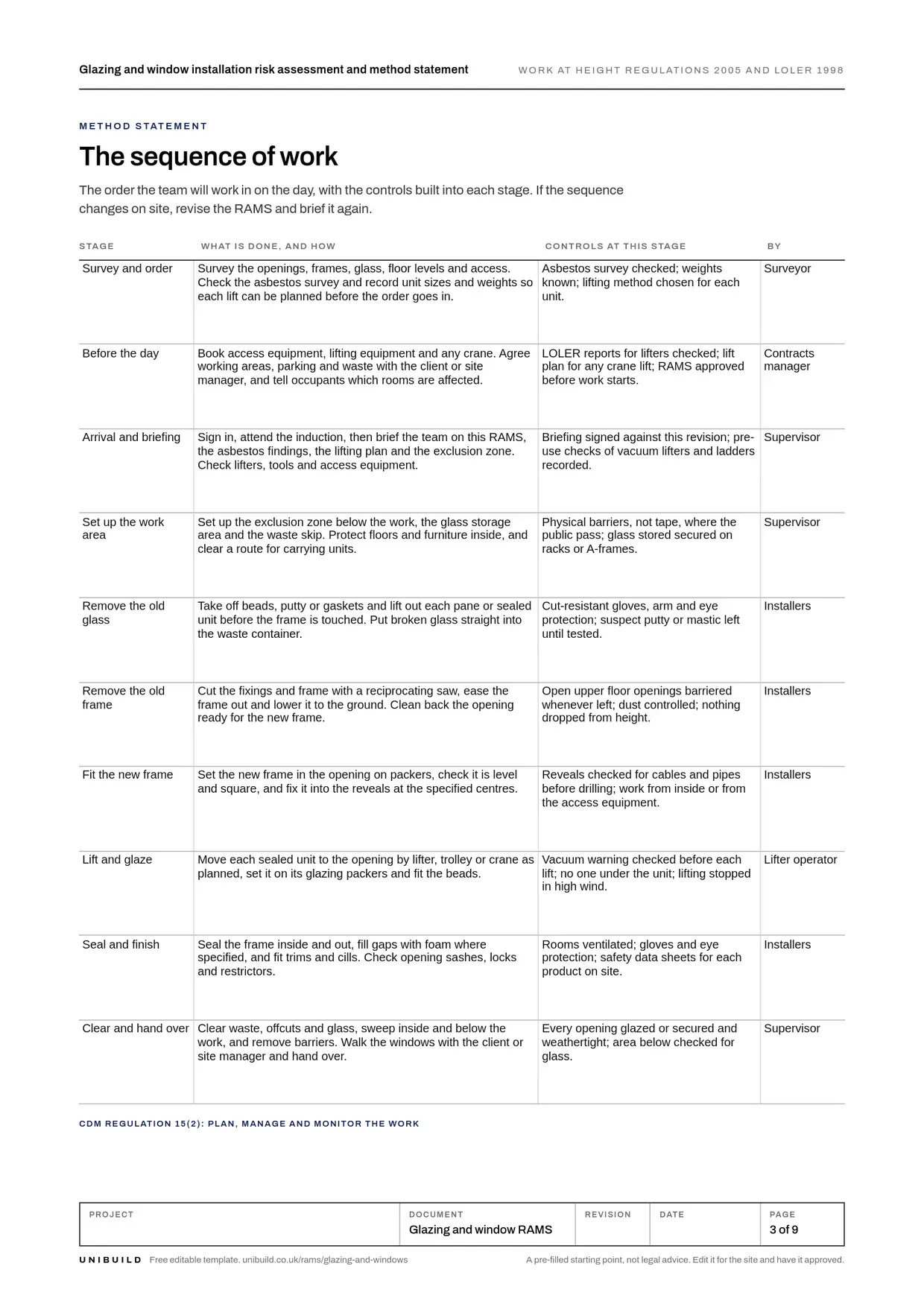
The order of work, with the controls at each stageThe order the team works in on the day, with the controls built into each stage. If the sequence changes on site, revise the RAMS and brief it again.
Survey and order
Survey the openings, frames, glass, floor levels and access. Check the asbestos survey and record unit sizes and weights so each lift can be planned before the order goes in.
ControlsAsbestos survey checked; weights known; lifting method chosen for each unit.
Before the day
Book access equipment, lifting equipment and any crane. Agree working areas, parking and waste with the client or site manager, and tell occupants which rooms are affected.
ControlsLOLER reports for lifters checked; lift plan for any crane lift; RAMS approved before work starts.
Arrival and briefing
Sign in, attend the induction, then brief the team on this RAMS, the asbestos findings, the lifting plan and the exclusion zone. Check lifters, tools and access equipment.
ControlsBriefing signed against this revision; pre-use checks of vacuum lifters and ladders recorded.
Set up the work area
Set up the exclusion zone below the work, the glass storage area and the waste skip. Protect floors and furniture inside, and clear a route for carrying units.
ControlsPhysical barriers, not tape, where the public pass; glass stored secured on racks or A-frames.
Remove the old glass
Take off beads, putty or gaskets and lift out each pane or sealed unit before the frame is touched. Put broken glass straight into the waste container.
ControlsCut-resistant gloves, arm and eye protection; suspect putty or mastic left until tested.
Remove the old frame
Cut the fixings and frame with a reciprocating saw, ease the frame out and lower it to the ground. Clean back the opening ready for the new frame.
ControlsOpen upper floor openings barriered whenever left; dust controlled; nothing dropped from height.
Fit the new frame
Set the new frame in the opening on packers, check it is level and square, and fix it into the reveals at the specified centres.
ControlsReveals checked for cables and pipes before drilling; work from inside or from the access equipment.
Lift and glaze
Move each sealed unit to the opening by lifter, trolley or crane as planned, set it on its glazing packers and fit the beads.
ControlsVacuum warning checked before each lift; no one under the unit; lifting stopped in high wind.
Seal and finish
Seal the frame inside and out, fill gaps with foam where specified, and fit trims and cills. Check opening sashes, locks and restrictors.
ControlsRooms ventilated; gloves and eye protection; safety data sheets for each product on site.
Clear and hand over
Clear waste, offcuts and glass, sweep inside and below the work, and remove barriers. Walk the windows with the client or site manager and hand over.
ControlsEvery opening glazed or secured and weathertight; area below checked for glass.
What the law asks for glazing and window installation
Checked against the sourceRisk assessment
Every employer must make a suitable and sufficient assessment of the risks to employees and to others affected by the work, and record the significant findings if they employ five or more people.
Management of Health and Safety at Work Regulations 1999, regulation 3Avoid, prevent, then mitigate
Work is not done at height where it can be done safely another way. Where it cannot, falls are prevented, and only then are the distance and consequences of a fall reduced. A ladder is used only where the risk is low and either the work is short or features on site cannot be changed.
Work at Height Regulations 2005, regulation 6 and Schedule 6Falling objects
The fall of materials and objects is prevented so far as is reasonably practicable. Nothing is thrown or tipped from height where it could injure anyone, and materials are stored so they cannot collapse, overturn or move.
Work at Height Regulations 2005, regulation 10Lifting operations
Every lifting operation is properly planned by a competent person, appropriately supervised and carried out safely. Lifting accessories exposed to deterioration are thoroughly examined at least every 6 months, or to an examination scheme.
LOLER 1998, regulations 8 and 9Manual handling
Manual handling that carries a risk of injury is avoided so far as is reasonably practicable. Where it cannot be avoided, it is assessed and the risk reduced, and people are given an indication of the weight of each load.
Manual Handling Operations Regulations 1992, regulation 4Asbestos before removal
Nobody starts maintenance or removal work liable to disturb asbestos until the employer has assessed whether it is present. Where there is doubt, the employer assumes it is present and follows the regulations.
Control of Asbestos Regulations 2012, regulation 5Competence, equipment and PPE
Competence and cards
- Installers CSCS card for their occupation, with trainees supervised by an experienced installer.
- Supervisor Experienced installer with site supervision training, at the job throughout.
- Lifter operators Trained in the vacuum lifter in use, its limits, checks and what to do if the warning sounds.
- Crane lifts Lift planned by a competent person, with a trained slinger signaller and crane operator.
- Access equipment PASMA training for mobile towers and IPAF for MEWPs.
- Asbestos Asbestos awareness training for everyone liable to disturb it.
Plant and equipment
- Vacuum lifter or suction frame Pads and warning checked before use; LOLER examination in date.
- Hand suction lifters Cups and seals checked before each use; used within rated load.
- Glass trolley, A-frames and racks Checked for damage; units restrained during transport.
- Mobile tower or MEWP Pre-use check; tower inspected after assembly and moves.
- Reciprocating saw and drills Checked before use; blades and bits suited to the material.
- Cable and pipe detector Checked against a known cable before use.
PPE
- Gloves cut-resistant, with arm protection when handling and removing glass.
- Eye protection when removing glass, cutting out frames and using sealants.
- Safety boots with toe protection and a grip sole.
- Safety helmet outside, below work at height, and on construction sites.
- Respiratory protection FFP3 for cutting into masonry, render or plaster.
- High-visibility clothing to the site standard, and when unloading near traffic.
Permits and plans
A lift plan for any crane lift. A permit to work where the client or principal contractor requires one, for example in occupied buildings or near live services. A licence from the highway authority where a scaffold or other structure goes on the highway.
Emergency and rescue
First aider and a first aid kit with large wound dressings for glass cuts on site. Rescue plan for anyone stranded or injured on access equipment. Nearest accident and emergency department named on the briefing, and the site emergency procedure followed for any other incident.
Toolbox talk: glazing and window installation safety
Read this to the team before work starts, tick each point as it is covered, and record who attended.
- If old putty, mastic or a panel looks suspect, stop and tell the supervisor. Nothing gets broken out until we know what it is.
- Glass comes out of the old frame before the frame comes out. Gloves, sleeves and glasses on.
- Check the lifter before every lift. If the warning sounds, set the unit down and stop.
- Nobody stands under or beside a unit on the lifter or the crane.
- An open window upstairs is an open edge. Barrier it before you walk away, even for a minute.
- Nothing is thrown from height. Old frames and glass go down by hand or by hoist.
Ask the team
- Which units on this job are too heavy to carry by hand, and how are they moving?
- What wind would make us stop lifting glass today?
- Where is the asbestos survey, and what did it find in the frames?
What is in the glazing and window RAMS template
9 pages, pre-filled and editableThe work, pre-filled
Scope, location and access, interfaces with other trades and occupants, the documents the RAMS relies on, and the team with their cards.
The sequence of work
Ten stages from survey to hand over, with the controls and the person responsible at each one.
Hazards and controls
Sixteen glazing hazards rated before and after controls on a five by five matrix, with room for your own.
Plant, PPE and permits
Lifters and access equipment and their checks, PPE by type, sealants and foam, and the permits the job needs.
Glass lift check
A page to record each heavy unit, its weight, the lifting method and the checks made before it moves.
Emergency and briefing record
First aid for glass cuts and rescue, then twenty signatures against the revision, taken before work starts.
Brief it, and get it signed on the phone
On Unibuild a RAMS is written from a template, approved, then read by each operative on their phone in their own language and signed. Subcontract and agency workers sign through a link, with no app to install.
Every signature carries its date and time and prints as the last page of the RAMS PDF. Change the RAMS and it has to be signed again.
How RAMS work on UnibuildGlazing and window RAMS questions
Is this glazing risk assessment template free?
What should a window installation method statement include?
Is a glazing risk assessment a legal requirement?
Can I use this as a double glazing risk assessment for a house?
Can old window frames contain asbestos?
Do vacuum lifters need a LOLER thorough examination?
How heavy is too heavy to lift glass by hand?
Do I need scaffolding to fit upper floor windows?
RAMS templates for other trades and hazards
All free, pre-filled and editableBy trade
- Air conditioning and HVAC RAMS
- Bricklaying RAMS
- Carpentry and joinery RAMS
- CCTV installation RAMS
- Cleaning risk assessment
- Concrete works RAMS
- Demolition RAMS
- Drylining RAMS
- Electrical RAMS
- Facilities maintenance RAMS
- Fire alarm installation RAMS
- Glazing and window RAMS
- Groundworks RAMS
- Hot works and welding RAMS
- Insulation RAMS
- Landscaping and fencing RAMS
- Painting and decorating RAMS
- Pest control risk assessment
- Plastering and rendering RAMS
- Plumbing and heating RAMS
- Rail RAMS
- Refurbishment RAMS
- Roofing RAMS
- Rope access risk assessment
- Scaffolding RAMS
- Solar PV installation RAMS
- Steel erection RAMS
- Temporary works RAMS
- Tiling and flooring RAMS
- Tree surgery RAMS
By hazard
- Asbestos risk assessment
- Confined space risk assessment
- COSHH risk assessment
- Dust risk assessment
- Forklift and telehandler risk assessment
- Housekeeping risk assessment
- Lifting operations risk assessment
- Lone working risk assessment
- Manual handling risk assessment
- MEWP risk assessment
- Noise and vibration risk assessment
- Plant and excavator risk assessment
- Power tools risk assessment
- Traffic management risk assessment
- Working at height risk assessment
The blank RAMS template, the RAMS review checklist and every other free form are on Free downloads.
The RAMS, read and signed
before the work starts.
Unibuild keeps every RAMS with its versions, its approvals and each operative’s signature against the revision they read, for seven years, ready for the principal contractor or an auditor.