
Concrete works method statement and risk assessment
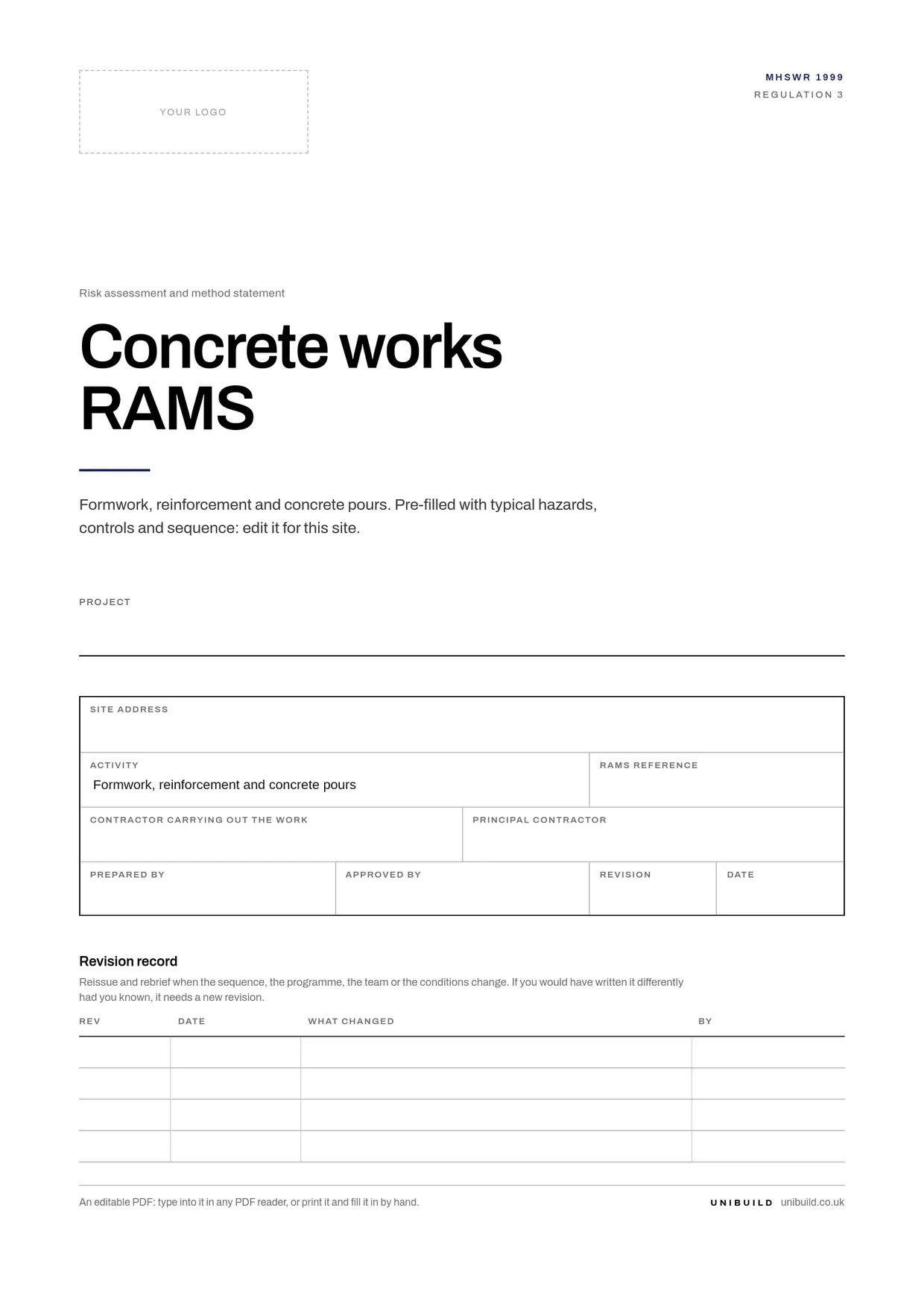
A concrete works method statement and risk assessment, already filled in for formwork, reinforcement, pouring by pump or skip, finishing and curing. Edit it for your pour, then brief it.
- Law
- CDM 2015 and COSHH 2002
- Formwork
- Checked and released before each pour
- Format
- Editable PDF and Word
- Cost
- Free, always
Do you need a method statement for concrete works?
Yes, in practice every concrete pour needs a concrete works method statement, as part of a RAMS, before the formwork goes up. Formwork carries a heavy, fluid load, the pour runs to the wagon timetable, and a principal contractor will expect to review the RAMS first.
The risk assessment is the legal duty, under regulation 3 of the Management of Health and Safety at Work Regulations 1999. The method statement sets out the plan: how the formwork is designed and checked, how the concrete is placed by pump or skip, how the team is kept off wet cement, and when the formwork is struck.
A concrete pouring risk assessment has to fit the pour in front of you. The size and height of the pour, the formwork, the access for wagons and the pump, and the trades nearby decide the controls. CDM 2015 regulation 19 and COSHH are what a reviewer checks it against.
Checked against legislation.gov.uk and HSE guidance on .
Concrete works hazards and controls
17 hazards, rated before and after controlsThe significant hazards on a typical slab, base, wall or column pour, with the controls a reviewer expects to see. Delete what does not apply and add what your pour has.
Formwork or falsework failure during the pour
Operatives on and below the formwork, from a blow-out, a sudden collapse or a deck giving way.
- Formwork and falsework built to a temporary works design that allows for the full wet concrete load and the rate of pour.
- Checked against the design and released in writing by the temporary works coordinator before the pour starts.
- Pour rate and sequence kept to the design, with a competent person watching the formwork and stopping the pour at any sign of movement.
BeforeHigh 15AfterMedium 5
Striking formwork or removing props too early
Operatives striking or working below a slab, beam or wall that cannot yet carry its own weight.
- Striking times and back-propping set by the temporary works designer or engineer, not by the calendar.
- Strike released in writing, using cube results or the method in the design where the design requires them.
- Struck in the order in the design, with props released gradually and nobody below the area being struck.
BeforeHigh 15AfterMedium 5
Falls from formwork, decks and slab edges
Formworkers, steel fixers and concrete teams working on decks, wall forms and unprotected edges.
- Edge protection on decks and slab edges: a top guard-rail at least 950mm high, no gap over 470mm, and toe boards.
- Working platforms on wall and column forms, with access by tied ladder or stair, never by climbing the formwork.
- Openings in decks covered with fixed, marked covers or guarded before the area is used.
BeforeHigh 20AfterMedium 5
Protruding reinforcement
Anyone who falls onto, walks into or trips over starter bars and projecting rebar.
- Protruding starter bars capped or covered wherever anyone could fall or walk onto them.
- Walkways across fixed reinforcement on boards or mesh walkways, not on the bars.
- Offcuts and tie wire cleared from decks and the pour area as work goes on.
BeforeMedium 12AfterLow 4
Manual handling of rebar, shutters and props
Steel fixers and formworkers carrying bars, mesh sheets, panels and props.
- Bundles of rebar, mesh and formwork panels lifted by crane or telehandler to where they are used, not carried by hand.
- Long bars and full mesh sheets carried by two people; lighter panel systems chosen where practicable.
- Knee pads for fixing at slab level, and rest breaks planned for long fixing shifts.
BeforeMedium 12AfterMedium 6
Concrete pump set-up and boom
Operatives at the pour, and anyone near the outriggers, boom or truck when it is set up or moves.
- Pump set up on hard standing provided by site management, stabilisers deployed to the maker's instructions on spreader plates, clear of excavations and voids.
- Pump booked with a trained operator, and a competent supervisor from the hirer with the pump from start to finish.
- Nobody under the boom; overhead lines identified before the pump arrives and the boom kept well clear.
BeforeHigh 15AfterMedium 5
Pump line blockage and end hose whip
The hose hand and operatives at the end hose when a line blocks, bursts or clears suddenly.
- Everyone clear of the end hose until concrete flows smoothly, at the start and after a blockage: the danger zone is twice the hose length across.
- No line opened under pressure: pumping stopped and reversed to release it, people moved clear, then opened at the safest point.
- Couplings, pins and clips checked before the pour, with signals agreed between the pour and the operator.
BeforeMedium 12AfterLow 4
Skip pours by crane
Operatives guiding the skip and anyone under the lift path.
- Lift planned by a competent person, with a trained slinger signaller in charge and a lift plan for the crane.
- Skip and crane with a LOLER thorough examination in date; skip not overfilled and the release checked before each lift.
- Skip guided by a tag line, not by hand under the load; nobody under the lift path.
BeforeHigh 15AfterMedium 5
Truck mixers reversing and washing out
Operatives, banksmen and other trades near wagons on site roads and at the pour.
- Wagon route, standing area and washout point planned and kept apart from pedestrian routes by barriers.
- Trained banksman for every reversing movement; nobody between the wagon and the pump hopper while it reverses.
- Washout to a lined area or skip, never to drains, with the driver staying in sight of the banksman.
BeforeHigh 20AfterMedium 5
Wet cement burns and dermatitis
Operatives placing, levelling and finishing concrete, and anyone kneeling in it.
- Waterproof gloves suitable for alkalis, and wellingtons with waterproof trousers worn over them so concrete cannot get in.
- Cement washed off the skin straight away, with clean water and welfare at the pour; wet clothing changed.
- Skin checks by a trained person before work starts and at intervals, with any problem reported.
BeforeMedium 12AfterMedium 6
Concrete and cement splashes to the eyes
Operatives at the end hose, the skip, the vibrator and the mixer.
- Eye protection worn by everyone at the point of placing and when cleaning down the pump or mixer.
- Eyewash at the pour, and the team briefed to rinse at once and get first aid.
BeforeMedium 9AfterLow 3
Vibration from pokers and power floats
Operatives using poker vibrators, vibrating screeds and walk-behind power floats.
- Vibration data for each tool obtained and trigger time planned per person to stay below the exposure action value of 2.5 m/s² A(8).
- Ride-on trowels used in place of walk-behind machines where practicable, and lower-vibration pokers and screeds chosen on their data.
- Tools maintained, work rotated, and anyone with tingling or numbness reporting it.
BeforeMedium 12AfterMedium 6
Power floating and trowelling machines
Operators of walk-behind and ride-on trowels, and others on the slab nearby.
- Machines guarded, with a dead man control that stops the blades when released, checked before use.
- Operators trained on the machine; nobody else on the slab within reach of the blades.
- Petrol or diesel machines used indoors only with enough ventilation, or electric machines chosen instead.
BeforeMedium 12AfterLow 4
Silica dust from cutting, coring and scabbling
Operatives preparing joints and kickers, cutting slabs and coring, and others nearby.
- Scabbling designed out where possible, by retarders and pressure washing or by joint formers cast into the formwork.
- Water suppression or on-tool extraction with an H or M class unit for cutting, coring and grinding.
- RPE with an assigned protection factor of 20, face fit tested, and the area kept clear of others.
BeforeMedium 12AfterMedium 6
Noise from pokers, saws and breakers
Operatives using noisy tools and those working near them.
- Quieter tools and methods chosen first, with noise data used to plan exposure.
- Hearing protection worn wherever the noise assessment shows exposure can reach 85 dB(A), the upper exposure action value.
BeforeMedium 9AfterMedium 6
Curing: heaters, covers and compounds
Operatives sheeting, heating and spraying new concrete, and anyone entering a heated enclosure.
- Fuel-burning heaters kept out of enclosed or sheeted areas unless the fumes are ducted away; electric heat chosen where possible.
- Curing compounds and release agents used to their safety data sheets, by spray with RPE where the sheet calls for it.
- Covers weighted down, and a new slab barriered and signed so nobody walks or loads it early.
BeforeMedium 12AfterLow 4
Working beside piling rigs and pile heads
Concrete and formwork teams working next to piling rigs, or breaking down pile heads.
- Our work kept outside the piling exclusion zone, on a working platform with a current certificate.
- Pile heads cut down before our pile caps start, by hydraulic croppers or another non-percussive method in place of hand-held breakers where practicable.
- Pile bores and open holes covered or fenced before our team works near them.
BeforeHigh 15AfterMedium 5
Scores are likelihood times severity on the five by five matrix in the template. They are typical ratings for this work, a starting point for your own assessment of your site.
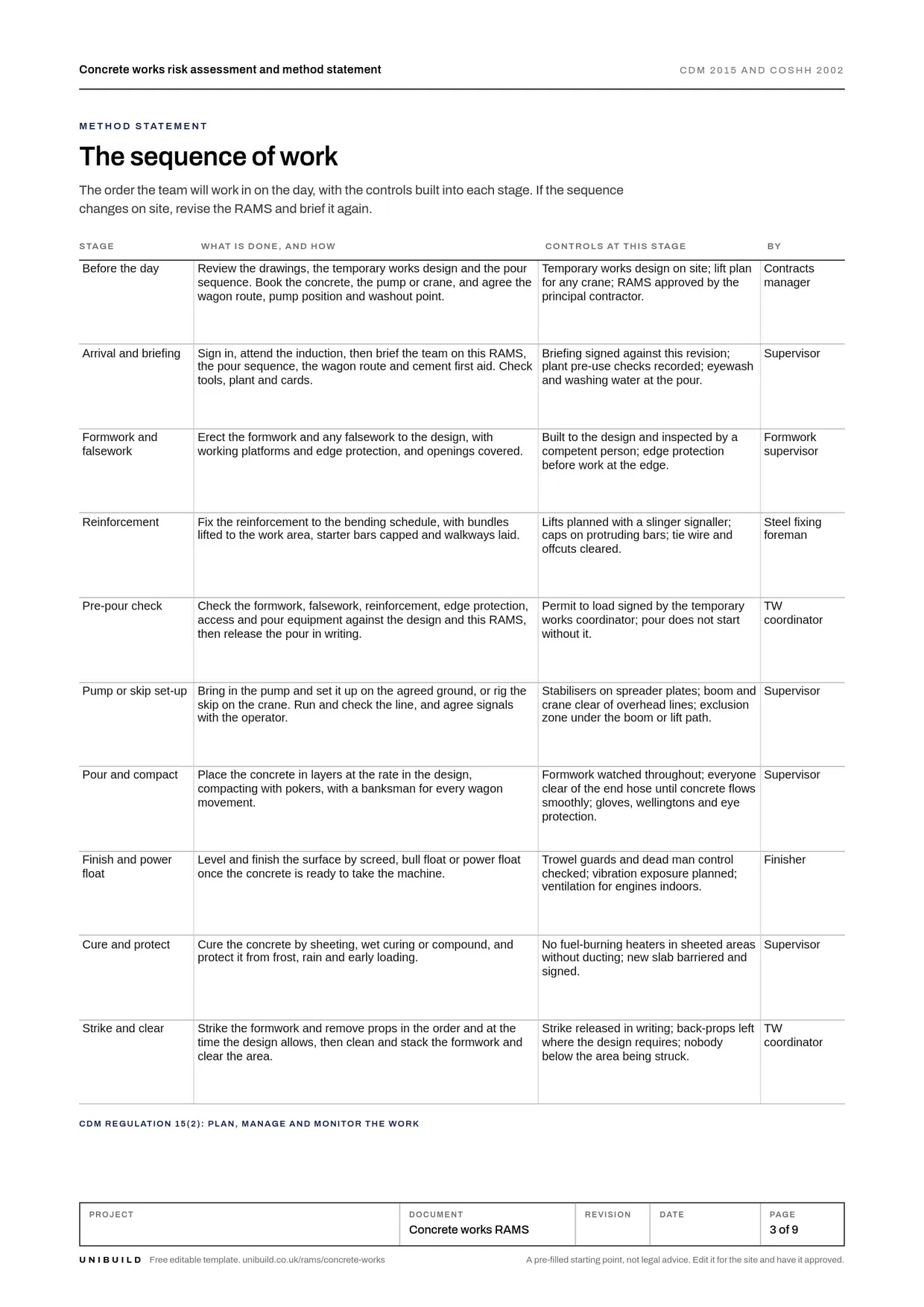
Concrete works method statement: the sequence of work
The order of work, with the controls at each stageThe order the team works in, from formwork to striking, with the controls built into each stage. If the sequence changes on site, revise the RAMS and brief it again.
Before the day
Review the drawings, the temporary works design and the pour sequence. Book the concrete, the pump or crane, and agree the wagon route, pump position and washout point.
ControlsTemporary works design on site; lift plan for any crane; RAMS approved by the principal contractor.
Arrival and briefing
Sign in, attend the induction, then brief the team on this RAMS, the pour sequence, the wagon route and cement first aid. Check tools, plant and cards.
ControlsBriefing signed against this revision; plant pre-use checks recorded; eyewash and washing water at the pour.
Formwork and falsework
Erect the formwork and any falsework to the design, with working platforms and edge protection, and openings covered.
ControlsBuilt to the design and inspected by a competent person; edge protection before work at the edge.
Reinforcement
Fix the reinforcement to the bending schedule, with bundles lifted to the work area, starter bars capped and walkways laid.
ControlsLifts planned with a slinger signaller; caps on protruding bars; tie wire and offcuts cleared.
Pre-pour check
Check the formwork, falsework, reinforcement, edge protection, access and pour equipment against the design and this RAMS, then release the pour in writing.
ControlsPermit to load signed by the temporary works coordinator; pour does not start without it.
Pump or skip set-up
Bring in the pump and set it up on the agreed ground, or rig the skip on the crane. Run and check the line, and agree signals with the operator.
ControlsStabilisers on spreader plates; boom and crane clear of overhead lines; exclusion zone under the boom or lift path.
Pour and compact
Place the concrete in layers at the rate in the design, compacting with pokers, with a banksman for every wagon movement.
ControlsFormwork watched throughout; everyone clear of the end hose until concrete flows smoothly; gloves, wellingtons and eye protection.
Finish and power float
Level and finish the surface by screed, bull float or power float once the concrete is ready to take the machine.
ControlsTrowel guards and dead man control checked; vibration exposure planned; ventilation for engines indoors.
Cure and protect
Cure the concrete by sheeting, wet curing or compound, and protect it from frost, rain and early loading.
ControlsNo fuel-burning heaters in sheeted areas without ducting; new slab barriered and signed.
Strike and clear
Strike the formwork and remove props in the order and at the time the design allows, then clean and stack the formwork and clear the area.
ControlsStrike released in writing; back-props left where the design requires; nobody below the area being struck.
What the law asks for concrete works
Checked against the sourceTemporary works carry the load
Any temporary support or temporary structure, such as formwork and falsework, is designed, installed and maintained to withstand any foreseeable loads, and used only for the purpose it was designed for. No structure may be so loaded as to make it unsafe.
CDM 2015, regulation 19(2) and 19(3)Cement and other substances
Exposure to substances hazardous to health, such as wet cement, silica dust and curing compounds, is prevented or, where that is not reasonably practicable, adequately controlled. HSE guidance on cement adds skin checks by a trained person.
COSHH 2002, regulations 7 and 11Lifting operations
Every lift with lifting equipment, including a skip pour by crane and lifting bundles of rebar, is properly planned by a competent person, appropriately supervised and carried out in a safe manner.
LOLER 1998, regulation 8Wagons, pumps and people
A construction site is organised so that, so far as is reasonably practicable, pedestrians and vehicles can move without risk. Where separation is not practicable, other protection and warnings are used.
CDM 2015, regulation 27Hand-arm vibration
The daily exposure action value for hand-arm vibration is 2.5 m/s² A(8) and the limit value is 5 m/s² A(8). Pokers, power floats and breakers are planned against them.
Control of Vibration at Work Regulations 2005, regulation 4Risk assessment
Every employer must make a suitable and sufficient assessment of the risks, and record the significant findings if they employ five or more people.
Management of Health and Safety at Work Regulations 1999, regulation 3Competence, equipment and PPE
Competence and cards
- Temporary works coordinator Appointed for the formwork and falsework, and signs the permit to load and the strike.
- Formworkers and steel fixers Trained and experienced in the formwork system and the reinforcement work.
- Pump operator Supplied by the pump hire company, trained and carded, for example under CPCS, for the pump and boom in use.
- Slinger signaller CPCS or NPORS card, for crane skips and rebar lifts.
- Banksman Trained for reversing wagons and pumps on site.
- Power float operator Trained on the machine, walk-behind or ride-on.
Plant and equipment
- Concrete pump and boom Operator daily checks; inspection certificate in date, on the machine; spreader plates.
- Concrete skip and crane LOLER thorough examination in date; release checked before each lift.
- Poker vibrators Checked before use; vibration data known for exposure planning.
- Power float or ride-on trowel Guards and dead man control checked; vibration data known.
- Formwork and falsework Inspected against the design before loading and during the pour.
- Saws, corers and grinders Water feed or H or M class extraction working before use.
PPE
- Safety helmet worn at all times on the deck, near cranes and near the pump.
- Safety wellingtons with toe and midsole protection, high enough that concrete cannot get in.
- Waterproof trousers worn over the wellingtons, with knee pads for kneeling work.
- Gloves waterproof and alkali-resistant for concrete, grip gloves for formwork and rebar.
- Eye protection at the point of placing, cutting and cleaning down.
- Hearing and respiratory protection for pokers, saws and breakers; FFP3, face fit tested, for dust.
Permits and plans
A permit to load, signed by the temporary works coordinator, before each pour, and a written release before formwork is struck. A lift plan for crane skips and rebar lifts. A permit to work where the principal contractor requires one, for example near live services or overhead lines.
Emergency and rescue
For cement in the eye, rinse at once with eyewash or clean water and get first aid. For wet cement on the skin, wash it off and remove wet clothing. A formwork failure stops the pour and clears the area below. First aider and kit at the pour, and the nearest accident and emergency department named on the briefing.
Toolbox talk: pouring concrete safely
Read this to the team before the pour starts, tick each point as it is covered, and record who attended.
- No pour until the permit to load is signed. If the formwork moves, bulges or leaks badly, shout, stop the pour and get clear.
- Wet cement burns, and you will not feel it at first. Trousers over wellingtons, gloves on, and wash it off straight away.
- Nobody under the boom or the skip. Keep out of the lift path and away from the outriggers.
- If the line blocks, step clear of the end hose and stay clear until concrete flows smoothly again. Nobody opens a line under pressure.
- Every wagon reverses with a banksman. Never stand between a wagon and the hopper.
- Formwork comes down only when the strike is released. Nobody knocks out a prop to get a panel free.
Ask the team
- Where is the eyewash, and where do we wash cement off?
- What signal stops the pump, and who gives it?
- Who signs the permit to load and the strike today?
What is in the concrete works RAMS template
9 pages, pre-filled and editableThe work, pre-filled
Scope, location and access, interfaces with other trades, the documents the RAMS relies on, and the team with their cards.
The sequence of work
Ten stages from planning to striking, with the controls and the person responsible at each one.
Hazards and controls
Seventeen concrete works hazards rated before and after controls on a five by five matrix, with room for your own.
Plant, PPE and permits
The pump, skip, pokers and floats with their checks, PPE by type, cement and dust, and the permits the pour needs.
Pre-pour check
A page to record the formwork, reinforcement, access and pour equipment checks before the permit to load is signed.
Emergency and briefing record
Cement first aid and formwork failure arrangements, then twenty signatures against the revision.
Brief it, and get it signed on the phone
On Unibuild a RAMS is written from a template, approved, then read by each operative on their phone in their own language and signed. Subcontract and agency workers sign through a link, with no app to install.
Every signature carries its date and time and prints as the last page of the RAMS PDF. Change the RAMS and it has to be signed again.
How RAMS work on UnibuildConcrete works method statement questions
Is this concrete works RAMS template free?
What should a concrete works method statement include?
Do I need a risk assessment for pouring concrete?
When can formwork be struck?
Who is responsible for the concrete pump on site?
Can wet concrete burn your skin?
Does a concrete RAMS cover piling?
What PPE do you need for concrete work?
RAMS templates for other trades and hazards
All free, pre-filled and editableBy trade
- Air conditioning and HVAC RAMS
- Bricklaying RAMS
- Carpentry and joinery RAMS
- CCTV installation RAMS
- Cleaning risk assessment
- Concrete works RAMS
- Demolition RAMS
- Drylining RAMS
- Electrical RAMS
- Facilities maintenance RAMS
- Fire alarm installation RAMS
- Glazing and window RAMS
- Groundworks RAMS
- Hot works and welding RAMS
- Insulation RAMS
- Landscaping and fencing RAMS
- Painting and decorating RAMS
- Pest control risk assessment
- Plastering and rendering RAMS
- Plumbing and heating RAMS
- Rail RAMS
- Refurbishment RAMS
- Roofing RAMS
- Rope access risk assessment
- Scaffolding RAMS
- Solar PV installation RAMS
- Steel erection RAMS
- Temporary works RAMS
- Tiling and flooring RAMS
- Tree surgery RAMS
By hazard
- Asbestos risk assessment
- Confined space risk assessment
- COSHH risk assessment
- Dust risk assessment
- Forklift and telehandler risk assessment
- Housekeeping risk assessment
- Lifting operations risk assessment
- Lone working risk assessment
- Manual handling risk assessment
- MEWP risk assessment
- Noise and vibration risk assessment
- Plant and excavator risk assessment
- Power tools risk assessment
- Traffic management risk assessment
- Working at height risk assessment
The blank RAMS template, the RAMS review checklist and every other free form are on Free downloads.
The RAMS, read and signed
before the work starts.
Unibuild keeps every RAMS with its versions, its approvals and each operative’s signature against the revision they read, for seven years, ready for the principal contractor or an auditor.