
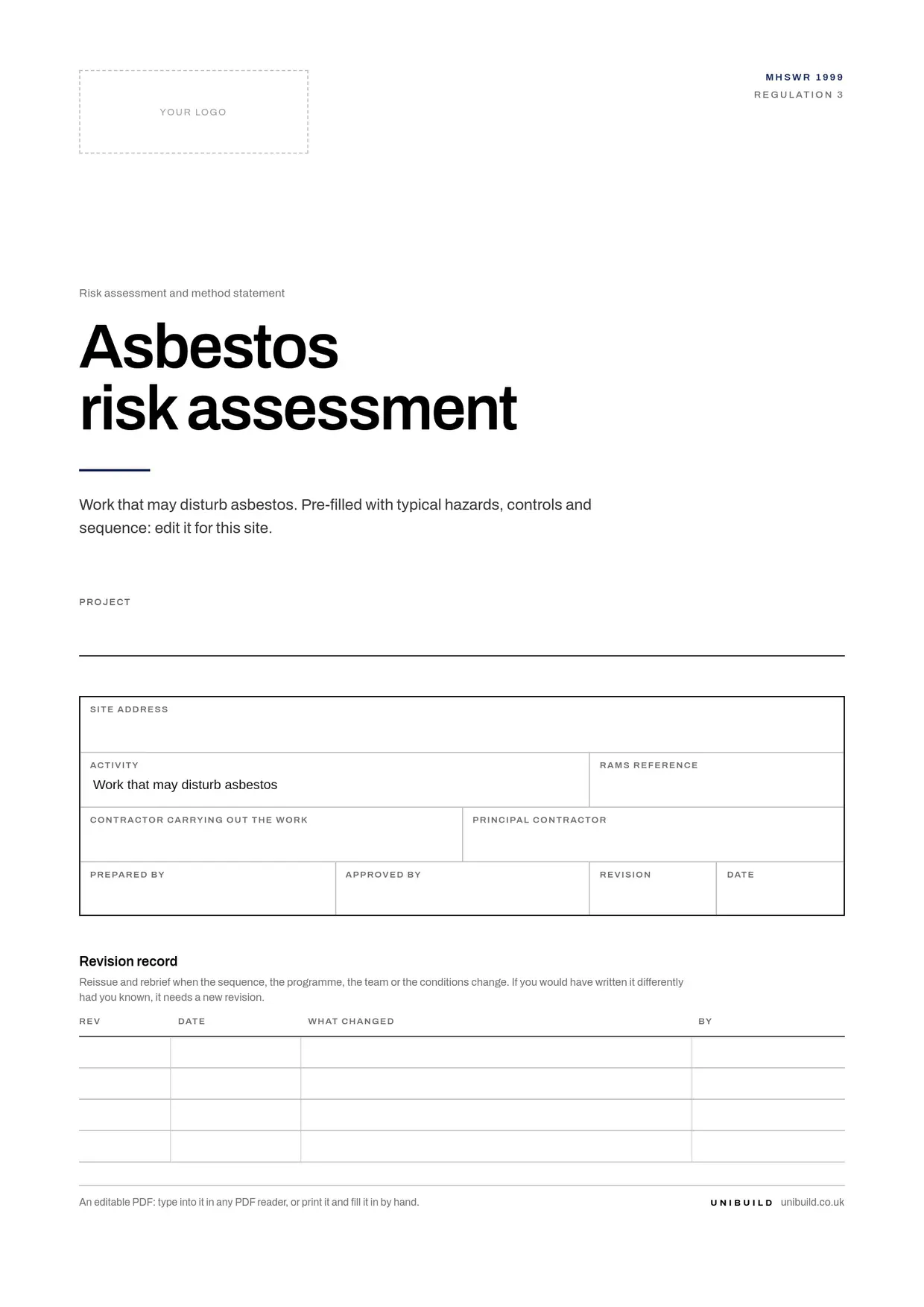
Asbestos risk assessment template
An asbestos risk assessment for refurbishment and maintenance trades, already filled in: checking the survey, deciding the work category and controlling non-licensed work. Edit it for your job.
- Law
- Control of Asbestos Regulations 2012
- Control limit
- 0.1 fibres/cm³ over 4 hours
- Format
- Editable PDF and Word
- Cost
- Free, always
Do you need an asbestos risk assessment?
Yes, before any work that could disturb asbestos. Regulation 6 of the Control of Asbestos Regulations 2012 requires a suitable and sufficient assessment, with the significant findings recorded, whatever the size of the firm.
The assessment starts with what is there. Regulation 5 says work must not start in any premises, homes included, until you know whether asbestos is present, what type, in what material and in what condition. If you cannot find out, you presume it is there. HSE advises assuming asbestos is present in any building built or refurbished before 2000.
The assessment then decides the category of work: licensed, notifiable non-licensed or non-licensed. That decision sets who may do the work, whether it is notified and which controls apply. Licensed work is for an HSE licence holder only. This template covers the work before and around it.
Asbestos hazards and controls for trades
13 hazards, rated before and after controlsThe ways refurbishment and maintenance trades meet asbestos, with the controls a reviewer expects to see. Delete what does not apply and add the materials your survey shows.
Asbestos not shown on the survey
Trades opening up walls, ceilings, floors and boxing in areas the survey did not inspect.
- A refurbishment and demolition survey to HSG264 for the areas to be worked on, in place before work starts.
- Survey checked against the actual scope; any area it does not cover is presumed to contain asbestos until sampled.
- Team briefed on the materials likely in a building of this age and type.
BeforeHigh 20AfterMedium 10
Sprayed coatings and pipe lagging
Plumbers, heating engineers and electricians working near pipes, boilers, ducts and steelwork.
- Licensed work only: non-licensed trades do not disturb these materials at all.
- Material presumed to be asbestos until sampled, the area barriered and the client told.
- Our work programmed after a licence holder has removed or made safe the material.
BeforeHigh 15AfterMedium 5
Asbestos insulating board (AIB)
Trades working on ceiling tiles, partitions, soffits, fire breaks and boxing made of AIB.
- A licensed contractor for AIB unless the work is short duration: no more than 2 hours in 7 days, with no one person over 1 hour.
- Short duration AIB work treated as notifiable non-licensed work, with notification, medical examinations and records.
- Ceiling voids above AIB tiles entered only after checking whether they have been cleaned.
BeforeHigh 15AfterMedium 5
Drilling or fixing into textured coatings
Electricians, joiners and decorators working on textured ceilings and walls.
- Work done to the HSG210 task sheet for the material, using the controlled method it sets out.
- Area cleared of other people and the floor protected with polythene sheeting.
- Large-scale removal of textured coatings by steam or gel is notifiable non-licensed work, planned and notified as such.
BeforeHigh 15AfterMedium 5
Asbestos cement sheets, pipes and gutters
Roofers and maintenance trades repairing or removing cement roofs, gutters, flues and panels.
- Non-licensed work only while the material is in reasonable condition; substantially damaged or broken-up cement is NNLW.
- Sheets wetted and removed whole where possible, without breaking or power cutting.
- Cement roofs treated as fragile: nobody stands or walks on the sheets.
BeforeHigh 15AfterMedium 5
Floor tiles, gaskets and rope seals
Flooring trades and heating engineers lifting old tiles or working on old boilers, flues and doors.
- Non-licensed work to the HSG210 task sheet, with materials kept damp and removed whole where possible.
- Waste bagged as it comes away, not left to collect on the floor.
BeforeHigh 15AfterMedium 5
Spreading contamination beyond the work area
Other trades, occupants and the public, from dust on clothing, tools and waste.
- Work area segregated and signed, with others kept out until it is clean.
- Disposable coveralls removed and bagged before leaving, with personal decontamination as the task sheet sets out.
- No dry sweeping; clean-up with an H class vacuum and damp wipes.
BeforeHigh 15AfterMedium 10
RPE that does not protect the wearer
Operatives on non-licensed work wearing the wrong mask, or one that does not seal.
- RPE chosen to the task sheet, with each wearer face-fit tested on that model.
- Wearers clean-shaven where a tight-fitting mask seals; pre-use checks before each job.
BeforeHigh 15AfterMedium 10
Exposure above the control limit
Anyone in the work area if the task releases more fibres than the assessment allowed for.
- Methods chosen to keep exposure as low as reasonably practicable and well under the control limit.
- If the job grows or the material breaks up, work stops and the category is decided again.
- Any work where the assessment cannot show the control limit will not be exceeded is licensed work.
BeforeMedium 10AfterMedium 5
Asbestos waste
Operatives bagging and moving waste, and anyone who handles it later.
- Waste wrapped or bagged and labelled as asbestos waste, as HSG210 sets out.
- Stored in a locked skip or secure area, then removed by a registered waste carrier to a permitted site.
- Used coveralls, gloves and wipes treated as asbestos waste.
BeforeHigh 15AfterMedium 5
Operatives without asbestos training
Anyone whose work could disturb asbestos without knowing what it looks like or what to do.
- Asbestos awareness training for every trade that works on the fabric of buildings, with refreshers as needed.
- Training for non-licensed work, refreshed every year, for anyone who carries out that work.
BeforeHigh 15AfterMedium 5
Finding suspected asbestos during work
Any operative who uncovers a material that is not on the survey.
- Stop work at once, keep others out of the area and do not try to clean up.
- Report to the supervisor, who checks the survey and arranges sampling or treats the material as asbestos.
- Work restarts only once the material is identified and the right category of contractor is in place.
BeforeHigh 15AfterMedium 5
Occupied premises
Residents, staff, pupils or customers in the building while work goes on.
- Work area closed to occupants and signed; work timed for when the area is empty where possible.
- Client or dutyholder told about the work and the controls before it starts.
BeforeHigh 15AfterMedium 10
Scores are likelihood times severity on the five by five matrix in the template. They are typical ratings for this work, a starting point for your own assessment of your site.
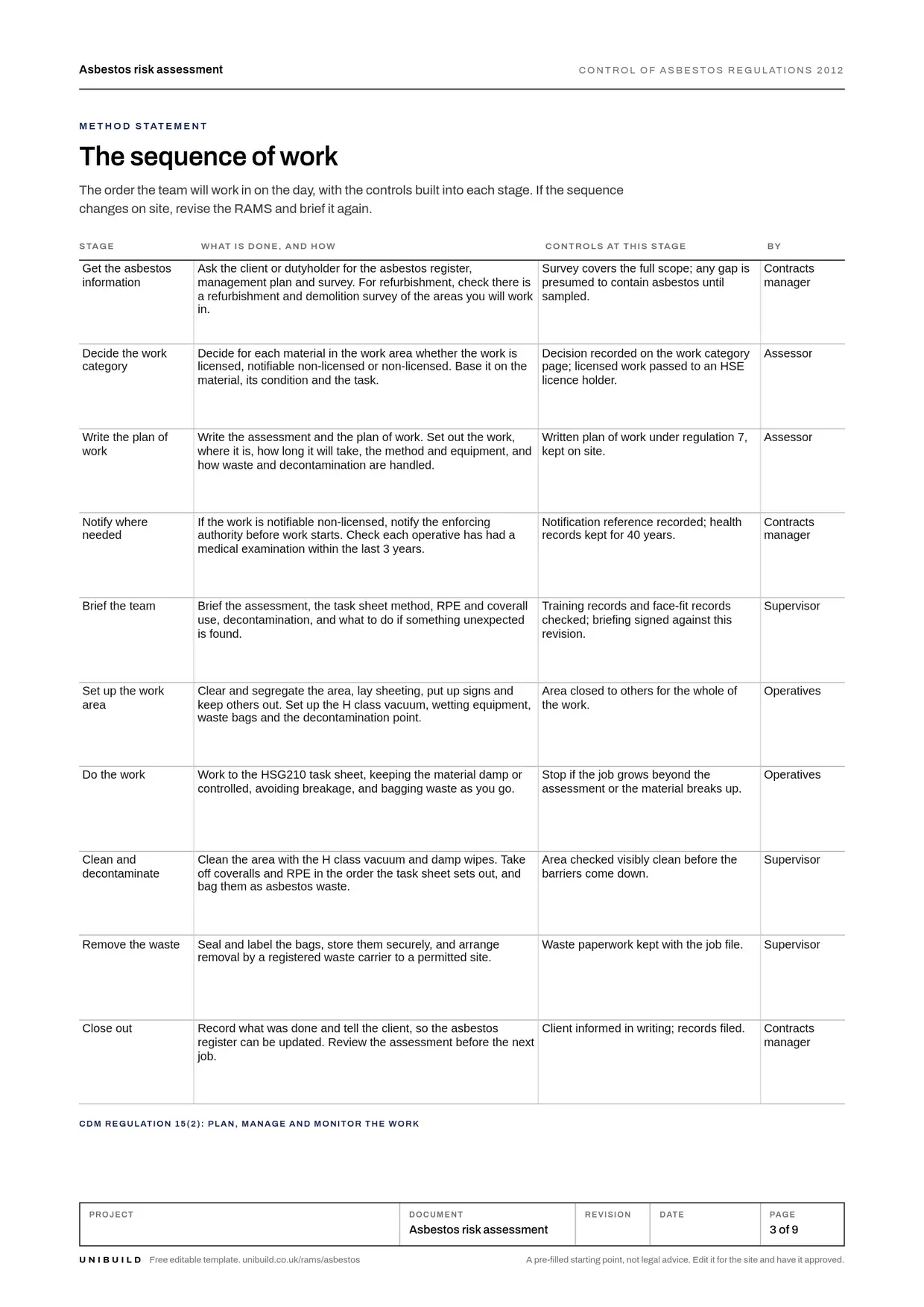
Asbestos risk assessment: the sequence of work
The order of work, with the controls at each stageThe order a trade works in where asbestos may be present, with the controls built into each stage. If anything unexpected is found, stop and revise the assessment before going on.
Get the asbestos information
Ask the client or dutyholder for the asbestos register, management plan and survey. For refurbishment, check there is a refurbishment and demolition survey of the areas you will work in.
ControlsSurvey covers the full scope; any gap is presumed to contain asbestos until sampled.
Decide the work category
Decide for each material in the work area whether the work is licensed, notifiable non-licensed or non-licensed. Base it on the material, its condition and the task.
ControlsDecision recorded on the work category page; licensed work passed to an HSE licence holder.
Write the plan of work
Write the assessment and the plan of work. Set out the work, where it is, how long it will take, the method and equipment, and how waste and decontamination are handled.
ControlsWritten plan of work under regulation 7, kept on site.
Notify where needed
If the work is notifiable non-licensed, notify the enforcing authority before work starts. Check each operative has had a medical examination within the last 3 years.
ControlsNotification reference recorded; health records kept for 40 years.
Brief the team
Brief the assessment, the task sheet method, RPE and coverall use, decontamination, and what to do if something unexpected is found.
ControlsTraining records and face-fit records checked; briefing signed against this revision.
Set up the work area
Clear and segregate the area, lay sheeting, put up signs and keep others out. Set up the H class vacuum, wetting equipment, waste bags and the decontamination point.
ControlsArea closed to others for the whole of the work.
Do the work
Work to the HSG210 task sheet, keeping the material damp or controlled, avoiding breakage, and bagging waste as you go.
ControlsStop if the job grows beyond the assessment or the material breaks up.
Clean and decontaminate
Clean the area with the H class vacuum and damp wipes. Take off coveralls and RPE in the order the task sheet sets out, and bag them as asbestos waste.
ControlsArea checked visibly clean before the barriers come down.
Remove the waste
Seal and label the bags, store them securely, and arrange removal by a registered waste carrier to a permitted site.
ControlsWaste paperwork kept with the job file.
Close out
Record what was done and tell the client, so the asbestos register can be updated. Review the assessment before the next job.
ControlsClient informed in writing; records filed.
What the law asks for asbestos
Checked against the sourceDuty to manage
Whoever is responsible for maintaining non-domestic premises must find out whether asbestos is present and record it. They manage it under a written plan and give the information to anyone liable to disturb it.
Control of Asbestos Regulations 2012, regulation 4Identify before work
In any premises, an employer must not start work that could expose employees to asbestos until they have found out. They need to know whether it is present, its type, the material and its condition. Where in doubt, they presume it is.
Control of Asbestos Regulations 2012, regulation 5Assess and plan
Before work with asbestos, the employer makes a suitable and sufficient risk assessment and records the significant findings. Every job with asbestos also needs a written plan of work.
Control of Asbestos Regulations 2012, regulations 6 and 7Licensed work
Licensable work includes work on asbestos coatings and most work on AIB and asbestos insulation. Only an employer holding an HSE licence may do it, and it is notified at least 14 days before it starts.
Control of Asbestos Regulations 2012, regulations 2, 8 and 9Notifiable non-licensed work
NNLW is notified to the enforcing authority before work starts. Workers have a medical examination at least every 3 years, and health records are kept for at least 40 years.
Control of Asbestos Regulations 2012, regulations 3, 9 and 22Control limit and training
Exposure is prevented, or reduced as low as reasonably practicable. It never exceeds the control limit of 0.1 fibres per cm³ over 4 hours. Workers liable to be exposed are trained at regular intervals.
Control of Asbestos Regulations 2012, regulations 2, 10 and 11Competence, equipment and PPE
Competence and cards
- All trades Asbestos awareness training before working on the fabric of any building that could contain asbestos.
- Non-licensed work Training for the specific non-licensed tasks, refreshed every year.
- Supervisor Trained in non-licensed work and the HSG210 methods the job uses.
- Surveyor A competent surveyor for the refurbishment and demolition survey, working to HSG264.
- Licensed contractor An HSE licence holder for any licensable work, with the licence checked before they start.
Plant and equipment
- H class vacuum cleaner Suitable for asbestos; filter and hose checked before use.
- Hand sprayer for wetting Filled and working before work starts.
- Polythene sheeting and tape Enough to protect surfaces and seal off the area.
- Asbestos waste bags Labelled for asbestos waste; enough for the work and the PPE.
- Reusable RPE Pre-use check; filters suitable for asbestos; examined at intervals.
PPE
- Respiratory protection as the task sheet specifies, face-fit tested, with a clean-shaven wearer.
- Disposable coveralls with a hood, bagged as asbestos waste after use.
- Gloves disposable, bagged as asbestos waste after use.
- Safety footwear wiped clean or bagged before leaving the work area.
Permits and plans
A permit to work where the client or principal contractor requires one before the building fabric is opened up. Notifiable non-licensed work is notified to the enforcing authority before it starts. Licensed work is notified by the licence holder at least 14 days before it starts.
Emergency and rescue
If suspected asbestos is found or disturbed: stop work, keep everyone out of the area and do not clean up. Tell the supervisor, who checks the survey and arranges sampling. Contaminated clothing is bagged as asbestos waste, never taken home. First aid and the site emergency procedure apply to any other incident.
Toolbox talk: asbestos
Read this to the team before work starts, tick each point as it is covered, and record who attended.
- Any building built or refurbished before 2000 can contain asbestos. Check the survey before you drill, cut or lift anything.
- If it is not on the survey and you are not sure what it is, treat it as asbestos.
- Lagging, sprayed coatings and most insulating board are licensed work. We do not touch them.
- If you uncover something suspect: stop, keep people out and tell the supervisor. Do not sweep it up.
- Masks on and checked before the work starts, and coveralls bagged before you leave the area.
- Nothing contaminated goes home. No work clothes in the van or the washing machine.
Ask the team
- Where is the asbestos survey for this job, and what does it show in our work area?
- What would you do if you broke into a board you did not expect?
- Which materials here would need a licensed contractor?
What is in the asbestos risk assessment template
9 pages, pre-filled and editableThe work, pre-filled
Scope, location and access, interfaces with occupants and other trades, and the documents the assessment relies on, including the survey.
The sequence of work
Ten stages from getting the asbestos information to close-out, with the controls and the person responsible at each one.
Hazards and controls
Thirteen asbestos hazards rated before and after controls on a five by five matrix, with room for your own.
Information check and work category
A page to confirm the survey covers the job, then decide for each material whether the work is licensed, NNLW or non-licensed.
Equipment, PPE and permits
The vacuum, wetting and waste equipment with their checks, PPE by type, and the notifications the job needs.
Briefing record
Twenty signatures against the revision, taken on the day before the work starts.
Brief it, and get it signed on the phone
On Unibuild a RAMS is written from a template, approved, then read by each operative on their phone in their own language and signed. Subcontract and agency workers sign through a link, with no app to install.
Every signature carries its date and time and prints as the last page of the RAMS PDF. Change the RAMS and it has to be signed again.
How RAMS work on UnibuildAsbestos risk assessment questions
Is this asbestos risk assessment template free?
Is an asbestos risk assessment a legal requirement?
Can a non-licensed contractor remove asbestos?
What is notifiable non-licensed work?
What counts as short duration work on AIB?
Do I need an asbestos survey before refurbishment work?
How often is asbestos training refreshed?
Does the asbestos duty to manage apply to houses?
RAMS templates for other trades and hazards
All free, pre-filled and editableBy trade
- Electrical RAMSSafe isolation, live work, testing and inspection, and working near other trades.
- Scaffolding RAMSErecting, altering and dismantling tube and fitting and system scaffold, with handover and inspection.
- Roofing RAMSPitched and flat roofs, fragile surfaces, edge protection, hot work and getting materials up safely.
- Groundworks RAMSExcavations, buried services, plant, trench support and inspections at the start of each shift.
- Plumbing and heating RAMSSoldering and brazing, gas work, unvented systems, lofts and occupied homes.
- Painting and decorating RAMSAccess equipment, solvents and spray, old lead paint, dust from preparation and occupied buildings.
- Hot works and welding RAMSWelding, cutting, grinding and torch-on work: permits, fire watch, fume and gas cylinders.
By hazard
- COSHH risk assessmentHazardous substances on site: dusts, solvents, cement, resins and fume, assessed and controlled.
- Manual handling risk assessmentLifting, carrying, pushing and pulling, assessed by task, individual, load and environment.
- Working at height risk assessmentLadders, towers, MEWPs, scaffolds and roofs, chosen and controlled in the order the law sets.
- Lone working risk assessmentPeople working alone on site, in empty buildings and out of hours, with check-ins and a plan if they go quiet.
- Noise and vibration risk assessmentNoise exposure and hand-arm vibration from tools, measured against the action and limit values.
- Asbestos risk assessmentFinding asbestos before work starts, deciding whether work is licensed, and controlling non-licensed work.
- Confined space risk assessmentManholes, tanks, voids and chambers: avoiding entry, a safe system of work, gas testing and rescue.
The blank RAMS template, the RAMS review checklist and every other free form are on Free downloads.
The RAMS, read and signed
before the work starts.
Unibuild keeps every RAMS with its versions, its approvals and each operative’s signature against the revision they read, for seven years, ready for the principal contractor or an auditor.