Free toolbox talk · Manual handling

Manual handling toolbox talk

A toolbox talk on manual handling, written to be read aloud in about six minutes: why bad backs build up, the order the law asks you to think in, the loads on this site, and how to lift when you have to. The last page is the attendance record.

PDF · 3 pages · 210 KB · Word 41 KB · Free to use and reuse · Terms

Law
Manual Handling Operations Regulations 1992
Time to deliver
About six minutes
Format
PDF and Word, with a sign-off sheet
Cost
Free, always

What this toolbox talk covers

This talk is for anyone who lifts, lowers, carries, pushes or pulls a load by hand: blocks, bags, boards, kerbs, kit, cable drums, anything that moves because a person moved it. It takes about six minutes to give and covers why manual handling injuries build up over months rather than in one lift, the order the law puts the choices in, and what to look at before a load is picked up.

It is written to be read aloud, with the points a supervisor makes in the order they make them, two short lists of do and do not, and questions to put to the team so the talk is a conversation rather than a reading. The last page is the record: who gave it, who heard it and what was raised.

There is no legal weight limit for manual handling. The law asks for the risk to be avoided where it can be, assessed where it cannot, and reduced as far as reasonably practicable. The manual handling risk assessment holds the full task, individual, load and environment assessment this talk briefs.

Checked against HSE guidance and legislation.gov.uk on .

Toolbox talk · About six minutes

Manual handling: the talk

Read it as written or in your own words. Tick each point as you make it. Stop for the questions.

Why it matters

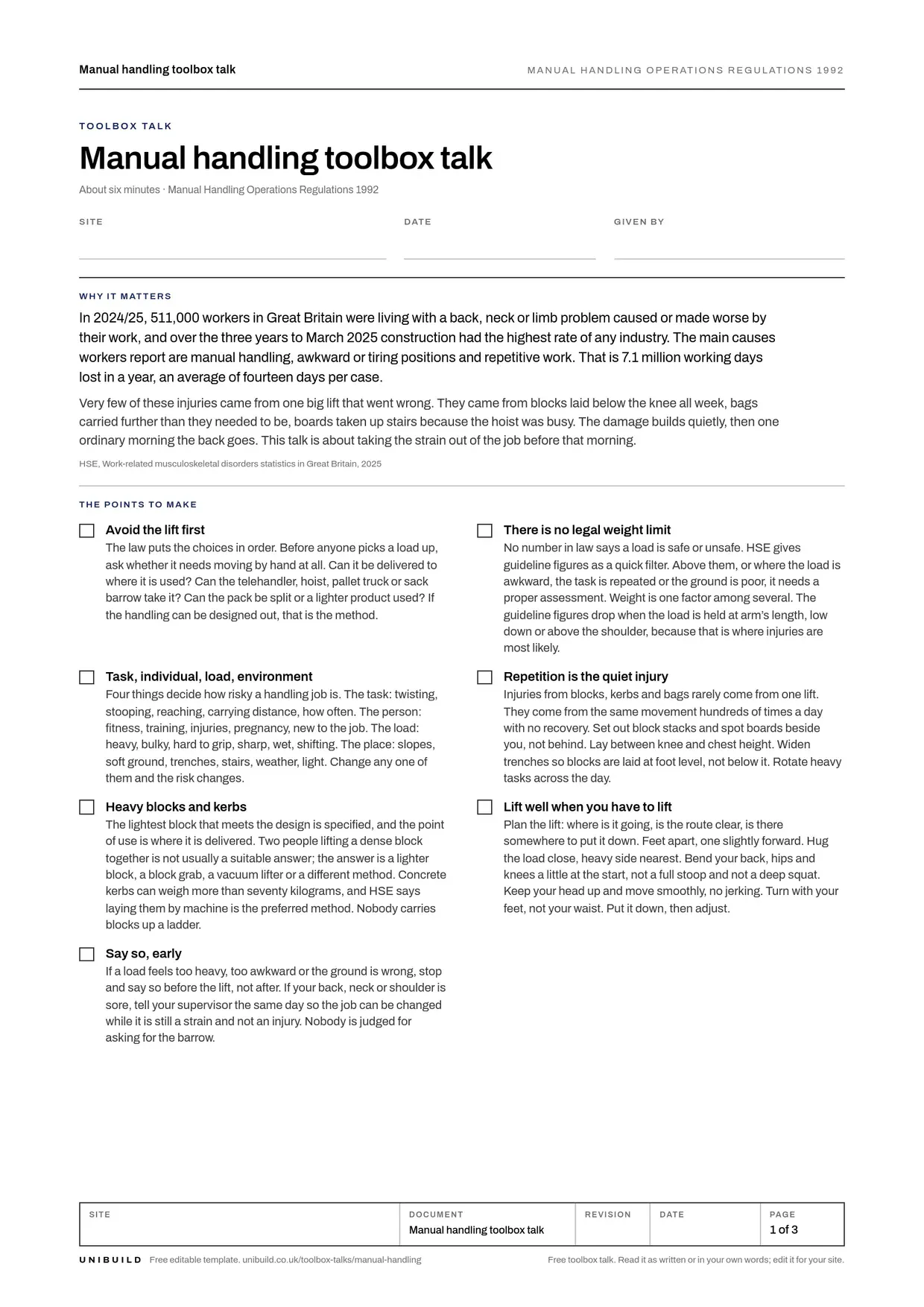
In 2024/25, 511,000 workers in Great Britain were living with a back, neck or limb problem caused or made worse by their work, and over the three years to March 2025 construction had the highest rate of any industry. The main causes workers report are manual handling, awkward or tiring positions and repetitive work. That is 7.1 million working days lost in a year, an average of fourteen days per case.

Very few of these injuries came from one big lift that went wrong. They came from blocks laid below the knee all week, bags carried further than they needed to be, boards taken up stairs because the hoist was busy. The damage builds quietly, then one ordinary morning the back goes. This talk is about taking the strain out of the job before that morning.

HSE, Work-related musculoskeletal disorders statistics in Great Britain, 2025

The points to make

Avoid the lift first

The law puts the choices in order. Before anyone picks a load up, ask whether it needs moving by hand at all. Can it be delivered to where it is used? Can the telehandler, hoist, pallet truck or sack barrow take it? Can the pack be split or a lighter product used? If the handling can be designed out, that is the method.

There is no legal weight limit

No number in law says a load is safe or unsafe. HSE gives guideline figures as a quick filter. Above them, or where the load is awkward, the task is repeated or the ground is poor, it needs a proper assessment. Weight is one factor among several. The guideline figures drop when the load is held at arm’s length, low down or above the shoulder, because that is where injuries are most likely.

Task, individual, load, environment

Four things decide how risky a handling job is. The task: twisting, stooping, reaching, carrying distance, how often. The person: fitness, training, injuries, pregnancy, new to the job. The load: heavy, bulky, hard to grip, sharp, wet, shifting. The place: slopes, soft ground, trenches, stairs, weather, light. Change any one of them and the risk changes.

Repetition is the quiet injury

Injuries from blocks, kerbs and bags rarely come from one lift. They come from the same movement hundreds of times a day with no recovery. Set out block stacks and spot boards beside you, not behind. Lay between knee and chest height. Widen trenches so blocks are laid at foot level, not below it. Rotate heavy tasks across the day.

Heavy blocks and kerbs

The lightest block that meets the design is specified, and the point of use is where it is delivered. Two people lifting a dense block together is not usually a suitable answer; the answer is a lighter block, a block grab, a vacuum lifter or a different method. Concrete kerbs can weigh more than seventy kilograms, and HSE says laying them by machine is the preferred method. Nobody carries blocks up a ladder.

Lift well when you have to lift

Plan the lift: where is it going, is the route clear, is there somewhere to put it down. Feet apart, one slightly forward. Hug the load close, heavy side nearest. Bend your back, hips and knees a little at the start, not a full stoop and not a deep squat. Keep your head up and move smoothly, no jerking. Turn with your feet, not your waist. Put it down, then adjust.

Say so, early

If a load feels too heavy, too awkward or the ground is wrong, stop and say so before the lift, not after. If your back, neck or shoulder is sore, tell your supervisor the same day so the job can be changed while it is still a strain and not an injury. Nobody is judged for asking for the barrow.

Do

  • Ask whether the load needs moving by hand before anyone picks it up.
  • Get materials delivered as close as possible to where they are used, on level ground, single stacked where you can.
  • Use the hoist, telehandler, pallet truck, sack barrow or block grab whenever one would do the job.
  • Check the route is clear, lit and firm, and the set-down point is ready before you lift.
  • Keep the load close, feet apart, head up, and turn with your feet.
  • Report aches, pains and awkward loads the same day so the work can be changed.

Do not

  • Do not carry blocks, bags or boards up a ladder. Use the hoist or a platform.
  • Do not twist while holding a load. Put it down, move your feet, pick it up again.
  • Do not lay or lift below knee height or above shoulder height for long periods.
  • Do not rely on two people for a dense block when a lighter block or a machine is available.
  • Do not carry on with a sore back because the job is nearly finished.
  • Do not lift a load you cannot see over or get a firm grip on. Split it or get help.

Ask the team

  • Which loads on this site today are heaviest, and how are they getting to where they are used?
  • What handling kit do we have on site, and where is it right now?
  • Where are we laying or lifting below the knee or above the shoulder, and can we change the height?
  • If a block or bag feels wrong, who do you tell and what happens next?
  • Has anyone got a strain or ache at the moment that we should be working around?

To close

Backs do not go on purpose. They go because the stack was behind you, the hoist was busy, the trench was narrow and the job was nearly done. The lift you can design out is the safest lift there is. If a load looks wrong, stop, ask, and we will find a better way to move it.

Record it. Who gave the talk, where, when, who was there and what was raised. The last page of the sheet is the record.

In Unibuild a talk is read in each operative’s own language and signed on the phone. How toolbox talks work

The law behind this talk

Checked against the source

Avoid, assess, reduce

Each employer must, so far as is reasonably practicable, avoid the need for employees to undertake manual handling operations at work which involve a risk of their being injured. Where that is not reasonably practicable, the employer makes a suitable and sufficient assessment of those operations, takes appropriate steps to reduce the risk of injury to the lowest level reasonably practicable, and gives employees general indications and, where reasonably practicable, precise information on the weight of each load and the heaviest side of any load whose centre of gravity is not central.

Manual Handling Operations Regulations 1992, regulation 4(1)

What the assessment looks at

The assessment considers the tasks (holding loads away from the trunk, twisting, stooping, reaching, large vertical movement, long carrying distances, strenuous pushing or pulling, repetition, insufficient rest), the loads (heavy, bulky, hard to grasp, unstable, sharp or hot), the working environment (space, floors, levels, temperature, lighting) and individual capability, together with any hindrance from clothing or personal protective equipment. It is reviewed when there is reason to suspect it is no longer valid or the operations change significantly.

Manual Handling Operations Regulations 1992, regulation 4(2) and Schedule 1

Who the person is

In deciding whether a manual handling operation involves a risk of injury and what steps to take, the employer has regard to the physical suitability of the employee, the clothing, footwear and other personal effects they are wearing, their knowledge and training, the results of any relevant risk assessment under the Management Regulations, whether the employee is in a group identified by that assessment as especially at risk, and the results of any health surveillance.

Manual Handling Operations Regulations 1992, regulation 4(3)

The duty on the person lifting

Each employee while at work makes full and proper use of any system of work provided by the employer to reduce the risk of injury from manual handling. HSE guidance adds that employees follow the systems of work in place, use the equipment provided, cooperate on health and safety, tell the employer about hazardous handling activities, and take care that their own work does not put others at risk.

Manual Handling Operations Regulations 1992, regulation 5; HSE INDG143(rev4)

What is on the sheet

3 pages, the talk and the record

The talk, over two pages

Why it matters, the points to make, do and do not, and the questions to ask, laid out to read from in the cabin or at the workface. Space at the top for the site, the date and who is giving it.

The last page, the record

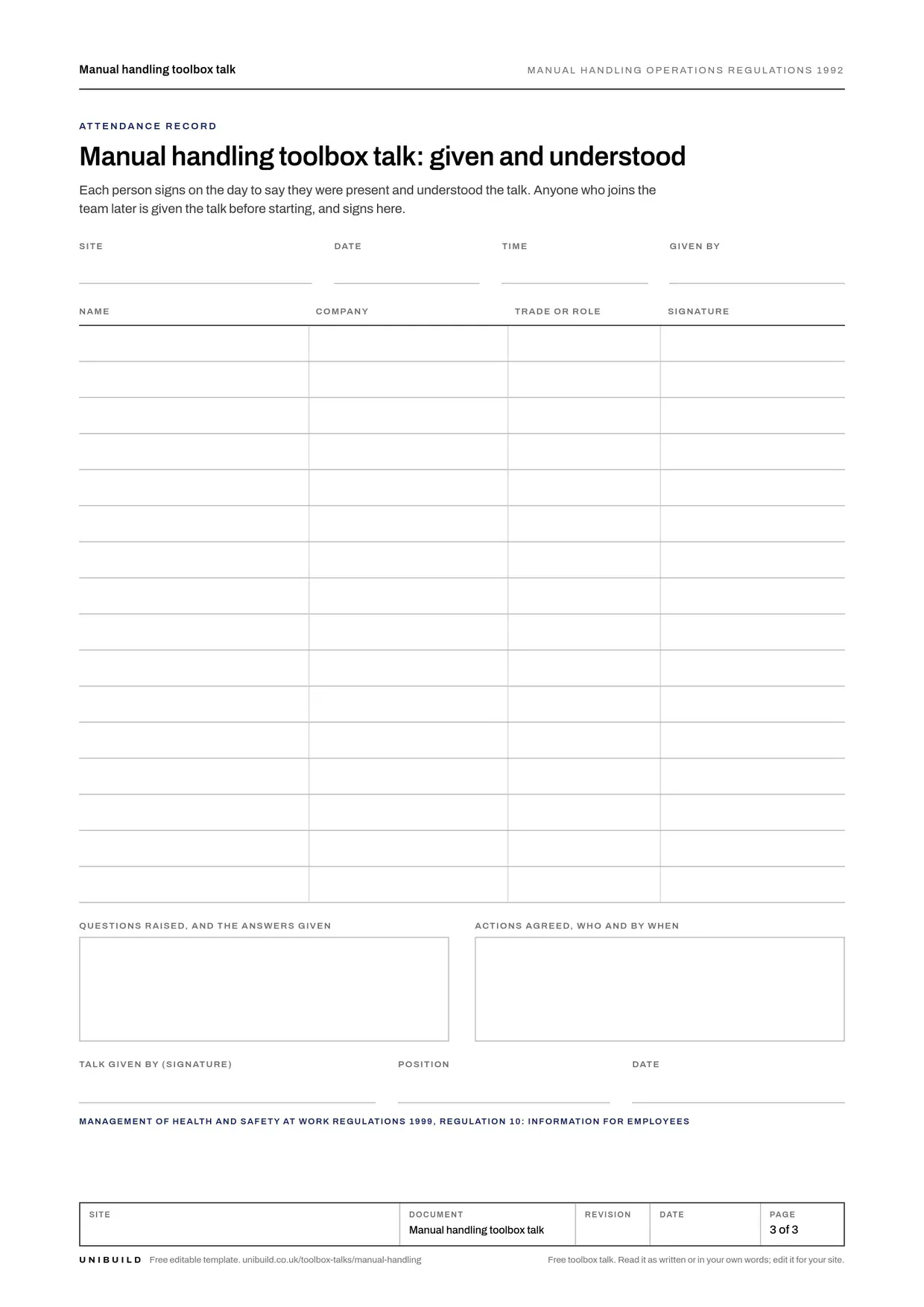
The attendance record: each person's name, company and signature, the questions raised and any actions, signed off by the person who gave the talk. Type into it or print it and pass it round.

The Word version

The same talk as a Word document, so you can put your own letterhead on it, add a site photograph or change a point to match how your job is set up.

Download the talk as PDF Word versionPDF · 3 pages · 210 KB
After it is given

Delivered on the phone, signed in the room

On Unibuild a toolbox talk is picked from the library, read by each operative on their own phone in their own language and signed there and then. The record is filed against the operative, the site and the date.

A site manager sees who has had which talk, and who has not, without a sheet going round on Thursday.

How toolbox talks work on Unibuild
How long should a manual handling toolbox talk be?
About five to ten minutes. This one reads in about six if you make every point and stop for the questions. A toolbox talk is a short, focused briefing, not a training course. Manual handling training is separate and is recorded in the training matrix.
Is there a legal weight limit for lifting at work?
No. The Manual Handling Operations Regulations 1992 set no weight limit. HSE INDG143 gives guideline figures for a quick check, 25 kg for men and 16 kg for women lifting at knuckle height close to the body, with lower figures further from the body and at other heights. Loads above the guideline, or awkward, repeated or carried loads, need a proper assessment.
Can two people lift a heavy block or kerb between them?
HSE says relying on two people to handle heavier blocks is not usually a suitable solution. The answer is the lightest block that meets the design, delivery close to the point of use, a block grab or vacuum lifter, or a different construction method. For kerbs and heavy paving HSE says mechanised laying is the preferred method, with manual laying kept to rare short sections.
How often should we give this talk?
The law does not set an interval. Give it when a team starts a job with heavy or repeated handling, when the materials or the delivery point change, after anyone reports a strain, and as part of a rolling programme so no topic goes more than a few months without a refresh. Record each delivery.
Who can deliver a toolbox talk on manual handling?
A supervisor, site manager or a competent member of the team who knows the job and the handling aids on site. The person delivering it should be able to answer the questions on the sheet for this site. If they cannot, they bring someone who can.
Do we have to keep a record of the talk?
There is no regulation that names toolbox talk records, but the Management Regulations require information and training to be provided and most principal contractors and auditors ask for the evidence. A signed attendance record, with the date and the topic, is the evidence. The last page of the sheet is that record.
Does a toolbox talk count as manual handling training?
No. It is a reminder and a conversation about the loads on this site. Regulation 4(3) expects the employer to take account of each person’s knowledge and training, and HSE says training helps but on its own will not make handling safe. Keep the talk, and keep the training record separately.
Is this manual handling toolbox talk free?
Yes. Download it, print it, give it, edit it and put your own name on it, including on paid work and for clients, with no sign-up and no email address.
Next step

The talk given, understood
and on record.

Unibuild keeps every toolbox talk against the operative who signed it, the site and the date, for seven years, ready for the principal contractor or an auditor.