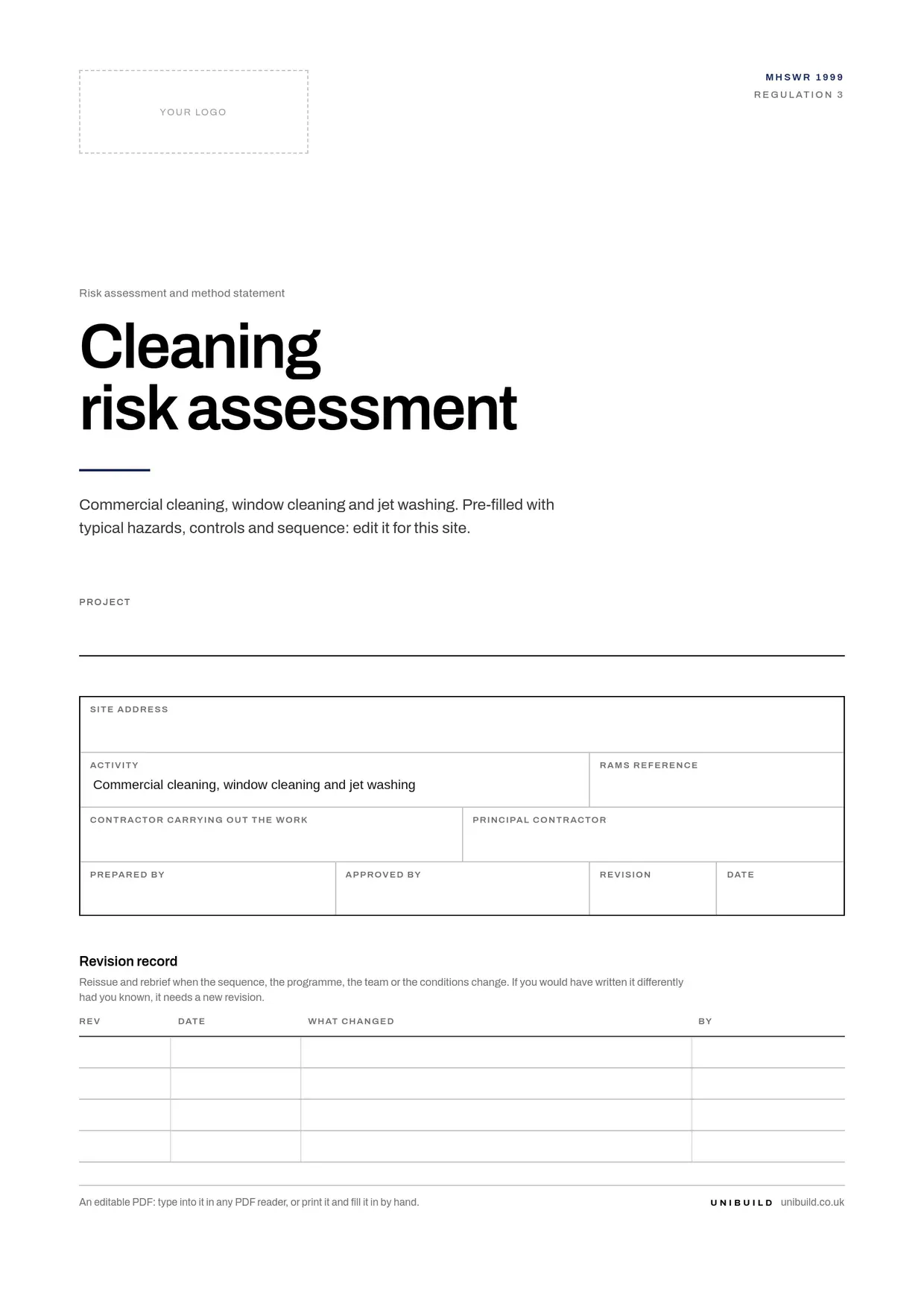
Commercial cleaning risk assessment template
A commercial cleaning risk assessment and method statement, already filled in for cleaning chemicals, wet floors, window cleaning, jet washing, sharps, lone work and builders' cleans. Edit it for your site, then brief it.
- Law
- COSHH 2002 and MHSWR 1999
- Wet floors
- Barriers or sections, not just signs
- Format
- Editable PDF and Word
- Cost
- Free, always
Do you need a risk assessment for commercial cleaning?
Yes. Every cleaning business must assess the risks of its work, and a commercial cleaning risk assessment is usually the first document a client or principal contractor asks for. The record must be written down if you employ five or more people.
The general duty is regulation 3 of the Management of Health and Safety at Work Regulations 1999. COSHH adds an assessment for the cleaning products, the Work at Height Regulations cover windows, gutters and high-level cleaning, and jet washing a building, or cleaning it with corrosive or toxic substances, falls within the CDM 2015 definition of construction work.
A risk assessment for cleaners should describe the building in front of you: the floors, the products, the windows and how they are reached, who else is in the building, and whether anyone works alone or out of hours. A method statement then sets out the order of work, which most sites expect for window cleaning, jet washing and builders' cleans.
Checked against legislation.gov.uk and HSE guidance on .
Cleaning hazards and controls
18 hazards, rated before and after controlsThe significant hazards on a typical commercial, window cleaning or jet washing contract, with the controls a client or reviewer expects to see. Delete what does not apply and add what your site has.
Corrosive and irritant cleaning products
Cleaners diluting, decanting and using products, from burns to the skin and eyes.
- A COSHH assessment for each hazardous product, from its label and safety data sheet; milder products used where they do the job.
- Products used at the dilution on the label, from dosing equipment where supplied, and decanted only into labelled containers.
- Gloves and eye protection as the data sheet specifies; eyewash on hand where corrosives are used.
BeforeMedium 12AfterLow 4
Mixing products and toxic gas
Cleaners and occupants, from gas released when bleach meets acid or other products.
- Products never mixed. Bleach is kept apart from acid descalers and toilet cleaners, which release chlorine gas on contact.
- Incompatible products stored separately, in their original containers, and cupboards kept locked.
- Rooms ventilated while products are in use; anyone affected moved to fresh air.
BeforeMedium 12AfterLow 4
Wet work and dermatitis
Cleaners whose hands are wet for long periods or many times a day.
- Gloves suited to the product, with cotton liners for long wear, and changed when wet inside.
- Contamination removed promptly, hands washed and dried thoroughly, and skin cream used regularly.
- Regular skin checks by a responsible person, with any redness or cracking reported early.
BeforeMedium 8AfterLow 4
Slips on wet and contaminated floors
Cleaners, occupants and the public walking on floors left wet or being cleaned.
- Access stopped with barriers, locked doors or by cleaning in sections, keeping a dry route open. Signs and cones only warn.
- Floors cleaned when they are quietest, with a dry mop or squeegee to cut drying time; spills spot cleaned straight away.
- Slip-resistant footwear for cleaners; signs removed once the floor is dry.
BeforeMedium 12AfterMedium 6
Falls from ladders and stepladders
Window cleaners and cleaners reaching high-level glass, fittings and ledges.
- Water fed poles or work from the inside first; ladders only for light, low-risk work, with other equipment considered for any task over 30 minutes at a time.
- Ladders checked before use, footed or tied whenever possible, never on a wet or uneven base.
- Stepladders face on, locks engaged, three points of contact; no overreaching.
BeforeHigh 16AfterMedium 8
Water fed poles near power lines
Window cleaners extending poles near overhead lines, cables and building services.
- Overhead lines and cables checked before poles are extended; no pole work within reach of them.
- Poles carried lowered and extended only at the point of work.
BeforeMedium 10AfterMedium 5
Roofs, gutters and fragile surfaces
Cleaners clearing gutters, roof glazing and high-level surfaces.
- Gutters cleared from the ground with a gutter vacuum and poles where possible.
- No one on a roof unless the plan provides edge protection or a MEWP; fragile rooflights and sheets covered or kept off.
- MEWPs used only by IPAF trained operators, with a restraint lanyard in a boom.
BeforeHigh 15AfterMedium 5
Pressure washer jet injuries
Operators, helpers and passers-by, from cuts and water forced under the skin.
- Only trained operators; lance never pointed at people, trigger lock on when not spraying.
- Exclusion zone barriered, with the work timed or the route closed so the public are kept clear of spray and debris.
- Face visor, waterproof clothing and boots; any jet injury seen by a doctor at once, however small it looks.
BeforeMedium 12AfterLow 4
Electricity and water
Operators of electric pressure washers, scrubber dryers and vacuums in wet areas.
- Equipment and leads checked each time before use, with a set testing interval suited to wet and outdoor use.
- Mains equipment on an RCD-protected supply, or reduced voltage on site; plugs and connections kept out of water.
- Damaged equipment taken out of use and labelled.
BeforeHigh 15AfterMedium 5
Petrol and diesel washers and fuel
Operators and occupants, from exhaust fumes, hot surfaces and fuel spills.
- Engine-driven units run only in the open air, never in buildings, car parks or enclosed yards.
- Refuelled with the engine off and cool, from a proper fuel can, away from drains.
BeforeMedium 10AfterMedium 5
Needles and sharps
Cleaners emptying bins, clearing washrooms, stairwells, car parks and grounds.
- Bins and bags never compacted by hand or foot; bags held away from the body.
- Needles picked up only with tongs or a litter picker, into a sharps box, wearing puncture-resistant gloves.
- Wound encouraged to bleed, washed with soap and water, and urgent medical advice sought.
BeforeMedium 12AfterLow 4
Body fluids and contaminated waste
Cleaners dealing with blood, vomit and soiled waste in washrooms and public areas.
- Spill kit with disposable gloves, apron and absorbent; spill contained, then the area disinfected to the product label.
- Cuts covered with waterproof dressings; hands washed after removing gloves.
BeforeMedium 9AfterLow 3
Bird droppings
Cleaners clearing droppings from ledges, canopies, gutters and plant areas.
- Droppings damped down first and removed by hand tools into sealed bags. Never pressure washed, which creates contaminated droplets.
- RPE with an assigned protection factor of 20, such as FFP3, face fit tested; disposable overalls and gloves.
- Hands washed before eating or smoking; breaks away from the work area; no one with a weakened immune system on this task.
BeforeMedium 12AfterLow 4
Lone and out of hours working
Cleaners working alone early, late or at weekends, in empty or remote buildings.
- Lone work agreed in the risk assessment, with check-ins at arrival, set times and departure, and action on a missed one.
- No higher-risk tasks, such as ladder work or jet washing, done alone.
- Alarm, entry and exit procedures agreed with the client; doors kept secured while working.
BeforeMedium 12AfterMedium 8
Manual handling and repetitive work
Cleaners lifting buckets, machines and waste, and using poles and mops for long periods.
- Buckets filled and emptied where they stand, with trolleys and wheeled buckets; machines moved by two on stairs.
- Lightweight poles of the right length, with tasks rotated and breaks taken.
- Waste bags kept to a weight that can be lifted easily.
BeforeMedium 8AfterLow 4
Floor machines and trailing cables
Operators and occupants, from trips over leads and contact with rotating brushes.
- Leads run along walls and kept behind the operator; cordless machines where practicable.
- Machines switched off and unplugged before brushes or pads are changed.
BeforeMedium 6AfterLow 2
Dust on builders' cleans
Cleaners clearing plaster, concrete and other construction dust at the end of a job.
- Dust removed with an M class vacuum or by damp methods, never by dry sweeping or blowing.
- FFP3 RPE, face fit tested, for dusty work.
BeforeMedium 12AfterMedium 6
Unfinished buildings and other trades
Cleaners on site near open edges, unfinished stairs, live services and plant.
- Site induction and the principal contractor's rules followed; areas cleaned only when handed over for cleaning.
- No entry beyond barriers or into unguarded areas; damage or hazards reported, not moved.
- Helmet, boots and high visibility clothing to the site standard.
BeforeMedium 12AfterLow 4
Scores are likelihood times severity on the five by five matrix in the template. They are typical ratings for this work, a starting point for your own assessment of your site.
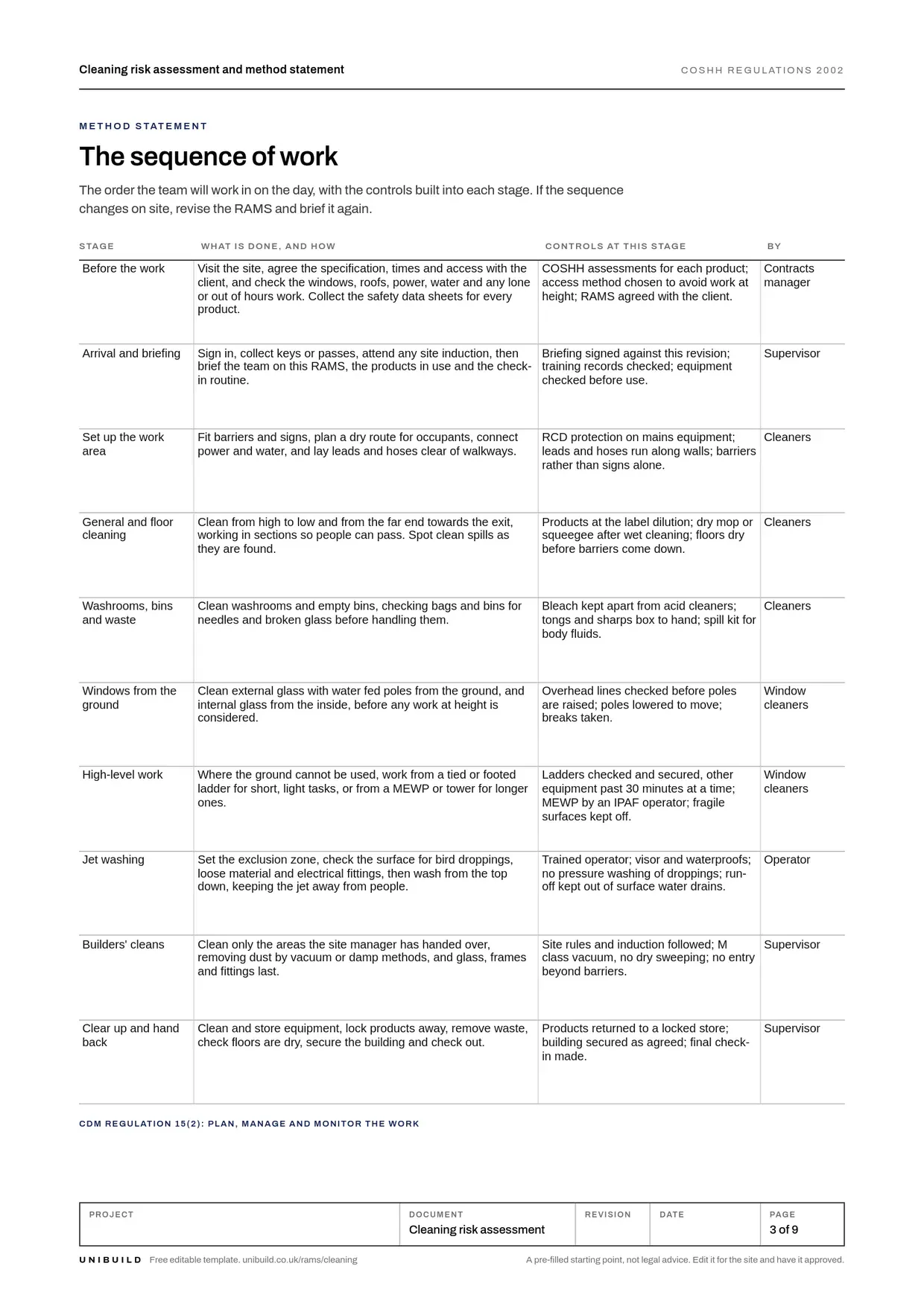
Cleaning method statement: the sequence of work
The order of work, with the controls at each stageThe order the team works in, with the controls built into each stage. If the sequence changes on site, revise the method statement and brief it again.
Before the work
Visit the site, agree the specification, times and access with the client, and check the windows, roofs, power, water and any lone or out of hours work. Collect the safety data sheets for every product.
ControlsCOSHH assessments for each product; access method chosen to avoid work at height; RAMS agreed with the client.
Arrival and briefing
Sign in, collect keys or passes, attend any site induction, then brief the team on this RAMS, the products in use and the check-in routine.
ControlsBriefing signed against this revision; training records checked; equipment checked before use.
Set up the work area
Fit barriers and signs, plan a dry route for occupants, connect power and water, and lay leads and hoses clear of walkways.
ControlsRCD protection on mains equipment; leads and hoses run along walls; barriers rather than signs alone.
General and floor cleaning
Clean from high to low and from the far end towards the exit, working in sections so people can pass. Spot clean spills as they are found.
ControlsProducts at the label dilution; dry mop or squeegee after wet cleaning; floors dry before barriers come down.
Washrooms, bins and waste
Clean washrooms and empty bins, checking bags and bins for needles and broken glass before handling them.
ControlsBleach kept apart from acid cleaners; tongs and sharps box to hand; spill kit for body fluids.
Windows from the ground
Clean external glass with water fed poles from the ground, and internal glass from the inside, before any work at height is considered.
ControlsOverhead lines checked before poles are raised; poles lowered to move; breaks taken.
High-level work
Where the ground cannot be used, work from a tied or footed ladder for short, light tasks, or from a MEWP or tower for longer ones.
ControlsLadders checked and secured, other equipment past 30 minutes at a time; MEWP by an IPAF operator; fragile surfaces kept off.
Jet washing
Set the exclusion zone, check the surface for bird droppings, loose material and electrical fittings, then wash from the top down, keeping the jet away from people.
ControlsTrained operator; visor and waterproofs; no pressure washing of droppings; run-off kept out of surface water drains.
Builders' cleans
Clean only the areas the site manager has handed over, removing dust by vacuum or damp methods, and glass, frames and fittings last.
ControlsSite rules and induction followed; M class vacuum, no dry sweeping; no entry beyond barriers.
Clear up and hand back
Clean and store equipment, lock products away, remove waste, check floors are dry, secure the building and check out.
ControlsProducts returned to a locked store; building secured as agreed; final check-in made.
What the law asks for cleaning work
Checked against the sourceRisk assessment
Every employer must make a suitable and sufficient assessment of the risks to their employees and to anyone else affected by the work, such as occupants and the public. With five or more employees, the significant findings are recorded.
Management of Health and Safety at Work Regulations 1999, regulation 3COSHH assessment
No work that could expose employees to a hazardous substance is carried out until the risk has been assessed. The assessment uses the label and safety data sheet, the level and length of exposure, and the risk from products used together.
COSHH Regulations 2002, regulation 6Substitute, then control
Exposure is prevented first, by substituting a safer product where reasonably practicable. Where it cannot be prevented, it is controlled by the way the work is done and by ventilation, with gloves and other PPE as the last measure.
COSHH Regulations 2002, regulation 7Floors free of slip hazards
So far as is reasonably practicable, floors and traffic routes in a workplace are kept free of obstructions and of anything that may cause a person to slip, trip or fall. Wet floors left after cleaning fall under this duty.
Workplace (Health, Safety and Welfare) Regulations 1992, regulation 12(3)Avoid work at height
Work is not done at height where it can reasonably be done safely another way, such as water fed poles from the ground. Where it cannot, suitable measures prevent falls so far as is reasonably practicable.
Work at Height Regulations 2005, regulation 6When cleaning is construction work
Maintenance of a structure, including cleaning with water or an abrasive at high pressure, or with corrosive or toxic substances, is construction work, as is preparing a structure for use or occupation when a project ends. CDM 2015 then applies, with its duties on clients and contractors.
Construction (Design and Management) Regulations 2015, regulation 2Competence, equipment and PPE
Competence and cards
- Cleaners Trained in the products, dilutions, equipment and this RAMS before starting, with new starters supervised.
- Supervisor Experienced cleaner able to check work, brief the team and act on a missed check-in.
- Window cleaners Trained in water fed pole use and safe ladder use; ladder work only by those trained for it.
- Pressure washer operators Trained on the machine, its pressure settings and the exclusion zone.
- MEWP operators IPAF PAL card for the category of machine.
- RPE wearers Face fit tested for tight-fitting masks, and clean shaven where the mask seals.
Plant and equipment
- Water fed pole system Pole, hose and joints checked before use; lightweight pole for the height.
- Ladders and stepladders Pre-use check each day; detailed inspection on a set schedule.
- Pressure washer Lance, trigger lock, hoses and leads checked before use; RCD tested.
- Scrubber dryer and vacuums Leads, plugs and brushes checked; M class vacuum for construction dust.
- MEWP Pre-use check; thorough examination at least every 6 months.
- Spill and sharps kits Stocked and in date; sharps box sealed when full.
PPE
- Gloves chemical-resistant as the data sheet specifies, puncture-resistant for waste and sharps.
- Eye protection for decanting, diluting and spraying products, and a face visor for jet washing.
- Safety footwear slip-resistant, and waterproof boots for jet washing.
- Respiratory protection FFP3, face fit tested, for construction dust and bird droppings.
- Waterproof clothing for jet washing and external work.
- Helmet and high visibility on construction sites and near traffic, to the site standard.
Permits and plans
A permit to work where the client or principal contractor requires one, for example for roofs, plant rooms or access to restricted areas. Agreement from the client before jet washing near public routes or out of hours. A lift plan or MEWP plan where the site rules ask for one.
Emergency and rescue
First aider and first aid kit on site or with the team, with eyewash for chemical splashes. Anyone affected by fumes is moved to fresh air. Needlestick or jet injuries get urgent medical attention. Missed check-ins are acted on at once. Nearest accident and emergency department named on the briefing.
Toolbox talk: cleaning safety
Read this to the team before work starts, tick each point as it is covered, and record who attended.
- Read the label before you use a product. Dilute it as it says, and never mix two products together.
- Bleach and acid cleaners make chlorine gas. Keep them apart, and if you smell gas, get out into fresh air.
- Barrier wet floors or clean in sections. A sign on its own does not stop anyone walking on it.
- Poles from the ground first. If you need a ladder, it is checked, secured and used for short jobs only.
- Never put your hand into a bin or bag. Needles are picked up with tongs and go straight into the sharps box.
- Keep the jet away from people, and never pressure wash bird droppings. Damp them down and bag them.
Ask the team
- Which products on this site must never be stored or used together?
- Who do you call if you are working alone and something goes wrong?
- Where are the overhead lines and fragile surfaces on this job?
What is in the cleaning risk assessment template
9 pages, pre-filled and editableThe work, pre-filled
Scope, location and access, interfaces with the client and other trades, the documents the RAMS relies on, and the team.
The sequence of work
Ten stages from the site visit to handing back, with the controls and the person responsible at each one.
Hazards and controls
Eighteen cleaning hazards rated before and after controls on a five by five matrix, with room for your own.
Equipment, PPE and products
Poles, ladders, pressure washers and machines with their checks, PPE by type, and the products with their COSHH references.
Cleaning products register
A page listing each product with its use, hazards, dilution, what it must not be mixed with, and the gloves and eye protection.
Emergency and briefing record
First aid, chemical splashes, sharps injuries and missed check-ins, then twenty signatures against the revision.
Brief it, and get it signed on the phone
On Unibuild a RAMS is written from a template, approved, then read by each operative on their phone in their own language and signed. Subcontract and agency workers sign through a link, with no app to install.
Every signature carries its date and time and prints as the last page of the RAMS PDF. Change the RAMS and it has to be signed again.
How RAMS work on UnibuildCleaning risk assessment questions
Is this cleaning risk assessment template free?
What should a commercial cleaning risk assessment include?
Is a risk assessment for cleaners a legal requirement?
Do I need a COSHH assessment for cleaning products?
What does a window cleaning risk assessment need?
What should a jet washing risk assessment cover?
Do I need a cleaning method statement as well?
Can cleaners work alone?
RAMS templates for other trades and hazards
All free, pre-filled and editableBy trade
- Air conditioning and HVAC RAMS
- Bricklaying RAMS
- Carpentry and joinery RAMS
- CCTV installation RAMS
- Cleaning risk assessment
- Concrete works RAMS
- Demolition RAMS
- Drylining RAMS
- Electrical RAMS
- Facilities maintenance RAMS
- Fire alarm installation RAMS
- Glazing and window RAMS
- Groundworks RAMS
- Hot works and welding RAMS
- Insulation RAMS
- Landscaping and fencing RAMS
- Painting and decorating RAMS
- Pest control risk assessment
- Plastering and rendering RAMS
- Plumbing and heating RAMS
- Rail RAMS
- Refurbishment RAMS
- Roofing RAMS
- Rope access risk assessment
- Scaffolding RAMS
- Solar PV installation RAMS
- Steel erection RAMS
- Temporary works RAMS
- Tiling and flooring RAMS
- Tree surgery RAMS
By hazard
- Asbestos risk assessment
- Confined space risk assessment
- COSHH risk assessment
- Dust risk assessment
- Forklift and telehandler risk assessment
- Housekeeping risk assessment
- Lifting operations risk assessment
- Lone working risk assessment
- Manual handling risk assessment
- MEWP risk assessment
- Noise and vibration risk assessment
- Plant and excavator risk assessment
- Power tools risk assessment
- Traffic management risk assessment
- Working at height risk assessment
The blank RAMS template, the RAMS review checklist and every other free form are on Free downloads.
The RAMS, read and signed
before the work starts.
Unibuild keeps every RAMS with its versions, its approvals and each operative’s signature against the revision they read, for seven years, ready for the principal contractor or an auditor.