
Rope access risk assessment and method statement
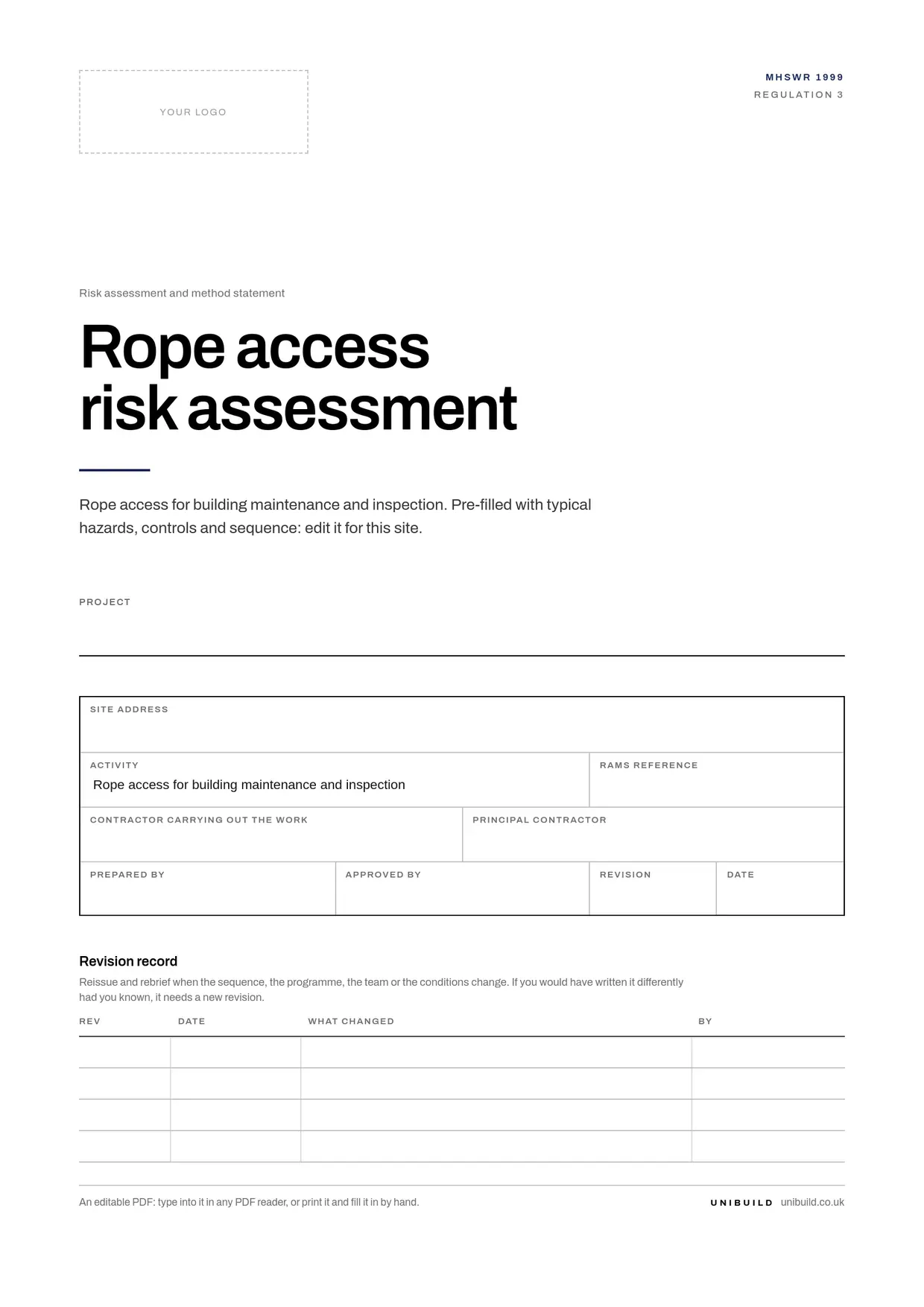
A rope access risk assessment and method statement, already filled in for rigging, the two-rope system, rescue from the rope, the zone below and the weather. Edit it for the building in front of you, then brief it.
- Law
- Work at Height Regulations 2005, Schedule 5
- System
- Two separately anchored lines
- Format
- Editable PDF and Word
- Cost
- Free, always
Do you need a risk assessment for rope access?
Yes. A rope access risk assessment comes before anyone goes over the edge, and the law goes further than for most work at height: rope access may only be used where a risk assessment shows safer equipment is not reasonably practicable. Clients and principal contractors will ask for it with a rope access method statement.
The duty to assess risk sits in regulation 3 of the Management of Health and Safety at Work Regulations 1999. Schedule 5 of the Work at Height Regulations 2005 then sets the system: two separately anchored lines, a suitable harness, and training for the user and enough others to carry out a rescue. An abseiling risk assessment for building work follows the same rules.
A rope access RAMS has to fit the building. The anchors and their records, the edges the ropes run over, the drop, the people below and the wind on that elevation decide the controls, and the rescue plan for each drop is what a reviewer reads first.
Checked against legislation.gov.uk and HSE guidance on .
Rope access hazards and controls
16 hazards, rated before and after controlsThe significant hazards on a typical rope access job for building inspection, cleaning, maintenance and repair, with the controls a reviewer expects to see. Delete what does not apply and add what your site has.
Falls while on the ropes
Technicians descending, ascending or working on a drop.
- Two separately anchored lines, a working line and a safety line, with the technician attached to both at all times.
- A back-up device on the safety line that travels with the technician, and a descender that locks if control is lost.
- Buddy check of harness, devices and connectors before every descent, confirmed by the Level 3.
BeforeHigh 15AfterMedium 5
Anchor failure
Technicians on the system if an eyebolt, anchor or structural member gives way.
- Installed anchors used only with a current test or examination record, kept with the RAMS.
- Structural anchors chosen by the Level 3 for the foreseeable load; never vents, pipework or rails of unknown strength.
- Working line and safety line each on their own anchor, so no single anchor failure drops the technician.
BeforeMedium 10AfterMedium 5
Ropes cut or damaged on edges
Technicians, if a rope is cut, worn or melted where it runs over a parapet, sill or coping.
- Rope protectors or edge rollers at every edge and contact point, checked on each descent.
- Ropes rigged clear of sharp metal, glass, hot exhausts and moving parts, with deviations where needed.
- No cutting, grinding or chemicals near the ropes unless the ropes are shielded or rerouted.
BeforeHigh 15AfterMedium 5
Falls while rigging at the roof edge
Technicians setting up anchors and ropes on a roof with open edges or fragile surfaces.
- Rigging done behind a parapet or guard-rail where there is one.
- Elsewhere, a work restraint lanyard to a separate anchor, short enough that nobody can reach the edge.
- Fragile rooflights and roof sheets identified in the survey and kept out of the rigging area.
BeforeHigh 15AfterMedium 5
Technician stranded or injured on the rope
A technician taken ill, injured or stuck on the ropes and unable to get down.
- Written rescue plan for each drop, with the rescue kit at the top and ready to use.
- Nobody on the ropes alone; enough people on site trained in the rescue, led by the Level 3.
- Rescue started at once by the team, without waiting for the emergency services, who are called at the same time.
BeforeMedium 10AfterMedium 5
Loss of control on descent
Technicians descending too fast, with a misthreaded device or off the end of a rope.
- Descender with a self-locking function, threaded and checked by the user and a second technician.
- Ropes long enough to reach the ground or landing, with stopper knots tied in the ends.
- Technicians trained and assessed for the devices in use, and familiar with the model.
BeforeMedium 10AfterMedium 5
Dropped tools and materials
The public, occupants and other trades below the drop.
- Every tool tethered to the technician or the work seat, with bags closed between uses.
- Heavier materials raised and lowered in bags on a separate line, never thrown or dropped.
- Exclusion zone below kept in place until the last technician is down.
BeforeHigh 16AfterMedium 8
People walking under the work
The public, building occupants and other trades entering the zone below.
- Barriered and signed exclusion zone, sized for the drop and for drift in the wind.
- Entrances and routes below closed or covered, as agreed with the building manager in advance.
- A ground person stationed where the zone crosses a route, in radio contact with the team.
BeforeMedium 12AfterLow 4
Wind, rain, cold and lightning
Technicians on exposed elevations, blown off line or chilled on long drops.
- Forecast checked each morning and the wind limit for the job written on the briefing.
- Wind measured at the top during the day; work stopped above the limit, in lightning or in icing.
- Warm, waterproof clothing in winter, water and shade in summer, and planned breaks.
BeforeMedium 12AfterMedium 8
Equipment failure or misuse
Technicians relying on ropes, devices, harnesses, connectors and slings.
- Pre-use check by the user each day, with defective kit tagged and taken out of use.
- Thorough examination at least every 6 months, or to an examination scheme, and each item traceable to its record.
- Kit used to the manufacturer's instructions, with components checked as compatible.
BeforeMedium 10AfterMedium 5
Loose facade material
People below, if stone, render, glass or cladding found loose during inspection falls.
- Inspection drops planned with the exclusion zone in place before anyone touches the facade.
- Loose material reported to the client at once, then made safe or removed under control.
- Nothing levered off and dropped; pieces bagged and lowered.
BeforeMedium 12AfterLow 4
Building plant, windows and cradles
Technicians struck by an opening window, a moving cradle or BMU, or hot fan exhausts.
- Work agreed with the building manager: cradles and BMUs isolated and roof plant made safe.
- Occupants told in advance, with windows on the drop locked or kept shut.
- Permit to work for roof access where the building operates one.
BeforeMedium 12AfterLow 4
Power tools used from the rope
Technicians drilling, grinding or fixing from a work seat or harness.
- Tools on lanyards, battery powered where possible, and chosen for one-handed control.
- A secure work position, with extra rigging or a seat for any task with high torque.
- Dust and fume controlled at source, with eye protection worn.
BeforeMedium 12AfterMedium 8
Harness pressure and fatigue
Technicians on long drops and full days in the harness.
- A work seat provided where the length of the task makes it necessary, as Schedule 5 requires.
- Planned breaks off the rope, tasks rotated and water at the top.
BeforeMedium 9AfterMedium 6
Cleaning and repair substances
Technicians using cleaning chemicals, sealants and resins, and the textile kit they touch.
- COSHH assessment for each product, with the safety data sheet checked before use.
- Products carried in small closed containers, kept away from ropes, harnesses and slings.
- Kit that touches a chemical quarantined until a competent person has checked it.
BeforeMedium 9AfterMedium 6
Carrying kit to the roof
Technicians carrying rope bags and equipment up stairs, ladders and roof hatches.
- Kit split into bags of a manageable weight and taken up in the lift where there is one.
- Bags hauled through roof hatches on a line, rather than carried up a fixed ladder.
BeforeMedium 6AfterLow 4
Scores are likelihood times severity on the five by five matrix in the template. They are typical ratings for this work, a starting point for your own assessment of your site.
Rope access method statement: the sequence of work
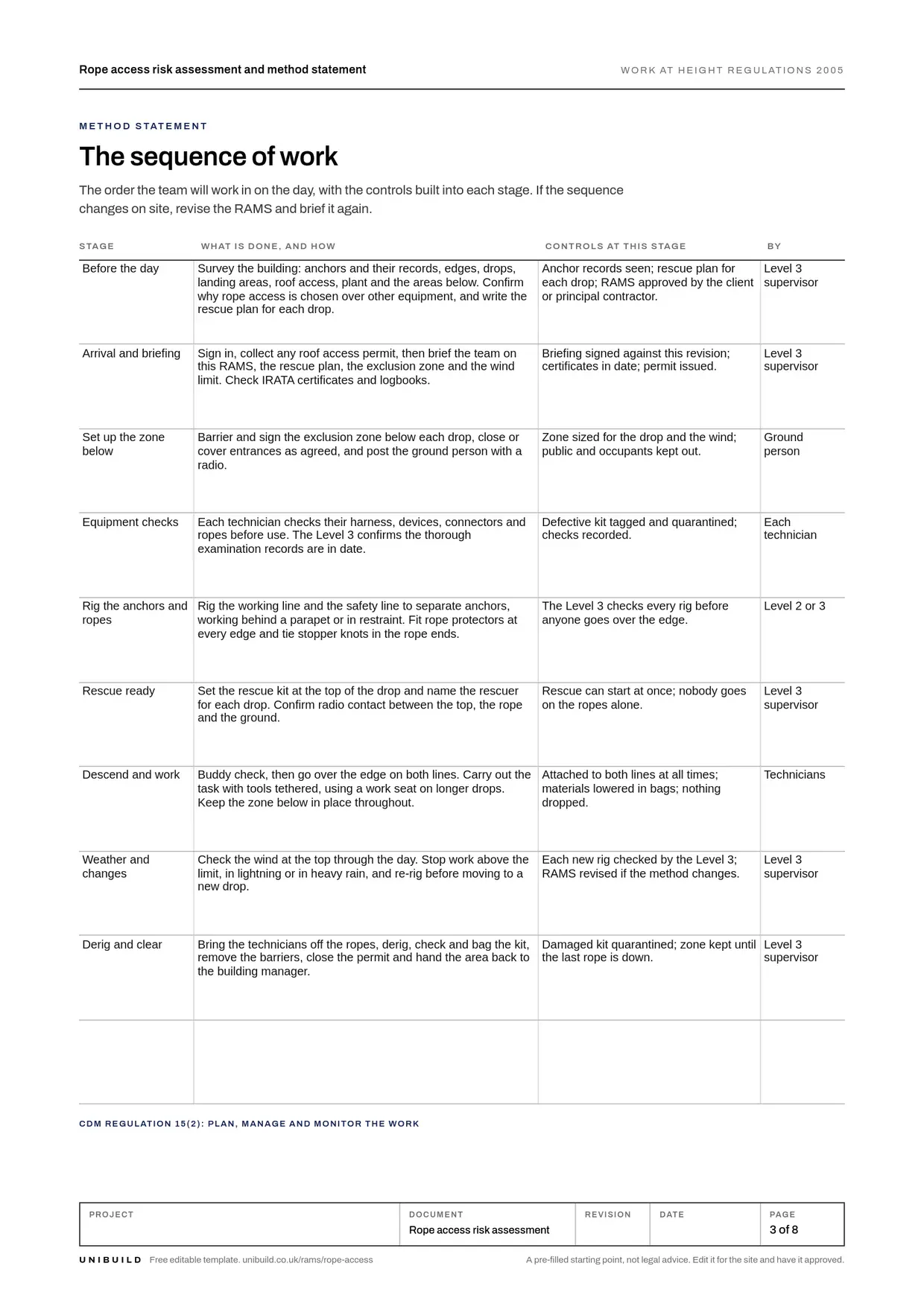
The order of work, with the controls at each stageThe order the team works in on the day, with the controls built into each stage. If the drops, the anchors or the task change on site, revise the RAMS and brief it again.
Before the day
Survey the building: anchors and their records, edges, drops, landing areas, roof access, plant and the areas below. Confirm why rope access is chosen over other equipment, and write the rescue plan for each drop.
ControlsAnchor records seen; rescue plan for each drop; RAMS approved by the client or principal contractor.
Arrival and briefing
Sign in, collect any roof access permit, then brief the team on this RAMS, the rescue plan, the exclusion zone and the wind limit. Check IRATA certificates and logbooks.
ControlsBriefing signed against this revision; certificates in date; permit issued.
Set up the zone below
Barrier and sign the exclusion zone below each drop, close or cover entrances as agreed, and post the ground person with a radio.
ControlsZone sized for the drop and the wind; public and occupants kept out.
Equipment checks
Each technician checks their harness, devices, connectors and ropes before use. The Level 3 confirms the thorough examination records are in date.
ControlsDefective kit tagged and quarantined; checks recorded.
Rig the anchors and ropes
Rig the working line and the safety line to separate anchors, working behind a parapet or in restraint. Fit rope protectors at every edge and tie stopper knots in the rope ends.
ControlsThe Level 3 checks every rig before anyone goes over the edge.
Rescue ready
Set the rescue kit at the top of the drop and name the rescuer for each drop. Confirm radio contact between the top, the rope and the ground.
ControlsRescue can start at once; nobody goes on the ropes alone.
Descend and work
Buddy check, then go over the edge on both lines. Carry out the task with tools tethered, using a work seat on longer drops. Keep the zone below in place throughout.
ControlsAttached to both lines at all times; materials lowered in bags; nothing dropped.
Weather and changes
Check the wind at the top through the day. Stop work above the limit, in lightning or in heavy rain, and re-rig before moving to a new drop.
ControlsEach new rig checked by the Level 3; RAMS revised if the method changes.
Derig and clear
Bring the technicians off the ropes, derig, check and bag the kit, remove the barriers, close the permit and hand the area back to the building manager.
ControlsDamaged kit quarantined; zone kept until the last rope is down.
What the law asks for rope access
Checked against the sourceJustify the method
Rope access counts as a personal fall protection system, and one is used only where a risk assessment shows the work can be done safely with it and safer work equipment is not reasonably practicable. The user and enough others must be trained for the work, including rescue.
Work at Height Regulations 2005, Schedule 5, Part 1Two separately anchored lines
Rope access uses at least two separately anchored lines: a working line for access, egress and support, with a self-locking system, and a safety line with a fall protection device that travels with the user. A seat is provided where the length of the job and its ergonomic demands call for one.
Work at Height Regulations 2005, Schedule 5, Part 3Plan, rescue and weather
Work at height must be properly planned, appropriately supervised and carried out as safely as reasonably practicable. The planning includes emergencies and rescue, and the work only goes ahead when the weather does not put people at risk.
Work at Height Regulations 2005, regulation 4Falling objects and danger areas
Steps are taken to prevent materials and objects falling and, where that is not reasonably practicable, to stop anyone being struck. Nothing is thrown from height. An area with a risk of falling objects is marked, with unauthorised people kept out.
Work at Height Regulations 2005, regulations 10 and 11Thorough examination
Lifting equipment for lifting people, and lifting accessories, exposed to conditions that cause deterioration are thoroughly examined at least every 6 months, or to an examination scheme. HSE guidance lists rope access systems, anchor points, ropes, karabiners and harnesses as lifting equipment.
LOLER 1998, regulation 9Risk assessment
Every employer must make a suitable and sufficient assessment of the risks to employees and to others affected by the work, and record the significant findings if they employ five or more people.
Management of Health and Safety at Work Regulations 1999, regulation 3Competence, equipment and PPE
Competence and cards
- Level 3 supervisor IRATA Level 3, responsible for rope access safety on the job, with advanced rigging and rescue skills and a current first aid certificate.
- Level 2 technicians IRATA Level 2 for more complex rigging and rescue, working under the Level 3.
- Level 1 technicians IRATA Level 1 for a set range of rope access tasks, working under the Level 3.
- Rescue Enough people on site trained and practised in the rescue plan for each drop.
- Ground person Briefed on the exclusion zone, the radio and how to call the emergency services.
- Anchor installer Competent to install and test anchors to BS 7883, for any new anchors.
Plant and equipment
- Working and safety ropes Pre-use check each day; thorough examination at least every 6 months.
- Descenders, ascenders and back-up devices Pre-use check and function test; examination record in date.
- Harnesses, connectors and slings Pre-use check each day; damaged items quarantined.
- Installed anchors and eyebolts Current test or examination record seen before rigging.
- Rope protectors and work seats Checked on each rig; fitted at every edge.
- Rescue kit At the top of each drop and checked before work starts.
PPE
- Safety helmet with chin strap, worn at all times on the roof and the rope.
- Full body harness suited to rope access, with a work seat on longer drops.
- Gloves for rope handling, with good grip.
- Eye protection for drilling, cleaning and chemical work.
- Safety boots with a grip sole for roof and facade work.
Permits and plans
A permit to work for roof access where the building or the principal contractor operates one. Written agreement from the building manager to isolate cradles, BMUs and roof plant, and to close entrances below. A lift plan for any materials raised or lowered on a separate line.
Emergency and rescue
A written rescue plan for each drop, with the rescue kit at the top and a named rescuer. Rescue starts at once, without waiting for the emergency services. First aider on site, the nearest accident and emergency department named on the briefing, and the building's emergency procedure followed.
Toolbox talk: rope access safety
Read this to the team before work starts, tick each point as it is covered, and record who attended.
- Two ropes, two anchors, both devices on. Nobody goes over the edge on one line, even for a quick look.
- Buddy check every time: harness, devices, connectors and threading, before you leave the roof.
- Rope protectors go on every edge the rope touches. If one moves, stop and refit it.
- Every tool is tethered. Materials go up and down in bags. Nothing is dropped from the rope.
- The zone below stays closed until the last rope is down. If anyone walks in, stop and call the ground person.
- If the wind passes the limit, or you hear thunder, come off the rope and tell the Level 3.
Ask the team
- Who is the rescuer on each drop, and where is the rescue kit?
- What is the wind limit today, and who is measuring it?
- Which anchors are we using, and where is their test record?
What is in the rope access risk assessment template
8 pages, pre-filled and editableThe work, pre-filled
Scope, location and access, interfaces with the building and other trades, the documents the RAMS relies on, and the team with their IRATA levels.
The sequence of work
Nine stages from the building survey to derigging, with the controls and the person responsible at each one.
Hazards and controls
Sixteen rope access hazards rated before and after controls on a five by five matrix, with room for your own.
Equipment, PPE and permits
Ropes, devices, anchors and their checks, PPE by type, and the permits and agreements the job needs.
Emergency and rescue
The rescue plan for a technician on the rope, first aid and the environment section.
Briefing record
Twenty signatures against the revision, taken on the day before the work starts.
Brief it, and get it signed on the phone
On Unibuild a RAMS is written from a template, approved, then read by each operative on their phone in their own language and signed. Subcontract and agency workers sign through a link, with no app to install.
Every signature carries its date and time and prints as the last page of the RAMS PDF. Change the RAMS and it has to be signed again.
How RAMS work on UnibuildRope access risk assessment questions
Is this rope access risk assessment template free?
What should a rope access method statement include?
What should a rescue plan for abseiling cover?
Does rope access always need two ropes?
Who can carry out rope access work?
How often does rope access equipment need inspecting?
Is abseiling the same as rope access?
Can rope access be used instead of scaffolding?
RAMS templates for other trades and hazards
All free, pre-filled and editableBy trade
- Air conditioning and HVAC RAMS
- Bricklaying RAMS
- Carpentry and joinery RAMS
- CCTV installation RAMS
- Cleaning risk assessment
- Concrete works RAMS
- Demolition RAMS
- Drylining RAMS
- Electrical RAMS
- Facilities maintenance RAMS
- Fire alarm installation RAMS
- Glazing and window RAMS
- Groundworks RAMS
- Hot works and welding RAMS
- Insulation RAMS
- Landscaping and fencing RAMS
- Painting and decorating RAMS
- Pest control risk assessment
- Plastering and rendering RAMS
- Plumbing and heating RAMS
- Rail RAMS
- Refurbishment RAMS
- Roofing RAMS
- Rope access risk assessment
- Scaffolding RAMS
- Solar PV installation RAMS
- Steel erection RAMS
- Temporary works RAMS
- Tiling and flooring RAMS
- Tree surgery RAMS
By hazard
- Asbestos risk assessment
- Confined space risk assessment
- COSHH risk assessment
- Dust risk assessment
- Forklift and telehandler risk assessment
- Housekeeping risk assessment
- Lifting operations risk assessment
- Lone working risk assessment
- Manual handling risk assessment
- MEWP risk assessment
- Noise and vibration risk assessment
- Plant and excavator risk assessment
- Power tools risk assessment
- Traffic management risk assessment
- Working at height risk assessment
The blank RAMS template, the RAMS review checklist and every other free form are on Free downloads.
The RAMS, read and signed
before the work starts.
Unibuild keeps every RAMS with its versions, its approvals and each operative’s signature against the revision they read, for seven years, ready for the principal contractor or an auditor.