
COSHH risk assessment template
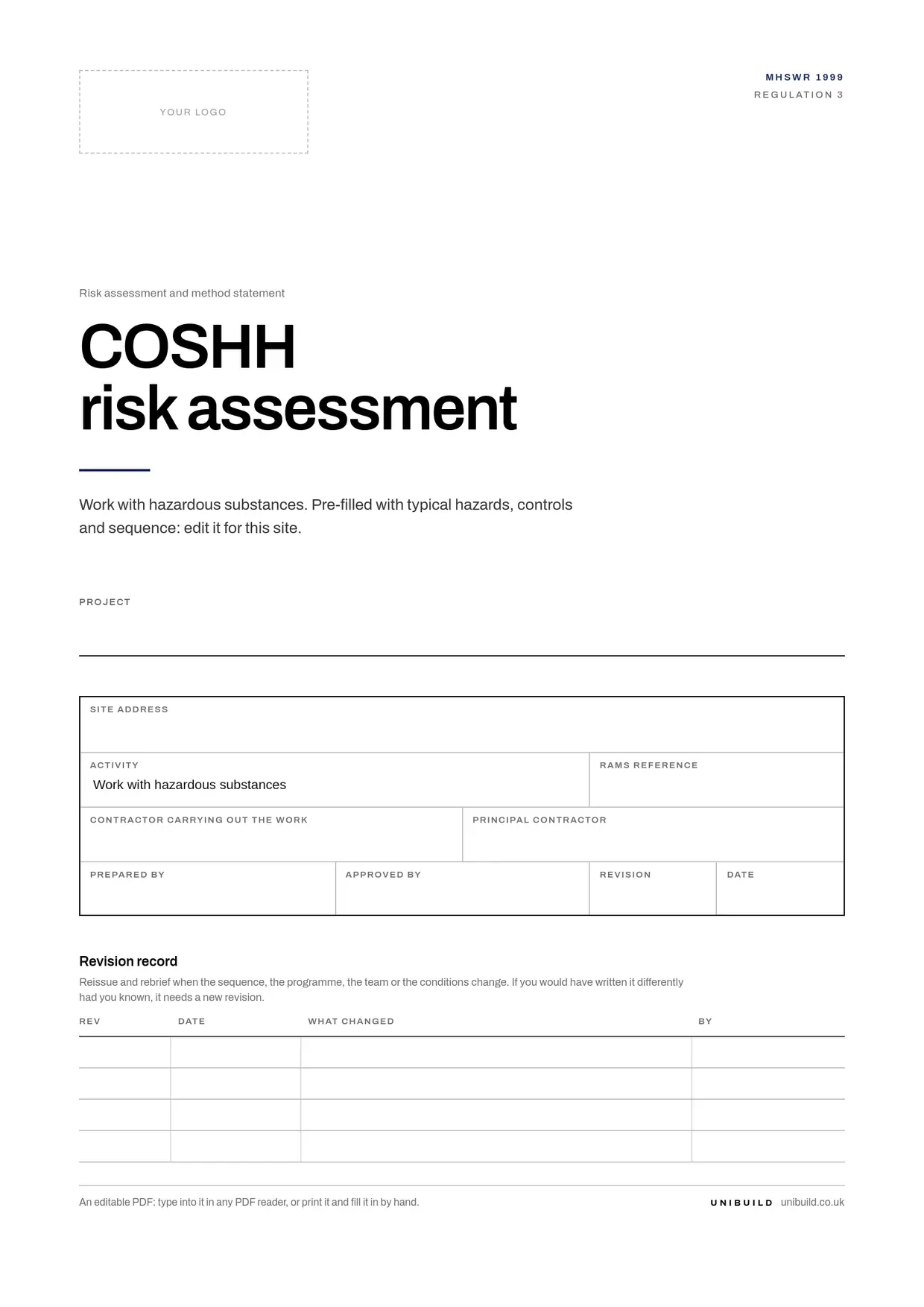
A COSHH risk assessment already filled in for site and workshop work: silica and wood dust, cement, solvents, resins, isocyanates and fume. Edit it for your job, then brief it.
- Law
- COSHH Regulations 2002
- Silica dust WEL
- 0.1 mg/m3, 8-hour average
- Format
- Editable PDF and Word
- Cost
- Free, always
What is a COSHH risk assessment?
A COSHH risk assessment is the assessment the COSHH Regulations 2002 require before any work that could expose employees to a substance hazardous to health. It names the substance and the task, who is exposed and how, and the controls that keep exposure down.
It is about the task, not just the product. The safety data sheet says what a product can do. The assessment says what happens when your team cuts, mixes, sprays or sands it, for how long, in what space and with what extraction. Some of the worst exposures on site, such as silica dust from chasing or fume from welding, come from the process and have no data sheet at all.
Employers with five or more employees must record the significant findings and the steps taken to control exposure. The assessment is reviewed regularly, and straight away when the work changes or there is reason to think it no longer holds.
COSHH hazards and controls on site
14 hazards, rated before and after controlsThe hazardous substances most trades meet on site and in the workshop, with the controls a reviewer expects to see. Delete what does not apply and add the products your job uses.
Silica dust from cutting, chasing and drilling
Operatives cutting blocks, kerbs, slabs or tiles, chasing walls or drilling concrete, and people nearby.
- Cutting designed out where possible: materials ordered to size, block splitters used, or fixings chosen that avoid chasing.
- Water suppression on cut-off saws, or on-tool extraction with an M or H class extractor set to the right flow rate.
- RPE with an assigned protection factor of at least 20, such as an FFP3 mask or a half mask with a P3 filter, face-fit tested.
BeforeHigh 20AfterMedium 10
Wood dust from sawing, routing and sanding
Joiners, carpenters and anyone near saws, routers and sanders, especially indoors.
- On-tool extraction with an M or H class unit, and materials bought pre-cut where possible.
- RPE with a protection factor of at least 20, such as FFP3, for most cutting and sanding.
- Hardwood dust is a carcinogen under COSHH, so exposure is kept as low as reasonably practicable, not just under the limit.
BeforeHigh 16AfterMedium 8
Cement, mortar and wet concrete on skin
Anyone mixing, laying or finishing mortar, render, screed or concrete.
- Waterproof gloves suitable for alkalis, with long sleeves, and wellingtons high enough to keep concrete out during pours.
- Knee pads or boards where kneeling cannot be avoided, and time spent kneeling kept short.
- Washing facilities with warm water, soap and basins big enough for forearms, and skin checks before starting and at intervals.
BeforeMedium 12AfterMedium 6
Solvents in paints, adhesives and cleaners
Operatives using solvent-based products, more so in small rooms and enclosed areas.
- Water-based or low-solvent products chosen wherever they will do the job.
- Ventilation in every case, mechanical where the room is small or enclosed; lids kept on tins.
- Particulate filters do not stop vapour: RPE has the vapour filter the data sheet specifies, and gloves are matched to the product.
BeforeMedium 12AfterLow 4
Isocyanates in two-pack coatings and foams
Sprayers and applicators of two-pack paints, spray foam and some sealants, and people nearby.
- Isocyanate-free products used wherever possible.
- Spraying only in an enclosed, extracted area or with air-fed RPE, and the area kept clear until the clearance time has passed.
- Health surveillance for asthma, with a questionnaire and lung function testing.
BeforeHigh 15AfterMedium 5
Epoxy and polyester resins
Operatives mixing and applying resin floors, anchors, grouts and repairs.
- Gloves chosen from the safety data sheet, changed when contaminated, and skin contact avoided.
- Ventilation while mixing and curing, with only the quantity needed mixed at once.
- Skin checks for anyone using resins regularly, and early signs of dermatitis reported.
BeforeMedium 9AfterMedium 6
Welding and hot cutting fume
Welders and fabricators, and anyone working in the same area.
- LEV for all indoor welding; general ventilation alone does not control the fume.
- RPE where LEV alone does not control exposure, and for welding outdoors.
- Mild steel welding fume can cause lung cancer, so exposure is kept as low as reasonably practicable.
BeforeHigh 20AfterMedium 10
Exhaust from engines and generators
Anyone near petrol or diesel engines indoors, in basements or in excavations.
- Electric or battery tools and plant used indoors and in enclosed areas.
- Generators and engines sited outside, with exhausts pointing away from doors, windows and air intakes.
- Engines switched off when not in use.
BeforeHigh 15AfterMedium 5
Acids, alkalis and cleaning chemicals
Operatives using brick cleaners, descalers, drain cleaners and site cleaning products.
- Products used at the dilution and in the way the safety data sheet sets out.
- Goggles and gloves to the data sheet, with eyewash on hand.
- Products never mixed, and kept in their original labelled containers.
BeforeMedium 12AfterLow 4
Dust raised by sweeping and clean-up
Labourers and anyone nearby when dust is swept up or blown down.
- Clean-up with an M or H class vacuum, or by damping down first.
- No dry sweeping and no blowing down clothing or surfaces with compressed air.
- Clean-up planned as part of each dusty task, not left to the end of the day.
BeforeHigh 16AfterMedium 8
Leptospirosis and other biological hazards
Operatives working in drains, sewers, watercourses or where there are rats.
- Cuts covered with waterproof dressings, and waterproof gloves worn.
- Hands washed before eating, drinking or smoking, with welfare close to the work.
- Operatives told to mention their work to a doctor if they develop flu-like symptoms.
BeforeMedium 12AfterMedium 8
Unlabelled or decanted products
Anyone using a product moved into an unmarked bottle, tub or sprayer.
- Products kept in their original containers, or decanted only into containers labelled with the contents and hazards.
- Safety data sheets for every product kept on site and available to the team.
BeforeMedium 9AfterLow 3
RPE that does not seal or is not maintained
Wearers whose mask is the wrong size, worn over stubble, or fitted with a spent filter.
- Each wearer face-fit tested on each tight-fitting model they use, and clean-shaven where the mask seals.
- Loose-fitting powered hoods for anyone who cannot be clean-shaven.
- Pre-use checks, filters changed as the maker directs, and reusable RPE thoroughly examined at suitable intervals.
BeforeMedium 12AfterLow 4
Extraction that has stopped working
Operatives relying on on-tool extraction or LEV that has lost flow without anyone noticing.
- On-tool extraction checked as working at least weekly, with hoses tight and filters in good order.
- LEV thoroughly examined and tested at least every 14 months, with the report kept for 5 years.
- Work stopped and reported if extraction fails during a task.
BeforeMedium 12AfterLow 4
Scores are likelihood times severity on the five by five matrix in the template. They are typical ratings for this work, a starting point for your own assessment of your site.
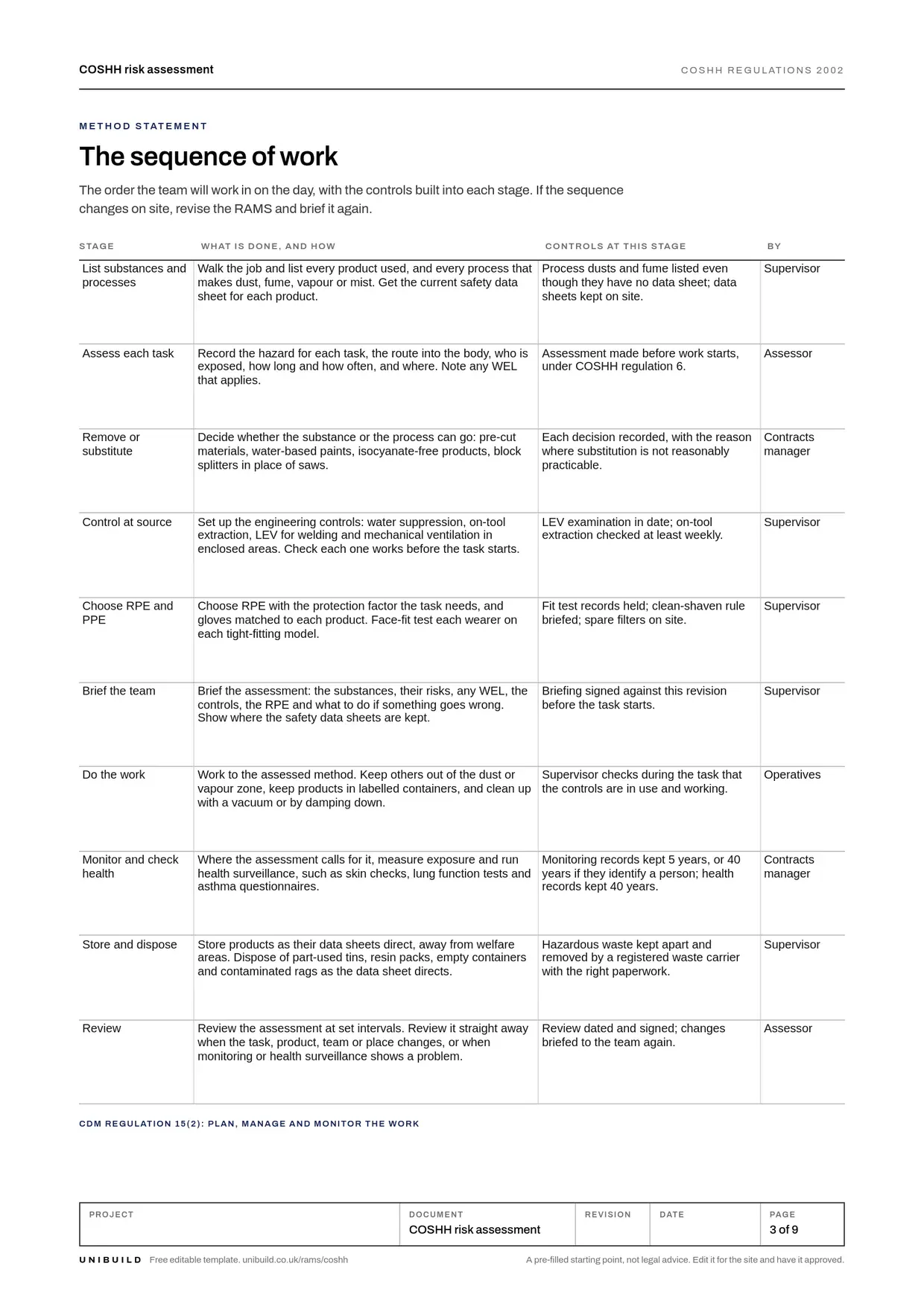
COSHH assessment: the sequence of work
The order of work, with the controls at each stageHow a COSHH assessment is made and put to work on the job, with the controls built into each stage. If a product or method changes, revise the assessment and brief it again.
List substances and processes
Walk the job and list every product used, and every process that makes dust, fume, vapour or mist. Get the current safety data sheet for each product.
ControlsProcess dusts and fume listed even though they have no data sheet; data sheets kept on site.
Assess each task
Record the hazard for each task, the route into the body, who is exposed, how long and how often, and where. Note any WEL that applies.
ControlsAssessment made before work starts, under COSHH regulation 6.
Remove or substitute
Decide whether the substance or the process can go: pre-cut materials, water-based paints, isocyanate-free products, block splitters in place of saws.
ControlsEach decision recorded, with the reason where substitution is not reasonably practicable.
Control at source
Set up the engineering controls: water suppression, on-tool extraction, LEV for welding and mechanical ventilation in enclosed areas. Check each one works before the task starts.
ControlsLEV examination in date; on-tool extraction checked at least weekly.
Choose RPE and PPE
Choose RPE with the protection factor the task needs, and gloves matched to each product. Face-fit test each wearer on each tight-fitting model.
ControlsFit test records held; clean-shaven rule briefed; spare filters on site.
Brief the team
Brief the assessment: the substances, their risks, any WEL, the controls, the RPE and what to do if something goes wrong. Show where the safety data sheets are kept.
ControlsBriefing signed against this revision before the task starts.
Do the work
Work to the assessed method. Keep others out of the dust or vapour zone, keep products in labelled containers, and clean up with a vacuum or by damping down.
ControlsSupervisor checks during the task that the controls are in use and working.
Monitor and check health
Where the assessment calls for it, measure exposure and run health surveillance, such as skin checks, lung function tests and asthma questionnaires.
ControlsMonitoring records kept 5 years, or 40 years if they identify a person; health records kept 40 years.
Store and dispose
Store products as their data sheets direct, away from welfare areas. Dispose of part-used tins, resin packs, empty containers and contaminated rags as the data sheet directs.
ControlsHazardous waste kept apart and removed by a registered waste carrier with the right paperwork.
Review
Review the assessment at set intervals. Review it straight away when the task, product, team or place changes, or when monitoring or health surveillance shows a problem.
ControlsReview dated and signed; changes briefed to the team again.
What the law asks for COSHH
Checked against the sourceAssess before the work
An employer must not carry out work liable to expose employees to a hazardous substance without a suitable and sufficient risk assessment. With five or more employees, the significant findings and the control steps are recorded.
COSHH Regulations 2002, regulation 6Prevent, then control in order
Exposure is prevented or, where that is not reasonably practicable, adequately controlled. Process and engineering controls come first, then control at source, then PPE. Control counts as adequate only if good practice is applied and no WEL is exceeded.
COSHH Regulations 2002, regulation 7Maintain and examine controls
LEV is thoroughly examined and tested at least once every 14 months, or more often for some processes. Reusable RPE is examined and tested at suitable intervals. Records are kept for at least 5 years.
COSHH Regulations 2002, regulation 9Monitoring and health surveillance
Exposure is monitored where the assessment shows it is needed. Health surveillance is required where a disease is linked to the exposure and likely in the conditions of the work. Health records are kept for at least 40 years.
COSHH Regulations 2002, regulations 10 and 11Information and training
Employees exposed to hazardous substances get information, instruction and training. It covers the substances and their risks, any WEL, the safety data sheets, the significant findings and the precautions to take.
COSHH Regulations 2002, regulation 12Workplace exposure limits
HSE publishes the workplace exposure limits in EH40/2005. Respirable crystalline silica has a WEL of 0.1 mg/m3, averaged over 8 hours.
HSE EH40/2005 Workplace exposure limitsCompetence, equipment and PPE
Competence and cards
- Assessor Knows the work and the products, reads safety data sheets and EH40, and gets expert help for unfamiliar tasks.
- Supervisor Checks the controls are in place and working before and during each task.
- Operatives Briefed on the assessment and trained in the extraction and RPE they use.
- Fit tester Trained, qualified and experienced, as HSE guidance expects.
- LEV examiner Competent to carry out the thorough examination and test.
- Occupational health A competent provider for skin checks, lung function tests and asthma questionnaires.
Plant and equipment
- On-tool extraction unit M or H class; flow, hose and filter checked at least weekly.
- Water suppression kit Water connected and flowing before cutting starts.
- LEV for welding Thorough examination and test within the last 14 months.
- Mechanical ventilation Draws vapour out of the room, away from the operative.
- Reusable RPE Pre-use check, filters in date, thorough examination at intervals.
PPE
- Respiratory protection with the protection factor the task needs, at least 20 for most dusty work.
- Gloves chosen from the safety data sheet for each product, not one type for everything.
- Eye protection goggles where cement, acid or solvent could splash.
- Coveralls disposable or washable, taken off before entering the welfare cabin.
- Wellington boots high enough to keep concrete out, for pours.
Permits and plans
A permit to work where the principal contractor requires one for spraying or solvent use in enclosed areas. A hot work permit for welding and cutting. Work inside a tank, chamber or other confined space follows the confined space entry procedure, with its own atmosphere testing.
Emergency and rescue
Section 4 of each safety data sheet gives the first aid for that product. Eyewash on hand where splashes are possible, and cement washed off skin at once with clean water. Anyone affected by vapour is moved to fresh air. A diagnosis of occupational dermatitis or asthma from regular exposure at work is reportable under RIDDOR regulation 8.
Toolbox talk: hazardous substances
Read this to the team before work starts, tick each point as it is covered, and record who attended.
- If a job makes dust you can see, it makes dust you cannot see. Silica and wood dust do their damage years later.
- Cutting goes wet or through the extractor, every time. If the water is off or the extractor is not pulling, stop and tell the supervisor.
- Your mask only works if it seals. Be clean-shaven for a tight-fitting mask, and wear the model you were fit-tested on.
- No dry sweeping and no blowing down with an air line. Vacuum it or damp it down first.
- Gloves on for cement and resin, and wash before you eat, drink or smoke. Report itchy, red or cracked skin early.
- Products stay in their labelled containers. If you do not know what is in a tin, do not use it.
Ask the team
- Which tasks on this job make the most dust, and how is each one controlled?
- Where are the safety data sheets kept?
- When were you last face-fit tested, and on which mask?
What is in the COSHH risk assessment template
9 pages, pre-filled and editableThe work, pre-filled
Scope, location and access, interfaces with other trades, the documents the assessment relies on, and the main substances with their controls.
The sequence of work
Ten stages from listing the substances to review, with the controls and the person responsible at each one.
Hazards and controls
Fourteen substance hazards rated before and after controls on a five by five matrix, with room for your own.
Substance register
A page for each product and process: hazard and WEL, route of exposure, controls, RPE and health surveillance, with five worked examples.
Equipment, PPE and permits
Extraction and RPE checks, PPE by type, and the permits the job needs.
Briefing record
Twenty signatures against the revision, taken on the day before the work starts.
Brief it, and get it signed on the phone
On Unibuild a RAMS is written from a template, approved, then read by each operative on their phone in their own language and signed. Subcontract and agency workers sign through a link, with no app to install.
Every signature carries its date and time and prints as the last page of the RAMS PDF. Change the RAMS and it has to be signed again.
How RAMS work on UnibuildCOSHH risk assessment questions
Is this COSHH risk assessment template free?
Is a COSHH risk assessment a legal requirement?
Is a safety data sheet the same as a COSHH assessment?
What needs a COSHH assessment on a building site?
What is the workplace exposure limit for silica dust?
Do operatives need face-fit testing?
How often should a COSHH assessment be reviewed?
Who should carry out a COSHH assessment?
RAMS templates for other trades and hazards
All free, pre-filled and editableBy trade
- Electrical RAMSSafe isolation, live work, testing and inspection, and working near other trades.
- Scaffolding RAMSErecting, altering and dismantling tube and fitting and system scaffold, with handover and inspection.
- Roofing RAMSPitched and flat roofs, fragile surfaces, edge protection, hot work and getting materials up safely.
- Groundworks RAMSExcavations, buried services, plant, trench support and inspections at the start of each shift.
- Plumbing and heating RAMSSoldering and brazing, gas work, unvented systems, lofts and occupied homes.
- Painting and decorating RAMSAccess equipment, solvents and spray, old lead paint, dust from preparation and occupied buildings.
- Hot works and welding RAMSWelding, cutting, grinding and torch-on work: permits, fire watch, fume and gas cylinders.
By hazard
- COSHH risk assessmentHazardous substances on site: dusts, solvents, cement, resins and fume, assessed and controlled.
- Manual handling risk assessmentLifting, carrying, pushing and pulling, assessed by task, individual, load and environment.
- Working at height risk assessmentLadders, towers, MEWPs, scaffolds and roofs, chosen and controlled in the order the law sets.
- Lone working risk assessmentPeople working alone on site, in empty buildings and out of hours, with check-ins and a plan if they go quiet.
- Noise and vibration risk assessmentNoise exposure and hand-arm vibration from tools, measured against the action and limit values.
- Asbestos risk assessmentFinding asbestos before work starts, deciding whether work is licensed, and controlling non-licensed work.
- Confined space risk assessmentManholes, tanks, voids and chambers: avoiding entry, a safe system of work, gas testing and rescue.
The blank RAMS template, the RAMS review checklist and every other free form are on Free downloads.
The RAMS, read and signed
before the work starts.
Unibuild keeps every RAMS with its versions, its approvals and each operative’s signature against the revision they read, for seven years, ready for the principal contractor or an auditor.