
Digger RAMS and plant risk assessment template
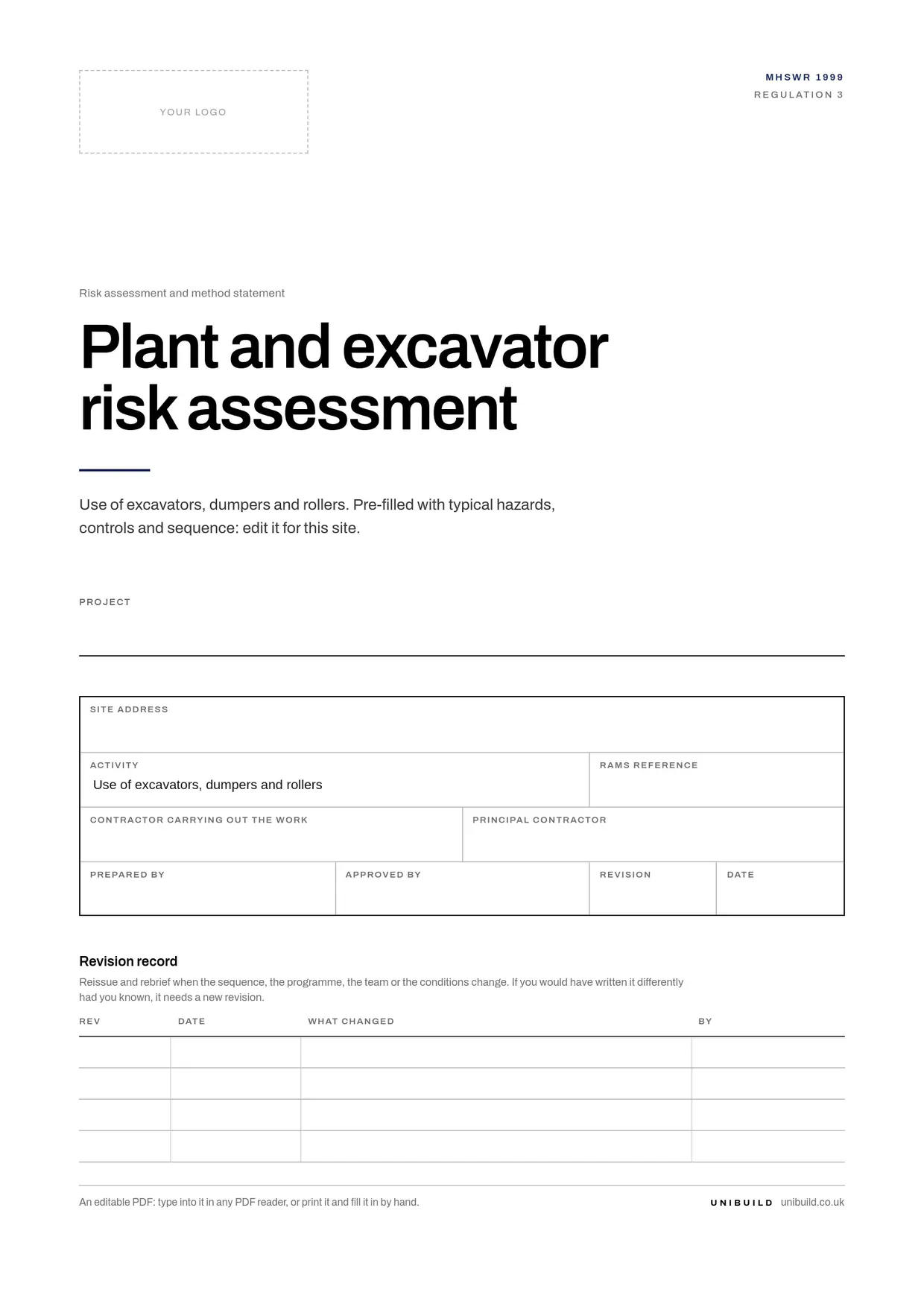
A plant risk assessment, already filled in for excavators, mini diggers, dumpers and rollers on site, with a plant and operator register. Edit it for your job, then brief it.
- Law
- PUWER 1998 and LOLER 1998
- Quick hitch pin
- Checked at every attachment change
- Format
- Editable PDF and Word
- Cost
- Free, always
What is a digger RAMS?
A digger RAMS, or plant risk assessment, covers how excavators, mini diggers, dumpers and rollers are used on a job and sets the controls that protect operators and people on foot. Regulation 3 of the Management Regulations 1999 requires the assessment, and employers with five or more employees record the significant findings.
Most of the controls come from PUWER 1998: adequate training for every operator, roll-over protection and a restraint where an overturn could crush the driver, and inspection at suitable intervals. On site, CDM 2015 adds safe vehicle movement, no riding on plant, measures to stop vehicles falling into excavations, and steps against buried and overhead services.
An excavator that lifts loads on slings or chains is lifting equipment, so LOLER 1998 applies. The lift is planned by a competent person, and the machine is fitted out for lifting and thoroughly examined. An excavator used only for digging is inspected under PUWER instead.
Checked against legislation.gov.uk and HSE guidance on .
Plant and excavator hazards and controls
18 hazards, rated before and after controlsA worked example of the significant hazards when excavators, mini diggers, dumpers and rollers work on site, with the controls a reviewer expects to see. Delete what does not apply and add what your job has.
Untrained or unauthorised operators
Anyone who drives an excavator, dumper or roller without training for that machine, and the people near them.
- Card checked for the machine and category, such as CPCS A58 or A59 for 360 excavators and A09 for dumpers, or NPORS or equivalent.
- Familiarisation on the model and its hitch, then written authorisation recorded on the plant and operator register.
- Keys held by the supervisor and removed when plant is parked, so nobody else can start it.
BeforeHigh 15AfterMedium 5
People on foot struck by plant
Groundworkers, banksmen, other trades and visitors near digging, loading, slewing and travelling plant.
- Exclusion zone around each working machine, barriered where people work nearby; walkways fenced off from plant routes.
- Nobody approaches a working machine until the operator has seen them, stopped and applied the safety control lever.
- Trained plant and vehicle marshaller, in a protected position, where plant and people must work close together.
BeforeHigh 20AfterMedium 10
Crushing by the slewing excavator
Anyone caught between the slewing upper body or counterweight and a wall, vehicle, spoil heap or scaffold.
- Short or zero tail swing machine on tight sites, with more than 0.5 m kept between the machine and any fixed object.
- Slew area barriered where that clearance cannot be kept; nobody enters it while the machine is running.
BeforeHigh 15AfterMedium 5
Unintended movement of the controls
Slingers and groundworkers beside the bucket when a sleeve, a lean from the cab or a knock moves a joystick.
- Safety control lever or isolation device applied whenever anyone is in the working area, before they approach.
- Operator warns everyone and sees them clear before releasing the lever and moving the machine.
- Supervisors check the lever is used, as HSE's 2025 safety notice on excavator control levers asks.
BeforeHigh 15AfterMedium 5
Attachment falling from the quick hitch
Groundworkers in the trench or near the bucket when a bucket or attachment drops off the hitch.
- Retaining pin or locking device checked before work and each time an attachment is fitted, from the ground if not visible from the cab.
- Attachment check after every change, as the hitch maker's instructions set out, with everyone clear; only the maker's pins, never bolts or wire.
- Operator trained on that hitch; nobody stands under or in front of the bucket.
BeforeHigh 15AfterMedium 5
Excavator overturning
Operators when a machine tips on a slope, soft ground or an edge, or swings a heavy load out to the side.
- Gradients and ground checked against the maker's limits; travel up and down slopes, not across, with the bucket carried low.
- Machine set on firm, level standing, kept back from unsupported edges, and loads kept within the rated capacity.
- Seat belt worn wherever one is fitted, so the operator stays inside the protective cab.
BeforeHigh 15AfterMedium 5
Dumper overturning
Dumper drivers, crushed when a dumper overturns on a slope, stockpile, ramp or tipping edge.
- Dumpers with roll-over protection, and the seat belt worn every time.
- Kept to gradients within the maker's limits and off stockpiles; loads spread evenly and not above the skip edge.
- Wheel stops at a safe distance from excavation edges wherever dumpers tip.
BeforeHigh 15AfterMedium 5
Rollers at edges and on slopes
Roller drivers, when an edge gives way or a ride-on roller slides on a slope, camber or wet surface.
- Edges of embankments, trenches and kerb lines marked, with a safe margin kept from any unsupported edge.
- Roller with roll-over protection and the seat belt worn; slopes kept within the maker's limits.
BeforeMedium 10AfterMedium 5
Plant falling into excavations or water
Drivers of excavators, dumpers and rollers near trenches, pits, spoil heaps, ponds and watercourses.
- Stop blocks or barriers at excavation, embankment and water edges, as CDM regulation 28(6) requires suitable measures.
- Plant and spoil kept back from the sides so the ground beside an excavation is not overloaded.
- Routes kept clear of open excavations, with covers or barriers on any that plant must pass.
BeforeHigh 15AfterMedium 5
Striking buried services
Operators and groundworkers when a bucket hits a cable, gas main or water main: shock, burns or gas escape.
- Service plans checked and the area scanned and marked before digging, as HSE HSG47 sets out; permit to dig issued.
- Services exposed by hand digging before the machine works near them.
- Strike plan briefed: stop, move everyone clear, call the service owner and do not touch damaged cables or pipes.
BeforeHigh 15AfterMedium 5
Overhead power lines
Excavator and dumper drivers, and anyone touching a machine whose arm or body reaches a line.
- Line owner asked to divert or switch off the line; otherwise barriers keep plant out of a 6 m safety zone, as HSE GS6 advises.
- Goalposts and signs at crossing points; arms, booms and tipping bodies lowered to pass under.
- Physical height or slew restraints where an excavator must work near a line; warning devices alone are not enough.
BeforeMedium 10AfterMedium 5
Lifting with an excavator
Slingers and anyone nearby when an excavator lifts pipes, chambers or trench boxes on slings.
- Machine set up for lifting: lifting point, check valves, load warning device and capacity chart in the cab; LOLER examination in date.
- Lift planned by a competent person; operator with a lifting endorsement; trained slinger signaller.
- Bucket removed where the lifting point is not on it, or the bucket and hitch weight added to the load; nobody under the load.
BeforeHigh 15AfterMedium 5
Reversing and blind spots
Anyone behind or beside an excavator, dumper or roller where the driver cannot see them.
- Site laid out to cut reversing, with one-way routes and turning areas.
- Mirrors, cameras, beacons and alarms working; dumpers not loaded so high that the load blocks the driver's view.
- Marshaller in a safe place in the driver's view where reversing cannot be avoided.
BeforeHigh 20AfterMedium 10
Defects and poor maintenance
Operators and people nearby when brakes, steering, hydraulics, hoses or the hitch fail in use.
- Daily pre-use check by the operator, recorded, with a weekly inspection by a competent person.
- Machine taken out of use and tagged until any safety defect is put right; servicing to the maker's intervals.
- Hired plant arrives with evidence of its last inspection, as PUWER regulation 6(4) requires.
BeforeMedium 12AfterLow 4
Riding on plant and in buckets
Anyone given a lift on a dumper, on a step or in an excavator bucket, or raised to height in a bucket.
- Nobody rides on plant except in a safe place provided for that purpose, as CDM regulation 28(4) requires.
- Nobody is ever lifted in a bucket; MEWPs, towers or scaffolds for work at height.
BeforeHigh 15AfterMedium 5
Loading and unloading plant trailers
Operators and helpers when a machine slides off the ramps or tips off a trailer or low loader.
- Trailer coupled and braked on firm, level ground, with ramps secured and clear of mud.
- Machine driven on slowly and centrally with the attachment low; nobody beside the ramps or the trailer.
- Machine chained down at the maker's lashing points before it is moved.
BeforeHigh 15AfterMedium 5
Refuelling plant
Operators refuelling from bowsers or cans, and anyone nearby, from spills, fire and diesel on the skin.
- Engine off and no smoking; refuelling at a set point away from drains, watercourses and excavations.
- Bunded, secure bowser with a sound hose and nozzle; spill kit and fire extinguisher at the fuel point.
- Gloves worn; spills cleaned up at once and reported.
BeforeMedium 8AfterLow 4
Getting on and off machines
Operators slipping from tracks, steps or a dumper as they climb on or jump down, often in mud.
- Steps and handholds clean and sound; three points of contact, facing the machine; never jump down.
- Machine parked, attachment lowered, controls isolated and engine off before the operator gets off.
BeforeMedium 9AfterMedium 6
Scores are likelihood times severity on the five by five matrix in the template. They are typical ratings for this work, a starting point for your own assessment of your site.
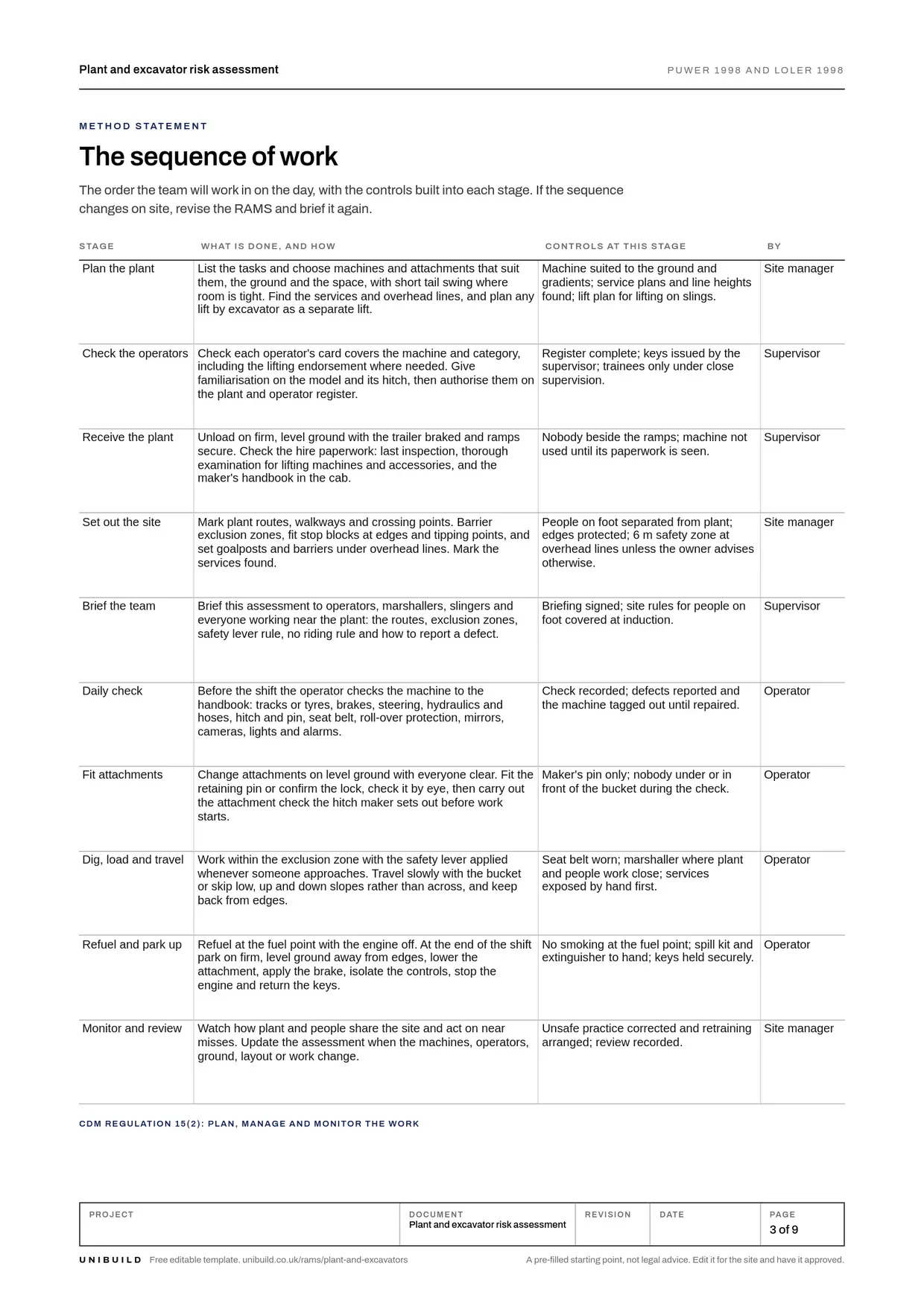
Plant method statement: the sequence of work
The order of work, with the controls at each stageHow excavators, dumpers and rollers are planned, checked and used on the job, with the controls at each stage. If the plan changes on site, revise the assessment and brief it again.
Plan the plant
List the tasks and choose machines and attachments that suit them, the ground and the space, with short tail swing where room is tight. Find the services and overhead lines, and plan any lift by excavator as a separate lift.
ControlsMachine suited to the ground and gradients; service plans and line heights found; lift plan for lifting on slings.
Check the operators
Check each operator's card covers the machine and category, including the lifting endorsement where needed. Give familiarisation on the model and its hitch, then authorise them on the plant and operator register.
ControlsRegister complete; keys issued by the supervisor; trainees only under close supervision.
Receive the plant
Unload on firm, level ground with the trailer braked and ramps secure. Check the hire paperwork: last inspection, thorough examination for lifting machines and accessories, and the maker's handbook in the cab.
ControlsNobody beside the ramps; machine not used until its paperwork is seen.
Set out the site
Mark plant routes, walkways and crossing points. Barrier exclusion zones, fit stop blocks at edges and tipping points, and set goalposts and barriers under overhead lines. Mark the services found.
ControlsPeople on foot separated from plant; edges protected; 6 m safety zone at overhead lines unless the owner advises otherwise.
Brief the team
Brief this assessment to operators, marshallers, slingers and everyone working near the plant: the routes, exclusion zones, safety lever rule, no riding rule and how to report a defect.
ControlsBriefing signed; site rules for people on foot covered at induction.
Daily check
Before the shift the operator checks the machine to the handbook: tracks or tyres, brakes, steering, hydraulics and hoses, hitch and pin, seat belt, roll-over protection, mirrors, cameras, lights and alarms.
ControlsCheck recorded; defects reported and the machine tagged out until repaired.
Fit attachments
Change attachments on level ground with everyone clear. Fit the retaining pin or confirm the lock, check it by eye, then carry out the attachment check the hitch maker sets out before work starts.
ControlsMaker's pin only; nobody under or in front of the bucket during the check.
Dig, load and travel
Work within the exclusion zone with the safety lever applied whenever someone approaches. Travel slowly with the bucket or skip low, up and down slopes rather than across, and keep back from edges.
ControlsSeat belt worn; marshaller where plant and people work close; services exposed by hand first.
Refuel and park up
Refuel at the fuel point with the engine off. At the end of the shift park on firm, level ground away from edges, lower the attachment, apply the brake, isolate the controls, stop the engine and return the keys.
ControlsNo smoking at the fuel point; spill kit and extinguisher to hand; keys held securely.
Monitor and review
Watch how plant and people share the site and act on near misses. Update the assessment when the machines, operators, ground, layout or work change.
ControlsUnsafe practice corrected and retraining arranged; review recorded.
What the law asks for plant and excavators
Checked against the sourceTraining
Everyone who uses work equipment receives adequate training in how to use it, the risks and the precautions. Anyone who supervises or manages its use is trained too. The law names no card scheme; cards are how most sites check the training.
Provision and Use of Work Equipment Regulations 1998, regulation 9Rolling over
Where an employee riding on mobile work equipment is at risk from it rolling over, the risk is minimised, for example by a protective structure. Where anyone carried could be crushed by it rolling over, there is a suitable restraining system.
Provision and Use of Work Equipment Regulations 1998, regulation 26Inspection
Equipment exposed to conditions that cause dangerous deterioration is inspected at suitable intervals and after exceptional circumstances. Results are recorded, and hired equipment comes with evidence of its last inspection.
Provision and Use of Work Equipment Regulations 1998, regulation 6Lifting with an excavator
Every lifting operation is properly planned by a competent person, appropriately supervised and carried out safely. Lifting equipment is thoroughly examined at least every 12 months, and accessories every 6 months, unless an examination scheme sets other intervals.
Lifting Operations and Lifting Equipment Regulations 1998, regulations 8 and 9Vehicles on site
Unintended vehicle movement is prevented or controlled, and a warning given where a vehicle could endanger anyone. Nobody rides except in a safe place provided for that purpose, and suitable measures stop vehicles falling into an excavation, pit or water, or overrunning the edge of an embankment.
Construction (Design and Management) Regulations 2015, regulation 28Overhead and buried services
Where overhead power cables put the work at risk, they are diverted or isolated; where neither is reasonably practicable, warnings with barriers or suspended protections are provided. Work near an underground service goes ahead only once suitable and sufficient steps are taken.
Construction (Design and Management) Regulations 2015, regulation 25Competence, equipment and PPE
Competence and cards
- Excavator operators A card for the machine, such as CPCS A58 (360 below 10 tonnes) or A59 (above 10 tonnes), NPORS or equivalent, with familiarisation on the model and hitch.
- Dumper and roller drivers A card for the machine, such as CPCS A09 forward tipping dumper or A31 ride on roller, NPORS or equivalent.
- Lifting by excavator Operator with the lifting operations endorsement for the category, and a slinger signaller trained for excavators, such as CPCS A40.
- Plant and vehicle marshaller Trained to direct plant from a protected position and to manage people on foot nearby.
- Supervisor Trained to supervise the use of the plant, as PUWER regulation 9(2) requires, and to check seat belts, safety levers and hitch pins.
- Lift planner Competent to plan lifts under LOLER regulation 8, including lifts by excavator.
Plant and equipment
- 360 excavator or mini digger Daily check recorded; weekly inspection; hitch pin checked at every attachment change.
- Excavator used for lifting Check valves, load warning, capacity chart; LOLER exam at least every 12 months.
- Quick hitch Maker's pin only; examined with the machine, or every 6 months if moved between machines.
- Forward tipping dumper Daily check; roll-over protection and seat belt sound; brakes, steering and skip.
- Ride-on roller Daily check; roll-over protection and seat belt sound; brakes and drum.
- Slings, shackles and lifting buckets Safe working load marked; checked before use; examined every 6 months.
- Fuel bowser Bunded and secure; hose and nozzle sound; spill kit and extinguisher.
PPE
- High-visibility clothing for everyone on foot near plant, and for operators whenever they leave the cab.
- Safety boots with toe protection and a grip sole.
- Safety helmet to the site standard, and wherever an excavator is lifting.
- Gloves for slinging, refuelling and changing attachments.
- Hearing protection where breakers, compactors or older machines make it needed.
Permits and plans
A permit to dig before any machine breaks ground. A lift plan for any lift by excavator on slings or chains. Written agreement with the line owner where an overhead line must be diverted or switched off, and a permit to work where the principal contractor's rules require one near live services.
Emergency and rescue
If a machine overturns, stay in the seat with the belt on. Call the first aider and 999. Overhead line contact: stay in the cab, or if you must leave, jump clear and do not touch the machine and ground together. Plant touching or arcing from an uninsulated line over 200 volts, or an excavator used for lifting collapsing or overturning, is a RIDDOR dangerous occurrence.
Toolbox talk: plant and excavators
Read this to the team before work starts, tick each point as it is covered, and record who attended.
- Only drive the machines you are trained and authorised for. If your card does not cover it, do not start it.
- Check your machine before the shift, and check the hitch pin every time you change an attachment. No pin, no work.
- Seat belt on, every time. If the machine tips, stay in the seat and hold on. Do not jump.
- On foot, never walk into the swing of an excavator. Wait until the driver has seen you, stopped and applied the safety lever.
- No riding on dumpers, no riding in buckets, and nobody under a bucket or a load.
- Know where the services and overhead lines are today. If the bucket hits anything unexpected, stop and tell the supervisor.
Ask the team
- Where are the exclusion zones and the walkways on this site today?
- What check do you do after changing a bucket, and who is clear while you do it?
- Which machines here are set up for lifting, and who plans the lift?
What is in the plant and excavator risk assessment template
9 pages, pre-filled and editableThe work, pre-filled
Scope, location and access, interfaces with other trades, the documents the assessment relies on, and the team with their cards.
The sequence of work
Ten stages from planning the plant to review, with the controls and the person responsible at each one.
Hazards and controls
Eighteen plant and excavator hazards rated before and after controls on a five by five matrix, with room for your own.
Plant, PPE and permits
The machines, hitches and lifting accessories with their checks, PPE by type, and the permit to dig and lift plan.
Plant and operator register
A page that records each machine, its attachments, the operator, their card and authorisation, and the lifting examinations due.
Briefing record
Twenty signatures against the revision, taken on the day before the work starts.
Brief it, and get it signed on the phone
On Unibuild a RAMS is written from a template, approved, then read by each operative on their phone in their own language and signed. Subcontract and agency workers sign through a link, with no app to install.
Every signature carries its date and time and prints as the last page of the RAMS PDF. Change the RAMS and it has to be signed again.
How RAMS work on UnibuildPlant risk assessment questions
Is this plant risk assessment template free?
What should a digger RAMS include?
Do you need a licence to drive a mini digger?
Do excavator and dumper drivers have to wear a seat belt?
Does an excavator need a LOLER thorough examination?
Can you lift with a digger bucket?
How often should plant be inspected?
How long is a plant risk assessment valid for?
RAMS templates for other trades and hazards
All free, pre-filled and editableBy trade
- Air conditioning and HVAC RAMS
- Bricklaying RAMS
- Carpentry and joinery RAMS
- CCTV installation RAMS
- Cleaning risk assessment
- Concrete works RAMS
- Demolition RAMS
- Drylining RAMS
- Electrical RAMS
- Facilities maintenance RAMS
- Fire alarm installation RAMS
- Glazing and window RAMS
- Groundworks RAMS
- Hot works and welding RAMS
- Insulation RAMS
- Landscaping and fencing RAMS
- Painting and decorating RAMS
- Pest control risk assessment
- Plastering and rendering RAMS
- Plumbing and heating RAMS
- Rail RAMS
- Refurbishment RAMS
- Roofing RAMS
- Rope access risk assessment
- Scaffolding RAMS
- Solar PV installation RAMS
- Steel erection RAMS
- Temporary works RAMS
- Tiling and flooring RAMS
- Tree surgery RAMS
By hazard
- Asbestos risk assessment
- Confined space risk assessment
- COSHH risk assessment
- Dust risk assessment
- Forklift and telehandler risk assessment
- Housekeeping risk assessment
- Lifting operations risk assessment
- Lone working risk assessment
- Manual handling risk assessment
- MEWP risk assessment
- Noise and vibration risk assessment
- Plant and excavator risk assessment
- Power tools risk assessment
- Traffic management risk assessment
- Working at height risk assessment
The blank RAMS template, the RAMS review checklist and every other free form are on Free downloads.
The RAMS, read and signed
before the work starts.
Unibuild keeps every RAMS with its versions, its approvals and each operative’s signature against the revision they read, for seven years, ready for the principal contractor or an auditor.