
Carpentry and joinery method statement and risk assessment
A carpentry and joinery method statement and risk assessment, already filled in for first and second fix, door and fire door installation, saws, nail guns and wood dust. Edit it for your job, then brief it.
- Law
- PUWER 1998 and COSHH 2002
- Hardwood dust limit
- 3 mg/m³ over 8 hours
- Format
- Editable PDF and Word
- Cost
- Free, always
Do you need a method statement for carpentry and joinery?
Yes, in practice. A carpentry and joinery method statement and risk assessment is what a principal contractor asks for before first fix starts, and the risk assessment behind it is a legal duty. Most joinery work brings saws, nail guns, wood dust and work from steps and platforms onto the same job.
The duty to assess is regulation 3 of the Management of Health and Safety at Work Regulations 1999, recorded if you employ five or more people. PUWER covers the saws and nail guns, COSHH covers wood dust, adhesives and foams, and the Work at Height Regulations cover first fix at height and work from steps.
A carpentry method statement should describe the job in front of you: what is cut on site and where, which doors are fire doors, what is fixed at height, and who else is working nearby. A risk assessment for door installation, and a method statement for fire door installation, are both covered here.
Checked against legislation.gov.uk and HSE guidance on .
Carpentry and joinery hazards and controls
18 hazards, rated before and after controlsThe significant hazards on a typical first and second fix carpentry package, including door and fire door installation, with the controls a reviewer expects to see. Delete what does not apply and add what your job has.
Sawbenches and mitre saws
Carpenters cutting on site, from blade contact and kickback.
- Machines used only by people trained on them; guards, riving knife and brake checked before use.
- Push sticks for short or narrow cuts; long stock supported on stands; blade suited to the material and sharp.
- Saw set up on a level, well lit cutting station with space around it and others kept out.
BeforeHigh 15AfterMedium 5
Hand-held circular and plunge saws
Carpenters cutting boards, sheet materials and worktops, from kickback and blade contact.
- Lower guard checked to return freely; blade depth set just through the material.
- Workpiece clamped or supported on both sides of the cut, guided by a rail or fence, never held by hand or across the knee.
- Saw allowed to stop before it is lifted or put down.
BeforeMedium 12AfterLow 4
Nail guns
Users and people nearby, from nails fired by accident, through thin timber or by ricochet.
- Users trained on the tool; single sequential trigger mode where the tool has it.
- Never pointed at anyone or carried with a finger on the trigger; hands kept clear of the nailing line.
- Air line or battery removed before clearing jams or adjusting; eye protection for the user and anyone nearby.
BeforeMedium 12AfterLow 4
Wood dust, including hardwood and MDF
Carpenters cutting and sanding, and other trades in the same area, from asthma and nasal cancer.
- Saws and sanders connected to extraction at the tool, to an M class unit or better.
- FFP3 RPE, face fit tested, for dusty tasks; cutting done in a ventilated area away from other trades.
- Clean up with an M class vacuum; no dry sweeping and no compressed air; health surveillance where assessed.
BeforeHigh 16AfterMedium 8
Falls from stepladders and hop-ups
Carpenters fixing ceilings, high doors, pelmets, architraves and boxing.
- Podium steps or low platforms with guard-rails for longer work; stepladders only for light, short tasks.
- Stepladders on firm, level floors, locks engaged, facing the work; no overreaching or standing on the top steps.
- Pre-use check each day; faulty equipment taken out of use.
BeforeMedium 12AfterLow 4
Falls at first fix: joists, roofs, open edges
Carpenters fixing joists, roof timbers, stairs and landings before floors and balustrades are in.
- Edge protection at open edges and stairwells; voids covered or guarded until the balustrade is fixed.
- Joists and trusses fixed from a working platform, crash deck or netting below; nobody walks the joists.
- Work at height planned and avoided where it can be done from below.
BeforeHigh 15AfterMedium 5
Fire doors installed wrongly
Future occupants, if a fire doorset fails to hold back fire and smoke.
- Doorset installed to the manufacturer's instructions and the certification or test evidence for that assembly.
- Only listed frames, hinges, seals, glazing and ironmongery used; gaps checked; no cutting outside the evidence.
- Label left in place, self-closer adjusted, and each door recorded on the installation record.
BeforeHigh 15AfterMedium 5
Hanging doors and fitting frames
Joiners hanging heavy and fire-rated doors, and anyone nearby if a door falls.
- Doors stored flat on bearers, never leaning loose against walls.
- Door held in a door jack or by a second person while hinges are fixed; frames braced until fixed.
- Two people for heavy or large doors.
BeforeMedium 9AfterLow 3
Manual handling of doors, boards and timber
Carpenters carrying doorsets, sheet materials, joists, stairs and worktops up stairs and across site.
- Deliveries placed close to the work; trolleys, door lifters and board carriers used.
- Two-person lifts for long, heavy or awkward items, and on stairs.
- Team briefed on the weights and the route before carrying.
BeforeMedium 12AfterMedium 6
Hidden cables and pipes
Carpenters fixing into walls, floors and ceilings.
- Cable and pipe detector used before drilling or fixing; drawings checked for service routes.
- Floor and wall zones where services run are marked before second fix.
- Any service hit is reported and made safe by a competent person before work goes on.
BeforeMedium 10AfterMedium 5
Electric shock from tools and leads
Carpenters using mains tools on site, from damaged leads and wet conditions.
- Battery tools, or 110V tools where the site rules require them; leads routed off the floor where possible.
- Tools and leads checked before use and inspected on a set schedule; damaged kit taken out of use.
BeforeMedium 10AfterMedium 5
Noise from saws, planers and nailers
Carpenters and other trades close to cutting stations.
- Quieter tools and blades chosen; cutting station sited away from other trades.
- Hearing protection zone marked where levels may reach the upper action value of 85 dB(A).
- Hearing protection provided and worn; health surveillance for anyone regularly exposed above 85 dB(A).
BeforeMedium 9AfterMedium 6
Hand-arm vibration
Carpenters using sanders, routers, impact drivers and SDS drills for long periods.
- Low-vibration tools chosen and kept maintained; trigger time planned from the manufacturer's data.
- Tasks rotated so exposure stays below the action value of 2.5 m/s² A(8) where practicable; symptoms reported.
BeforeMedium 9AfterMedium 6
Adhesives, foams and treated timber
Carpenters using expanding foam, contact adhesive and preservative-treated timber.
- Safety data sheets read and COSHH assessments made for each product.
- Nitrile gloves and eye protection; ventilation for solvent adhesives; no ignition sources nearby.
- Hands washed before breaks; treated offcuts never burned.
BeforeMedium 9AfterLow 3
Asbestos in old doors, panels and boards
Joiners stripping out old doors, frames, panels and boxing in buildings built or refurbished before 2000.
- Asbestos survey checked before any strip out; old fire doors treated as having AIB panels until checked.
- Suspect material left in place and reported; removal only under the asbestos plan.
- A door with AIB fireproofing removed whole by trained workers to HSE Asbestos Essentials sheet A3, or by a licensed contractor where the sheet does not apply.
BeforeHigh 15AfterMedium 5
Cuts from chisels, knives and sharp edges
Carpenters using hand tools and handling cut metal, glass and ironmongery.
- Sharp tools kept sharp and guarded in the tool box; cutting away from the body.
- Cut-resistant gloves when handling sharp materials; first aid kit at hand.
BeforeMedium 8AfterLow 4
Slips, trips and fire from offcuts and shavings
Carpenters and other trades in the work area.
- Offcuts, packaging and shavings cleared as work goes on and removed from the building daily.
- Leads run along walls; materials stacked out of walkways.
- No smoking in the work area; fire extinguisher at the cutting station.
BeforeMedium 9AfterMedium 6
Occupied buildings and other trades
Occupants, visitors and other trades near cutting, door hanging and open doorways.
- Work area barriered and signed; cutting kept in a set area away from routes.
- Doors removed for work are made safe, and fire doors are not left off or wedged open overnight without agreement.
- Noisy and dusty work timed with the building manager or site manager.
BeforeMedium 12AfterLow 4
Scores are likelihood times severity on the five by five matrix in the template. They are typical ratings for this work, a starting point for your own assessment of your site.
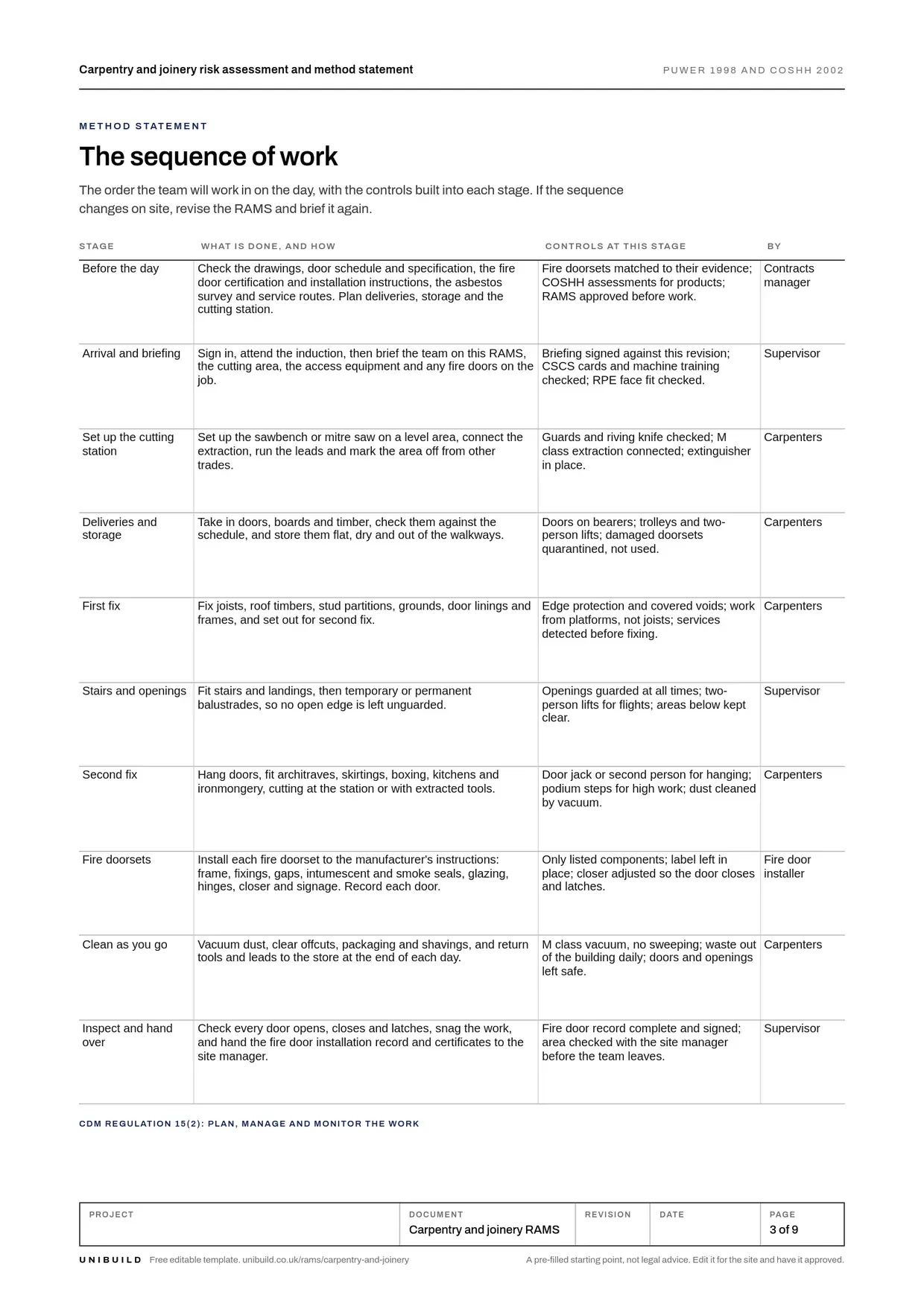
Carpentry method statement: the sequence of work
The order of work, with the controls at each stageThe order the team works in, from first fix to handover, with the controls built into each stage. If the sequence changes on site, revise the RAMS and brief it again.
Before the day
Check the drawings, door schedule and specification, the fire door certification and installation instructions, the asbestos survey and service routes. Plan deliveries, storage and the cutting station.
ControlsFire doorsets matched to their evidence; COSHH assessments for products; RAMS approved before work.
Arrival and briefing
Sign in, attend the induction, then brief the team on this RAMS, the cutting area, the access equipment and any fire doors on the job.
ControlsBriefing signed against this revision; CSCS cards and machine training checked; RPE face fit checked.
Set up the cutting station
Set up the sawbench or mitre saw on a level area, connect the extraction, run the leads and mark the area off from other trades.
ControlsGuards and riving knife checked; M class extraction connected; extinguisher in place.
Deliveries and storage
Take in doors, boards and timber, check them against the schedule, and store them flat, dry and out of the walkways.
ControlsDoors on bearers; trolleys and two-person lifts; damaged doorsets quarantined, not used.
First fix
Fix joists, roof timbers, stud partitions, grounds, door linings and frames, and set out for second fix.
ControlsEdge protection and covered voids; work from platforms, not joists; services detected before fixing.
Stairs and openings
Fit stairs and landings, then temporary or permanent balustrades, so no open edge is left unguarded.
ControlsOpenings guarded at all times; two-person lifts for flights; areas below kept clear.
Second fix
Hang doors, fit architraves, skirtings, boxing, kitchens and ironmongery, cutting at the station or with extracted tools.
ControlsDoor jack or second person for hanging; podium steps for high work; dust cleaned by vacuum.
Fire doorsets
Install each fire doorset to the manufacturer's instructions: frame, fixings, gaps, intumescent and smoke seals, glazing, hinges, closer and signage. Record each door.
ControlsOnly listed components; label left in place; closer adjusted so the door closes and latches.
Clean as you go
Vacuum dust, clear offcuts, packaging and shavings, and return tools and leads to the store at the end of each day.
ControlsM class vacuum, no sweeping; waste out of the building daily; doors and openings left safe.
Inspect and hand over
Check every door opens, closes and latches, snag the work, and hand the fire door installation record and certificates to the site manager.
ControlsFire door record complete and signed; area checked with the site manager before the team leaves.
What the law asks for carpentry and joinery
Checked against the sourceSuitable equipment, trained users
Work equipment must suit the work and be used only for the jobs and conditions it suits. Everyone who uses it, and anyone who supervises them, needs adequate training in how to use it, the risks and the precautions.
PUWER 1998, regulations 4 and 9Guarding dangerous parts
Access to dangerous parts of machines such as saw blades is prevented, or the parts stopped first. Fixed guards come first, then other guards or protection devices, then jigs and push sticks, backed by training and supervision.
PUWER 1998, regulation 11Wood dust
Hardwood dust is listed in COSHH Schedule 1 as a carcinogen and wood dust can cause asthma, so exposure is reduced as low as is reasonably practicable. EH40 sets limits of 3 mg/m³ for hardwood and 5 mg/m³ for softwood over 8 hours; mixed dust takes the hardwood limit.
COSHH Regulations 2002, regulation 7(7) and Schedule 1; HSE EH40/2005Extraction examined
Control measures are kept in efficient working order. Local exhaust ventilation, which includes dust extraction on tools, has a thorough examination and test at least every 14 months, with the record kept for at least 5 years.
COSHH Regulations 2002, regulation 9Work at height
Work at height is avoided where it can be done safely another way. Where it cannot, falls are prevented with a safe place of work or suitable equipment, and only then is the distance and effect of a fall reduced.
Work at Height Regulations 2005, regulation 6Fire doorsets
In England, Approved Document B says test evidence should be checked to apply to the complete installed doorset, as small differences in detail can affect the rating. Most fire doorsets need a self-closing device and a fire door sign; doors to and within flats need no sign.
Approved Document B, Volumes 1 and 2, Appendix CCompetence, equipment and PPE
Competence and cards
- Carpenters and joiners CSCS card for the trade, with apprentices supervised.
- Machine users Trained on each woodworking machine they use, as PUWER regulation 9 and HSE L114 expect.
- Fire door installers Trained to install the doorsets on the job to the manufacturer's instructions, and certified where the specification asks for it.
- Supervisor Experienced carpenter with site supervision training.
- Tower users Trained to erect and move the aluminium tower, for example on a PASMA course.
- RPE wearers Face fit tested for tight-fitting masks, and clean shaven where the mask seals.
Plant and equipment
- Sawbench or mitre saw Guards, riving knife and brake checked before use; blade sharp and suited.
- Circular and plunge saws Lower guard returns freely; blade, lead and battery checked before use.
- Nail guns Contact tip, trigger, air line or battery checked before use.
- Dust extraction unit M class or better; hoses and filters checked; examined every 14 months.
- Podium steps and stepladders Pre-use check each day; detailed inspection on a set schedule.
- Door lifter or trolley Checked before use; rated for the heaviest door on the job.
PPE
- Eye protection for sawing, nailing, drilling overhead and using foams and adhesives.
- Hearing protection in marked zones and when using saws, planers and nailers.
- Respiratory protection FFP3, face fit tested, for cutting and sanding wood and board.
- Gloves cut-resistant for handling, nitrile for foams and adhesives.
- Safety footwear with toe protection and a grip sole.
- Safety helmet and high visibility where the site rules require them.
Permits and plans
A permit to work where the principal contractor's rules require one, for example in occupied or controlled areas. A lift plan where trusses, stairs or doorsets are lifted by crane. An asbestos check before any strip out of old doors, panels or boxing, and the building manager's agreement before any fire door is taken off.
Emergency and rescue
First aider and first aid kit on site, with dressings for deep cuts and eyewash for dust and splashes. Machine stopped and isolated before anyone is freed. Nail gun injuries go to hospital with the nail left in place. Fire procedure and extinguisher known. Nearest accident and emergency department named on the briefing.
Toolbox talk: carpentry and joinery safety
Read this to the team before work starts, tick each point as it is covered, and record who attended.
- Only use a saw you have been trained on. Guards stay on, push sticks for short cuts, and let the blade stop before you reach in.
- Nail guns are never pointed at anyone. Disconnect the air or take the battery out before clearing a jam.
- Plug the saw or sander into the extractor. Vacuum the dust up, never sweep it or blow it off with an air line.
- Stepladders are for short, light jobs. Anything longer goes on the podium or a platform.
- Fire doors go in exactly as the instructions say. No extra holes, no swapped hinges, no trimming beyond what the instructions allow.
- Two people for heavy doors, worktops and stairs. Ask for help rather than carry it alone.
Ask the team
- Which doors on this job are fire doors, and where are their instructions?
- Where is the cutting station, and who is trained on the sawbench?
- Where could there be cables or pipes behind the walls we are fixing to?
What is in the carpentry and joinery RAMS template
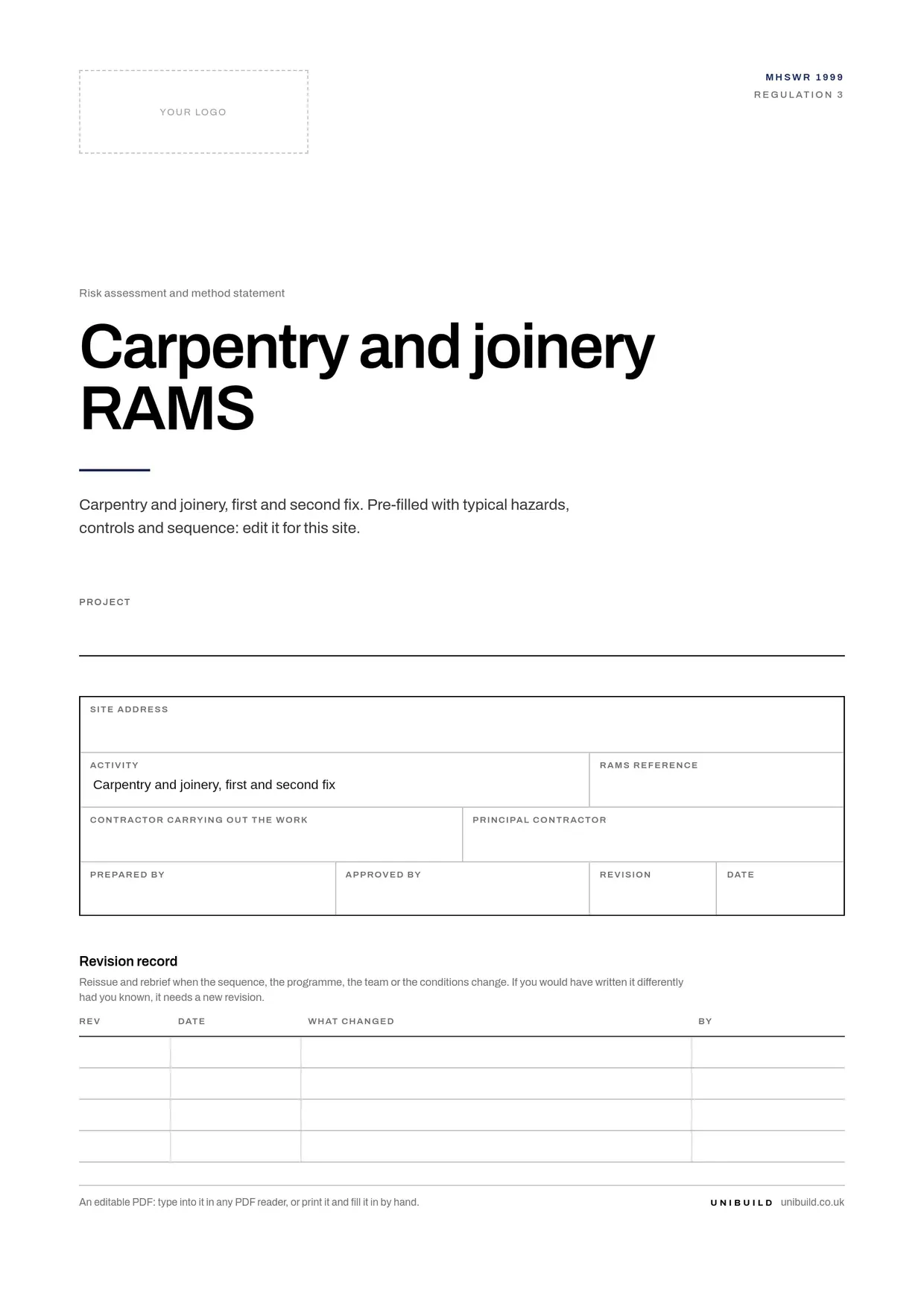
9 pages, pre-filled and editableThe work, pre-filled
Scope, location and access, interfaces with other trades, the documents the RAMS relies on, and the team with their cards.
The sequence of work
Ten stages from planning to handover, including first fix, second fix and fire doorsets, with the person responsible at each one.
Hazards and controls
Eighteen carpentry and joinery hazards rated before and after controls on a five by five matrix, with room for your own.
Plant, PPE and substances
Saws, nail guns and extraction with their checks, PPE by type, and wood dust, foams and adhesives.
Fire door installation record
A page to record each fire doorset: its rating and evidence, frame, gaps, seals, ironmongery, closer and sign.
Emergency and briefing record
First aid and fire arrangements, then twenty signatures against the revision, taken before the work starts.
Brief it, and get it signed on the phone
On Unibuild a RAMS is written from a template, approved, then read by each operative on their phone in their own language and signed. Subcontract and agency workers sign through a link, with no app to install.
Every signature carries its date and time and prints as the last page of the RAMS PDF. Change the RAMS and it has to be signed again.
How RAMS work on UnibuildCarpentry and joinery RAMS questions
Is this carpentry and joinery RAMS template free?
What should a carpentry method statement include?
Do I need a risk assessment for door installation?
What goes in a fire door installation method statement?
Does a fire door installer need to be certified?
What are the exposure limits for wood dust?
Does a self-employed joiner need a RAMS?
What PPE does a carpenter need?
RAMS templates for other trades and hazards
All free, pre-filled and editableBy trade
- Air conditioning and HVAC RAMS
- Bricklaying RAMS
- Carpentry and joinery RAMS
- CCTV installation RAMS
- Cleaning risk assessment
- Concrete works RAMS
- Demolition RAMS
- Drylining RAMS
- Electrical RAMS
- Facilities maintenance RAMS
- Fire alarm installation RAMS
- Glazing and window RAMS
- Groundworks RAMS
- Hot works and welding RAMS
- Insulation RAMS
- Landscaping and fencing RAMS
- Painting and decorating RAMS
- Pest control risk assessment
- Plastering and rendering RAMS
- Plumbing and heating RAMS
- Rail RAMS
- Refurbishment RAMS
- Roofing RAMS
- Rope access risk assessment
- Scaffolding RAMS
- Solar PV installation RAMS
- Steel erection RAMS
- Temporary works RAMS
- Tiling and flooring RAMS
- Tree surgery RAMS
By hazard
- Asbestos risk assessment
- Confined space risk assessment
- COSHH risk assessment
- Dust risk assessment
- Forklift and telehandler risk assessment
- Housekeeping risk assessment
- Lifting operations risk assessment
- Lone working risk assessment
- Manual handling risk assessment
- MEWP risk assessment
- Noise and vibration risk assessment
- Plant and excavator risk assessment
- Power tools risk assessment
- Traffic management risk assessment
- Working at height risk assessment
The blank RAMS template, the RAMS review checklist and every other free form are on Free downloads.
The RAMS, read and signed
before the work starts.
Unibuild keeps every RAMS with its versions, its approvals and each operative’s signature against the revision they read, for seven years, ready for the principal contractor or an auditor.