Free toolbox talk · Site security

Site security toolbox talk

A toolbox talk on site security and protecting the public, written to be read aloud in about six minutes: the boundary, the gate and visitors, deliveries and the pavement, falling objects, plant keys and fuel, and leaving the site safe at the end of every day so children and intruders cannot get hurt. The last page is the attendance record.

PDF · 3 pages · 209 KB · Word 41 KB · Free to use and reuse · Terms

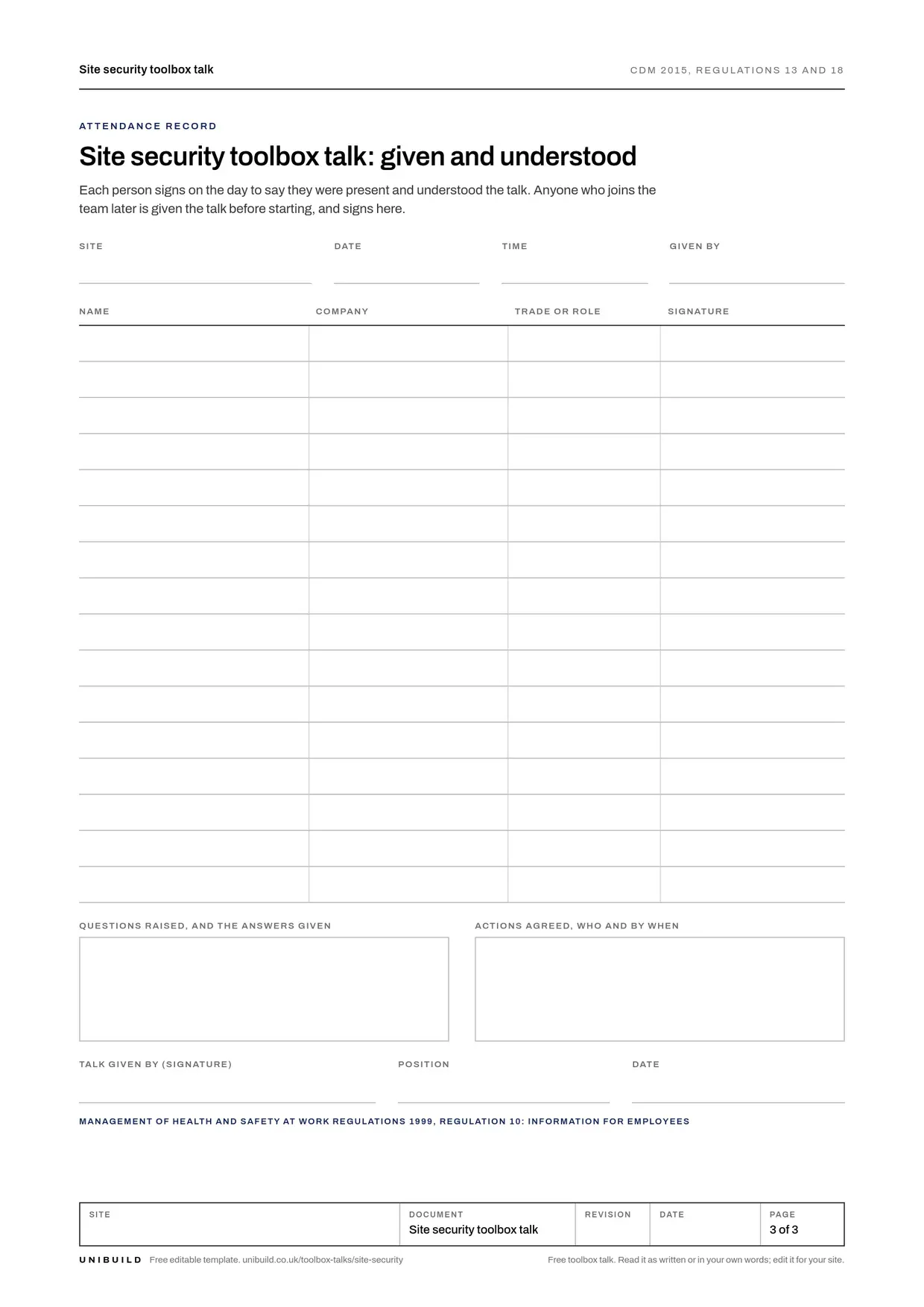
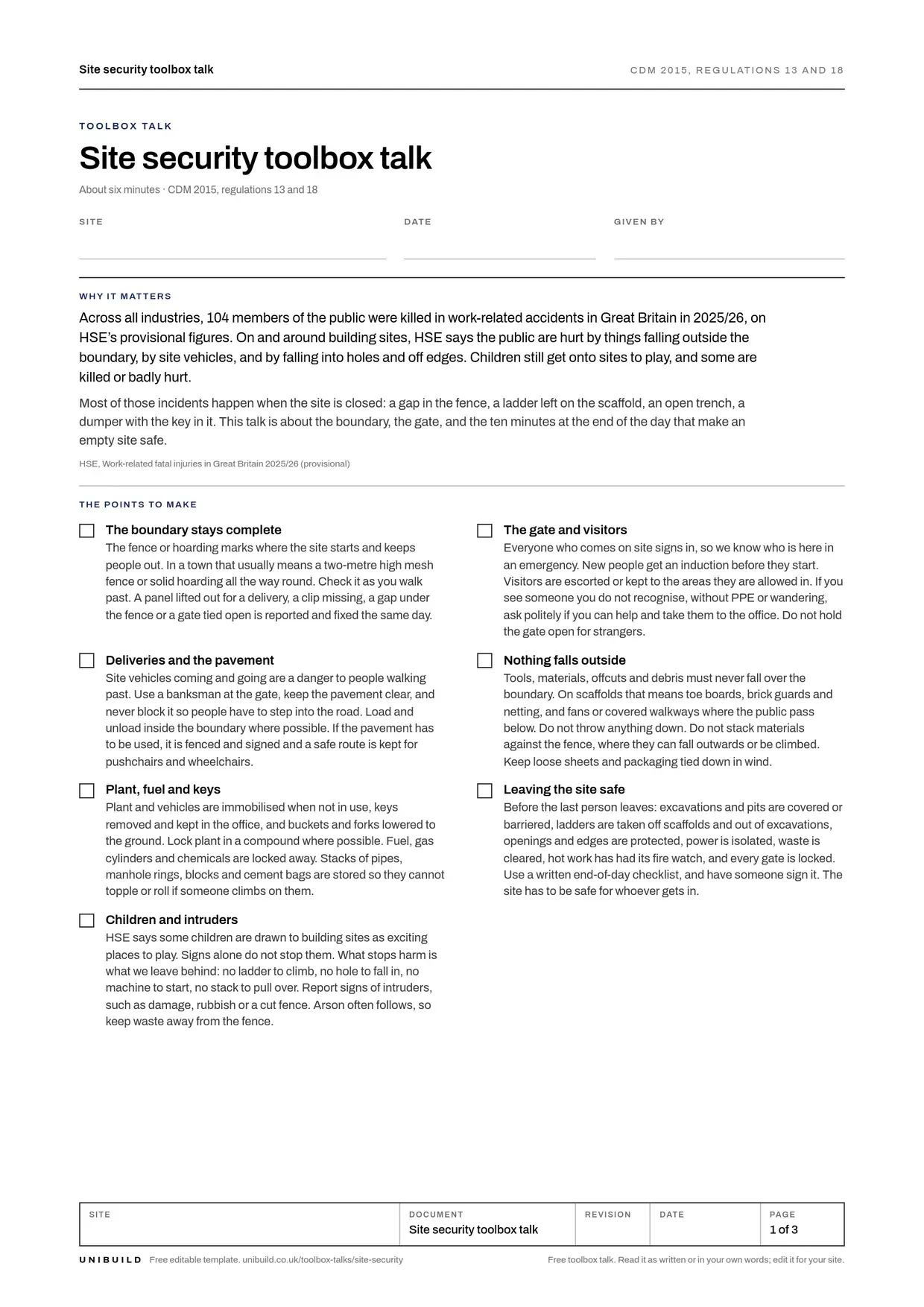
Attendance record page of the free site security toolbox talk from Unibuild, where each person signs to say they were given the talk and understood itFront page of the free site security toolbox talk from Unibuild
Law
CDM 2015, regulations 13 and 18
Time to deliver
About six minutes
Format
PDF and Word, with a sign-off sheet
Cost
Free, always

What this toolbox talk covers

This talk is for everyone on site, and especially the people who lock up. It takes about six minutes to give and covers keeping the boundary complete, the gate and signing visitors in, deliveries and pedestrians, stopping things falling outside the site, plant keys, fuel and materials, and the checks at the end of each day that keep children and intruders safe.

It is written to be read aloud, with the points in the order a supervisor makes them, short lists of do and do not, and questions about this site’s boundary and routine. The last page is the record: who gave it, who heard it and what was raised.

The temporary works and hoarding risk assessment covers the fence itself, and the scaffolding toolbox talk covers keeping scaffolds closed off.

Checked against HSE guidance and legislation.gov.uk on .

Toolbox talk · About six minutes

Site security: the talk

Read it as written or in your own words. Tick each point as you make it. Stop for the questions.

Why it matters

Across all industries, 104 members of the public were killed in work-related accidents in Great Britain in 2025/26, on HSE’s provisional figures. On and around building sites, HSE says the public are hurt by things falling outside the boundary, by site vehicles, and by falling into holes and off edges. Children still get onto sites to play, and some are killed or badly hurt.

Most of those incidents happen when the site is closed: a gap in the fence, a ladder left on the scaffold, an open trench, a dumper with the key in it. This talk is about the boundary, the gate, and the ten minutes at the end of the day that make an empty site safe.

HSE, Work-related fatal injuries in Great Britain 2025/26 (provisional)

The points to make

The boundary stays complete

The fence or hoarding marks where the site starts and keeps people out. In a town that usually means a two-metre high mesh fence or solid hoarding all the way round. Check it as you walk past. A panel lifted out for a delivery, a clip missing, a gap under the fence or a gate tied open is reported and fixed the same day.

The gate and visitors

Everyone who comes on site signs in, so we know who is here in an emergency. New people get an induction before they start. Visitors are escorted or kept to the areas they are allowed in. If you see someone you do not recognise, without PPE or wandering, ask politely if you can help and take them to the office. Do not hold the gate open for strangers.

Deliveries and the pavement

Site vehicles coming and going are a danger to people walking past. Use a banksman at the gate, keep the pavement clear, and never block it so people have to step into the road. Load and unload inside the boundary where possible. If the pavement has to be used, it is fenced and signed and a safe route is kept for pushchairs and wheelchairs.

Nothing falls outside

Tools, materials, offcuts and debris must never fall over the boundary. On scaffolds that means toe boards, brick guards and netting, and fans or covered walkways where the public pass below. Do not throw anything down. Do not stack materials against the fence, where they can fall outwards or be climbed. Keep loose sheets and packaging tied down in wind.

Plant, fuel and keys

Plant and vehicles are immobilised when not in use, keys removed and kept in the office, and buckets and forks lowered to the ground. Lock plant in a compound where possible. Fuel, gas cylinders and chemicals are locked away. Stacks of pipes, manhole rings, blocks and cement bags are stored so they cannot topple or roll if someone climbs on them.

Leaving the site safe

Before the last person leaves: excavations and pits are covered or barriered, ladders are taken off scaffolds and out of excavations, openings and edges are protected, power is isolated, waste is cleared, hot work has had its fire watch, and every gate is locked. Use a written end-of-day checklist, and have someone sign it. The site has to be safe for whoever gets in.

Children and intruders

HSE says some children are drawn to building sites as exciting places to play. Signs alone do not stop them. What stops harm is what we leave behind: no ladder to climb, no hole to fall in, no machine to start, no stack to pull over. Report signs of intruders, such as damage, rubbish or a cut fence. Arson often follows, so keep waste away from the fence.

Do

  • Check the fence and gates as you pass, and report any gap the same day.
  • Sign in and out every time, and make sure visitors do too.
  • Keep deliveries inside the boundary and the pavement clear for pedestrians.
  • Take the keys out of plant and lower buckets and forks when you leave it.
  • Remove ladders, cover holes and lock the gates at the end of the day.
  • Report anyone on site you do not recognise to the office.

Do not

  • Do not leave a gate open or a fence panel out, even for a minute.
  • Do not stack materials against the fence or leave them where they can roll.
  • Do not leave keys in plant or vehicles.
  • Do not throw or drop anything from height near the boundary.
  • Do not leave ladders on scaffolds or in excavations overnight.
  • Do not let anyone onto site who has not signed in.

Ask the team

  • Where are the weak points in our boundary right now?
  • Who does the end-of-day check on this site, and what is on the list?
  • Where are the plant keys kept, and who has them now?
  • Which parts of this site would be most dangerous to a child who got in tonight?
  • What would you do if you saw a stranger walking around the site?

To close

A building site is one of the most dangerous places a child can get into, and an empty site at night has nobody watching. The boundary, the gate and the end-of-day check are what keep the public safe. Keep the fence complete and the gates locked, sign everyone in, keep things from falling outside, and before you leave take the ladders down, cover the holes and take the keys. If you see a gap, a stranger or signs of a break-in, tell us straight away.

Record it. Who gave the talk, where, when, who was there and what was raised. The last page of the sheet is the record.

In Unibuild a talk is read in each operative’s own language and signed on the phone. How toolbox talks work

The law behind this talk

Checked against the source

Preventing unauthorised access

The principal contractor ensures that a suitable site induction is provided, that the necessary steps are taken to prevent access by unauthorised persons to the construction site, and that welfare facilities complying with Schedule 2 are provided throughout the construction phase.

CDM 2015, regulation 13(4)

Good order and site security

Where necessary in the interests of health and safety, a construction site, so far as is reasonably practicable and in line with the level of risk, has its perimeter identified by suitable signs and arranged so that its extent is readily identifiable, or is fenced off, or both. Each part of the site is kept in good order.

CDM 2015, regulation 18

Duty to people who are not employees

Every employer conducts their undertaking so as to ensure, so far as is reasonably practicable, that people not in their employment who may be affected, including the public, are not exposed to risks to their health or safety.

Health and Safety at Work etc. Act 1974, section 3

What is on the sheet

3 pages, the talk and the record

The talk, over two pages

Why it matters, the points to make, do and do not, and the questions to ask, laid out to read from in the cabin or at the workface. Space at the top for the site, the date and who is giving it.

The last page, the record

The attendance record: each person's name, company and signature, the questions raised and any actions, signed off by the person who gave the talk. Type into it or print it and pass it round.

The Word version

The same talk as a Word document, so you can put your own letterhead on it, add a site photograph or change a point to match how your job is set up.

Download the talk as PDF Word versionPDF · 3 pages · 209 KB
After it is given

Delivered on the phone, signed in the room

On Unibuild a toolbox talk is picked from the library, read by each operative on their own phone in their own language and signed there and then. The record is filed against the operative, the site and the date.

A site manager sees who has had which talk, and who has not, without a sheet going round on Thursday.

How toolbox talks work on Unibuild
How long should a site security toolbox talk be?
About five to ten minutes. This one reads in about six if you make every point and stop for the questions. Give it at the start of a job, when the boundary or the gate changes, after any break-in, and before the school holidays.
Is a construction site legally required to be fenced?
CDM 2015 requires the perimeter to be signed and clearly identifiable, or fenced off, or both, where necessary for health and safety and in line with the risk, and the principal contractor must take the necessary steps to prevent unauthorised access. HSE says in populated areas that typically means a two-metre high small mesh fence or hoarding.
Who is responsible for site security?
The principal contractor has the duty to prevent unauthorised access and to arrange the site. Every contractor and worker plays a part, by keeping gates shut, reporting gaps and leaving their own work area safe at the end of the day.
What should be done at the end of the day on a building site?
HSE’s list for keeping children safe is to secure the site, cover or barrier excavations and pits, isolate and immobilise plant and lock it away if possible, store materials so they cannot topple or roll, and remove access ladders from excavations and scaffolds. Locking gates and isolating power complete it.
Do visitors need a site induction?
Anyone working on site needs a suitable induction. HSE says site rules are explained to authorised people, and some visitors need to be supervised or accompanied while on site or in particular areas, rather than given the full induction.
What should you do if you find an intruder on site?
Do not put yourself at risk. If it is safe, ask politely whether you can help and take them to the office or the gate. If you are worried, or they refuse to leave, tell the site manager and, if needed, the police. Report any signs of a break-in so the site can be checked before work.
How do we stop items falling outside the site?
HSE says objects must not fall outside the boundary. On scaffolds that means toe boards, brick guards and netting, with fans or covered walkways where the public pass underneath, and materials stored away from the perimeter fence.
Do we have to keep a record of the talk?
There is no regulation that names toolbox talk records, but employers must give information, instruction and training, and most principal contractors and auditors ask for the evidence. A signed attendance record with the date and the topic is that evidence. The last page of the sheet is the record.
Is this site security toolbox talk free?
Yes. Download it, print it, give it, edit it and put your own name on it, including on paid work and for clients, with no sign-up and no email address.
Next step

The talk given, understood
and on record.

Unibuild keeps every toolbox talk against the operative who signed it, the site and the date, for seven years, ready for the principal contractor or an auditor.

Get a quote
One figure per firm · For UK firms

Right, let’s talk numbers.

Five things about your business. We work your fee out properly and put it in writing the same working day.

What we build for you

  • Your own portalIn the browser, built around your firm
  • Your own appiOS and Android, under your name
  • Everyday AI includedHeavier AI at cost, nothing added
  • One platformEverything in one place, set up by us

Would you rather see it running first? Book a 30-minute demo

Quotation request