
Groundworks method statement and RAMS
A groundworks risk assessment and method statement, already filled in for excavation, buried services, trench support and plant. Edit it for your site, then brief it.
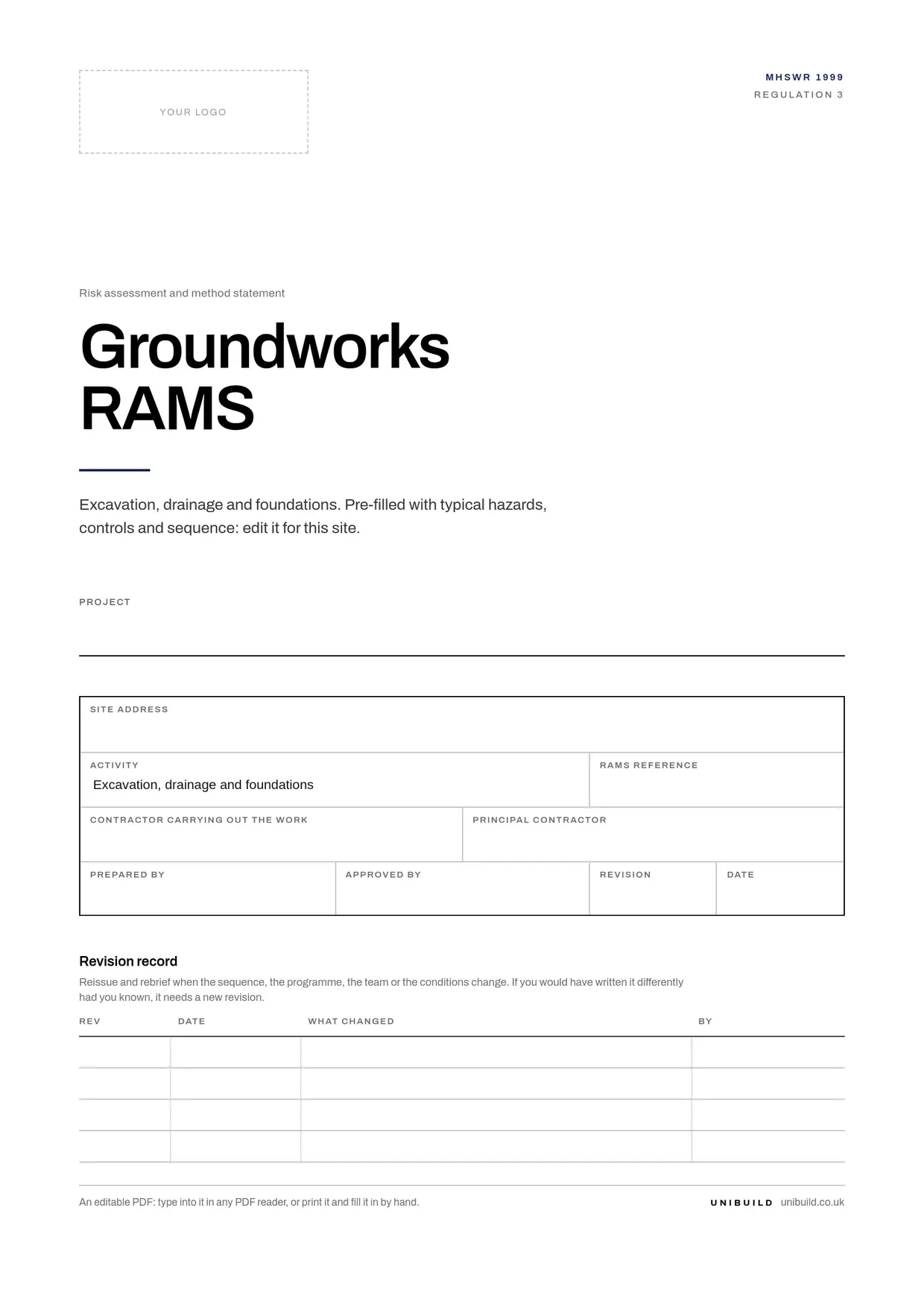
- Law
- CDM 2015, regulations 22 and 24
- Inspection
- At the start of every shift
- Format
- Editable PDF and Word
- Cost
- Free, always
Do you need a method statement for groundworks?
Yes, in practice every groundworks job needs a method statement, as part of a RAMS, before ground is broken. Excavation is one of the higher risk activities on site, and a principal contractor will expect to review the RAMS first.
The risk assessment is the legal duty, under regulation 3 of the Management of Health and Safety at Work Regulations 1999. The method statement sets out the plan: how services are found, how the dig is supported, how plant and people are kept apart, and when the excavation is inspected.
A groundworks method statement has to fit the ground in front of you. The soil, the water table, the services, nearby foundations, the depth and the plant on site decide the controls. CDM 2015 regulation 22 and HSE guidance HSG47 are what a reviewer checks it against.
Groundworks and excavation hazards and controls
17 hazards, rated before and after controlsThe significant hazards on a typical drainage, foundation or services excavation, with the controls a reviewer expects to see. Delete what does not apply and add what your site has.
Collapse of the excavation
Operatives in the trench or pit, buried or crushed by a fall of the sides.
- No ground relied on to stand unsupported: trench boxes, sheets and props, or battering to a safe angle, to the temporary works design.
- Support equipment on site before digging starts, and installed without anyone entering an unsupported trench.
- Excavation inspected at the start of each shift, after any event affecting stability, and after any fall of material.
BeforeHigh 20AfterMedium 5
Striking buried services
Operatives and the excavator driver, from electric shock, burns, gas escape or flooding.
- Service plans from each owner checked, the area scanned with a cable locator and signal generator, and services marked before breaking ground.
- Trial holes dug by hand or vacuum excavation to confirm position and depth; locator used again as the dig goes down.
- Every service treated as live until disconnected and proven safe; permit to dig issued for the area.
BeforeHigh 20AfterMedium 5
Falls into the excavation
Operatives, other trades and the public near open excavations.
- Guard-rails and toe boards at the edge, or trench box extensions or sheets standing above ground level.
- Covered or fenced at the end of each shift, with lighting where people pass at night.
- Safe access in and out: a tied ladder extending at least 1 metre above the landing, or a stair unit.
BeforeHigh 16AfterLow 4
Spoil, materials and plant at the edge
People in the excavation, from material falling in or the edge giving way.
- Spoil heaps and materials kept back from the edge, at the distance in the temporary works design.
- Plant and vehicles parked away from the edge, with wheel stops where dumpers tip into the excavation.
- Toe boards or projecting sheets to stop loose material falling in; helmets worn in the trench.
BeforeHigh 15AfterMedium 5
Undermining walls, buildings and scaffold
Operatives in the trench and people near a wall, building or scaffold beside it.
- Foundations of nearby walls, buildings and scaffold checked before digging, with a structural engineer where needed.
- Extra support or propping to the design before the dig goes below the foundation level.
BeforeHigh 15AfterMedium 5
Water in the excavation
Operatives in the excavation, from flooding, softened sides and loss of support.
- Groundwater and nearby watercourses identified in the ground investigation; support designed for the water load.
- Water channelled to a sump and pumped out, with the effect of pumping on stability considered.
- Work stopped and the excavation re-inspected after heavy rain or a burst main.
BeforeMedium 12AfterLow 4
People struck by plant
Operatives, banksmen and other trades near excavators, dumpers and lorries.
- Traffic routes and pedestrian routes planned and kept apart by barriers.
- Exclusion zone around the slewing excavator; nobody approaches until the operator has seen them and stopped.
- Trained banksman for reversing and for work near people in the trench.
BeforeHigh 20AfterMedium 5
Dumper overturning
Dumper drivers, crushed when a dumper overturns on a slope, spoil heap or edge.
- Dumpers with roll-over protection, and seat belts worn every time.
- Kept to gradients within the manufacturer's limits and off stockpiles; skips not loaded above the top edge.
- Wheel stops at a safe distance from the edge when tipping.
BeforeHigh 15AfterMedium 5
Quick hitch attachment falling
Operatives in the trench or near the bucket when an attachment drops off.
- Quick hitch with its safety pin or locking device in place, checked every time an attachment is changed.
- Operator trained on the specific hitch; nobody works under the bucket.
- Hitch thoroughly examined under LOLER at the interval set by the competent person.
BeforeHigh 15AfterMedium 5
Lifting with an excavator
Operatives guiding pipes, chambers or trench boxes into the excavation.
- Excavator set up by its manufacturer for lifting, with a marked lifting point, a rated capacity and a LOLER thorough examination in date.
- Lift planned, a trained slinger signaller in charge, and nobody under the load.
BeforeMedium 12AfterLow 4
Overhead power lines
Excavator drivers and tipper drivers, and anyone near plant that touches a line.
- Lines identified before work and the network operator asked to divert or switch them off where plant comes close.
- Where lines stay live, goal posts and barriers keep plant out of reach, with height limits briefed.
BeforeMedium 10AfterMedium 5
Fumes and bad air in deep excavations
Operatives in deep trenches, chambers and pits where gas or exhaust can collect.
- No petrol or diesel engines in or beside the excavation unless the exhaust is ducted away.
- Atmosphere tested before entry where gas, fume or low oxygen is foreseeable; work then treated as a confined space.
- Confined space entry only under a permit, with trained people and a rescue plan.
BeforeMedium 10AfterMedium 5
Contaminated ground
Operatives digging on brownfield land, near fuel tanks or old drains.
- Ground investigation and contamination report reviewed before work starts.
- Anything unexpected, such as odours, oily or discoloured soil, drums or asbestos, means stop and report.
- Welfare with hot water for washing before eating; cuts covered.
BeforeMedium 9AfterLow 3
Wet cement and concrete
Operatives placing, levelling and finishing concrete in foundations and bases.
- Waterproof gloves suitable for alkalis, and wellingtons high enough that concrete cannot get in.
- Waterproof trousers over the boots and knee pads when kneeling; cement washed off the skin straight away.
- Eyewash at the pour; skin checks for early signs of dermatitis.
BeforeMedium 12AfterMedium 6
Manual handling of kerbs, pipes and blocks
Operatives laying kerbs, edgings, pipes, chamber rings and blocks.
- Kerbs, chamber rings and heavy pipes placed by vacuum lifter, kerb lifter or excavator rather than lifted by hand.
- Materials delivered and stacked close to where they are laid, so carrying distances stay short.
- What must be moved by hand is a two-person lift or a lighter unit, with knee pads for kneeling work.
BeforeMedium 12AfterMedium 6
Breaking out: dust, vibration and noise
Operatives using breakers, cut-off saws and compactors on concrete and kerbs.
- Machine-mounted breakers used in place of hand-held ones wherever practicable.
- Water suppression or on-tool extraction for cutting, and FFP3 RPE, face fit tested.
- Vibration exposure planned per tool and per person, with hearing protection in the noise zone.
BeforeMedium 12AfterMedium 6
Rescue from an excavation
An injured operative, or one trapped by a fall of ground.
- Rescue plan agreed before work starts, with the means to lift someone out and the emergency services route kept clear.
- Nobody works alone in an excavation; nobody enters a collapsed trench without support in place.
BeforeMedium 10AfterMedium 5
Scores are likelihood times severity on the five by five matrix in the template. They are typical ratings for this work, a starting point for your own assessment of your site.
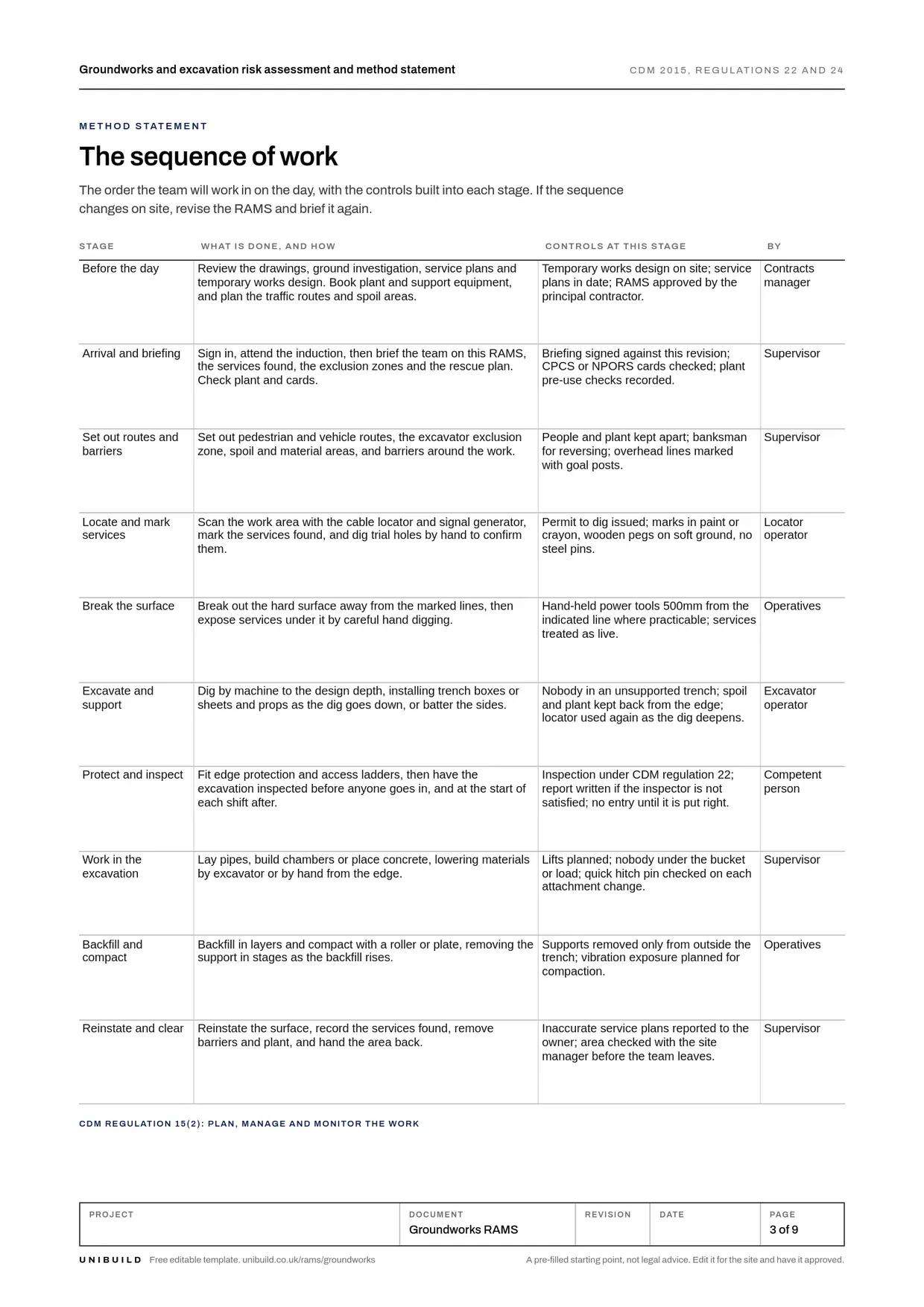
Groundworks method statement: the sequence of work
The order of work, with the controls at each stageThe order the team works in on the day, with the controls built into each stage. If the sequence changes on site, revise the RAMS and brief it again.
Before the day
Review the drawings, ground investigation, service plans and temporary works design. Book plant and support equipment, and plan the traffic routes and spoil areas.
ControlsTemporary works design on site; service plans in date; RAMS approved by the principal contractor.
Arrival and briefing
Sign in, attend the induction, then brief the team on this RAMS, the services found, the exclusion zones and the rescue plan. Check plant and cards.
ControlsBriefing signed against this revision; CPCS or NPORS cards checked; plant pre-use checks recorded.
Set out routes and barriers
Set out pedestrian and vehicle routes, the excavator exclusion zone, spoil and material areas, and barriers around the work.
ControlsPeople and plant kept apart; banksman for reversing; overhead lines marked with goal posts.
Locate and mark services
Scan the work area with the cable locator and signal generator, mark the services found, and dig trial holes by hand to confirm them.
ControlsPermit to dig issued; marks in paint or crayon, wooden pegs on soft ground, no steel pins.
Break the surface
Break out the hard surface away from the marked lines, then expose services under it by careful hand digging.
ControlsHand-held power tools 500mm from the indicated line where practicable; services treated as live.
Excavate and support
Dig by machine to the design depth, installing trench boxes or sheets and props as the dig goes down, or batter the sides.
ControlsNobody in an unsupported trench; spoil and plant kept back from the edge; locator used again as the dig deepens.
Protect and inspect
Fit edge protection and access ladders, then have the excavation inspected before anyone goes in, and at the start of each shift after.
ControlsInspection under CDM regulation 22; report written if the inspector is not satisfied; no entry until it is put right.
Work in the excavation
Lay pipes, build chambers or place concrete, lowering materials by excavator or by hand from the edge.
ControlsLifts planned; nobody under the bucket or load; quick hitch pin checked on each attachment change.
Backfill and compact
Backfill in layers and compact with a roller or plate, removing the support in stages as the backfill rises.
ControlsSupports removed only from outside the trench; vibration exposure planned for compaction.
Reinstate and clear
Reinstate the surface, record the services found, remove barriers and plant, and hand the area back.
ControlsInaccurate service plans reported to the owner; area checked with the site manager before the team leaves.
What the law asks for groundworks
Checked against the sourcePreventing collapse and falls
All practicable steps are taken, including support or battering where necessary, so no excavation collapses and nobody is buried. Steps are also taken to stop people, plant and materials falling in.
CDM 2015, regulation 22Inspection of excavations
Where support or battering is provided, nobody works in the excavation until a competent person has inspected it. That happens at the start of the shift, after events affecting stability, and after any fall of material.
CDM 2015, regulation 22(4)Reports of inspections
If the inspector is not satisfied the work is safe, they say so before the end of the shift and give a written report within 24 hours. Reports stay on site, then for 3 months after the work ends.
CDM 2015, regulation 24Underground services
Work that could damage an underground service goes ahead only once suitable and sufficient steps have been taken to prevent the risk. HSE guidance HSG47 sets out how: planning the work, locating and marking the services, and safe digging.
CDM 2015, regulation 25(4), with HSE HSG47People and vehicles
A construction site is organised so that pedestrians and vehicles can move safely, with enough separation between them. Where separation is not reasonably practicable, other protection and warnings are used.
CDM 2015, regulation 27Confined spaces
A trench, pit or chamber where gas, fume, lack of oxygen or flooding can foreseeably harm someone is a confined space. Nobody enters unless it is unavoidable, and then only under a safe system of work.
Confined Spaces Regulations 1997, regulations 1 and 4Competence, equipment and PPE
Competence and cards
- Plant operators CPCS or NPORS card for the excavator, dumper or roller they drive.
- Supervisor Experienced in excavation work, with site supervision training, on site throughout.
- Excavation inspector A competent person who knows the dangers and the support system in use.
- Locator operator Trained in the cable locator and signal generator and their limits.
- Slinger signaller CPCS or NPORS card, for any lift by excavator.
- Confined space entry Trained for the level of risk, with a trained rescue team on standby.
Plant and equipment
- Excavator Daily check; quick hitch pin checked on each change; LOLER exam if lifting.
- Site dumper Daily check; roll-over protection fitted; seat belt worn.
- Roller and plate compactor Daily check; vibration data known for exposure planning.
- Trench boxes, sheets and props Checked on delivery and at each shift inspection.
- Cable locator and signal generator Calibration or self-test in date; checked before use.
- Gas detector Calibrated and bump tested before entry to deep excavations.
PPE
- Safety helmet worn at all times near plant and in excavations.
- Safety boots with midsole protection, and safety wellingtons for concrete.
- High-visibility clothing to the site standard, worn near plant.
- Gloves waterproof and alkali-resistant for concrete, grip gloves for handling.
- Hearing and eye protection for breaking out, cutting and compaction.
- Respiratory protection FFP3, face fit tested, for cutting and breaking concrete.
Permits and plans
A permit to dig before breaking ground in any area. A confined space entry permit for any excavation or chamber assessed as a confined space. A lift plan for lifts by excavator or crane, and the temporary works design for the excavation support.
Emergency and rescue
Rescue plan for an injured or trapped operative, with the means to lift them out and the access route for the emergency services kept clear. For a service strike: stop, move everyone clear, call the service owner and the emergency services, and do not touch damaged cables or pipes.
Toolbox talk: excavation and buried services
Read this to the team before work starts, tick each point as it is covered, and record who attended.
- Assume there are services where we dig. We scan, mark and hand dig trial holes before the machine goes in.
- Nobody goes into a trench until the support is in and it has been inspected this shift.
- Keep spoil, materials and plant back from the edge. If the edge cracks or moves, get out and tell the supervisor.
- Never approach a working excavator until the driver has seen you and stopped.
- The quick hitch pin goes in every time the attachment changes. Nobody stands under the bucket.
- If you hit a service, or find one nobody marked, stop, move back and tell the supervisor.
Ask the team
- What services are marked in our work area today, and where are the trial holes?
- How do we get out of the excavation in a hurry?
- What would make us stop and get the excavation re-inspected?
What is in the groundworks RAMS template
9 pages, pre-filled and editableThe work, pre-filled
Scope, location and access, interfaces with other trades, the documents the RAMS relies on, and the team with their cards.
The sequence of work
Ten stages from planning to reinstatement, with the controls and the person responsible at each one.
Hazards and controls
Seventeen groundworks hazards rated before and after controls on a five by five matrix, with room for your own.
Plant, PPE and permits
The plant and its checks, PPE by type, cement, dust and ground contamination, and the permits the job needs.
Buried services check
A page to record the plans, the locator search, trial holes and the permit to dig before ground is broken.
Emergency and briefing record
Rescue and service strike arrangements, then twenty signatures against the revision.
Brief it, and get it signed on the phone
On Unibuild a RAMS is written from a template, approved, then read by each operative on their phone in their own language and signed. Subcontract and agency workers sign through a link, with no app to install.
Every signature carries its date and time and prints as the last page of the RAMS PDF. Change the RAMS and it has to be signed again.
How RAMS work on UnibuildGroundworks method statement questions
Is this groundworks RAMS template free?
What should a groundworks method statement include?
How often must an excavation be inspected?
Does every excavation inspection need a written report?
How deep can you dig without trench support?
What is a permit to dig?
Is a deep excavation a confined space?
Who signs the groundworks RAMS?
RAMS templates for other trades and hazards
All free, pre-filled and editableBy trade
- Electrical RAMSSafe isolation, live work, testing and inspection, and working near other trades.
- Scaffolding RAMSErecting, altering and dismantling tube and fitting and system scaffold, with handover and inspection.
- Roofing RAMSPitched and flat roofs, fragile surfaces, edge protection, hot work and getting materials up safely.
- Groundworks RAMSExcavations, buried services, plant, trench support and inspections at the start of each shift.
- Plumbing and heating RAMSSoldering and brazing, gas work, unvented systems, lofts and occupied homes.
- Painting and decorating RAMSAccess equipment, solvents and spray, old lead paint, dust from preparation and occupied buildings.
- Hot works and welding RAMSWelding, cutting, grinding and torch-on work: permits, fire watch, fume and gas cylinders.
By hazard
- COSHH risk assessmentHazardous substances on site: dusts, solvents, cement, resins and fume, assessed and controlled.
- Manual handling risk assessmentLifting, carrying, pushing and pulling, assessed by task, individual, load and environment.
- Working at height risk assessmentLadders, towers, MEWPs, scaffolds and roofs, chosen and controlled in the order the law sets.
- Lone working risk assessmentPeople working alone on site, in empty buildings and out of hours, with check-ins and a plan if they go quiet.
- Noise and vibration risk assessmentNoise exposure and hand-arm vibration from tools, measured against the action and limit values.
- Asbestos risk assessmentFinding asbestos before work starts, deciding whether work is licensed, and controlling non-licensed work.
- Confined space risk assessmentManholes, tanks, voids and chambers: avoiding entry, a safe system of work, gas testing and rescue.
The blank RAMS template, the RAMS review checklist and every other free form are on Free downloads.
The RAMS, read and signed
before the work starts.
Unibuild keeps every RAMS with its versions, its approvals and each operative’s signature against the revision they read, for seven years, ready for the principal contractor or an auditor.