
Traffic management risk assessment template
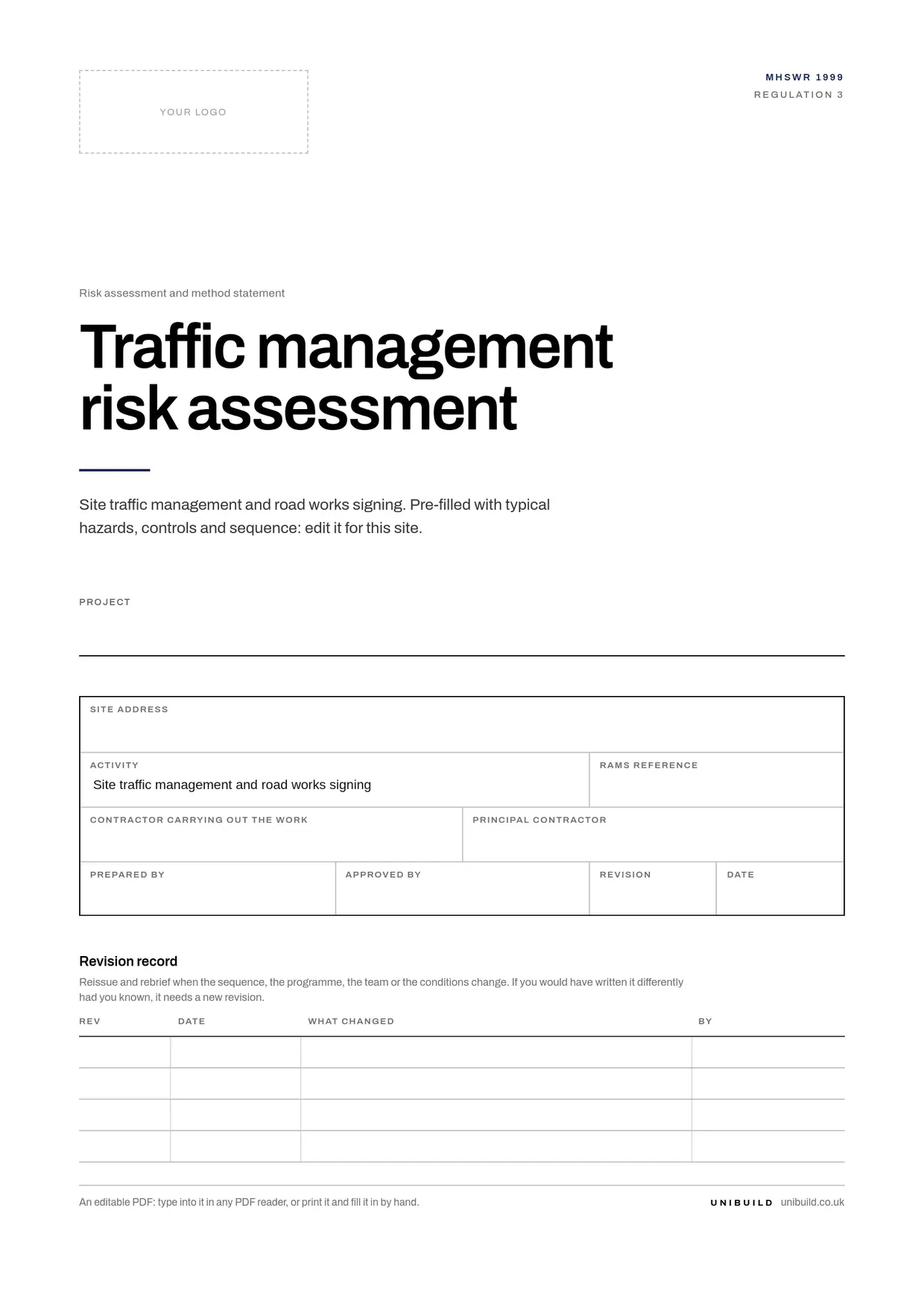
A traffic management risk assessment, already filled in for vehicles and people on site and for signing, lighting and guarding road works, with a traffic management plan check. Edit it for your job, then brief it.
- Law
- CDM 2015, regulations 27 and 28
- Road works
- Safety at Street Works code
- Format
- Editable PDF and Word
- Cost
- Free, always
What is a traffic management risk assessment?
A traffic management risk assessment looks at how vehicles, plant and people move on and around a site, and how they are kept apart. Regulation 27 of the Construction (Design and Management) Regulations 2015 requires a site organised so that, so far as is reasonably practicable, pedestrians and vehicles can move without risk.
On site, HSE guidance HSG144 sets the approach: separate people from vehicles, cut the number of movements, design out reversing with one-way systems and turning areas, and use trained signallers where reversing remains. HSE says most construction transport accidents come from poor separation of pedestrians and vehicles.
Work on the public highway follows different rules. Signing, lighting and guarding follow the Safety at Street Works and Road Works code of practice, with Chapter 8 of the Traffic Signs Manual for motorways and dual carriageways of 50 mph or more. This template covers both, with a traffic management plan check.
Checked against legislation.gov.uk and HSE guidance on .
Traffic management hazards and controls
15 hazards, rated before and after controlsA worked example of the significant hazards from vehicles and plant on site and from working beside traffic on the highway, with the controls a reviewer expects to see. Delete what does not apply and add what your job has.
People on foot struck by site vehicles
Operatives, visitors and delivery drivers on foot, where walkways and vehicle routes meet.
- Separate pedestrian gate and fenced walkways from the gate, parking and welfare to the work, kept apart from vehicle routes.
- Marked crossing points with a clear view of traffic, and barriers that guide people to them.
- High-visibility clothing worn; pedestrians kept out of plant working areas and loading areas.
BeforeHigh 20AfterMedium 10
Reversing vehicles
Anyone behind a reversing lorry, dumper or excavator, including the person directing it.
- One-way system, turning areas and drive-through unloading, so the need to reverse is designed out.
- Where reversing remains: a trained signaller in a safe position and in sight of the driver; the driver stops if sight is lost.
- Cameras, mirrors, proximity sensors and reversing alarms in working order on site vehicles.
BeforeHigh 20AfterMedium 10
Site entrance and the public footway
Members of the public on the footway and road as vehicles enter and leave the site.
- Gate placed for good sight lines; vehicles cross the footway under the control of a signaller, with barriers.
- Lorry holding area and booked delivery times, kept away from school and shopping peaks where the site is near them.
- Wheel washing and road sweeping keep mud off the public highway.
BeforeHigh 15AfterMedium 5
Deliveries and unloading
Drivers and operatives at the unloading point, from moving plant and falling loads.
- Deliveries booked to a slot, with site instructions and the route sent to the supplier when the order is placed.
- Unloaded on level ground away from traffic, pedestrians and overhead hazards; loads checked before restraints are released.
- Loading bays with a separate exit for pedestrians; drivers wait in a safe, agreed place.
BeforeMedium 12AfterMedium 8
Plant falling into excavations
Drivers of dumpers and excavators near trench edges, spoil heaps, slopes and water.
- Stop blocks or barriers at excavation edges and tipping points, fixed so they cannot move.
- Routes kept clear of edges and steep gradients; rollover protection and seat belts used where fitted.
BeforeHigh 15AfterMedium 5
Poor routes: surfaces, gradients and bends
Drivers and people nearby, from soft, rutted or steep routes and blind corners.
- Routes firm, drained, wide enough for the largest vehicle, and maintained as the site changes.
- Speed limits set for the site and signed; mirrors at blind corners; as few junctions as possible.
- Routes checked regularly and kept clear of stored materials, as regulation 27 requires.
BeforeMedium 12AfterMedium 8
Overhead lines and structures
Drivers of tippers, excavators and lorry loaders passing under power lines, gantries or scaffold.
- Barriers set 6 m horizontally from the nearest wire on either side of overhead lines; passageways with non-conducting goalposts and the clearance height signed.
- Tipper bodies, booms and jibs lowered before moving; low headroom marked on the traffic plan.
BeforeMedium 10AfterMedium 5
Untrained or unauthorised drivers
Everyone near plant driven by someone not competent or not authorised to drive it.
- Only trained, competent and authorised people drive plant; training cards checked for validity, with experience and familiarisation on the machine.
- Keys controlled and removed when vehicles are parked and left.
- Nobody drives when impaired by drink, drugs or ill health.
BeforeHigh 15AfterMedium 5
Riding on plant and vehicles
People riding on dumpers, buckets, forks, tailgates or loads.
- Nobody rides on a vehicle except in a safe place provided for that purpose: CDM 2015, regulation 28(4).
- Passenger seats used only where the vehicle is built for a passenger.
BeforeMedium 10AfterMedium 5
Darkness and poor visibility
Pedestrians and drivers on dark mornings and evenings, and in fog or heavy rain.
- Site approaches, routes, crossings and loading areas lit, as regulation 35 requires.
- High-visibility clothing for everyone on foot; vehicle lights and beacons working.
- Deliveries timed for daylight where an area cannot be lit well enough.
BeforeMedium 12AfterMedium 8
Working beside live traffic on the road
Operatives working in the carriageway or footway, struck by passing vehicles.
- Layout set by a competent person to the code: advance signs, lead-in taper, cones, information board and a safety zone.
- Nobody enters the safety zone in the normal course of work, and no materials are stored in it.
- Warning lights at night and in poor visibility on roads of 40 mph or more; traffic control chosen by the code.
BeforeHigh 20AfterMedium 10
Setting out and removing signs
Operatives placing and collecting signs, cones and lights, when they are most exposed.
- High-visibility clothing on before leaving the vehicle; vehicle parked safely, off the road where possible.
- Signs set out in the order the code sets, starting with advance signs, and removed in reverse order.
- Only trained and competent people set out, maintain or remove signing and temporary traffic control.
BeforeHigh 15AfterMedium 10
Pedestrians diverted at road works
The public, including disabled and older people, wheelchair users and people with pushchairs.
- At least 1.5 m of footway kept where possible, and never less than 1.0 m.
- Where the footway is lost, a walkway in the carriageway, generally 1.2 m wide, with barriers and ramps at the kerb.
- Continuous pedestrian barriers with a tapping rail around the working space.
BeforeMedium 12AfterLow 4
Public and children entering the site
Members of the public, children in particular, getting in out of hours and using plant.
- Site fenced and gates locked out of hours, with steps taken to prevent unauthorised access.
- Plant immobilised and keys held under a key custody procedure.
- On part-occupied sites, site traffic kept out of occupied areas and the public routes separated.
BeforeMedium 10AfterMedium 5
Vehicle defects
Drivers and people nearby, from brake, steering, mirror or warning device failures.
- Daily checks by the driver, with defects reported at once and the vehicle taken out of use until repaired.
- Inspection and servicing to the manufacturer's instructions, with a maintenance log for each machine.
BeforeMedium 12AfterLow 4
Scores are likelihood times severity on the five by five matrix in the template. They are typical ratings for this work, a starting point for your own assessment of your site.
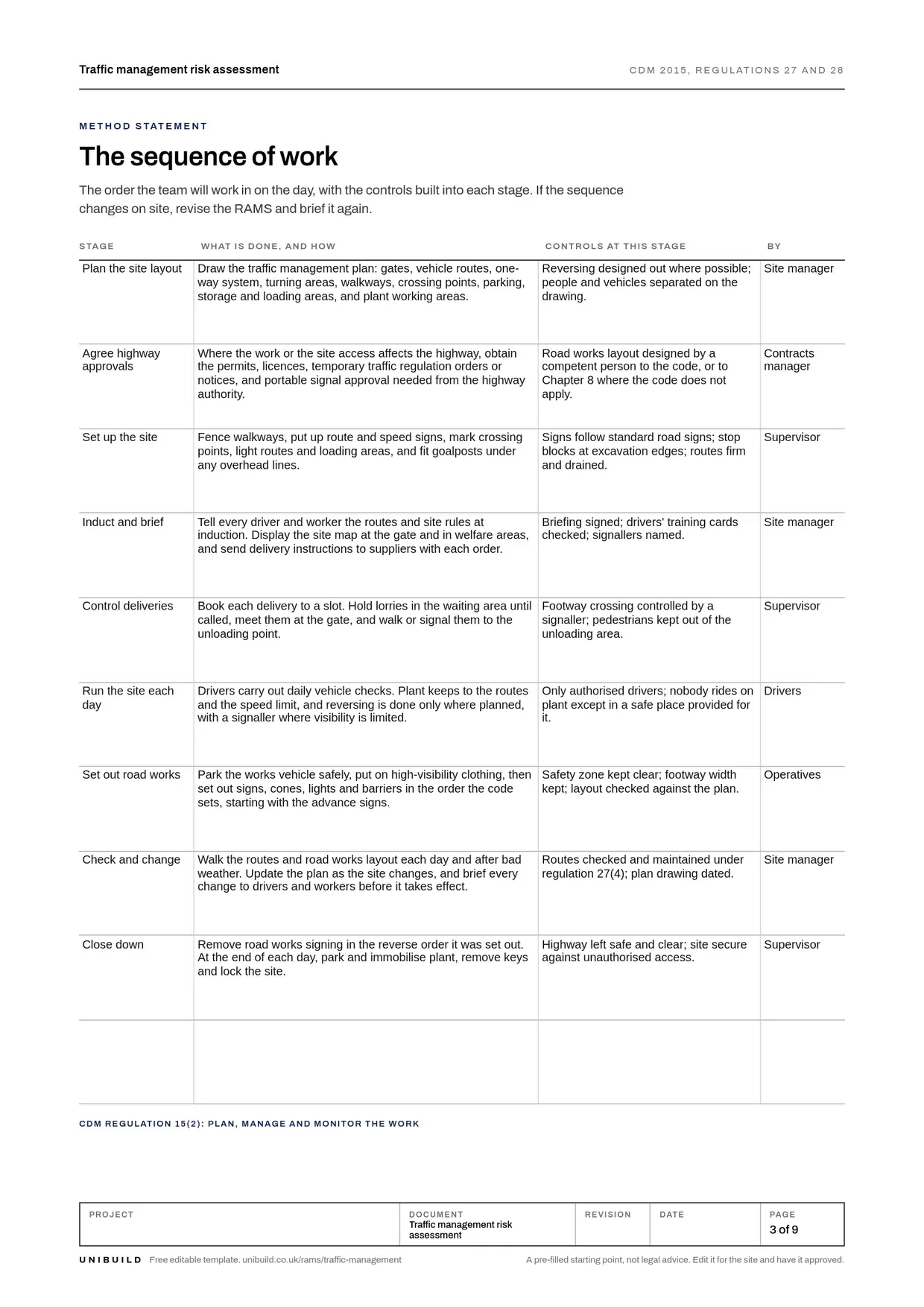
Traffic management method statement: the sequence of work
The order of work, with the controls at each stageHow the traffic plan is set up, run and kept up to date, on site and on the highway, with the controls at each stage. If the layout changes, update the plan, revise the assessment and brief it again.
Plan the site layout
Draw the traffic management plan: gates, vehicle routes, one-way system, turning areas, walkways, crossing points, parking, storage and loading areas, and plant working areas.
ControlsReversing designed out where possible; people and vehicles separated on the drawing.
Agree highway approvals
Where the work or the site access affects the highway, obtain the permits, licences, temporary traffic regulation orders or notices, and portable signal approval needed from the highway authority.
ControlsRoad works layout designed by a competent person to the code, or to Chapter 8 where the code does not apply.
Set up the site
Fence walkways, put up route and speed signs, mark crossing points, light routes and loading areas, and fit goalposts under any overhead lines.
ControlsSigns follow standard road signs; stop blocks at excavation edges; routes firm and drained.
Induct and brief
Tell every driver and worker the routes and site rules at induction. Display the site map at the gate and in welfare areas, and send delivery instructions to suppliers with each order.
ControlsBriefing signed; drivers' training cards checked; signallers named.
Control deliveries
Book each delivery to a slot. Hold lorries in the waiting area until called, meet them at the gate, and walk or signal them to the unloading point.
ControlsFootway crossing controlled by a signaller; pedestrians kept out of the unloading area.
Run the site each day
Drivers carry out daily vehicle checks. Plant keeps to the routes and the speed limit, and reversing is done only where planned, with a signaller where visibility is limited.
ControlsOnly authorised drivers; nobody rides on plant except in a safe place provided for it.
Set out road works
Park the works vehicle safely, put on high-visibility clothing, then set out signs, cones, lights and barriers in the order the code sets, starting with the advance signs.
ControlsSafety zone kept clear; footway width kept; layout checked against the plan.
Check and change
Walk the routes and road works layout each day and after bad weather. Update the plan as the site changes, and brief every change to drivers and workers before it takes effect.
ControlsRoutes checked and maintained under regulation 27(4); plan drawing dated.
Close down
Remove road works signing in the reverse order it was set out. At the end of each day, park and immobilise plant, remove keys and lock the site.
ControlsHighway left safe and clear; site secure against unauthorised access.
What the law asks for traffic management
Checked against the sourcePeople and vehicles move safely
A construction site must be organised so that, so far as is reasonably practicable, pedestrians and vehicles can move without risks to health or safety. Traffic routes must be suitable, sufficient in number, in suitable positions and of sufficient size.
CDM 2015, regulation 27(1) and (2)Separation, signs and upkeep
Routes keep vehicles and pedestrians apart or, where that is not reasonably practicable, protect people by other means and warn them of vehicles. Every loading bay has at least one exit for pedestrians only. Routes are signed where needed, regularly checked, maintained and kept clear.
CDM 2015, regulation 27(3) to (5)Vehicles
Unintended movement of vehicles is prevented or controlled. The driver, or the person directing a driver who lacks full visibility, warns anyone at risk. Nobody rides except in a safe place provided, and vehicles are kept from falling into excavations or water.
CDM 2015, regulation 28Lighting
Each construction site, and the approach and traffic routes to it, has suitable and sufficient lighting, by natural light so far as is reasonably practicable.
CDM 2015, regulation 35Street works
In England and Wales an undertaker executing street works keeps them adequately guarded and lit, with the traffic signs needed. Following the Safety at Street Works and Road Works code counts as compliance; failing to follow it is evidence of a breach, and a breach is an offence.
New Roads and Street Works Act 1991, section 65(1), (3) and (4)Other works in a street
In England and Wales anyone executing other works in a street erects the barriers and traffic signs needed to prevent danger to traffic, removes them once no longer needed, and keeps the works properly guarded and lit in darkness. The code is also issued under this section.
Highways Act 1980, section 174Competence, equipment and PPE
Competence and cards
- Traffic plan author Competent to plan site traffic routes to HSG144 and, for highway work, to design the layout to the code or Chapter 8.
- Drivers and plant operators Trained, competent and authorised for the machine, with a card from a recognised scheme such as CPCS or NPORS, experience and familiarisation.
- Signallers and banksmen Trained in the signals and safe positions, authorised by site management and easy to pick out on site.
- Street works supervisor and operative Street works that break up the street are supervised by a person holding the prescribed supervisor qualification, with at least one qualified operative on site at all times: NRSWA section 67.
- Road works operatives Trained and competent to set out, maintain and remove signing, lighting, guarding and temporary traffic control.
- Portable signals Anyone placing portable traffic signals has a full understanding of their requirements and correct operation.
Plant and equipment
- Dumpers and excavators Daily checks by the driver; rollover protection, seat belt, mirrors and alarm working.
- Delivery vehicles Visibility aids and reversing alarm working; driver briefed on the route.
- Pedestrian barriers and fencing Continuous and joined; checked regularly and after any change.
- Cones, signs and warning lights Clean and undamaged; set to the code layout; lights checked before dusk.
- Stop/Go boards or portable signals Approval in place where needed; method chosen from the code.
- Goalposts and height barriers Non-conducting under power lines; clearance height signed; maintained.
PPE
- High-visibility clothing for everyone on foot on site, and on before leaving the vehicle at road works.
- Safety helmet to the site standard.
- Safety boots with toe protection and a grip sole.
- Gloves for handling barriers, signs and cones.
Permits and plans
Highway authority permits, licences and any temporary traffic regulation order or notice, with approval for portable traffic signals, in place before work on the highway starts. A permit to work where the principal contractor's rules require one, for example for work under overhead lines. A lift plan for any crane or lorry loader delivery.
Emergency and rescue
Emergency vehicle access kept clear and marked on the traffic plan, with someone sent to meet the ambulance at the gate. After any collision or near miss, vehicle movements in that area stop until the supervisor has checked it. First aider on site. Accidents reported to HSE where RIDDOR requires.
Toolbox talk: traffic management
Read this to the team before work starts, tick each point as it is covered, and record who attended.
- Walk only on the marked walkways and cross at the crossing points. If a route is blocked, tell the supervisor; do not cut across.
- Never walk behind a reversing vehicle. If you cannot see the driver in the mirror, the driver cannot see you.
- Only trained and authorised people drive plant here. Take the keys out when you park and leave the vehicle.
- Signallers stand where the driver can see them and out of the vehicle's path. If the driver loses sight of you, they stop.
- Nobody rides on plant except in a proper seat. Not on the bucket, the forks or the tailgate.
- On the road, high-visibility clothing goes on before you leave the van, and nobody steps into the safety zone while working.
Ask the team
- Where are the walkways and crossing points on this site today?
- Which vehicles reverse here, and who signals them?
- What changes to the routes are planned this week?
What is in the traffic management risk assessment template
9 pages, pre-filled and editableThe work, pre-filled
Scope, location and access, interfaces with other trades, the documents the assessment relies on, and the drivers and signallers.
The sequence of work
Nine stages from the site layout to closing down, with the controls and the person responsible at each one.
Hazards and controls
Fifteen traffic management hazards rated before and after controls on a five by five matrix, with room for your own.
Plant, PPE and permits
Site vehicles and road works equipment with their checks, PPE by type, and highway permits and approvals.
Traffic management plan check
A page that checks the plan against gates, routes, walkways, crossings, reversing, deliveries, lighting and the highway.
Briefing record
Twenty signatures against the revision, taken on the day before the work starts.
Brief it, and get it signed on the phone
On Unibuild a RAMS is written from a template, approved, then read by each operative on their phone in their own language and signed. Subcontract and agency workers sign through a link, with no app to install.
Every signature carries its date and time and prints as the last page of the RAMS PDF. Change the RAMS and it has to be signed again.
How RAMS work on UnibuildTraffic management risk assessment questions
Is this traffic management risk assessment template free?
What should a traffic management plan include?
Is a traffic management risk assessment the same as a traffic management plan?
Who is responsible for traffic management on a construction site?
Do you need a banksman for reversing?
Which rules apply to traffic management on the road?
How wide must a footway be at road works?
Do you need a qualification to set out road works?
RAMS templates for other trades and hazards
All free, pre-filled and editableBy trade
- Air conditioning and HVAC RAMS
- Bricklaying RAMS
- Carpentry and joinery RAMS
- CCTV installation RAMS
- Cleaning risk assessment
- Concrete works RAMS
- Demolition RAMS
- Drylining RAMS
- Electrical RAMS
- Facilities maintenance RAMS
- Fire alarm installation RAMS
- Glazing and window RAMS
- Groundworks RAMS
- Hot works and welding RAMS
- Insulation RAMS
- Landscaping and fencing RAMS
- Painting and decorating RAMS
- Pest control risk assessment
- Plastering and rendering RAMS
- Plumbing and heating RAMS
- Rail RAMS
- Refurbishment RAMS
- Roofing RAMS
- Rope access risk assessment
- Scaffolding RAMS
- Solar PV installation RAMS
- Steel erection RAMS
- Temporary works RAMS
- Tiling and flooring RAMS
- Tree surgery RAMS
By hazard
- Asbestos risk assessment
- Confined space risk assessment
- COSHH risk assessment
- Dust risk assessment
- Forklift and telehandler risk assessment
- Housekeeping risk assessment
- Lifting operations risk assessment
- Lone working risk assessment
- Manual handling risk assessment
- MEWP risk assessment
- Noise and vibration risk assessment
- Plant and excavator risk assessment
- Power tools risk assessment
- Traffic management risk assessment
- Working at height risk assessment
The blank RAMS template, the RAMS review checklist and every other free form are on Free downloads.
The RAMS, read and signed
before the work starts.
Unibuild keeps every RAMS with its versions, its approvals and each operative’s signature against the revision they read, for seven years, ready for the principal contractor or an auditor.