
Scaffolding: the talk
Read it as written or in your own words. Tick each point as you make it. Stop for the questions.
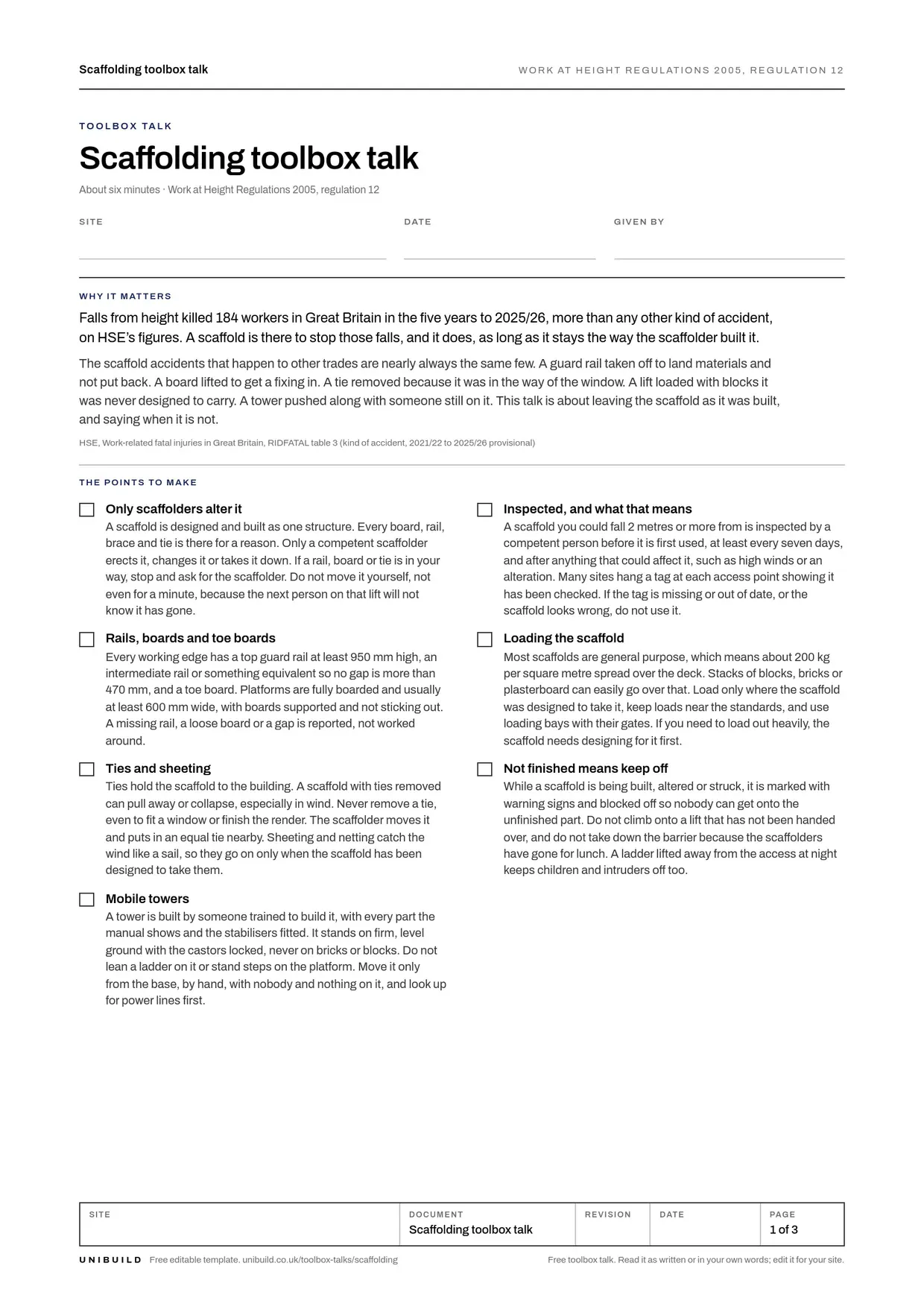
Why it matters
Falls from height killed 184 workers in Great Britain in the five years to 2025/26, more than any other kind of accident, on HSE’s figures. A scaffold is there to stop those falls, and it does, as long as it stays the way the scaffolder built it.
The scaffold accidents that happen to other trades are nearly always the same few. A guard rail taken off to land materials and not put back. A board lifted to get a fixing in. A tie removed because it was in the way of the window. A lift loaded with blocks it was never designed to carry. A tower pushed along with someone still on it. This talk is about leaving the scaffold as it was built, and saying when it is not.
HSE, Work-related fatal injuries in Great Britain, RIDFATAL table 3 (kind of accident, 2021/22 to 2025/26 provisional)The points to make
Only scaffolders alter it
A scaffold is designed and built as one structure. Every board, rail, brace and tie is there for a reason. Only a competent scaffolder erects it, changes it or takes it down. If a rail, board or tie is in your way, stop and ask for the scaffolder. Do not move it yourself, not even for a minute, because the next person on that lift will not know it has gone.
Inspected, and what that means
A scaffold you could fall 2 metres or more from is inspected by a competent person before it is first used, at least every seven days, and after anything that could affect it, such as high winds or an alteration. Many sites hang a tag at each access point showing it has been checked. If the tag is missing or out of date, or the scaffold looks wrong, do not use it.
Rails, boards and toe boards
Every working edge has a top guard rail at least 950 mm high, an intermediate rail or something equivalent so no gap is more than 470 mm, and a toe board. Platforms are fully boarded and usually at least 600 mm wide, with boards supported and not sticking out. A missing rail, a loose board or a gap is reported, not worked around.
Loading the scaffold
Most scaffolds are general purpose, which means about 200 kg per square metre spread over the deck. Stacks of blocks, bricks or plasterboard can easily go over that. Load only where the scaffold was designed to take it, keep loads near the standards, and use loading bays with their gates. If you need to load out heavily, the scaffold needs designing for it first.
Ties and sheeting
Ties hold the scaffold to the building. A scaffold with ties removed can pull away or collapse, especially in wind. Never remove a tie, even to fit a window or finish the render. The scaffolder moves it and puts in an equal tie nearby. Sheeting and netting catch the wind like a sail, so they go on only when the scaffold has been designed to take them.
Not finished means keep off
While a scaffold is being built, altered or struck, it is marked with warning signs and blocked off so nobody can get onto the unfinished part. Do not climb onto a lift that has not been handed over, and do not take down the barrier because the scaffolders have gone for lunch. A ladder lifted away from the access at night keeps children and intruders off too.
Mobile towers
A tower is built by someone trained to build it, with every part the manual shows and the stabilisers fitted. It stands on firm, level ground with the castors locked, never on bricks or blocks. Do not lean a ladder on it or stand steps on the platform. Move it only from the base, by hand, with nobody and nothing on it, and look up for power lines first.
Do
- Check the scaffold has been inspected and looks right before you go up.
- Report a missing rail, toe board, board or tie straight away and keep off that area.
- Use the loading bays and their gates, and keep stacks within what the scaffold was built for.
- Keep platforms clear of offcuts, waste and tripping hazards.
- Use the proper access, a stair tower or a tied ladder, every time.
- Ask for the scaffolder whenever the scaffold needs changing.
Do not
- Do not remove or move a guard rail, board, brace or tie, even for a minute.
- Do not climb the outside of a scaffold or go up a scaffold that has not been handed over.
- Do not stack heavy materials on a lift that was not designed for them.
- Do not fix sheeting, netting or signs to a scaffold without the scaffold designer’s agreement.
- Do not move a tower with anyone or anything on it, or in strong wind.
- Do not use steps or a ladder on a scaffold platform to gain height.
Ask the team
- Who is the scaffold contractor on this job, and how do we get a scaffolder when something needs changing?
- Where is the inspection record or tag for this scaffold, and when was it last checked?
- What loads are we putting on the lifts this week, and were they designed for them?
- Has anyone seen a rail, board or tie missing on this job?
- Who builds and inspects the mobile towers we use?
To close
A scaffold only protects you if it stays the way it was built. Every rail you take off, every board you lift and every tie you move turns it into something nobody designed. So leave it alone. Check it has been inspected, keep the loads within what it was built for, keep off anything unfinished, and call the scaffolder when it needs to change. If something looks wrong, get off and tell us. We will get it fixed before anyone goes back up.
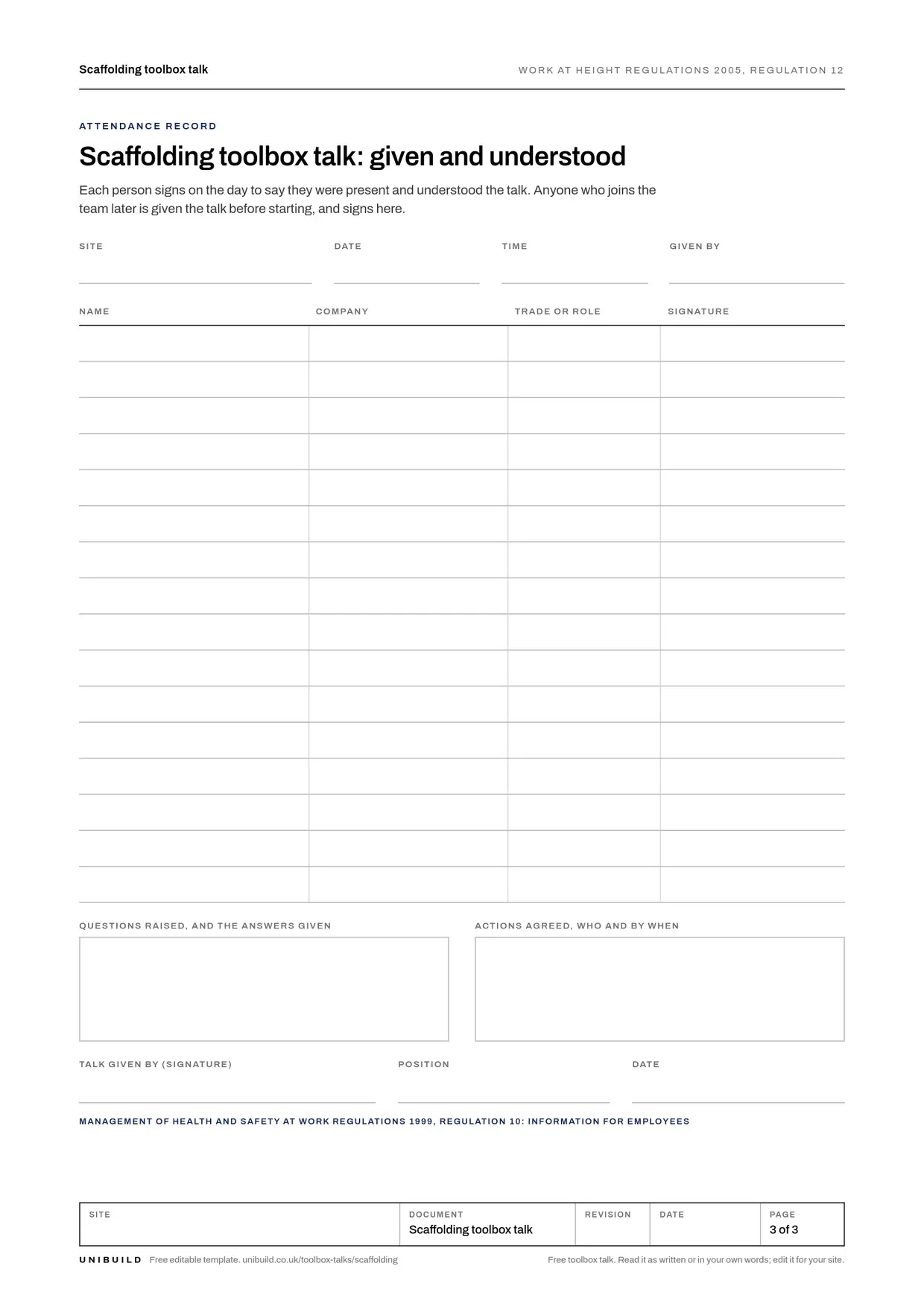
Record it. Who gave the talk, where, when, who was there and what was raised. The last page of the sheet is the record.