
PAT testing on site:
how often, and what to record.
No regulation sets a date for testing a site drill. HSE guidance gives starting intervals by voltage and risk, and a register with last and next due dates keeps every tool on them.
Published ·7 min read·Written by Darshan Parmar, Founder
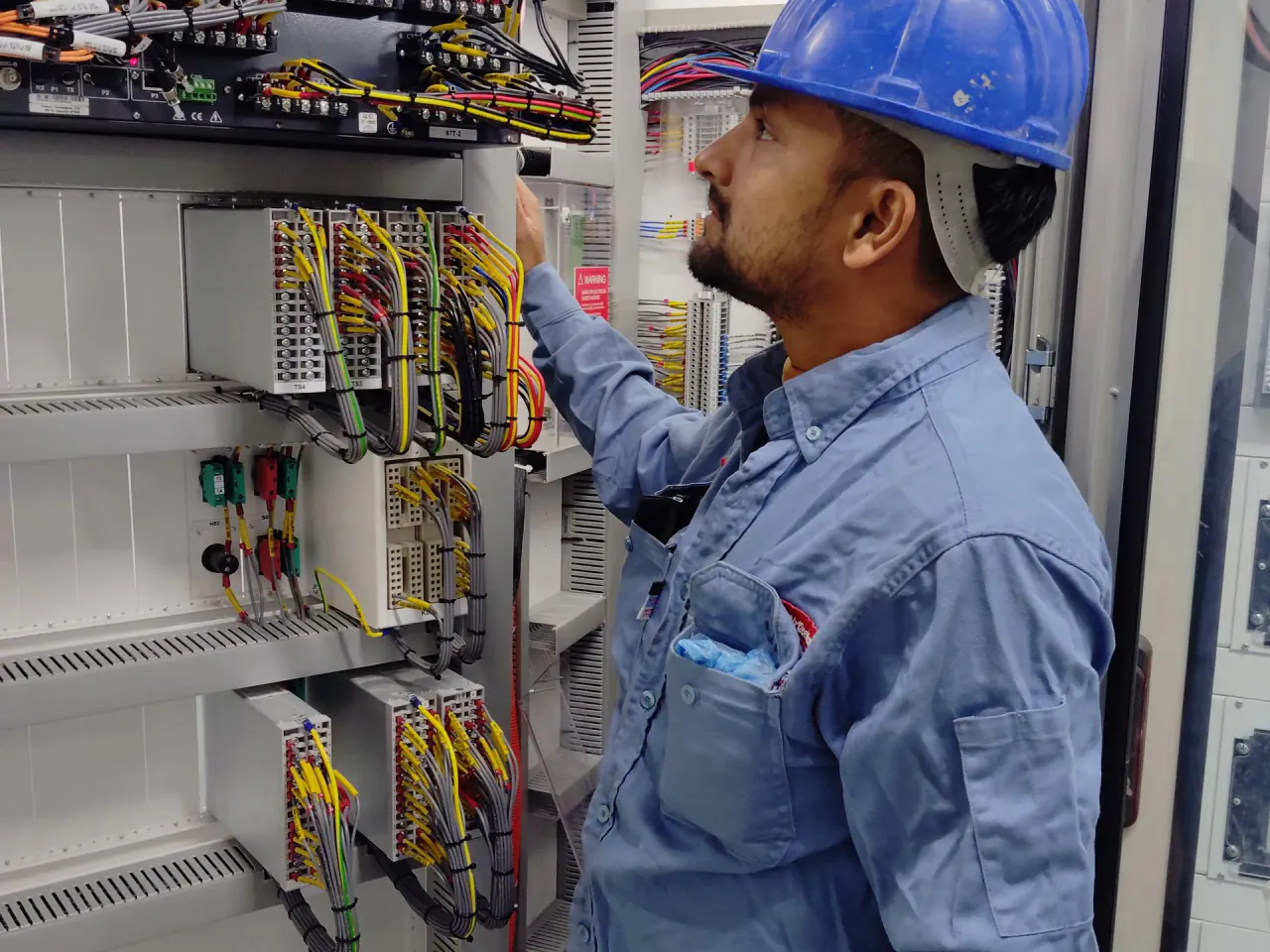
No regulation sets a date for testing a site drill. The law requires electrical equipment to be maintained so that it stays safe, and HSE guidance turns that into starting intervals by voltage and environment. For a 110V power tool on a construction site, the suggestion is a combined inspection and test before first use on site, then every three months. The rest of the work is keeping every tool on its date, and being able to show it.
What the law requires
Two sets of regulations do the work. The Electricity at Work Regulations 1989 require electrical systems to be maintained, as far as is necessary, to prevent danger so far as is reasonably practicable. A power tool, its lead and its plug are part of that. The Provision and Use of Work Equipment Regulations 1998 add that work equipment must be kept in an efficient state, in efficient working order and in good repair.
Neither sets a method or a frequency. HSE says so directly: the regulations do not specify what needs to be done, by whom or how often, and they do not make annual testing a legal requirement. What they require is a maintenance regime that suits the equipment and the place it is used.
HSE gives its own example of how far apart two answers can be. A power tool used on a construction site should be examined more frequently than a lamp in a hotel bedroom. The interval is the dutyholder’s decision, made by risk assessment, and HSE’s guidance is the starting point for it.
PAT testing frequency on a construction site
HSE’s guidance on maintaining portable electrical equipment, HSG107, sets out suggested initial intervals for three levels of check. For construction work they are:
| Equipment | User checks | Formal visual inspection | Combined inspection and test |
|---|---|---|---|
| 110V equipment | Weekly | Monthly | Before first use on site, then every three months |
| 230V equipment | Daily or every shift | Weekly | Before first use on site, then monthly |
| Fixed RCDs | Daily or every shift | Weekly | Before first use on site, then every three months (portable RCDs monthly) |
| Equipment in the site office | Monthly | Every six months | Before first use on site, then yearly |
| Battery tools under 40V | None suggested | None suggested | None suggested |
| Hired equipment | Not applicable | Before issue and after return | Before issue |
These are starting intervals, not fixed ones. HSG107 adds two practical rules. Where equipment is grouped for testing at the same time, use the shortest interval in the group. And as results build up, the trend tells you whether a group needs testing more or less often.
The IET Code of Practice for In-service Inspection and Testing of Electrical Equipment, now in its fifth edition, takes the same risk-based approach in more technical detail. HSE describes the two as consistent with each other.
Why site tools are on a shorter cycle
A tool on site works harder than anything in an office. It is carried between vans and sites, dropped from a step, dragged across rebar and plugged in wet. Most of that damage lands on the plug, the lead and where the lead enters the casing, which are the parts a check looks at first.
HSE notes that a formal visual inspection can reveal most potentially dangerous faults. That is why the site intervals put so much weight on looking. The combined test catches what a look cannot, such as a failed earth or broken insulation inside the casing.
110V on site, and why it is the standard
HSE advises cordless tools, or tools running from a 110V supply that is centre tapped to earth, on construction sites. The transformer halves the voltage between a live conductor and earth, so the maximum voltage to earth does not exceed 55V. That reduces the shock risk from a damaged lead or tool.
The table shows the practical benefit as well. A 110V tool needs its combined test every three months. The same tool at 230V needs it every month, with a check every shift. Standardising on 110V and cordless tools cuts the testing workload as well as the risk.
User checks, formal inspection and the combined test
A maintenance regime for portable equipment runs at three levels, and each has its own job.
- User checks. The person about to use the tool switches it off, unplugs it and looks at the plug, lead and casing for damage, burn marks or loose parts. It takes seconds, and it is the check that happens most often.
- Formal visual inspection. A trained member of staff inspects the tool to a set routine and records the result. It can include removing the plug cover to check the fuse and connections. HSE confirms that a competent employee can do this.
- Combined inspection and test. The inspection plus electrical tests, which is what most people mean by PAT. It needs somebody electrically competent, with the right test equipment, who can use it properly and understand the results.
Each level supports the one above it. HSG107 notes that where formal visual inspections are done and user checks are monitored, testing can be carried out less often.
Battery tools, chargers and hired kit
Cordless tools running at less than 40V sit outside HSG107’s table altogether: no user checks, formal inspections or tests are listed for them. The charger is a different matter. It plugs into the mains, so it belongs in the register and on the same cycle as other mains equipment on that site.
Hired equipment arrives already inspected and tested. The hire company inspects it before issue and after return, and tests it before issue. While it is on your site, user checks and safe use are part of your own regime. Record hired items in the same register, with the hire company’s certificate against them and the off-hire date alongside.
Labels, faults and quarantine
The law does not require a label or a written log. A label with the next due date is still the quickest check a user has, and it answers the question at the moment the tool is picked up. A QR label that opens the tool’s own record goes further, because it shows the full history rather than a single date.
A tool that fails comes out of use straight away. HSG107 suggests labelling it as faulty and, where it has a rewireable plug, removing the plug, so it cannot be used again until a competent person has repaired it. The register should show it as out of use too, so it cannot be issued from the store by mistake.
Keeping a PAT register that stands up
HSE describes a maintenance log as a useful management tool rather than a legal duty. On a construction site it is also the evidence a principal contractor, an ISO auditor or an accreditation assessor will ask to see. A register that stands up holds, for every item:
- A unique number, matching the label on the tool.
- What it is, its class and its voltage.
- Where it is, or who has it.
- Each test, with the date, the result, the readings and the tester.
- The next due date, and whether the item is in use, due or out of use.
- Any hand-arm vibration figure for the tool, covered below.
A label tells the person holding the tool. A register tells everyone else.
One building services contractor we work with runs it like this. Site power tools are on a three-monthly cycle and office equipment on an annual one, each with its own certificate. Every item carries a QR label that opens its record, with its full test history and its last and next due dates. Tests falling due within fourteen days are flagged, so nothing lapses on a Friday. Only named, competent people test and record, and the whole register exports for the ISO audit.
Vibration values on the same record
The same record is the natural home for a tool’s vibration figure. The Control of Vibration at Work Regulations 2005 set a daily exposure action value of 2.5 m/s² A(8) and a limit value of 5 m/s² A(8) for hand-arm vibration. Holding the vibration magnitude with the tool means an exposure assessment uses the tool actually in the operative’s hands, rather than a generic figure.
This is general guidance, not legal advice. The intervals above are HSE’s starting points, and the right interval for your own equipment comes from your own risk assessment.
On Unibuild, portable appliance test records are held against the individual tool with the full readings, and the QR label on the tool opens its test history on site. The next test date is set per item, and an item out of test is flagged before anybody signs it out. The calibration register holds every test instrument with its expiry date, and the hand-arm vibration magnitude sits on the power tool record. The whole register exports whenever an auditor asks. Operatives use your staff app, published under your company’s own name. Unibuild is bespoke construction management software in daily production since 2016, so the register follows the cycle you set.
Where to start, this week
Pick ten tools at random from the store and the vans. For each one, find the last test date, the result and who tested it, and time how long it takes. If the answer lives on a sticker and nowhere else, start the register now, beginning with any 230V kit and anything due in the next fortnight.
Sources
Checked against the source rather than against commentary. Where a schedule, a rate or a threshold is definitive on a government site, read it there.
- The Electricity at Work Regulations 1989, regulation 4 legislation.gov.uk
- The Provision and Use of Work Equipment Regulations 1998, regulation 5 legislation.gov.uk
- HSE: Maintaining portable electrical equipment (HSG107) Health and Safety Executive
- HSE: portable appliance testing, frequently asked questions Health and Safety Executive
- HSE: portable electrical equipment on construction sites Health and Safety Executive
- HSE: the Control of Vibration at Work Regulations 2005 Health and Safety Executive
- IET Code of Practice for In-service Inspection and Testing of Electrical Equipment, 5th edition shop.theiet.org
The follow-up questions.
How each tool’s test history, location and certificates are held against the item itself is on assets and inventory.
How often should power tools be PAT tested on a construction site?
Is PAT testing a legal requirement?
How often should 110V tools be tested?
How often should 230V tools be tested on site?
Do battery powered tools need PAT testing?
Who can carry out PAT testing?
Do hired tools need PAT testing by us?
Is a PAT test label a legal requirement?
What should a PAT register include?
How often should office equipment be PAT tested?
What happens to a tool that fails a PAT test?
Does the IET Code of Practice set PAT testing intervals?
More from Insights.
 LOLER, and the clock on every lifting accessorySix months for anything that lifts people, twelve for everything else, and a report that has to exist before the next lift. What thorough examination means, and what it is not.Read it →
 Knowing what plant you own and where it isThe losses are quiet: kit that walks between sites, kit hired because nobody could find the one you have, and kit written off that is still in a container.Read it →
 The certificates that expire without anybody noticingInsurance, cards, plant inspections, training and first aid all run out on different dates, and nothing about your file changes on the day one of them does. What has to watch them.Read it →
All 6 articles on plant and assets.