
Welding fume: the health risks and the controls HSE expects
What is in welding fume, what it does to health, how COSHH applies to it, and the extraction, RPE and health checks HSE expects for welding indoors and out.
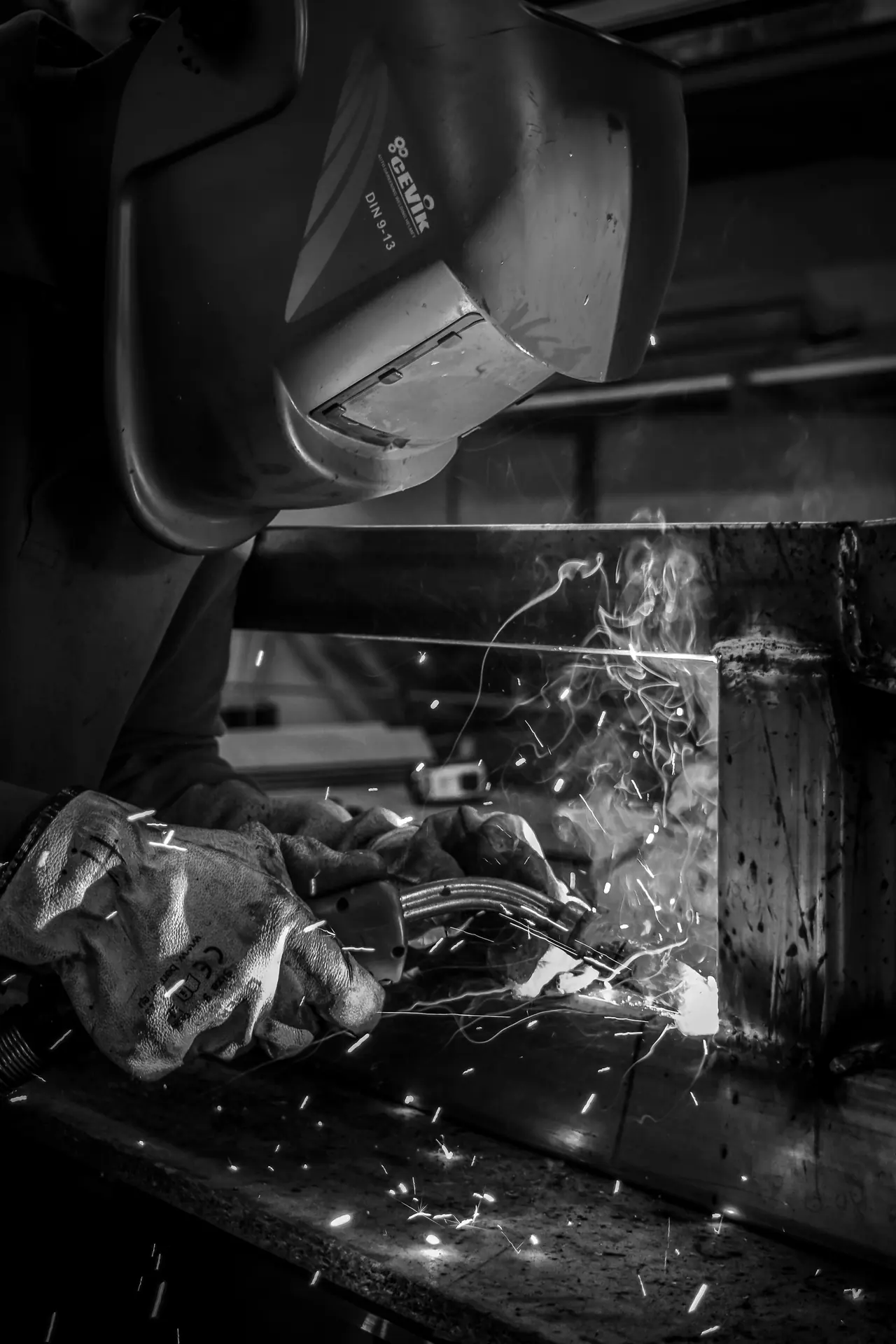
What is welding fume, and is it a carcinogen?
Welding fume is the cloud of fine metal particles and gases that welding and hot cutting give off. HSE says all welding fume, including mild steel fume, can cause lung cancer.
In March 2017 the International Agency for Research on Cancer concluded that welding fume, whatever its composition, is carcinogenic to humans. HSE’s Workplace Health Expert Committee agreed. The fume can also cause occupational asthma, metal fume fever and pneumonia, and the manganese in it can affect the nervous system.
COSHH applies to welding fume as to any substance hazardous to health: exposure must be prevented or, where that is not reasonably practicable, adequately controlled. Since February 2019 HSE has expected engineering controls, usually local exhaust ventilation, for indoor welding. RPE is added where extraction is not enough, and used for welding outdoors.
HSE calls this a change in its enforcement expectations, resting on existing law rather than a new regulation. How far the legal carcinogen rules reach is set out in what the law asks. Record the controls in your COSHH assessment; the hot works and welding RAMS covers fire, permits and the other hazards.
Where trades meet welding fume
From HSE guidanceWelding and hot cutting turn up in steel erection, fabrication, M&E, plant maintenance and facilities work. The metal, the process and any coating decide what is in the fume.
| Metal, process or task | Who meets it | What is in the fume | Main concern |
|---|---|---|---|
| Mild steel: MIG, MAG, MMA and flux-cored welding | Steel erectors, fabricators, plant fitters and maintenance engineers | Particles of metal, metal oxide and flux, including manganese, with gases such as oxides of nitrogen | Lung cancer. Manganese can cause neurological effects similar to Parkinson’s disease. High exposure can cause metal fume fever. |
| Stainless steel welding | Fabricators and pipefitters working in stainless steel | Chromium, including hexavalent chromium, nickel and cobalt. MMA welding puts more of these metals in the fume. | Lung cancer and occupational asthma. Nickel and chromium can also cause allergic contact dermatitis. |
| TIG welding on stainless steel and aluminium | Fabricators and pipe welders | Ozone, which HSE singles out for this process | Dry throat, coughing and chest tightness. HSE says extreme exposure to ozone can cause fluid on the lungs. |
| Galvanised steel | Anyone welding or hot cutting galvanised sections, railings or fixings | Fume from the galvanised coating | Metal fume fever: flu-like symptoms a few hours after exposure, often worse at the start of the working week. |
| Painted, coated or dirty metal | Maintenance, refurbishment and demolition teams cutting or welding existing steelwork | Breakdown products of paint, resin or grease | HSE says paint and resin coatings may release toxic components when heated. Lead paint brings in the lead regulations, and polyurethane coatings can give off isocyanates. |
| Hot cutting: plasma, flame cutting and arc-air gouging | Steel fabricators and demolition teams | Fume similar to welding fume; flame cutting turns steel into iron oxide | HSE says this fume has not been classified as carcinogenic but is covered by COSHH. Where the operator is exposed, control it to a similar standard as welding. |
| Welding in confined spaces | Welders in tanks, ducts, pits and chambers | Carbon monoxide, and shielding gases such as argon, helium, nitrogen and argon-based mixtures | Asphyxiation. HSE says welding in a confined space must only be done when absolutely necessary. See confined spaces. |
Welding fume is made by the work, so it comes with no safety data sheet. HSE’s L5 guidance says employers should find its hazards from reliable sources, such as HSE’s COSHH essentials welding sheets. Sources: HSE health risks from welding, cutting metals, safety risks from welding, WL0 and WL3.
What welding fume does to health
HSE says occupational lung disease, including lung cancer, is the most common health risk from welding. These are the effects HSE describes.
Lung cancer
All welding fume can cause lung cancer, and there is limited evidence linking it to kidney cancer. HSE’s expert committee found it is not possible to identify specific welding processes or base metals that give rise to the risk.
HSE safety alert STSU1 - 2019; HSE WHEC-11a (2019)Occupational asthma
Metals in the fume, such as hexavalent chromium, nickel and cobalt, can cause asthma. Stainless steel fume contains them. Symptoms usually start a few months to a few years after first exposure.
HSE, health risks from weldingMetal fume fever
Flu-like symptoms that often start a few hours after exposure begins and are worse at the start of the working week. It is usually linked to welding or hot work on galvanised metal. It does not usually have lasting effects.
HSE, health risks from weldingPneumonia
Breathing welding fume raises the risk of pneumococcal pneumonia, which HSE says kills about 2 welders a year. A vaccination is available, but HSE says it is not a substitute for good exposure control.
HSE, health risks from weldingManganese and the nervous system
Studies suggest manganese in mild steel fume can lead to symptoms similar to Parkinson’s disease, including speech and balance disorders. HSE says the respirable manganese WEL is highly likely to be exceeded in many welding activities without effective controls.
HSE, health risks from welding; HSE safety alert STSU1 - 2019Irritation and COPD
Gases and fine particles can dry the throat and cause coughing or chest tightness. HSE says current evidence suggests welding fume may cause COPD, but there is not enough evidence to prove a definitive link.
HSE, health risks from welding; HSE WL3Skin and eyes
Nickel and chromium released during welding may cause allergic contact dermatitis. Ultraviolet from the arc reddens the skin, causes arc eye and is associated with ocular melanoma, a rare eye cancer.
HSE, health risks from weldingHSE estimates that breathing metal fume at work leads to 40 to 50 welders being admitted to hospital each year. More in occupational asthma and occupational dermatitis.
What the law asks, and what HSE enforces
COSHH 2002COSHH has no regulation written for welding. Its general duties apply to the fume, and HSE’s 2019 alert says how it expects them to be met. Each row says which is law and which is HSE’s expectation.
Covered by COSHH
HSE says welding fume is subject to COSHH, for specialist welders and for workers who do some welding, however small the amount. Parts of the fume, such as manganese and chromium (VI), have a WEL. That alone brings them inside the legal definition of a substance hazardous to health.
HSE, welding fume: protect your workers; regulation 2Assess before the work starts
The law requires a suitable and sufficient assessment before work that may expose employees. It must consider the hazardous properties, the level, type and duration of exposure, any relevant WEL and combined exposures. Employers with 5 or more employees record the significant findings.
Regulation 6(1), (2) and (4)Prevent, then control in order
Exposure must be prevented or, where that is not reasonably practicable, adequately controlled. Substitution comes first. Then processes and engineering controls, then control at source including ventilation. PPE such as RPE comes only where nothing else gives adequate control, on top of the rest.
Regulation 7(1) to (3)What adequate control means
Control counts as adequate only if the Schedule 2A principles of good practice are applied and no WEL is exceeded. For the substances named in regulation 7(7)(c), exposure must also be as low as is reasonably practicable.
Regulation 7(7) and Schedule 2AWelding fume and the carcinogen rules
The regulation 7(7)(c)(i) ALARP duty covers substances carrying hazard statement H340, H350 or H350i, and substances or processes listed in Schedule 1. Welding fume is not listed, and fume made by the work carries no hazard statement, so that duty does not reach it as a whole. The regulation 7(5) measures apply to any carcinogen. Regulation 2 defines that to include anything meeting the CLP category 1A or 1B criteria, whether or not it would have to be classified. EH40 says this covers substances generated by a work process. HSE’s welding pages call welding fume a carcinogen, but neither they nor the 2019 alert say regulation 7(5) applies, and EH40 has no entry for it.
Regulations 2, 7(5) and 7(7)(c)(i); Schedule 1; EH40 paragraphs 48 to 51; HSE, welding fume: health surveillanceStainless steel fume: chromium (VI)
HSE’s Asthmagen? review lists chromium (VI) compounds in section C. Under regulation 7(7)(c)(ii), control of them is adequate only if exposure is as low as reasonably practicable. Stainless steel fume as a whole is in section D, not C, but the same duty applies if your assessment shows it may cause occupational asthma. EH40 marks chromium (VI) Carc and Sen, names welding fume as process-generated exposure, and asks for ALARP. Our reading of regulation 2 with EH40 is that the regulation 7(5) measures apply too; HSE’s welding pages do not spell this out.
Regulations 2, 7(5) and 7(7)(c)(ii); EH40 Table 1 and paragraphs 48 to 50 and 84; Asthmagen? sections C6 and D13HSE’s 2019 enforcement expectation
In February 2019 HSE strengthened its enforcement expectation for all welding fume, mild steel included, because general ventilation does not achieve the necessary control. It expects engineering controls such as LEV for indoor welding, RPE for residual fume and outdoors, and an RPE programme. Regardless of duration, it will not accept welding without suitable exposure controls, “as there is no known level of safe exposure”.
HSE safety alert STSU1 - 2019Self-employed welders
A self-employed person whose work is of a prescribed description, such as any work on a construction site, has the COSHH duties of both employer and employee. Monitoring and health surveillance are the exceptions.
Regulation 3(2) and (2A); SI 2015/1583Our practical advice: plan all welding as work with a carcinogen, as HSE now does, and apply the regulation 7(5) measures. Keep exposure as low as reasonably practicable, keep eating, drinking and smoking away from the fume, and clean down regularly. HSE’s L5 guidance asks for an active precautionary policy for substances suspected of causing cancer that are not yet under the special provisions.
Controlling welding fume in the order HSE sets
HSE’s welding guidance follows the regulation 7 order: avoid or reduce the fume, extract it at source, then add RPE. These are its examples, applied to site and workshop work.
Avoid welding
Join by other means where the design allows: bolts, rivets and other mechanical fasteners, or adhesives. Buying material cut to size avoids hot cutting.
NoteHSE’s WL3 also suggests designing the job so less welding is needed, for example with thinner gauge metal.
Reduce the fume
Do less welding, choose a lower-fume process or consumable, and automate or mechanise where you can. HSE gives MIG instead of MMA as an example. Clean the metal and remove grease and coatings first.
NotePaint and resin coatings may release toxic components when heated. Metal with lead paint needs its own assessment under the lead regulations.
Extract at source
Use LEV for indoor welding. On-torch extraction can be very effective for MIG welding. Extracted benches and booths suit work brought to them. Movable hoods must sit within one hood diameter of the weld and move with it.
NoteFit an airflow indicator. Discharge outside, away from doors, windows and air inlets, or filter the air before it returns to the workplace.
Add RPE for residual fume
If fume is still visible near the welder, or ozone can be smelt during TIG welding, the LEV is not controlling the risk. Provide RPE as well, and keep unprotected people out of the welding area.
NoteTight-fitting RPE needs a clean-shaven wearer and a face fit test. See face fit testing.
RPE for welding outdoors
LEV cannot be relied on to capture fume outdoors, so HSE says to provide suitable RPE for any outdoor welding and to consider others nearby.
NoteWL3 says the same where LEV is not reasonably practicable at a temporary location, such as some work at height. Everyone in the area likely to be exposed then needs RPE.
Ventilate the workshop
Good general ventilation clears fume that LEV misses. HSE says most welding workshops need mechanical ventilation, because open doors and windows do not disperse the fume.
NoteScreens and curtains meeting BS EN ISO 25980 protect passers-by from arc light.
Keep controls working
Check equipment for damage each day and repair faults straight away. The law requires LEV to be thoroughly examined and tested at least every 14 months, with records kept for at least 5 years. HSE says to use a competent ventilation engineer.
NoteWL3 adds weekly recorded visual checks of LEV, a logbook, and a recorded examination of non-disposable RPE at least once a month.
Train and supervise
Tell welders the fume can cause lung cancer. Train them to position the hood, the work and themselves so fume stays out of the breathing zone, to check LEV and RPE before use, and to report problems.
NoteSee COSHH training for what the law requires.
HSE’s page on controlling the risks from welding does not normally expect engineered fume controls for occasional welding, done less than once a week and for less than an hour. RPE and good general ventilation are still needed, with others nearby protected. Its example is a mechanic making a short repair to an exhaust bracket. The 2019 alert itself asks for engineering controls for all welding indoors, so our advice is to record the reasoning in the assessment if you rely on this. Separately, LEV on dry power grinding of metal for more than 12 hours a week in a room is examined at least every 6 months (Schedule 4). More in local exhaust ventilation.
Which fume control for which welding job
HSE WL3HSE’s COSHH essentials sheet WL3 sets out good control practice by process and by how often and how long people weld. Its definitions follow the table.
| How often and how long | Process | Good control practice |
|---|---|---|
| Sporadic, low intensity | Gas, MMA, flux-cored, MIG and MAG | LEV where reasonably practicable. Otherwise good general ventilation and RPE. |
| Regular or high intensity | Gas, MMA, flux-cored, MIG and MAG | LEV, and consider supplementary RPE. |
| Regular or high intensity, outdoors in the open air | Gas, MMA, flux-cored, MIG, MAG and TIG | RPE where LEV is not reasonably practicable. |
| Sporadic, low intensity | TIG and resistance spot welding | Good general ventilation. |
| Regular or high intensity | TIG and resistance spot welding | LEV. |
WL3 defines low intensity as welding for less than 1 hour per welder per shift. High intensity is repeated welding through the shift, with more than 1 hour of arc time per welder per shift. Regular means daily or weekly welding at any intensity. Sporadic means less than once a week, incidental to the core business and unplanned, such as repairs. WL3 was published in April 2021, after the alert, and still accepts good general ventilation alone for sporadic, low-intensity TIG and resistance spot welding. HSE’s welding pages add that, for spot welding, this is usually sufficient on clean uncoated metal. For RPE, WL3 asks for an assigned protection factor of at least 20, and a powered respirator for more than 1 hour of welding a day. It notes TH2 powered respirator filters have a protection factor of 20 and TH3 filters 40. HSE says a powered or supplied air respirator with a built-in welding visor is the best option for arc welders. For work of up to an hour, an FFP3 disposable mask or a half mask with a P3 filter may be adequate for a clean-shaven wearer. Particulate filters do not protect against the gases in the fume.
Exposure limits for parts of the fume
EH40 Table 1EH40 sets no workplace exposure limit for welding fume as a whole. Several of its parts have their own. The figures are copied from the current EH40, fourth edition 2020.
| Substance | Where it comes from in welding | 8-hour limit | 15-minute limit | EH40 notation |
|---|---|---|---|---|
| Manganese and its inorganic compounds (as Mn) | Mild steels, some stainless steels and welding consumables | 0.2 mg/m³ inhalable; 0.05 mg/m³ respirable | None listed | None |
| Chromium (VI) compounds (as Cr) | Stainless steel, more so with MMA welding | 0.01 mg/m³; 0.025 mg/m³ for process-generated exposure such as welding fume | None listed | Carc, Sen, BMGV |
| Nickel and its inorganic compounds (as Ni) | Stainless steel | 0.1 mg/m³ water-soluble compounds; 0.5 mg/m³ nickel and water-insoluble compounds | None listed | Sk; Carc for nickel oxides and sulphides; Sen for nickel sulphate |
| Iron oxide, fume (as Fe) | Flame cutting of steel | 5 mg/m³ | 10 mg/m³ | None |
| Ozone | TIG welding on stainless steel and aluminium | None listed | 0.2 ppm (0.4 mg/m³) | None |
| Nitrogen dioxide | Oxides of nitrogen from most arc welding | 0.5 ppm (0.96 mg/m³) | 1 ppm (1.91 mg/m³) | None |
| Carbon monoxide | Welding in confined spaces | 20 ppm (23 mg/m³) | 100 ppm (117 mg/m³) | BMGV |
A WEL must not be exceeded, and EH40 paragraph 84 asks for exposure to any Carc or Sen substance to be as low as reasonably practicable. HSE’s WL0 says an exposure measurement survey may be needed, with biological monitoring for some substances, and names ISO 10882 as the standard the sampler can follow. EH40 Table 2 gives a guidance value for chromium (VI) of 10 μmol chromium per mol creatinine in urine, post shift. How the limits work: EH40 and workplace exposure limits.
Health surveillance and reporting
Where the regulation 11 test is met, health surveillance is law. The full scheme is on the health surveillance page.
When it applies
The law requires suitable health surveillance where a disease may be related to the exposure and is reasonably likely in the work. There must also be a valid, low-risk way to detect it.
Regulation 11(1) and (2)(b)Stainless steel welders
HSE says to provide respiratory health surveillance when welding stainless steel, where an asthmagen such as chromium is in the fume. The exception is where the assessment shows asthma is not reasonably likely. WL3 says the same for regular welding of metals that give off respiratory sensitisers.
HSE, welding fume: health surveillance; HSE WL3What the checks involve
HSE describes a baseline questionnaire and spirometry, a further questionnaire 6 and 12 weeks after starting, then an annual questionnaire and spirometry. Take advice from a competent person, such as an occupational health provider.
HSE, welding fume: health surveillanceHealth records for the cancer risk
HSE says it may be helpful to keep an individual health record for everyone exposed to welding fume, with their details and a history of jobs involving the exposure. If you do, keep it for at least 40 years. Where surveillance is required by law, the 40-year record is compulsory.
HSE, welding fume: health surveillance; regulation 11(3)When a case is found
If surveillance finds disease that a doctor or occupational health professional links to the exposure, the employer must review the assessment and the controls. The employer must also consider alternative work and review the health of others similarly exposed.
Regulation 11(9)Reporting under RIDDOR
Occupational asthma is reportable on a doctor’s diagnosis where the work involves significant or regular exposure to a known respiratory sensitiser. Any cancer attributed to occupational exposure to a known human carcinogen is reportable too. HSE says that applies where the work significantly increases the risk and the current job involves the exposure.
RIDDOR 2013, regulations 8(e) and 9(a); HSE guidanceHSE expects workers to be trained to report symptoms such as coughing, wheezing or chest tightness. WL0 also points to HSE’s G401 sheet on health monitoring for COPD. How to report: RIDDOR reporting.
Written, signed and kept,
tied to the job that uses it.
In Unibuild, a COSHH assessment is written once and operatives read and sign it on their phone, the same way as a RAMS. The AI builds a draft from the supplier’s safety data sheet and checks an assessment before it goes out. A person reviews and finalises every one.
Each substance holds its data sheet and supplier, linked to the jobs, materials and purchase orders that use it. Review dates are tracked and every version is kept. When an auditor or a principal contractor asks for the COSHH register, it is a search, not a spreadsheet.
- Signed on the phone by every operative, the same way as a RAMS
- Drafted by AI from the safety data sheet, and checked before issue
- A data sheet for every substance, tied to the job through materials and purchase orders
- Review dates tracked and every version kept
- COSHH e-learning, with the certificate on the training matrix
Free COSHH templates
Free to use and reuse, no sign-upWelding fume: common questions
Is welding fume a carcinogen?
Is mild steel welding fume dangerous?
Do I need fume extraction for welding?
What RPE do welders need?
Do welders need RPE when welding outdoors?
Is there a workplace exposure limit for welding fume?
What is metal fume fever?
Do welders need health surveillance?
Do I need a COSHH assessment for welding?
Is plasma or flame cutting fume a carcinogen too?
Substances and diseases
Read in any orderSources
Great Britain law and HSE guidance, read on the dates above. Northern Ireland has its own COSHH Regulations.
- HSE safety alert STSU1 - 2019, change in enforcement expectations for mild steel welding fume
- HSE, Welding fume: protect your workers
- HSE, Welding fume: control the risk
- HSE, Welding fume: maintain exposure controls
- HSE, Welding fume: health surveillance
- HSE, Welding fume: training
- HSE, Health risks from welding
- HSE, Controlling the risks from welding
- HSE, Cutting metals
- HSE COSHH essentials WL0, Welding, hot work and allied processes: advice for managers (PDF)
- HSE COSHH essentials WL3, Welding fume control (PDF)
- HSE WHEC-11a, Assessment of the evidence underpinning the IARC reclassification of welding fume (2019, archived PDF)
- HSE, Asthma: welders
- HSE, Asthmagen? Critical assessments of the evidence for agents implicated in occupational asthma (PDF)
- HSE EH40/2005 Workplace exposure limits, fourth edition 2020 (PDF)
- HSE L5, Control of substances hazardous to health, ACOP and guidance, sixth edition 2013
- The Control of Substances Hazardous to Health Regulations 2002, regulation 2, legislation.gov.uk
- The Control of Substances Hazardous to Health Regulations 2002, regulation 7, legislation.gov.uk
- The Control of Substances Hazardous to Health Regulations 2002, regulation 9, legislation.gov.uk
- The Control of Substances Hazardous to Health Regulations 2002, regulation 11, legislation.gov.uk
- The Control of Substances Hazardous to Health Regulations 2002, Schedule 1, legislation.gov.uk
- RIDDOR 2013 (SI 2013/1471), regulation 9, legislation.gov.uk
- HSE, RIDDOR: exposure to carcinogens, mutagens and biological agents
The COSHH register,
tied to the job.
Unibuild keeps each substance’s data sheet and supplier against the jobs, materials and purchase orders that use it, with review dates tracked and every version kept.