
Temporary electrical supply,
and the paperwork behind it.
Why site power runs at 110 volts, what has to be inspected every three months, and why the isolation permit is the document that decides whether anybody is allowed to work on it.
Published ·Updated ·10 min read·Written by Darshan Parmar, Founder
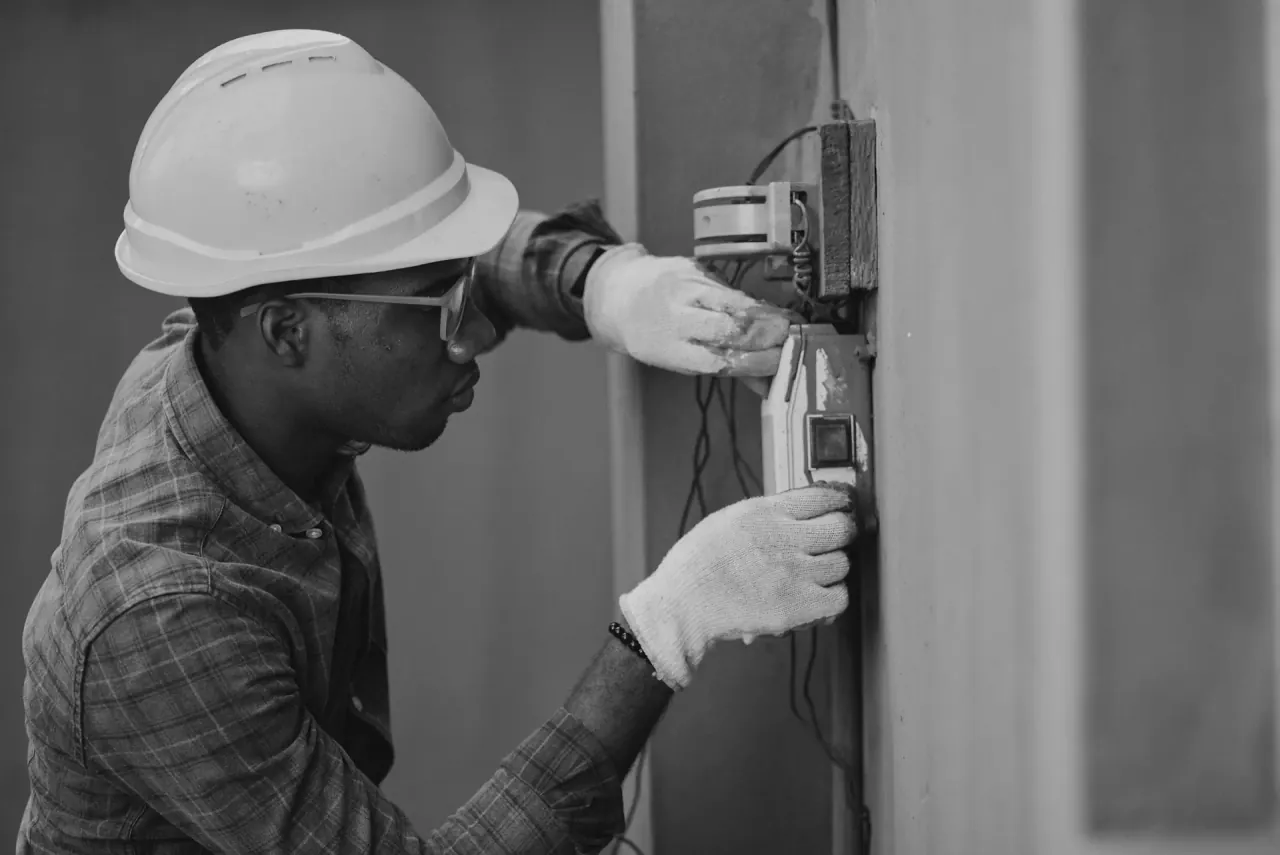
A temporary electrical installation on a construction site is judged by the same standards as a permanent one, and inspected considerably more often. The cable and the boards are the straightforward part. What decides whether the installation is defensible is the initial verification certificate, the periodic inspection interval, and the isolation permit that says who was allowed to work on it and when.
Builder's supply or generator
The first commercial decision on a site is where the power comes from, and it is usually made on programme rather than on cost.
A builder's supply is a temporary connection from the local distribution network operator, taken from the network at the point where the permanent supply will eventually land. It is metered, the energy is charged at commercial rates, and it is quiet. The difficulty is lead time. A new connection involves an application, a quotation, a wayleave or easement where the cable crosses third party land, and a scheduled excavation. On a constrained urban site that can run to months, which is why the decision has to be made at tender rather than at mobilisation.
A generator is available immediately and costs more to run. It brings fuel deliveries, a bunded tank, a refuelling procedure, noise limits under the site's own planning conditions or a section 61 consent, and exhaust emissions that are increasingly regulated in low emission zones. Hybrid units with battery storage have changed the arithmetic on smaller sites, because the engine runs only to recharge rather than continuously.
Most sites of any length end up with both, in sequence. The generator carries enabling works and the early programme, the builder's supply takes over once the connection is in, and the changeover is a planned event with an isolation and a re-energisation rather than something that happens on a Friday afternoon.
Why site power runs at 110 volts
Portable tools on UK construction sites run at 110 volts from a centre-tapped transformer. The centre tap is earthed, which means the voltage between either conductor and earth is 55 volts rather than 110. That is the entire point of the arrangement. A fault to earth, or a person completing a circuit to earth, sees 55 volts instead of the 230 volts a domestic supply would present.
It is worth being precise about the status of this. Nothing in the Electricity at Work Regulations 1989 names 110 volts. What regulation 4 requires is that systems are constructed and maintained so as to prevent danger, so far as is reasonably practicable. Reduced low voltage is the accepted way of achieving that for portable equipment on a construction site, it is what BS 7671 Section 704 and HSE guidance describe, and it is what an inspector expects to find. A site running 230 volt tools without a very good documented reason is not breaching a specific numbered rule. It is failing the general one, which is worse, because there is no technicality to argue about.
Lower voltages appear where the risk is higher again. Handlamps in confined or damp locations run on SELV, and portable lighting in particularly conductive locations is the usual example. The principle is the same each time: as the consequences of a fault get worse, the voltage available to cause one comes down.
Distribution across the site
Between the incoming supply and the tool at the end of the lead sits a distribution arrangement that has to survive being on a construction site, which is a harsher environment than almost anything a permanent installation deals with.
The practical requirements are ordinary and routinely missed. Enclosures need an ingress protection rating suited to being outside in a British winter. Residual current devices need to be present where required and, critically, need to be tested rather than assumed. Cables need routing where plant will not run over them and where they will not be the thing somebody trips on at the top of a stair. Where a cable does have to cross a route, it needs a ramp or a catenary rather than a plank.
Regulation 34 of CDM 2015 sits over all of this. Energy distribution installations must be suitably located, checked and clearly indicated. Where there is a risk from electric power cables, either they are directed away from the risk area, the supply is cut off, or there are suitable warning notices and barriers. That regulation is why buried and overhead services get marked and guarded before plant moves, and it is enforced against sites that treat cable protection as tidiness rather than as a control measure.
The colour coding that stops a cross-connection
Site connectors are colour coded by voltage, and the colours are not decoration. Yellow is 110 volts, blue is 230, red is 400 volt three phase. The system arrived as BS 4343, is now the European standard, and is on every site in the country.
What makes it work is the mechanics, not the colour. The pins sit at different clock positions for each voltage, and the barrels are keyed. A 110 volt tool cannot be pushed into a 230 volt socket by somebody in a hurry in poor light, which is the whole design intent. The protection does not depend on anybody reading the colour.
Which is why the failures are always the improvised ones. A plug rewired onto the wrong body. An adaptor made up on site. A damaged socket with the keyway broken out of it. Each defeats a safeguard built to work when nobody is paying attention. Each is found at inspection, long after it was made.
Initial verification and the three month cycle
This is the part that separates a well-run temporary installation from one that merely works.
Every new installation, including a temporary one, requires initial verification: inspection and testing before it is energised for use, and an Electrical Installation Certificate recording the result. That certificate is not paperwork for its own sake. It is the document that establishes the installation was safe at the moment it was handed over, which is the baseline everything afterwards is measured against.
Then it is inspected again, periodically, and the interval on a construction site is short. BS 7671 recommends a maximum period between periodic inspection and testing of three months for construction site installations, against one to five years for most permanent ones. The reason is not that site electricians are careless. It is that a construction site changes weekly, equipment is moved and damaged, and an installation that was correct in March may have four unrecorded alterations by June.
Two points about that three month figure, because both are commonly got wrong. It is a recommended maximum interval in a standard, not a statutory deadline, so nobody is prosecuted for being at three months and a week. And it is a maximum rather than a target, so an installation that takes heavy abuse should be looked at more often than that, not less.
Portable equipment is a separate regime running alongside. In-service inspection and testing of the tools plugged into the installation is its own discipline with its own intervals, and it is the one that generates the volume of records, because there are hundreds of items rather than one installation.
Safe isolation, and the permit that authorises it
Most serious electrical incidents on construction sites do not happen because an installation was badly designed. They happen because somebody worked on something they believed was dead.
Regulation 12 of the Electricity at Work Regulations 1989 requires suitable means of cutting off the supply and isolating equipment. Regulation 13 requires adequate precautions to prevent equipment made dead from becoming live while work is carried out. Regulation 14 restricts work on or near live conductors to circumstances where it is unreasonable to make them dead and suitable precautions are taken. Between them, those three regulations describe a procedure rather than a state of mind.
The procedure in practice is a sequence: identify the correct point of isolation, isolate it, secure the isolation with a lock and a unique key held by the person doing the work, prove the test instrument on a known source, test the conductors dead, then prove the instrument again. That last step catches the instrument that failed between the two tests, and it is the step people skip.
What ties it to the commercial side of the business is the permit. A four part isolation permit records who authorised the isolation, what was isolated and where, who took the permit and accepted responsibility for it, and the switching schedule showing the order in which points were made dead and in which they will be restored. It is signed on issue, signed on acceptance, signed on cancellation and signed on final sign-off, and it carries a validity window that the issuer sets rather than the person asking for it.
That document is what makes the difference three years later when somebody asks who was allowed to remove the lock. A verbal arrangement between two people who have both since left the company is not an answer.
Emergency lighting, and the bit that gets forgotten
Temporary emergency lighting is part of the same installation and it is inspected on its own cycle. On a site with escape routes through unfinished areas, it is also the system most likely to have been altered without anybody recording it, because luminaires get moved as the works progress and the escape route changes with them.
The recurring failure is not the lighting itself. It is the test record. A monthly function test and an annual duration test are the accepted regime, both of which produce a result that has to be written down somewhere findable. On a temporary installation that "somewhere" is frequently a logbook in a cabin that leaves site with the cabin.
What belongs in the tender, and what gets left out
Firms that supply temporary electrical services tender against measured rates, which means the margin is decided before anybody turns up. The items that get missed are consistent, and they are all recurring rather than one-off.
- The periodic inspections. A twelve month programme carries four of them at three month intervals. A tender priced on the installation and the strike alone has three inspections in it that nobody costed.
- Alterations. Sites change. Every alteration to a temporary installation needs its own certification, and on a rate-based contract that is a variation to be measured and signed rather than a favour.
- The emergency lighting test regime. Monthly function tests over a long programme add up to real labour.
- Standing time on isolations. An isolation requested by another trade, for their work, is chargeable time. It is also the item most often given away because the permit was raised verbally and there is no record it happened.
- The collection. Cable, boards, transformers and festoon all have to come back, be counted and be repaired. That is covered in off-hire, and the charges that keep running.
The permit regime is the part of this Unibuild holds directly, in its permits to work. An isolation permit is raised on a phone on site against the job, so it inherits the job number, the project and the client. The phone runs the firm's own staff app, published under the contractor's name and icon rather than a software vendor's. The permit carries the authorised person and the person in charge, the points isolated, the switching schedule, and four signatures: issue, acceptance, cancellation and final sign-off. The issuer sets the final validity window separately from the one requested, so a permit granted only until two o'clock says so. It renders as a numbered PDF generated from the record on demand, which means there is no stale copy and nothing to file.
Electrical sign-off sheets certifying an installation before energisation sit in the same family. Inspection dates for the installation and the emergency lighting go into the reminders engine alongside calibration and accreditation renewals. An interval that has run over is a row that has already coloured itself. What the record closes is the gap between having done the work correctly and being able to prove it.
Where to start, on Monday
Take one live site and find two documents: the initial verification certificate for the temporary installation, and the date of the most recent periodic inspection. If either takes more than ten minutes to produce, that is the finding, and it is a more useful one than anything an audit would tell you.
Then look at how the last isolation was authorised. If the answer is that somebody rang somebody, the permit regime is the thing to fix first, because it is the only one of these documents that protects a named individual rather than the company.
Sources
Checked against the source rather than against commentary. Where a schedule, a rate or a threshold is definitive on a government site, read it there.
- Electricity at Work Regulations 1989 legislation.gov.uk
- Construction (Design and Management) Regulations 2015 legislation.gov.uk
- HSE: electrical safety on construction sites (HSG141) Health and Safety Executive
The follow-up questions.
The certificates that expire quietly, and the register that catches them, are covered in the certificates that expire without anybody noticing.
What is a temporary building supply?
How do I arrange a temporary electricity supply to a site?
How long does a temporary supply take to arrange?
What is site distribution and who is responsible for it?
Who is responsible for the temporary supply, us or the principal contractor?
What certificate does a temporary electrical installation need?
How often must a temporary electrical installation be inspected?
How often should RCDs on site be tested?
Who inspects the temporary installation, us or the supply company?
Is 110V legally required on construction sites?
What do the colours on site plugs and sockets mean?
What is a four part isolation permit?
Can a generator be used instead of a mains connection?
Does a generator need the same certification as a mains supply?
What happens at the changeover from temporary to permanent power?
Every permit, against the job that needed it.
The isolation happened. The question three years later is who authorised it, until when, and whether anybody signed to accept it.
- Thirty minutes, weekdays, from tomorrow.
- Nothing to prepare. Bring a job number and we mock that job up.
- You drive it. There is no slide deck.
- You keep what you saw as a 14-day trial. No card.
More from Insights.
 What a temporary water supply on site actually costsThe cost splits three ways, and only one of the three is the water. The connection is quoted, the consumption is metered, and the compliance is the part that gets left out of the price.Read it →
 Site welfare, and what Schedule 2 actually requiresToilets, washing, drinking water, somewhere to change and somewhere to sit down. The list is short, it is legally specific, and "so far as is reasonably practicable" does not apply to most of it.Read it →
 The certificates that expire without anybody noticingInsurance, cards, plant inspections, training and first aid all run out on different dates, and nothing about your file changes on the day one of them does. What has to watch them.Read it →
All 3 articles on site services.