
Face fit testing for tight-fitting RPE
Why a tight-fitting mask needs a face fit test, how the two methods work, the clean-shaven rule, when to test again and what the report should show. Checked against HSE guidance.
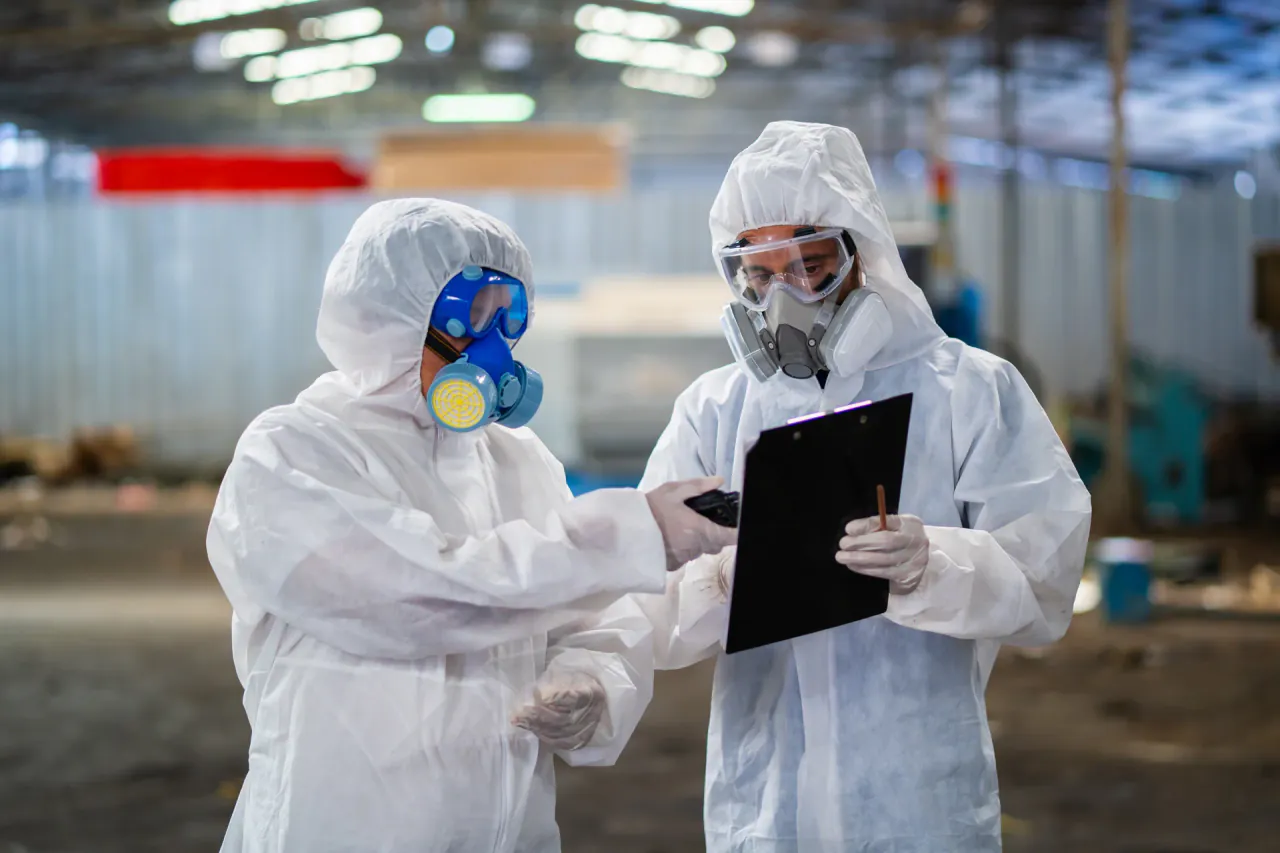
What is face fit testing?
Face fit testing checks that a specific make, model and size of tight-fitting mask seals properly to one wearer’s face. HSE’s COSHH Approved Code of Practice, L5, says tight-fitting RPE should be face fit tested by a competent person. HSE says the Approved Codes of Practice for asbestos, lead, confined spaces and ionising radiation work expect the same.
Faces vary in shape and size, so no single mask fits everyone. A mask that leaks at the seal lets dust, fume or vapour straight past the filter. That applies to a disposable FFP3 used for cutting block just as much as to a full face mask.
The test is done when the RPE is first selected, and again when the mask or the wearer’s face changes. It is separate from the fit check the wearer does every time the mask goes on. Respiratory protective equipment comes last in the order of control, so record why it is needed in the COSHH assessment first.
What the law and HSE say about fit testing
Law, ACOP and guidanceThe COSHH Regulations do not use the words fit test. Under COSHH the duty comes from the requirement for suitable protective equipment, and the detail sits in HSE’s Approved Code of Practice and guidance. Asbestos and lead work fall under their own regulations, with the same expectation.
The law: RPE must be suitable
Where adequate control cannot be achieved by other means, the employer provides suitable personal protective equipment, in addition to the other controls. Protective equipment provided under regulation 7 must be suitable for the purpose. HSE explains that suitable RPE is matched to the wearer, the task and the environment. A mask that does not seal to the wearer’s face is not suitable for that wearer.
Regulation 7(3)(c) and 7(9)The ACOP: fit test tight-fitting masks
L5 says tight-fitting RPE, meaning full and half masks, should be face fit tested using a suitable method by a competent person. Fit testing is repeated when any change in the equipment or the wearer’s face could affect the fit. Loose-fitting devices need not be fit tested but should still fit observably close to the face.
L5 ACOP, paragraph 160Why the ACOP carries weight
An Approved Code of Practice has a special status in law. If you are prosecuted and did not follow the relevant ACOP provisions, you must show you complied in some other way. An employer relying on untested tight-fitting masks would need another way to show each mask fits its wearer.
HSE, advice for employersThe guidance: INDG479 and HSG53
INDG479 is HSE’s guidance on how fit tests are done and reported, revised in October 2025. HSG53 covers choosing RPE as a whole. Following the guidance is not compulsory, but if you follow it you will normally be doing enough to comply.
HSE INDG479 (rev2)Not only COSHH
COSHH does not apply to lead or asbestos where their own regulations apply. Those regulations also require suitable RPE where other controls are not enough. INDG479 says the codes of practice for lead, asbestos, confined spaces and ionising radiation also expect tight-fitting RPE to be fit tested at selection.
COSHH regulation 5; INDG479The tester must be competent
Anyone who carries out work in connection with the employer’s COSHH duties, whether or not an employee, must have suitable and sufficient information, instruction and training. L5 links fit testing to this duty and to the duty to appoint competent help.
Regulation 12(4)Employees use what is provided
Employees must make full and proper use of the control measures provided, take reasonable steps to return them to their storage after use and report defects at once. L5 says that includes wearing RPE correctly, as the manufacturer instructs.
Regulation 8For the order of control that puts RPE last, see the COSHH Regulations explained.
Which RPE needs a face fit test
Any mask that relies on a seal against the face needs a fit test, whether it is disposable, reusable, powered or fed with air. The assigned protection factor (APF) shows how much protection the type can give when worn properly. Figures are from HSG53.
| RPE type | Assigned protection factor | Fit test needed | Methods that can be used |
|---|---|---|---|
| Disposable half mask (filtering facepiece) | FFP1: 4. FFP2: 10. FFP3: 20. | Yes | Qualitative or quantitative (particle counting) |
| Reusable half mask with particle filter | P1: 4. P2: 10. P3: 20. | Yes | Qualitative or quantitative |
| Reusable half mask with gas or vapour filter | 10 | Yes | Qualitative or quantitative |
| Full face mask with particle filter | P1: 4. P2: 10. P3: 40. | Yes | Quantitative only |
| Full face mask with gas or vapour filter | 20 | Yes | Quantitative only |
| Powered respirator or airline breathing apparatus with a tight-fitting mask | Depends on the type | Yes, even under positive pressure, because leakage is possible during heavy work | As for the half or full face mask fitted |
| Powered respirator or airline breathing apparatus with a loose-fitting hood or helmet | Depends on the type | No | Not applicable; it should still fit observably close to the face |
An APF of 20 means the wearer breathes in a twentieth or less of the substance in the air, if the RPE is used properly. L5 says to choose RPE using the APF as a guide; a fit factor from a test is not the protection the wearer gets at work. HSG53 recommends keeping continuous wear of tight-fitting unpowered RPE under an hour, then taking a break. For longer spells it points to powered or air-fed RPE.
Qualitative and quantitative fit testing
There are two basic types of fit test. Which one can be used depends on the mask, as the table above shows.
Qualitative fit testing
A pass or fail test. The wearer stands with a hood over the head and mask, and a bitter or sweet tasting aerosol is sprayed into the hood. If they taste it at any point during the exercises, the mask has failed. A sensitivity test comes first to show the wearer can taste the agent at all. It suits disposable and reusable half masks, not full face masks.
INDG479, qualitative fit testingQuantitative fit testing
An instrument measures how well the mask seals and gives a number called the fit factor. The two methods are ambient particle counting and controlled negative pressure. It suits disposable and reusable half masks and full face masks. Particle counting compares the concentration outside the mask with the concentration inside.
INDG479, quantitative fit testingThe pass mark for quantitative tests
HSE sets a minimum fit factor of 100 for half masks, including disposable FFP1, FFP2 and FFP3 masks. For full face masks it is 2,000. The figure should be reached in each exercise.
INDG479, Table 2The exercises
Taste and particle counting tests use at least seven exercises of at least one minute each. They are normal breathing, deep breathing, turning the head side to side, moving it up and down, talking, bending over, then normal breathing again. Taste tests are done standing. In a particle counting test, every exercise except bending over is done while cycling, walking on a treadmill or stepping. The negative pressure method uses the same seven exercises standing, with a short breath hold for a reading after each.
INDG479, Annex 2, Tables 3 and 4A fit factor is not workplace protection
HSE tells testers to stress that protection on the job is often lower than the fit test achieved. A high fit factor can give false confidence and make people careless putting the mask on.
INDG479, conducting the fit testHow a face fit test runs
What the employer, the wearer and the tester each need to do, from booking to the report.
Before the test
The employer confirms the wearer is medically fit to wear RPE, preferably in writing to the tester. Conditions such as asthma, skin allergies or heart problems can restrict or rule out some RPE. The wearer is trained to put the mask on and arrives clean-shaven where the mask seals.
NoteIf you are unsure about fitness to wear RPE, HSE says the employer should arrange a medical assessment.
Bring the right kit
The wearer brings their own issued mask in good condition, since the tester examines it first. Otherwise the tester uses one that matches it exactly in model, size and material. They also bring any glasses, goggles, helmet or ear defenders worn with it.
NoteOther head-worn kit can break the seal, so it is worn during the test.
No food, drink or smoking
Before a qualitative test the wearer should not eat, drink anything but still unflavoured water, smoke or chew gum for at least 30 minutes. Before a particle counting test, no smoking, including e-cigarettes, for at least 60 minutes.
Fitting and the exercises
The wearer puts the mask on without help, as trained, then works through the exercises while the tester watches for leaks. A cough or sneeze can mean the test is repeated.
Pass or fail
The tester tells the wearer the result as a pass or a fail. After two failed tests with the same mask, a different size, model or make is tried. Repeating tests until one mask passes, known as force fitting, should not be done.
NoteIf no tight-fitting mask fits, HSE says to choose RPE that does not rely on a face seal, such as a loose-fitting hood or helmet.
The report
The result is recorded in a report or certificate that clearly states pass or fail. INDG479 Annex 1 lists what it should show: the wearer, the mask make, model, material and size, and the filters fitted. It also records any spectacles worn inside the mask, other PPE worn, and whether the mask was the wearer’s own, a pool mask or a test mask. Then the method, the exercises, the pass level, the date, and the tester’s name and firm. A quantitative report adds the fit factor for each exercise and overall. Where relevant it also notes the condition of the wearer’s own mask, any help needed to put it on, repeat tests and why, and the test equipment’s serial number.
NoteThe report should be available to the employee and to enforcing authorities. Collective reports should be available to safety representatives.
HSE’s fit testing page also says that if someone wears more than one type of tight-fitting mask, each type is fit tested. The make, model, type and size they passed in should be the one made available to them.
Facial hair and the clean-shaven rule
HSE’s position is plain: stubble and beards make it impossible to get a good seal between a tight-fitting mask and the face. INDG479 tells testers not to test if any hair crosses the sealing surface. That includes stubble, a beard, a moustache, sideburns or a low hairline.
The rule does not stop at the test. L5 says training and supervision for tight-fitting RPE include wearers being clean-shaven where the mask seals. Testers are told to remind wearers to be clean-shaven in that area whenever they wear the mask at work. A pass on a shaven face says nothing about the same mask on day-old stubble.
Where a worker has a beard, for religious or other reasons, or cannot be clean-shaven, a tight-fitting mask is not suitable for them. HSG53 says to choose a loose-fitting device instead, such as a powered respirator with a hood or helmet. These do not need a fit test, because they do not rely on a face seal.
Facial piercings, scars and moles in the seal area can also cause leaks. HSE lists piercings and facial changes among the reasons to test again.
Sources: HSE, fit testing basics; INDG479, preparing the wearer; L5 paragraph 160; HSG53 paragraph 82.
When to repeat a face fit test
No fixed interval in lawNeither the regulations nor HSE set a fixed expiry date for a fit test. HSE says to repeat it whenever something changes that could alter the fit, and to have a system to review when a repeat is due.
A change of mask
A different RPE type, size, model or material needs a new fit test. Passing in one brand of FFP3 does not cover another.
INDG479, guidance for employersA change to the wearer’s face
Weight loss or gain, substantial dental work, scars, moles or the effects of ageing around the seal, and new facial piercings all call for a repeat test.
INDG479, guidance for employersNew or different head-worn PPE
Introducing or changing other head-worn protection, such as safety glasses, goggles or a different helmet, calls for a repeat test.
INDG479, guidance for employersRegular repeats as good practice
INDG479 says it is good practice to have a system to review when a repeat test may be due, since face shape changes with age alone. HSG53 adds that this matters most where RPE is used often as a main control. Its example, repeated in the asbestos ACOP guidance, is annual testing for licensed asbestos removal workers.
INDG479; HSG53, paragraph 86A mask already in use without a test
HSG53 says a fit test should be carried out where an untested facepiece is already in use. Do not wait for a change to test it.
HSG53, Appendix 4Many employers set their own repeat period in their RPE policy. Put it in writing, and record each operative’s test date so the next one is not missed.
Fit test, fit check and examination compared
Three different checks keep tight-fitting RPE working. Only one of them is the face fit test, and none replaces another.
| Check | What it shows | Who does it and when | Record |
|---|---|---|---|
| Face fit test | That a given make, model and size of mask can seal to this wearer’s face. | A competent fit tester, at selection and whenever the mask or the face changes. | A fit test report or certificate stating pass or fail. |
| Pre-use fit check | That the wearer has put the mask on correctly this time. For a reusable mask, cover the filter inlets, breathe in and hold for ten seconds: the mask should pull in and stay put. | The wearer, every time, before entering the work area, following the manufacturer’s instructions. | None required. It is not a substitute for a fit test. |
| Thorough examination of reusable RPE | That straps, facepiece, filters and valves are sound and the equipment works, including flow rate and battery on powered units. | Required by law at suitable intervals. HSG53 says at least monthly, or before use and within three months for occasional use. Disposable masks are excluded. | Required by law: a record of examinations, tests and repairs, kept for at least 5 years. |
Sources: COSHH regulation 9(3) and (4); L5 paragraphs 190 to 196; HSG53 paragraphs 79, 80 and 90; INDG479.
Every data sheet to hand,
tied to the job that uses it.
In Unibuild, each hazardous substance holds its safety data sheet and its supplier, linked to the jobs, materials and purchase orders that use it. Review dates are tracked, every version is kept, and the current one is the one out on site.
When an auditor or a principal contractor asks for the COSHH register, it is a search by name or supplier, not a spreadsheet somebody else kept.
- A data sheet for every substance held with its supplier
- Tied to the job through the materials and purchase orders that use it
- Review dates tracked and every version kept
- Searched by product name or supplier
Free COSHH templates
Free to use and reuse, no sign-upFace fit testing: common questions
Is face fit testing a legal requirement?
Do disposable FFP3 masks need a face fit test?
How often do you need a face fit test?
Can you be face fit tested with a beard or stubble?
What is the difference between qualitative and quantitative fit testing?
Who can carry out face fit testing?
What is the difference between a fit test and a fit check?
How long should face fit test records be kept?
Who pays for a face fit test?
Do I need a new fit test if I change employer?
The COSHH guide
Read in any orderSources
Great Britain law and HSE guidance, read on the dates above. Northern Ireland has its own COSHH Regulations.
- HSE INDG479 (rev2), Guidance on respiratory protective equipment (RPE) fit testing, October 2025
- HSE L5, Control of substances hazardous to health, ACOP and guidance, sixth edition 2013
- HSE HSG53, Respiratory protective equipment at work: a practical guide, fourth edition 2013
- HSE, Fit testing basics
- HSE, Respiratory protective equipment: advice for employers
- HSE, Respiratory protective equipment: frequently asked questions
- The Control of Substances Hazardous to Health Regulations 2002, regulation 7, legislation.gov.uk
- The Control of Substances Hazardous to Health Regulations 2002, regulation 9, legislation.gov.uk
- The Control of Substances Hazardous to Health Regulations 2002, regulation 5, legislation.gov.uk
- HSE L143, Managing and working with asbestos, ACOP and guidance, second edition 2013
- HSE L132, Control of lead at work, ACOP and guidance, third edition
The COSHH register,
tied to the job.
Unibuild keeps each substance’s data sheet and supplier against the jobs, materials and purchase orders that use it, with review dates tracked and every version kept.