Workforce and time

Construction timesheets that start
at the gate, not on a Friday.

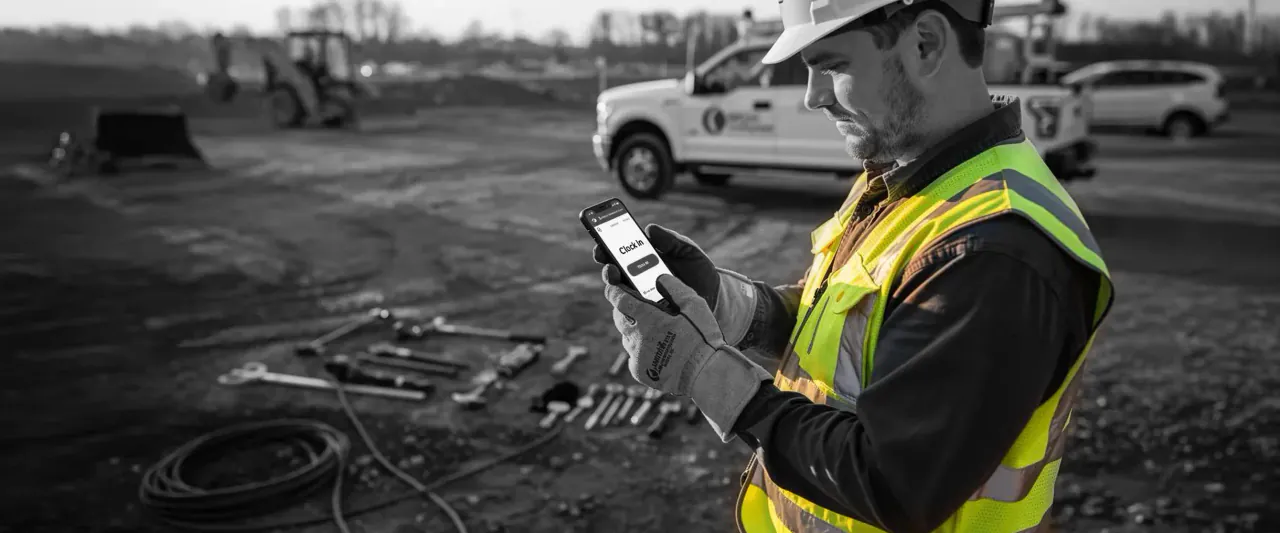
QR code clock-in at the construction site gate, in your own app, with a photograph and a time written by the server rather than read from the phone. About three seconds, and a PIN instead of a password.

The chase

Paper timesheets. Friday afternoons.
Hours bleeding away.

Not because anybody is careless. Because the record is made somewhere other than where the work happened, and by the time it reaches the office it is a reconstruction. Everything below is what a reconstruction costs you.

Friday afternoon
Somebody rings round site managers chasing timesheets that have to be deciphered before they can be entered.
Transcribed
Every payroll
Hours written up from memory at the end of the week. Nobody can say what time anyone actually arrived.
Unevidenced
Monday morning
A timesheet arrives saying same as last week, and it is accepted, because the alternative is holding up the run.
Unchecked
Travel
Travel time claimed alongside worked hours, with nothing separating the two on the record.
Not split out
A client audit
A main contractor asks who was on site on a given day. Producing it means a folder, a spreadsheet and two phone calls.
Two days lost
Sunday night
Overtime worked out in a spreadsheet. Time and a half, double time, bank holidays, by hand, every week.
Recalculated
The drain Hours reconstructed, rather than recorded Written up at the end of the week
How it actually works

Three steps, and nothing
for the operative to set up.

Your operatives punch in through your own app, published under your company name and built during implementation. You print a QR code poster for each gate, the operative scans it in the app, and the hours reach the office already attributed to the job, with a photograph and a time the server wrote, priced at that person's rate for the day into the job cost position while the job is still running. What your payroll system does with them afterwards is covered further down this page, honestly.

Print the
QR code poster

5 min

Add your sites in five minutes. The platform generates a numbered QR code poster for each gate, in your branding. Print on A4, laminate, screw it to the site board. That is the install.

  • Site, sub-site or floor codes
  • Weather-proof when laminated
  • Colour or black on white
  • Same QR code for every worker
Per siteone poster

Scan, photo,
confirm

3 sec

The operative opens your app, points it at the QR code, and the scan screen opens. It asks for a photograph, records the location with it, and the office sees the punch at the same instant the operative sees the confirm screen.

  • Your own app, iOS and Android
  • PIN entry after the first sign-in
  • Location recorded with the punch
  • Time written by the server
Per scan≈ 3 sec

Hours land
on the job

Friday

Every day line carries the project it was worked on, at the cost rate in force on that day, and the pay type set on that day drives the money through one cost formula on the timesheet, the timesheet report and the monthly analysis. Site managers approve on the phone rather than transcribing on a Friday.

  • Three pay types, normal to double
  • Travel time tracked separately
  • Costed against the job daily
  • Approval flow with audit trail
Approvedrather than deciphered
Inside the module

Construction timesheet software, built for the gate, not a demo room.

The field half either gets opened on a wet Tuesday with gloves on or it does not, and if it does not, the rest of the platform stops mattering. Everything below exists because of that.

QR code
clock-in

Gate

Open your app, scan the QR code poster, take the photograph. Three seconds at the construction site gate, and the server writes the time.

  • Your own app, iOS and Android
  • One QR code per gate
  • Re-scan clocks out
  • The scan screen is the form
Inside · Scan, ConfirmLive

Photo and
location

Proof

A camera photograph at punch in, the location recorded with it, and a time written by the server. Buddy punching becomes harder than turning up.

  • Photo on the scan
  • Location stored on the record
  • Server time, not phone time
  • Cannot be back-dated
Inside · Photo, LocationLive

Pay types
and overtime

Rates

Three pay types on the day line: normal, time and a half and double time. Once the type is on the day, the multiplier is applied to the money by the same cost formula on the timesheet, the timesheet report and the monthly analysis, so nobody is rebuilding Sunday night's spreadsheet on Monday.

  • Normal, 1.5x and 2x
  • Set per day, so a split day works
  • One cost formula, timesheet to report
  • Adjustment in minutes, plus or minus
Inside · Pay typesLive

Travel
time

Vans

Tracked separately from worked hours, with its own daily ceiling, so travel does not quietly become overtime on the same line.

  • Separate from worked hours
  • Daily ceiling
  • Visible to the approver
  • Own rate if you want one
Inside · Travel ledgerLive

WhatsApp
alerts

Comms

Punch events, near misses and accidents reach a manager who may never open the app, as an outbound template message. It is not a WhatsApp Business integration and it is not a two way channel.

  • Outbound WhatsApp template messages
  • To a list of numbers you maintain
  • Not a two way channel
  • Every send logged
Inside · Outbound alertsLive

Live labour
cost

Money

Per person, per project, per week, at the cost rate in force on the day. The labour half of the job cost position, while the job is still running.

  • Totals by person and by project
  • Overtime multipliers applied
  • Lands on the job cost position
  • Who has punched in, right now
Inside · Labour costLive

Approval
flow

Sign-off

Draft, submitted, approved, rejected. Site managers sign off on phone before payroll. Workers cannot edit after submission.

  • Four states, one queue
  • Reject with reason
  • Locked after submission
  • Append-only audit trail
Inside · Queue, LogLive

Rates that
hold history

Costing

Every person carries a dated cost rate. The rate in force on the day worked is stamped onto the line as it saves, so a rise in April cannot rewrite last quarter's job costs.

  • Effective-dated per person
  • Snapshotted onto the line
  • Historic costs stay put
  • Travel and adjustment at base rate
Inside · Rate historyLive

Three sites,
three rows

Jobs

Hours are attributed at day-line level, so somebody who worked three sites in a week produces three costed rows rather than one lump nobody can split later.

  • Attributed per day
  • Lands on the job cost
  • Holiday and leave overlaid
  • Nothing re-keyed anywhere
Inside · Day linesLive
Construction workers at the site gate at the start of a shift
5,204Punch records, one deployment
4,237Day lines from a scan, not a keyboard
3,421Punches carrying a photograph
What actually changes

The same hour, recorded
two different ways.

We are not going to put a saving figure on this page. Any number we invented for your firm would be wrong, and you would know it. What we can set out is exactly what changes about the record itself, which is the thing every downstream saving depends on.

Written up afterwardsA reconstruction
×When the record is madeEnd of the week
×Who wrote the time downThe person claiming it
×Evidence of who was thereNone
×Which job the hour belongs toAllocated later, from memory
×OvertimeWorked out by hand
×A later correctionOverwrites the original
Recorded at the gateContemporaneous
When the record is madeAt the moment of arrival
Who wrote the time downThe server, not the handset
Evidence of who was therePhotograph and location
Which job the hour belongs toThe QR code poster that was scanned
OvertimeMultipliers applied on save
A later correctionFlagged, with who changed it
The difference A record made where and when the work happened Everything else is a consequence of that
The scan itself

QR codes on a construction site,
and what each scan actually records.

A QR code on a construction site is only worth having if the record it produces survives an argument eighteen months later. Below is what the code is, where the poster goes, what the scan captures and, just as importantly, the two things it deliberately does not do.

What the
QR code is

Poster

A numbered code generated by the platform for one scan point, printed on an A4 poster in your branding and fixed to the site board. It is not a web address. A phone camera pointed at it opens nothing, because only your own app resolves the code, and only for somebody already signed in.

  • One code per scan point
  • Not a public URL
  • Resolved only by your app
  • Reprintable at any time
Per scan pointone poster

Where the
poster goes

Gate

Wherever the gang passes anyway. On a housing site that tends to be one QR code per plot, so the hour lands on the plot rather than the site. On a spread-out civils job it is the cabin. In a building it can be a floor code.

  • Site, sub-site or floor codes
  • One per plot on housing
  • The cabin on rural jobs
  • Laminated for weather
Placementa configuration decision

What the
scan records

Proof

A photograph taken at the moment of the punch, the location stored against it, the IP address, and a time written by our server rather than read from the handset. The job comes from the code that was scanned, so the hour is attributed before anybody types anything.

  • Photograph on every punch
  • Location on the record
  • Server time, not phone time
  • Job taken from the code
Per punch≈ 3 sec

What it
does not do

Limits

It is not a geofence. A punch made away from the construction site is shown to the approver as a map link rather than rejected automatically, and adding a distance check is tailoring rather than something switched on. It also cannot prove intent: it makes buddy punching harder than turning up, not impossible.

  • No automatic rejection
  • Distance checks are tailoring
  • Harder, not impossible
  • We would rather say so
Statedplainly
The point of the code The job is decided by the poster, not by memory on a Friday Everything downstream depends on that
Shapes of UK construction

Six shapes of firm,
and where each one puts the scan.

The module is the same in every case. What differs is where the poster goes and how the rates are set up, and that is a configuration decision taken with you. Below is how each shape of business tends to work.

Housebuilders
and developers

Plots

One poster per plot, so the hour lands on the plot rather than the site. Location is recorded on the punch and shown to the approver as a map link. It is not a geofence: nothing is rejected automatically.

Patternmulti-plot, one site

M&E
contractors

Callout

Call-out work means unpredictable hours. Overtime multipliers cover normal, time and a half and double time, and travel time is tracked separately from worked hours with its own ceiling.

Patterncallout · fixed price

Groundworks
and civils

Rural

Sites spread across a wide area, often with the cabin as the only fixed point. The scan point goes where the gang passes anyway, at the cabin or the gate, and the office can enter hours on an operative's behalf with a manual flag and the same audit trail.

Patternrural · low-signal

Shop fitting
and refurb

Nights

Night shifts and weekend work, where the multiplier matters and the arrival time is the thing that gets argued about. The server writes the time, so it is not a claim about when somebody arrived.

Patternnights · weekends

Facilities
management

Estate

Work spread across many buildings, where the question is who is actually where. Live presence shows who has punched in, on which site, on a map coloured by job, so a no-show is visible rather than reported.

Patterndistributed · large

General
contractors

Mixed

Multiple sites, mixed trades and different rates, with one approval route. Hours are attributed per day line, so somebody who worked three sites in a week produces three costed rows rather than one lump.

Patternmulti-site · mixed
The boring parts, in order

The record has to hold up
eighteen months later.

A timesheet ends up in front of an auditor, a client's surveyor or a solicitor. Everything below is about the record surviving that, and each claim is one we can show you rather than one that reads well.

An audit trail that holds

01

Every action on a timesheet is logged with who did it, when, and whether it came from the app or the portal. The hour, the location and the photo are stamped against the shift.

who · when · from where

UK data residency

02

AWS eu-west-2, London. Data does not leave the UK. No third-party trackers, no analytics brokers.

aws · eu-west-2

Encryption

03

AES-256 at rest, TLS 1.3 in transit. Backup and key management arrangements are set out in the agreement, where they can be held to, rather than summarised on a web page.

AES-256 · TLS 1.3

Corrections stay visible

04

A forgotten clock-out is corrected by the office with a manual flag on the record, so the change is visible rather than silent. The original and the correction both survive, with the person and the time against each.

Flagged, not overwritten
Asked in every demo

What every director asks
in the first ten minutes.

The full list lives at /faqs. These eleven are the ones we hear in every demo.

Do our operatives need to download an app?+
Yes, and it is your app rather than ours. Every Unibuild customer gets their own app, published to the App Store and Google Play under their own company name and icon, built during implementation and included in the monthly figure. Your operative installs the app carrying the name on their payslip, not a stranger’s. After the first sign-in it opens on a four digit PIN rather than a password. The app is also what makes the QR work: the code on the poster is not a web address, so a phone camera opens nothing and only your app resolves it, and only for someone logged in.
Can an operative clock in without being on site?+
It is made harder, and we will be precise about how. A photograph is required, the location is recorded on the punch, the IP is logged, and the time is written by our server rather than read from the handset, so it cannot be back-dated by changing a phone clock. The office sees the punch at the same instant the operative sees the confirm screen. What it is not is a geofence: the location is shown to the approver as a map link, and a punch made away from site is not rejected automatically. Adding a distance check against your site boundaries is straightforward tailoring if you want one.
How does a QR code timesheet work on a construction site?+
You add your sites in the platform and it generates a numbered QR code poster for each scan point, in your branding. Print it on A4, laminate it, fix it to the site board. An operative opens your own app at the gate, points it at the QR code, takes a photograph and confirms. That takes about three seconds. The hour is attributed to the job the poster belongs to, at that person’s cost rate for the day, and the office sees the punch at the same instant the operative sees the confirm screen. Re-scanning at the end of the shift clocks them out.
What stops one operative scanning the QR code for somebody else?+
Four things, and we will be honest that they raise the cost of it rather than make it impossible. The punch requires a photograph, so there is a face against the record. The location is stored with it and shown to the approver. The IP address is logged. And the time is written by our server, so it cannot be back-dated by changing a phone clock. On top of that the code is not a web address, so it cannot simply be photographed and sent to somebody at home: only your app resolves it, and only for a person already signed in as themselves. Buddy punching becomes harder than turning up, which is the honest claim.
Can we use one QR code for the whole site, or one for each area?+
Either, and the choice decides how precise your job costing is. One code for the whole construction site is the simplest and puts every hour on the site. One code per plot, floor or sub-site puts the hour on the plot or the floor instead, which is what housebuilders tend to want because it makes the labour cost per plot real rather than apportioned. There is no limit imposed on the number of scan points, and posters can be reprinted whenever the site layout changes. Where the posters go is agreed with you during implementation.
What about the worker who does not own a smartphone?+
Two options. The office enters their hours on their behalf, with the same audit trail and a manual flag on the record, or you keep a cheap Android tablet in the site cabin and everybody scans on that. The mobile login takes a PIN as well as a password, which is what makes a shared tablet usable by several people who each sign as themselves.
How long does setup take?+
The module itself is quick: add your sites, print the QR code posters, laminate them, fix them to the site board, and add your people with their rates. What takes the time is not the setup, it is the rollout. The paper route has to be closed on a named date and supervisors have to expect it for the first fortnight, and no software does either of those for you. The programme is agreed with you after scoping rather than quoted in advance.
Does it export to Sage or BrightPay?+
Timesheet and payroll data exports as CSV, XML or JSON, which covers most payroll packages including Sage and BrightPay. A direct bridge into a named package is built on request: you tell us the format and the behaviour you want and we build it. Behind the export is every hour attributed to a project, an overtime multiplier and a dated cost rate per person. What accounts receives is the approved week in a form they can work from: a weekly timesheet PDF per person showing each day, the site, start and finish, hours, adjustment, pay type and travel, with holiday and days off already overlaid, and a payslip-style PDF once the week is approved, carrying the employee number, the National Insurance number and the hours and rate for each of normal, time and a half, double time and travel, with signature lines for the operative and the manager. The Monthly Analysis screen totals approved hours per person for a calendar month, split the same way. If payroll is the reason you are looking, say so on the first call and we will price it before you commit to anything.
Is the data secure? Where does it live?+
AWS eu-west-2, London. Data does not leave the UK. AES-256 at rest, TLS 1.3 in transit. ICO registered, and Cyber Essentials Plus. ISO 27001 is in progress rather than held, and we will not describe it as anything else until we have been audited. The audit trail behind every clock-in is append-only, with the person, the time, the device and the IP address on each entry.
How much does construction timesheet software cost?+
There is no price list, and no honest one is possible while every implementation is configured around how the firm actually works. What we can tell you is the model. Unibuild is one flat monthly figure, sized to the modules you run rather than to the number of people using them, with no setup fee, no per-operative charge and no minimum term. Ask for a quote and a written figure comes back the same working day. The full model is set out on the construction software pricing page.
Can we cancel? Do we keep our data?+
Cancel by email, any time, on a monthly rolling agreement. There is no minimum term and no exit fee. You can export everything as CSV and PDF at any point during the agreement, not only on the way out, and on leaving we hand back a clean dataset within five working days.
What it costs

What construction timesheet software costs,
and what moves the figure.

There is no price list on this site and we are not going to invent one here. What we can set out is the shape of the figure and what moves it, which is where a construction timesheet system differs from a generic per-seat time tracking app.

Never per operative
One flat monthly figure, sized to the modules you run rather than to the number of people using them. The site teams, the site managers, the office and the subbies on your books all submit on the same fee, so there is no reason to ration logins at the gate.
What moves the figure
The modules you switch on, and the configuration work done before day one. Headcount does not. Taking on a gang of 12 for eight weeks, opening another site or printing another poster changes nothing on the invoice.
How you get a number
A short scoping conversation, then a written figure the same working day. There is no setup fee and no minimum term, and the 14-day trial runs without a card. The model is set out in full on the page covering how the flat monthly fee is sized to your firm.
The model One flat monthly figure, never per operative Headcount never moves the bill
No card, no lock-in

Try it on one gate,
before you commit to anything.

0114-day free trial
The full module, your own sites and your own people. No card.
02We set it up with you
On a screen-share. Your sites, your posters, your rates.
03Free migration
From paper, Excel, BrightHR, Connecteam, Clockify.
04Cancel by email
One sentence to success@unibuild.co.uk. Done.
05UK data, UK support
UK office, working hours, real phone number.
06Unlimited users
The site teams, the office, the subbies. Same price.
Further reading

What a scan can and cannot prove, and why a rollout stalls in week three.

Next step

Print one poster.
Try it on one gate.

Print a QR poster and try Unibuild timesheets on one site gate
The point Hours captured at the gate, not chased on Friday Attributed to the job as they happen
WhatsApp us