
Local exhaust ventilation and LEV testing under COSHH
What local exhaust ventilation is, where on-tool extraction fits, and what COSHH regulation 9 requires. The 14-month thorough examination and test, the checks in between and the records to keep.
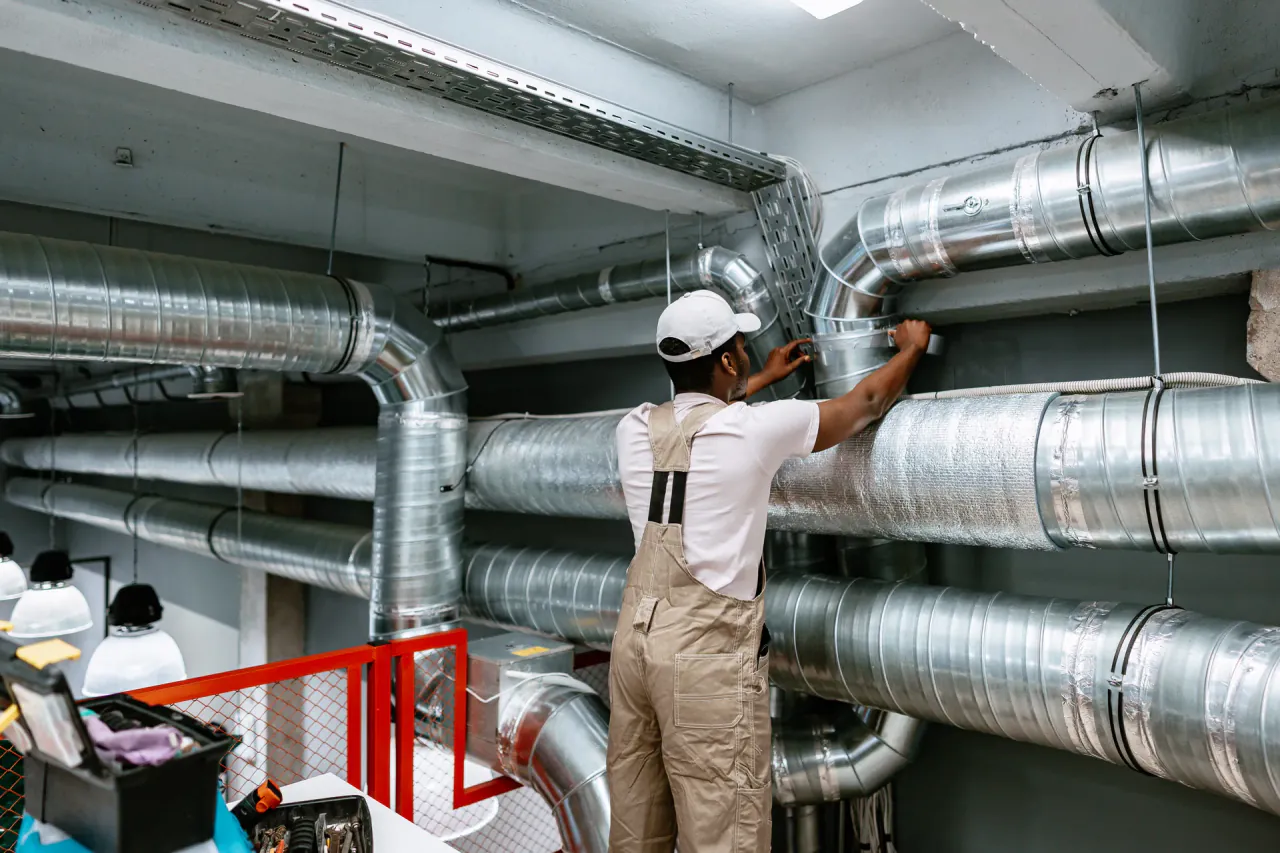
What is local exhaust ventilation (LEV)?
Local exhaust ventilation (LEV) is an engineering control that captures dust, fume, mist, vapour or gas at its source and carries it away before workers breathe it in. Under COSHH regulation 9, LEV provided to control exposure must be thoroughly examined and tested at least once every 14 months.
It covers a wide range of kit. A captor hood and extraction unit on a cut-off saw or sander is LEV. So is a fume arm over a welding bench, a spray booth, or the dust extraction in a joinery workshop. Since 2019 HSE has expected engineering controls such as LEV for all welding indoors, mild steel included. The law also requires LEV to be kept in efficient working order, in good repair and clean, with examination and repair records kept for at least 5 years.
LEV is not the first answer. Regulation 7 puts preventing exposure first, with a safer product or process preferred. Control at source, “including adequate ventilation systems”, comes after that. The full set of duties is on the COSHH Regulations explained page. The assessment that decides whether LEV is needed starts with the free COSHH assessment template.
What an LEV system is made of
HSG258, chapter 2HSE describes most LEV systems, though not all, as five parts working together. A weak part anywhere in the chain loses control at the hood.
Hood
Where the contaminant cloud enters the system. It may be tiny and built into a hand tool, or large enough to walk into. HSE says hood choice is critical, and that a common reason LEV underperforms is a hood that does not catch or contain the contaminant.
HSG258 paras 10 and 88; INDG408Three kinds of hood
An enclosing hood surrounds the process, such as a spray booth. A receiving hood catches a cloud already moving towards it, such as a canopy over a hot process. A capturing hood draws the cloud in from outside, from on-tool extraction to a slot along a bench. Enclosure is always the most effective.
HSG258 paras 95 to 99Ducting
Carries the air and contaminant from the hood to the discharge point, often through an air cleaner. On portable units this is the flexible tubing between tool and extractor.
HSG258 para 10Air cleaner or arrestor
Filters or cleans the extracted air. Not every system needs one. Filters clog, so their condition and the pressure across them belong in the routine checks.
HSG258 para 10Air mover
The engine of the system, usually a fan. It must be the right size and type to give enough suction at the hood.
HSG258 para 10; INDG408Discharge
Releases the extracted air to a safe place. Where cleaned air returns to the workroom, the ACOP expects its filter efficiency and contaminant level to be known.
HSG258 para 10; L5 para 189Airflow indicator
Shows the operator at a glance that the hood is drawing enough air. There is no specific legal requirement to fit one, but HSE recommends it, and the simplest is usually a manometer. HSE says paper or plastic tell-tales are not adequate, except on very simple systems extracting low-hazard substances.
HSE LEV FAQs; HSG258 para 106Air moving fast off a grinding wheel or circular saw carries fine dust a long way from the source. HSE warns that the dust you can see is not all that is there: respirable dust clouds are practically invisible.
On-tool extraction and M and H class units
HSE CIS69 and dust pagesFor cutting, grinding, chasing and sanding, LEV usually means a captor hood on the tool, tubing and a portable extraction unit. HSE treats it as a form of LEV.
It is LEV, so it is examined and tested
The COSHH ACOP names on-tool extraction systems among the LEV that must be examined and tested. HSE says the thorough examination and test covers the extraction unit itself, at least every 14 months. The hoods and hoses are covered by regular checks.
L5 para 185; HSE LEV FAQsThe hood matters most
HSE calls the captor hood the most important part. It should be designed for the tool and the task, and sit as close as possible to the work surface. Dust escapes through any gap between the two.
CIS69Choose an M or H class unit
For construction dust, HSE says to choose an H (high) or M (medium) class extraction unit. These carry a class label and are fitted with low-flow indicators. An L (low) class unit suits only lower-toxicity dust, such as gypsum from plasterboard. A HEPA filter in a general commercial vacuum is not a substitute. HSE’s current task pages for silica and wood dust say the same, and add that the flow rate must be right for the work.
CIS69 (2013); HSE construction dust pagesExtraction alone is often not enough
HSE says on-tool extraction does not capture all the silica when chasing, grinding or scabbling. RPE with a protection factor of 20, such as an FFP3 mask, is still needed as back-up. For wood, HSE expects RPE for most sanding and for longer cutting. Tight-fitting masks need a face fit test.
HSE construction dust pagesTubing, bags and filters
Tubing should be the right diameter and length and fit securely, using an adaptor, not tape. For wood dust, HSE asks for antistatic hoses. Empty the unit regularly into the correct disposable bags, sealed and never emptied for reuse. Pre-filters or built-in filter cleaning help where fine dust clogs filters quickly.
CIS69; HSE wood dust pageHired extraction units
HSE says the hire company, as owner, is responsible for making sure the thorough examination and test has been done. The hirer is responsible for not using the unit after that test expires. On a long hire, arrange a retest or a replacement before the date.
HSE LEV FAQsCordless tools with built-in extraction
Cordless tools with integrated filtered extraction fall outside the H, M and L classes. HSE says the same general principles still apply to them.
CIS69HSE gives the on-tool examination two stages: a thorough visual examination of the unit, then a measurement of its technical performance. For M and H class units, HSE tells examiners to check against BS EN 60335-2-69 that air velocity is above 20 m/s. It is measured in the largest hose the maker supplies. Examiners also check that the low-flow alarm or indicator operates when it falls below that.
What the law requires and what HSE recommends
Law, ACOP or guidanceMuch of what is called “LEV compliance” is HSE guidance rather than law. The ACOP has a special legal status; HSG258 and the leaflets do not. Following them will normally be enough to comply.
| Requirement | Where it comes from | Status |
|---|---|---|
| Keep LEV in an efficient state, in efficient working order, in good repair and clean | COSHH regulation 9(1)(a) | Law |
| Thorough examination and test at least once every 14 months | COSHH regulation 9(2)(a) | Law |
| Shorter maximum intervals for four named processes | COSHH Schedule 4 | Law |
| A suitable record of each examination and test, and of resulting repairs, kept for at least 5 years | COSHH regulation 9(4) | Law |
| The same duties for a self-employed person whose work is of a prescribed description, such as any work on a construction site | COSHH regulation 3(2) and (2A) | Law |
| Employees use LEV fully and properly and report defects forthwith | COSHH regulation 8 | Law |
| Whoever maintains, examines and tests LEV is competent | L5 para 175 | ACOP |
| Check new engineering controls on installation, as a benchmark for later tests | L5 para 177 | ACOP |
| What an examination and test record should normally contain | L5 para 186 | ACOP |
| Put critical defects right immediately | L5 para 187 | ACOP |
| Visual check of LEV at least once a week | L5 para 172 | HSE guidance |
| A commissioning report, a user manual and a logbook | HSG258 chapters 8 and 9; INDG408 | HSE guidance |
| Test label on each hood, and a red fail label on a failed hood | HSG258 paras 345 and 346 | HSE guidance |
| Airflow indicators on hoods | HSE LEV FAQs; HSG258 para 106 | HSE guidance |
Schedule 4 sets 1 month for blasting in or incidental to cleaning metal castings during their manufacture, and for jute cloth manufacture. It sets 6 months for processes giving off dust or fume in which non-ferrous metal castings are produced. Dry grinding, abrading or polishing of metal articles, other than gold, platinum or iridium, using mechanical power is also 6 months. That applies where it happens in any room for more than 12 hours in any week. HSE also points to DSEAR 2002 for fire and explosion risk in LEV, and to the noise regulations.
The thorough examination and test
At least every 14 monthsHSE calls it TExT. It checks that the LEV can still perform as designed and contribute to adequate control. It is carried out by a competent person, either an outside contractor or a competent employee. INDG408 says most systems are tested once a year, with no more than 14 months allowed in law. HSG258 divides the visit into three stages: a visual and structural examination, a review of technical performance and an assessment of control effectiveness.
Before the visit
Give the examiner the commissioning report, the user manual, the logbook and the last test report. Add any air sampling results, and confirm whether the LEV, the layout or the process has changed.
NoteWith no documents at all, the examiner can be asked to produce a commissioning-style report as well, by agreement.
Visual and structural examination
Every part is examined for damage, wear and tear, including inside ducts where needed. Filters, filter cleaning, gauges, alarms and the fan drive are checked. Settled dust around a hood, or a noisy or vibrating part, is a warning sign.
Technical performance
Smoke and dust lamp tests run with the process working. Air velocity and static pressure are measured at the hoods, ducts, air cleaner and fan. Alarms are tested by simulating a failure. The results are compared with the design figures in the commissioning report or user manual.
NoteIf the system is unsafe, the examination stops until it is repaired.
Control effectiveness
The examiner judges whether the LEV still contributes to adequate control. That takes in how operators actually use it and any relevant air sampling.
Labels and report
Each hood gets a test label with the test date, the next test and the examiner. A failed hood gets a red fail label instead. HSG258 lists the grounds: reduced or no detectable airflow, or a hood that fails to contain, receive or capture the contaminant cloud. The report gives a prioritised list of actions.
NoteLabels are HSE guidance, not a legal requirement. HSE says a red label should come with a short written report of what is wrong and what to do.
Acting on the report
The ACOP says critical defects are put right immediately. If the LEV is not controlling exposure, HSE says stop the work and repair it. Work that continues meanwhile needs further protection, such as suitable RPE. Repairs that follow the test go on the record, which the law requires.
NoteHSE says a competent person checks the repaired LEV controls exposure before the red label comes off. A long list of repairs points to weak routine checks.
Fourteen months is a maximum, not a target. HSG258 says to test more often where wear and tear is liable to degrade the system between tests.
The commissioning report, user manual and logbook
HSE guidance is to get three documents from the LEV supplier. Together they set the benchmark that every later test is measured against.
Commissioning report
Proves a new or modified system gives adequate control. HSG258 sets four stages: installation, technical performance, control effectiveness and reporting. The report records flow rates and pressures as benchmarks, and confirms every hood performs as required. It carries the date, the duty holder, and the commissioner’s name, job title and employer. HSE says to keep this information for the life of the equipment.
HSG258 chapter 8; HSE commissioning page and LEV FAQsUser manual
How to use and maintain the system. It describes the system with diagrams and the performance found at commissioning. It also covers the schedule of checks and part replacement, the statutory test requirements, and the signs of wear and control failure.
HSG258 paras 307 to 317Logbook
The schedules for regular checks and maintenance, and the record of each check, replacement and repair. It also records whether operators are using the LEV correctly, and who made each check. HSE suggests keeping it for at least 5 years, like the test reports.
HSG258 para 318; INDG408Examination and test record
Required by law. The ACOP lists what it should normally contain. That includes the dates of this and the last test, the LEV and the substances it controls, and a diagram with test points. It also covers whether the LEV still meets its intended performance, any critical defects, and the examiner’s name and signature. HSE says a report that follows this list will probably meet the legal duty to keep a record. HSG258 says a copy should be kept at the workplace.
COSHH regulation 9(4); L5 para 186; HSE LEV FAQsA system with no paperwork
Many existing systems were never commissioned. HSE says to ask the manufacturer first, then an LEV engineer or occupational hygienist. The system’s performance is measured to show it controls exposure, and the figures start a new logbook.
HSG258 paras 285 and 321; INDG408L5 says records may be kept on paper or electronically, as long as they can be produced for inspectors and safety representatives.
Routine LEV checks between tests
The 14-month test is an audit, not the maintenance plan. HSG258 expects daily, weekly and monthly checks, set out in the logbook and made by trained employees.
Every time it is used
HSE’s pocket card for workers asks: does the indicator show it is working, and are you close enough to it? Are there smells, settled dust, odd noises or vibration? Is the test label in date? Report anything wrong to the supervisor.
INDG409At least once a week
HSE guidance in L5 says LEV and work enclosures should be visually checked at least once a week. CIS69 asks for formal maintenance checks of on-tool extraction at least weekly, and more often where damage is likely.
L5 para 172; CIS69What the checks cover
Hoods and airflow indicators, for damage and blockage. Ducts and flexible hoses, for wear and partial blockage. Damper positions, the air cleaner and its pressure, and the fan for changes in noise or vibration. Whether operators are working the way the LEV needs.
HSG258 para 319When something changes
HSG258 says LEV needs recommissioning after a change to the process, the layout or the equipment making the dust or fume. The same applies when a branch is added or modified. Blanking off an inlet or adding a hood unbalances a multi-branch system.
HSG258 paras 272 and 274Who does what
Operators make daily checks and report faults; the law requires employees to report defects forthwith. INDG408 gives weekly checks to supervisors, who also arrange repairs and record what was found and done.
COSHH regulation 8; INDG408Who can examine and test LEV
The COSHH ACOP says employers must make sure whoever maintains, examines and tests LEV is competent to do so. That means adequate knowledge, training and expertise in examination methods. The examiner can be an outside contractor or a competent employee. HSE’s INDG408 says the test is not normally something an employer can do themselves. HSE’s LEV FAQs add that most businesses bring in a specialist.
HSE defines competence as knowledge, skills and experience together. A training course by itself does not make someone competent. HSE also says it does not require LEV suppliers to hold particular qualifications. HSG258 describes recognised qualifications and UKAS accreditation as routes to, or evidence of, competence. The law asks for competence, not a named qualification.
HSE advises being an “intelligent customer”. Ask an examiner or supplier about their experience with similar processes, their qualifications, references, and how they will show the LEV gives adequate control. Under regulation 12(4), anyone doing COSHH work for you, such as an LEV tester, must also have suitable and sufficient information, instruction and training.
Sources: L5 para 175; HSG258 paras 26 to 31, 327 and Appendix 1; HSE, LEV frequently asked questions; INDG408 Clearing the air.
Every data sheet to hand,
tied to the job that uses it.
In Unibuild, each hazardous substance holds its safety data sheet and its supplier, linked to the jobs, materials and purchase orders that use it. Review dates are tracked, every version is kept, and the current one is the one out on site.
When an auditor or a principal contractor asks for the COSHH register, it is a search by name or supplier, not a spreadsheet somebody else kept.
- A data sheet for every substance held with its supplier
- Tied to the job through the materials and purchase orders that use it
- Review dates tracked and every version kept
- Searched by product name or supplier
Free COSHH templates
Free to use and reuse, no sign-upLEV and LEV testing: common questions
What is local exhaust ventilation?
Is LEV testing a legal requirement?
How often does LEV need testing?
Who can carry out LEV testing?
What should an LEV test report include?
Does on-tool extraction need a thorough examination and test?
Do I need an M class or H class dust extractor?
Who tests a hired dust extractor?
What happens if LEV fails its test?
How long must LEV records be kept?
The COSHH guide
Read in any orderSources
Great Britain law and HSE guidance, read on the dates above. Northern Ireland has its own COSHH Regulations.
- COSHH Regulations 2002, regulation 9, maintenance, examination and testing of control measures, legislation.gov.uk
- COSHH Regulations 2002, Schedule 4, frequency of thorough examination and test of LEV, legislation.gov.uk
- COSHH Regulations 2002, regulation 7, prevention or control of exposure, legislation.gov.uk
- COSHH Regulations 2002, regulation 8, use of control measures, legislation.gov.uk
- HSE L5, Control of substances hazardous to health, ACOP and guidance, sixth edition 2013
- HSE HSG258, Controlling airborne contaminants at work: a guide to local exhaust ventilation, third edition 2017
- HSE, Local exhaust ventilation (LEV)
- HSE, LEV frequently asked questions
- HSE, Commission your local exhaust ventilation (LEV) system
- HSE INDG408, Clearing the air: a simple guide to buying and using LEV
- HSE INDG409, Time to clear the air!, a pocket guide to LEV for workers
- HSE CIS69, Controlling construction dust with on-tool extraction (2013)
- HSE, Construction dust: chasing concrete and raking mortar
- HSE, Construction dust: cutting and sanding wood
- HSE safety alert, change in enforcement expectations for mild steel welding fume (2019)
- COSHH Regulations 2002, regulation 3, duties under the Regulations, legislation.gov.uk
The COSHH register,
tied to the job.
Unibuild keeps each substance’s data sheet and supplier against the jobs, materials and purchase orders that use it, with review dates tracked and every version kept.