
Legionella in water systems at work
Where legionella bacteria grow, who carries the duty, what the L8 code and HSG274 ask, and the temperature, flushing and record checks that keep a water system under control.
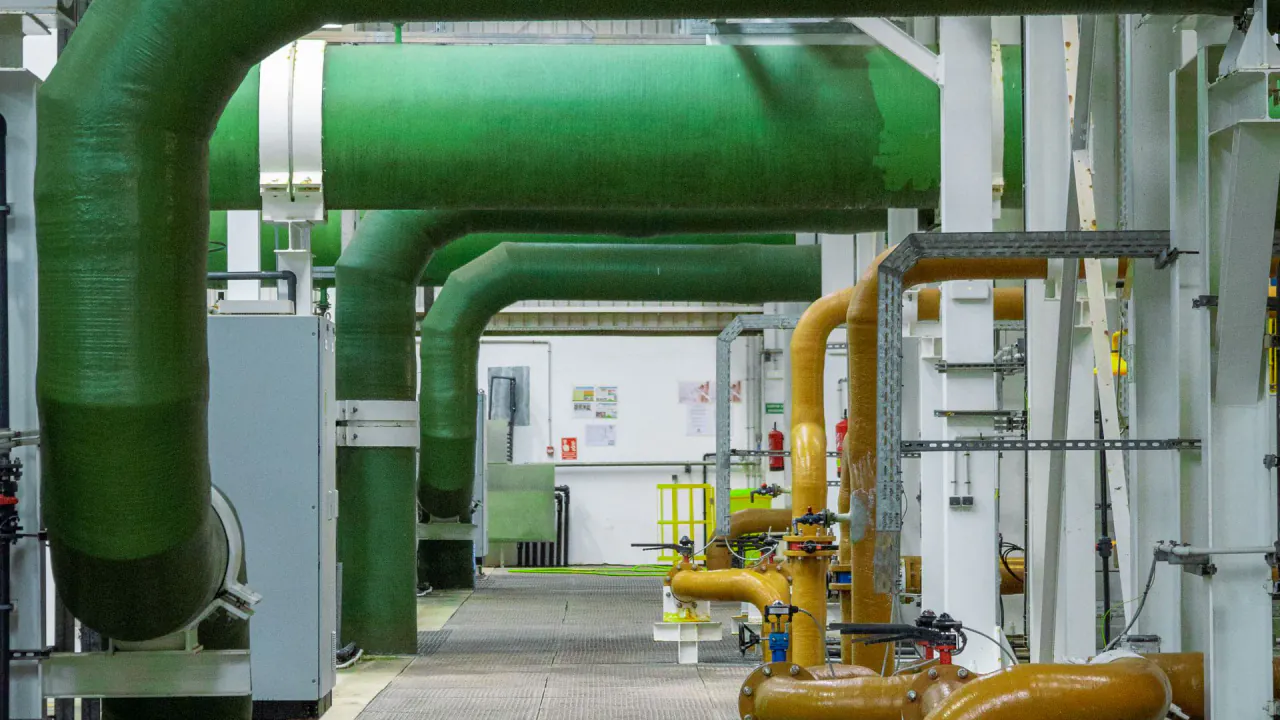
What is legionella?
Legionella are bacteria that multiply in man-made water systems held between 20 and 45°C, and cause Legionnaires’ disease, a potentially fatal pneumonia. People catch it by breathing in small droplets of contaminated water, from showers, taps, cooling towers and spray.
Trades meet it in hot and cold water systems, cooling towers, little-used outlets, new systems awaiting handover and stored site water. Stored or recirculated water, stagnation, scale, sludge and biofilm all raise the risk. Plumbing and heating engineers, FM teams and anyone running welfare units are closest to it.
COSHH treats legionella as a biological agent, so it is a substance hazardous to health. Employers and people in control of premises, including landlords, must assess the risk and prevent or control it. HSE’s Approved Code of Practice L8 and its technical guidance HSG274 set out how: keep hot water hot, cold water cold, and keep it moving.
The assessment itself is covered in legionella risk assessment. Water on construction sites is covered in temporary water supply on site.
Where trades, FM and site teams meet legionella
From L8 and HSG274L8 lists the systems with a reasonably foreseeable risk: cooling systems, hot and cold water systems, spa pools and other plant that holds water. These are the ones trades work on.
| System | Where the risk comes from | Who is closest to it |
|---|---|---|
| Hot and cold water systems | The cool base of calorifiers and cylinders where sediment collects, cold pipes gaining heat, dead legs, capped pipes and poor circulation | Plumbing and heating engineers, FM and maintenance teams |
| Little-used outlets and showers | Water stands in the pipe, and a shower or spray tap then releases breathable droplets | FM teams, cleaners and anyone flushing outlets |
| Cooling towers and evaporative condensers | Warm recirculating water, and drift carried into the air from the tower | HVAC and FM engineers, water treatment contractors |
| New systems before handover, and buildings out of use | HSG274 calls the time between filling a new system and normal use potentially the most hazardous. Mothballed systems stagnate the same way | Plumbers, fit-out contractors, site and project managers |
| Stored water on site | Our application of L8’s conditions, not an HSE list. Tanks in welfare units and water bowsers hold standing water that can warm in summer. Welfare showers and dust suppression sprays make droplets | Site managers and welfare hire teams |
| Other risk systems | HSG274 lists emergency showers and eyebaths, sprinkler and hose reel systems, vehicle washers, water softeners, and fire, dust and odour suppression systems | Fire protection engineers, plant yards, site teams using dust suppression |
| Cleaning and disinfecting the system itself | Jet washing, flushing and disinfecting make aerosol right where the operative stands. HSE’s own example of exposure is routine maintenance on a hot water service system | Water treatment and maintenance operatives |
L8 says a water system includes all its plant and components: pipework, pumps, tanks, valves, showers, heat exchangers and softeners. Dead legs and parts used intermittently count too. The stored site water row is our own application of L8’s growth conditions; HSG274 Part 3 lists dust suppression systems. Sources: HSE L8 paragraphs 23 and 26, HSG274 Part 2 paragraphs 2.4 and 2.40 and Part 3 paragraph 3.2, and HSE on RIDDOR and biological agents.
Legionnaires’ disease and who is at risk
Legionella bacteria live in rivers, lakes and reservoirs, usually in low numbers. The illness comes from purpose-built systems where the water is warm enough for them to multiply.
Legionellosis
The collective term for diseases caused by legionella bacteria. Legionnaires’ disease is the most serious, a potentially fatal form of pneumonia. Pontiac fever and Lochgoilhead fever are similar but less serious.
HSE L8, guidance paragraph 10How people catch it
By inhaling small droplets of water suspended in the air that contain the bacteria. HSE says Legionnaires’ disease is not known to spread from person to person.
HSE L8, guidance paragraph 13; HSE, what Legionnaires’ disease isThe conditions that raise the risk
Water between 20 and 45°C in any part of the system. Droplets that can be produced and spread. Water that is stored or recirculated. Deposits such as rust, sludge, scale, organic matter and biofilm that feed growth.
HSE L8, guidance paragraph 13Who is at higher risk
Everyone is susceptible, and the risk increases with age. L8 names people over 45, smokers and heavy drinkers, and people with chronic respiratory or kidney disease, diabetes, lung or heart disease, or an impaired immune system.
HSE L8, guidance paragraph 10The symptoms
At first they are like flu: high temperature, feverishness and chills, cough, muscle pains and headache. Pneumonia, diarrhoea and mental confusion can follow.
HSE, what Legionnaires’ disease isIf a worker has symptoms
HSE advises seeing a doctor. A worker who suspects the illness came from work should tell their manager, their safety representative and any occupational health service.
HSE, what Legionnaires’ disease isWhat the law asks, and where L8 fits
HSWA, COSHH, L8Apart from cooling tower notification, no regulation is written for legionella. The duties come from general health and safety law, applied through the L8 code. Each row says whether it is law, the L8 Approved Code of Practice or HSE guidance.
General duties
The law requires employers to protect the health of employees, and of people not in their employment affected by their work, so far as is reasonably practicable. L8 says these duties apply to legionella risks arising from work activities.
HSWA 1974, sections 2 and 3; L8 guidance paragraph 15Legionella under COSHH
A biological agent is a micro-organism that may cause infection or another hazard to health. Every biological agent is a substance hazardous to health, so COSHH applies: assess the risk, then prevent or adequately control exposure. HSE’s Approved List places the legionella species that cause human disease in Group 2.
COSHH regulations 2, 6 and 7; HSE Approved List of biological agentsSchedule 3 is not about water systems
COSHH Schedule 3 adds rules for work with biological agents. Its containment and notification duties apply to laboratories, work with infected animals and industrial processes that use the agents. They are not written for building water systems.
COSHH regulation 7(10) and Schedule 3, paragraphs 3 and 5The L8 code and its status
L8, fourth edition 2013, gives advice on the HSW Act and COSHH for legionella. Following its ACOP text is enough to comply on the matters it covers. Other methods are allowed, but a defendant who did not follow it must show they complied some other way. ACOP status covers risk assessment, the responsible person, the control scheme, review of controls and the duties of those who supply water systems.
HSE L8, page 2 and paragraphs 1 and 4Who holds the duty
The dutyholder is the employer, a self-employed person, or whoever is in control of premises or systems in connection with work. L8 gives the example of a landlord who keeps responsibility for maintenance of a let building.
L8 Approved Code of Practice, paragraph 28Assess, then avoid or write a scheme
A suitable and sufficient assessment must identify and assess the risk, by a competent person. Where the risk is reasonably foreseeable, systems that lead to exposure must be avoided so far as is reasonably practicable. Otherwise a written control scheme is needed.
L8 Approved Code of Practice, paragraphs 28, 29 and 58A responsible person
The dutyholder appoints one or more competent people with enough authority and knowledge of the installation to run the controls. L8’s guidance calls them the responsible person. A competent self-employed dutyholder may appoint themselves.
L8 Approved Code of Practice, paragraph 48; guidance paragraph 51Designers and installers
Anyone supplying or installing water systems must, so far as is reasonably practicable, make them safe in use. For hot and cold water L8 asks for no dead legs or, failing that, short ones, minimal stored cold water and insulation.
L8 Approved Code of Practice, paragraphs 75, 78 and 80Cooling towers must be notified
Whoever controls premises with a cooling tower or evaporative condenser must notify the local authority in writing, on the approved form. Changes go in within one month. A device taken out of use for good is notified too.
Notification of Cooling Towers and Evaporative Condensers Regulations 1992, regulation 3L8 also gives guidance on the Management of Health and Safety at Work Regulations 1999, which require risk assessment and access to competent help. A cooling tower stopped for maintenance or a seasonal shutdown has not gone out of use, so that needs no notice. More on COSHH itself is in the COSHH regulations explained.
Controlling legionella: hot, cold, moving and clean
L8 asks first whether the risk can be avoided, then for control that stops legionella growing and limits spray. Temperature is the traditional method. Each stage gives the figure as HSG274 and HSE’s pages state it.
Avoid: design the risk out
Replace a wet cooling tower with a dry air-cooled system where possible. Consider removing little-used showers and taps, cutting the redundant pipework back to a common supply. Remove dead ends and keep pipe runs short.
NoteL8 Approved Code of Practice, paragraph 58; HSG274 Part 2, paragraph 2.77; HSE, things to consider.
Control: keep hot water hot
Store hot water at 60°C or more. Distribute it so outlets reach at least 50°C within one minute, or 55°C in healthcare premises. Calorifier return water should not fall below 50°C.
NoteHSE warns of scalding above 44°C. Where the scald risk is significant, a thermostatic mixing valve is fitted, but water downstream of it can grow legionella. HSE says that pipe run should be no longer than 2 m.
Control: keep cold water cold
Keep cold water below 20°C where possible. Store only what is needed, which HSE puts at about one day’s use. Fit tanks with a tight lid, and insulate pipes near heat sources.
NoteCold sentinel taps should run below 20°C within two minutes.
Control: keep it moving
Outlets not used for seven days or more go on a weekly flushing regime. Flush until the temperature stabilises and matches the supply, and purge to drain without making spray.
NoteHSG274 says once flushing starts it must be sustained and logged, as lapses can cause a critical increase in legionella at the outlet.
Control: keep it clean
Inspect cold water tanks and calorifiers annually and clean as needed. Dismantle, clean and descale showerheads and hoses quarterly, or as the risk assessment says. Use fittings and materials that do not feed growth.
NoteHSG274 says biofilm and scale can significantly reduce the efficacy of any control measure.
Commission and recommission properly
HSG274 says any new system needs, as a minimum, flushing and disinfection before use. For large developments it points to BS EN 806 and BS 8558 for cleaning, flushing and disinfection. Small, simple developments are thoroughly flushed as close to occupation as possible.
NoteOnce filled for a pressure test, a system should not be drained down; compressed air or inert gas testing is the alternative. If occupation is a long way off after the test, flush weekly. A building taken out of use is normally left filled, then flushed, cleaned and disinfected as if new before it returns to use (HSG274 Part 2, paragraphs 2.41 to 2.47 and 2.52).
Protect the people doing the work
Wear suitable respiratory protective equipment when inspecting, cleaning or disinfecting where aerosol is made, such as high-volume flushing or jet washing. Water treatment chemicals need their own COSHH assessment.
NoteHSG274 Part 1 gives this for cooling systems. See face fit testing for tight-fitting masks.
Where temperature cannot be kept, HSG274 Part 2 describes biocide and other treatment methods; they need equally careful monitoring. Legionella controls also appear in the plumbing and heating and facilities maintenance risk assessments. Site water is covered in temporary water supply on site.
Routine checks and how often
HSG274 Table 2.1These are the checks HSG274 gives for hot and cold water systems that use temperature control. The risk assessment sets the actual frequency for each system; the figures here are HSE’s starting points.
| Check | What it should show | How often |
|---|---|---|
| Calorifier flow and return | Flow as close to 60°C as practicable without going below it; return not below 50°C | Monthly |
| Hot water sentinel points | At least 50°C within one minute at sentinel outlets, or at the return legs of principal loops on circulating systems (55°C in healthcare premises) | Monthly |
| Cold water sentinel taps | Below 20°C within two minutes of running | Monthly |
| Other outlets, hot and cold | The same temperatures, building a profile of the whole system | On a rotation that covers the system |
| Infrequently used outlets | Flushed until the temperature stabilises, and logged | Weekly, or as the risk assessment says |
| Showers and spray taps | Heads, inserts and hoses dismantled, cleaned and descaled | Quarterly, or by rate of fouling |
| Cold water storage tanks | Inspected, with remedial work where needed; stored and incoming water temperatures | Annually (temperatures in summer) |
| Calorifiers | Inspected internally or debris purged from the base | Annually, or by rate of fouling |
| Thermostatic mixing valves | Strainers and filters cleaned; valve maintained to the maker’s instructions | Annually, or as the risk assessment says |
Testing water for legionella is a different thing from temperature checks. HSE says it is not usually needed for hot and cold water systems, but may be where control is in doubt or temperatures are not being achieved. For open systems such as cooling towers and spa pools, HSE says at least quarterly. Testing and sampling are covered in legionella risk assessment.
Records, training, landlords and reporting
The log book is how a dutyholder shows the scheme is working. Landlords of homes carry the same duty in a much lighter form.
What to record
Employers with five or more employees must record the significant findings. L8 adds the responsible people, the written scheme, whether the system is in use, and every monitoring check with its date.
L8 Approved Code of Practice, paragraphs 70 and 71The legionella log book
L8 lists what should normally be kept. That includes names and deputies, schematic diagrams, precautions with dates, remedial work and contractor visits. It also includes cleaning and disinfection reports, water analysis, training records and signatures.
L8 guidance paragraph 74How long to keep records
Keep records for as long as they are current and for at least two years after. Keep the results of monitoring, inspections, tests and checks, with their dates, for at least five years.
L8 Approved Code of Practice, paragraph 72Training
The law requires suitable information, instruction and training for employees liable to be exposed. L8’s guidance says people running the controls must be trained to a level that makes the work safe and technically competent, with refresher training, and the training recorded.
COSHH regulation 12; L8 Approved Code of Practice, paragraph 49; guidance paragraphs 51 and 52Landlords of homes
HSE says landlords must assess the risk, but it need not be in-depth. HSE considers most homes low risk because water is used and turned over regularly. Most landlords can assess it themselves, and the law does not require a “legionella test certificate”.
HSE, legionella and landlords’ responsibilitiesEmpty properties
As a general principle, outlets should be used at least once a week. While a home is empty, consider a flushing regime, or draining the system if it will stay empty for a long period. Flush the system before letting it.
HSG274 Part 2, paragraphs 2.142 and 2.144Reporting under RIDDOR
When the employer receives a diagnosis, for a person at work, of any disease attributed to an occupational exposure to a biological agent, it must be reported. RIDDOR names legionellosis only in its offshore list; on shore it falls under this general rule. HSE’s example is exposure to legionella during routine maintenance on a hot water service system.
RIDDOR 2013, regulation 9(b) and Schedule 3; HSE, carcinogens, mutagens and biological agentsHSE says the law sets no annual or two-yearly review date for a landlord’s assessment: review it periodically and when something changes. Where homes are hard to get into, checks can be made during gas safety or routine maintenance visits. How to make a report is in RIDDOR reporting.
Written, signed and kept,
tied to the job that uses it.
In Unibuild, a COSHH assessment is written once and operatives read and sign it on their phone, the same way as a RAMS. The AI builds a draft from the supplier’s safety data sheet and checks an assessment before it goes out. A person reviews and finalises every one.
Each substance holds its data sheet and supplier, linked to the jobs, materials and purchase orders that use it. Review dates are tracked and every version is kept. When an auditor or a principal contractor asks for the COSHH register, it is a search, not a spreadsheet.
- Signed on the phone by every operative, the same way as a RAMS
- Drafted by AI from the safety data sheet, and checked before issue
- A data sheet for every substance, tied to the job through materials and purchase orders
- Review dates tracked and every version kept
- COSHH e-learning, with the certificate on the training matrix
Free COSHH templates
Free to use and reuse, no sign-upLegionella: common questions
What is legionella?
What temperature does legionella grow at?
Who is responsible for legionella control?
What is the L8 ACOP?
How often should little-used outlets be flushed?
Is legionella training a legal requirement?
What goes in a legionella log book?
Do landlords need a legionella risk assessment?
Is Legionnaires’ disease reportable under RIDDOR?
Does a cooling tower have to be registered?
Substances and diseases
Read in any orderSources
Great Britain law and HSE guidance, read on the dates above. Northern Ireland has its own COSHH Regulations.
- HSE L8, Legionnaires’ disease: the control of legionella bacteria in water systems, ACOP and guidance, fourth edition 2013 (PDF)
- HSE HSG274, Legionnaires’ disease: technical guidance, Parts 1 to 3
- HSE HSG274 Part 2, hot and cold water systems (PDF)
- HSE INDG458, Legionnaires’ disease: a brief guide for dutyholders (PDF)
- HSE, What Legionnaires’ disease is and typical symptoms
- HSE, Legionnaires’ disease: what you must do
- HSE, Hot and cold water systems
- HSE, Hot and cold water systems: things to consider
- HSE, Testing and monitoring your water system for legionella
- HSE, Legionella and landlords’ responsibilities
- HSE, RIDDOR: exposure to carcinogens, mutagens and biological agents
- HSE, The Approved List of biological agents, sixth edition 2026 (PDF)
- The Control of Substances Hazardous to Health Regulations 2002, regulation 2, legislation.gov.uk
- The Control of Substances Hazardous to Health Regulations 2002, Schedule 3, legislation.gov.uk
- RIDDOR 2013 (SI 2013/1471), regulation 9, legislation.gov.uk
- The Notification of Cooling Towers and Evaporative Condensers Regulations 1992, regulation 3, legislation.gov.uk
- Health and Safety at Work etc. Act 1974, section 3, legislation.gov.uk
The COSHH register,
tied to the job.
Unibuild keeps each substance’s data sheet and supplier against the jobs, materials and purchase orders that use it, with review dates tracked and every version kept.