
The HHSRS hazards list:
21 hazards since June 2026.
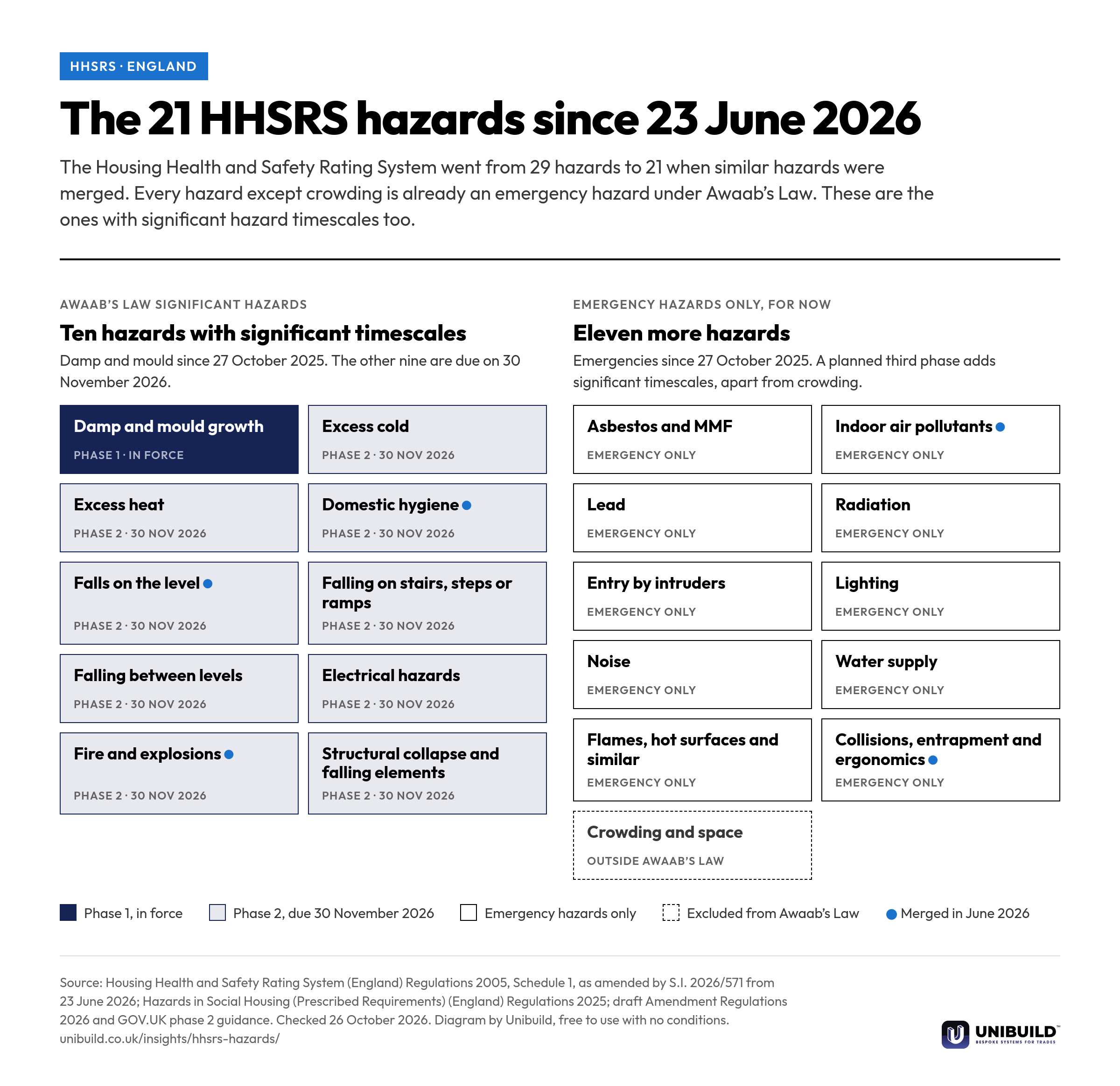
The Housing Health and Safety Rating System went from 29 hazards to 21 on 23 June 2026, and its ten bands became three. The current list, what each old hazard became, category 1 and 2, and where Awaab's Law fits.
Published ·6 min read·Written by Darshan Parmar, Founder

On 23 June 2026 the Housing Health and Safety Rating System in England went from 29 hazards to 21. Similar hazards were merged, and the ten scoring bands became three. Any list of “the 29 HHSRS hazards” is now out of date. This is the current list, what each old hazard became, and where Awaab’s Law fits.
What the HHSRS is
The Housing Health and Safety Rating System is how hazards in homes are assessed in England. It comes from Part 1 of the Housing Act 2004 and is set out in the Housing Health and Safety Rating System (England) Regulations 2005. Local authorities use it when they inspect a home.
Each hazard is scored on how likely it is to cause harm and how serious that harm could be. The score decides whether it is a category 1 hazard, which the local authority must act on, or a category 2 hazard, which it may act on.
The 21 HHSRS hazards
The list below follows Schedule 1 of the 2005 Regulations as it stands after the June 2026 amendments. Five of the 21 are new combined hazards.
| Hazard | What it covers | Replaced | Awaab’s Law |
|---|---|---|---|
| Damp and mould growth | House dust mites, damp, mould and fungal growth | Unchanged | Phase 1, significant hazard, in force |
| Excess cold | Low indoor temperatures | Unchanged | Phase 2, due 30 November 2026 |
| Excess heat | High indoor temperatures | Unchanged | Phase 2, due 30 November 2026 |
| Asbestos and MMF | Asbestos fibres and manufactured mineral fibres | Unchanged | Emergency hazards only |
| Indoor air pollutants | Timber and mould treatment chemicals, carbon monoxide, nitrogen dioxide, sulphur dioxide and smoke, uncombusted fuel gas, volatile organic compounds | Biocides; carbon monoxide and fuel combustion products; uncombusted fuel gas; volatile organic compounds | Emergency hazards only |
| Lead | Ingesting lead | Unchanged | Emergency hazards only |
| Radiation | Exposure to radiation | Unchanged | Emergency hazards only |
| Crowding and space | Too little space for living and sleeping | Unchanged | Excluded from Awaab’s Law |
| Entry by intruders | Difficulty keeping the home secure | Unchanged | Emergency hazards only |
| Lighting | Inadequate lighting | Unchanged | Emergency hazards only |
| Noise | Exposure to noise | Unchanged | Emergency hazards only |
| Domestic hygiene | Food storage and preparation, a home that cannot readily be kept clean, pests, household waste, washing facilities, sanitation and drainage | Domestic hygiene, pests and refuse; food safety; personal hygiene, sanitation and drainage | Phase 2, due 30 November 2026 |
| Water supply | An inadequate supply of clean water | Unchanged | Emergency hazards only |
| Falls on the level | Falls in baths, showers and toilets, on level surfaces, and at changes in level under 300mm | Falls associated with baths; falling on level surfaces | Phase 2, due 30 November 2026 |
| Falling on stairs, steps or ramps | Changes in level of 300mm or more | Unchanged | Phase 2, due 30 November 2026 |
| Falling between levels | Drops of 300mm or more, such as windows and balconies | Unchanged | Phase 2, due 30 November 2026 |
| Electrical hazards | Exposure to electricity | Unchanged | Phase 2, due 30 November 2026 |
| Fire and explosions | Uncontrolled fire, smoke and fumes, and explosions | Fire; explosions | Phase 2, due 30 November 2026 |
| Flames, hot surfaces and similar | Contact with controlled fire or flames, and hot objects, liquids or vapours | Unchanged | Emergency hazards only |
| Collisions, entrapment and ergonomics | Collision with or trapping in doors, windows and other features, and the position and operability of amenities | Collision and entrapment; position and operability of amenities | Emergency hazards only |
| Structural collapse and falling elements | Collapse of the whole or part of a building | Unchanged | Phase 2, due 30 November 2026 |
What changed in June 2026
The Housing Health and Safety Rating System (England) (Amendment) Regulations 2026 were made on 1 June 2026 and came into force on 23 June 2026. The government’s explanatory memorandum says the number of hazards was reduced from 29 to 21 by merging similar ones. Five merges account for the change:
- Indoor air pollutants replaced four hazards: biocides, carbon monoxide and fuel combustion products, uncombusted fuel gas, and volatile organic compounds.
- Domestic hygiene replaced three: domestic hygiene, pests and refuse; food safety; and personal hygiene, sanitation and drainage.
- Falls on the level replaced falls associated with baths and falling on level surfaces, and now covers changes in level under 300mm.
- Fire and explosions replaced fire and explosions as separate hazards.
- Collisions, entrapment and ergonomics replaced collision and entrapment, and position and operability of amenities.
Thirteen old hazards became five new ones, so 29 became 21.
Category 1 and category 2: the new bands
The same Regulations replaced the ten bands, A to J, with three: High, Medium and Low. The thresholds are a score of 1,000 or more for High, 100 to 999 for Medium, and under 100 for Low.
- Category 1 hazard. A hazard in the High band. The local authority must take enforcement action.
- Category 2 hazard. A hazard in the Medium or Low band. The local authority has a power to act.
The High band covers what bands A to C covered before, so the line for a category 1 hazard has not moved.
The HHSRS and Awaab’s Law
Awaab’s Law uses the HHSRS list to describe hazards in social housing, but it does not use the scoring. The guidance says it does not require an HHSRS assessment, or a category 1 hazard. It asks what a reasonable landlord, knowing the tenant’s circumstances, would do.
- Emergency hazards. Since 27 October 2025, every HHSRS hazard except overcrowding, where it needs making safe within 24 hours.
- Significant hazards, phase 1. Damp and mould growth, since 27 October 2025.
- Significant hazards, phase 2. Excess cold, excess heat, domestic hygiene, the three falls hazards, electrical hazards, fire and explosions, and structural collapse, due on 30 November 2026.
- A planned third phase. The remaining hazards apart from overcrowding, with no date set in the guidance.
What each phase 2 hazard looks like on a visit, with the government’s examples, is in Awaab’s Law phase 2 hazards.
The list got shorter. The ground it covers did not.
What it means for contractors
Nothing an engineer should notice has dropped out. Carbon monoxide is now part of indoor air pollutants, and a bath fall is now a fall on the level, but both are still hazards. Forms, toolbox talks and checklists that list 29 hazards by their old names still describe real risks, and are worth updating to the new names when next revised.
For firms working in social housing, the list matters most through Awaab’s Law. An engineer who reports a hazard beyond the job they were sent to do can start the landlord’s clock. A report that names the hazard as the regulations do makes the landlord’s triage faster.
On Unibuild, an engineer reports a hazard in the app at the property, against the Awaab’s Law phase 1 and phase 2 hazards. The report carries the suspected urgency and as many photographs as it needs. The office is alerted at once, records the escalation and handover on the same report, and sees every report on the Awaab’s Law Hazard Register.
The HHSRS changes described here apply in England. Wales has its own rating system regulations. This article is general guidance rather than legal advice.
Sources
Checked against the source rather than against commentary. Where a schedule, a rate or a threshold is definitive on a government site, read it there.
- Housing Health and Safety Rating System (England) Regulations 2005, Schedule 1 legislation.gov.uk
- The Housing Health and Safety Rating System (England) (Amendment) Regulations 2026, S.I. 2026/571 legislation.gov.uk
- Explanatory memorandum to S.I. 2026/571 legislation.gov.uk
- GOV.UK: Housing Health and Safety Rating System (HHSRS) guidance GOV.UK
- GOV.UK: HHSRS operating guidance GOV.UK
- GOV.UK: Awaab's Law phase 2 guidance for social landlords GOV.UK
The follow-up questions.
The timescales Awaab’s Law sets for these hazards are in Awaab’s Law for repair contractors.
How many hazards are in the HHSRS?
What were the 29 HHSRS hazards?
Which HHSRS hazards were merged in 2026?
What is a category 1 hazard?
What are the HHSRS bands now?
Does Awaab’s Law use the HHSRS?
Which HHSRS hazards are in Awaab’s Law phase 2?
Do the 2026 HHSRS changes apply in Wales?
More from Insights.
 Awaab's Law phase 2 hazards: what an engineer should reportFrom 30 November 2026, cold homes, falls, fire, electrical, structural and hygiene hazards join damp and mould on Awaab's Law timescales. Each hazard, what an engineer looks for, and the government's own examples of emergency and significant cases.Read it →
 Awaab's Law for repair contractors: timescales, phase 2 and the records to keepAwaab's Law puts statutory clocks on social landlords, and the work that meets them is usually done by their contractors. The timescales, what phase 2 adds, and the record a repairs contractor should hold at every attendance.Read it →
 Fire door classification: certified, notional and nominal doors explainedMost surveys of existing buildings find all three. What each classification means, the evidence that decides it, and what it changes for repair, replacement and the record kept for each door.Read it →
All 9 articles on reducing risk.