
Document control, and the revision
everybody was working to.
Building to a superseded drawing is expensive, common, and almost never anybody being careless. What has to be true for the right revision to reach the person holding the tool.
Published ·Updated ·5 min read·Written by Darshan Parmar, Founder
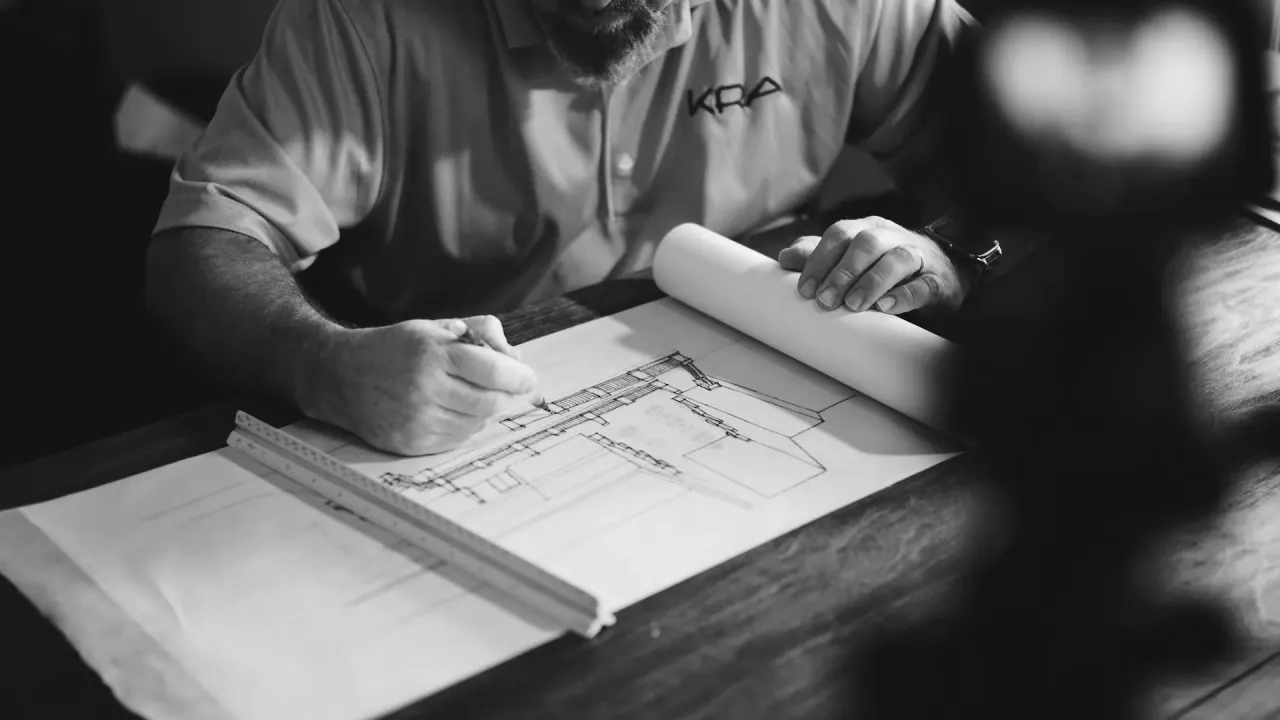
Building to a superseded drawing is almost never a filing failure. The register is usually right. What fails is distribution: the current revision reaches the office, and the revision in the van, on the wall and in the WhatsApp thread stays where it was. Control means knowing who holds what, not knowing where the master is.
How it actually happens
Nobody decides to build to an old drawing. The sequence is ordinary and it repeats.
Revision C is issued and goes out. Somebody prints it and pins it in the cabin. Somebody else saves it to a phone. A subcontractor is emailed it and forwards it to their own foreman. Three weeks later revision D is issued, because a service moved or a client changed their mind.
Revision D reaches the office and the register is updated correctly. It reaches the site manager's inbox, where it sits beneath forty other emails. The printout in the cabin still says C, and nothing about it changes on the day D is issued. The copy on the phone is still C. The subcontractor's foreman never saw D at all, because the email went to their office.
The work then gets built to C, correctly, carefully, by people doing their jobs properly.
The register was right the whole time. Being right in the office is not the same as being current in the hand holding the tool.
Why it is expensive out of proportion
Three reasons, and the third is the one that turns a mistake into an argument.
- It is found late. Work built to a superseded revision is usually discovered when something adjacent will not fit, which is after the trade has left and often after it has been covered up. The rework is not the original task, it is the original task plus opening up, plus resequencing.
- It moves other trades. A wall in the wrong place is a wall in the wrong place for the M&E first fix behind it and the fit-out after that. One revision failure becomes three programmes.
- Liability turns on issue records. The commercial question is not what was built. It is who was issued with what, and when. Where there is a clean issue record showing D was transmitted and receipted, the position is one thing. Where the drawing arrived as an attachment in a group chat, it is another, and the argument is expensive whichever way it lands. That is one of the six failures in why WhatsApp fails as a site record.
What control actually requires
Four things. None of them is a document management system, and all four can be done badly with one.
- One place that is unambiguously current. Not a folder called Latest, which will contain three files. A single location where the act of issuing a new revision makes the old one visibly not current.
- Superseding that is visible at the point of use. The failure is not that the old drawing exists, it is that it does not look old. Whatever a person is holding has to tell them it has been replaced, or it will be used.
- A record of who was issued with what, and when. This is the half that carries the commercial weight. An issue register showing transmittal and receipt is what turns a rework argument from a discussion into a document.
- A route to the person, not to the company. Issuing revision D to a subcontractor's head office does not put it in front of the foreman. Control that stops at the company boundary is not control of the thing you care about.
The printed drawing problem
Worth its own section, because every honest answer here has to deal with it.
People print drawings. They print them because paper works in the rain, does not need a signal, does not run out of battery, can be marked up with a pencil and can be laid out on a bench next to another one. Any system that assumes site will stop printing is describing a site that does not exist.
So the practical answer is not to abolish paper. It is to make the printed copy traceable and short-lived. Two habits do most of the work: print with the revision and date in a large mark rather than a small title block, and make the cabin wall somebody's explicit job once a week rather than nobody's job continuously. A wall walked every Friday with the current register in hand is a low-technology control that works.
It is not only drawings
The same failure applies to anything issued in versions, and the others are easier to overlook because nobody thinks of them as controlled documents.
A RAMS revised because the crane position changed, where the gang signed the previous version, is exactly this problem with a safety consequence rather than a commercial one, and it is covered in RAMS that hold up. So are method statements, the construction phase plan, specifications, and the subcontract order that was superseded by a variation. If it has a revision, it can be built to the wrong one.
Drawings, permits, RAMS and site records hang off one job record rather than a folder tree or a message thread, so what is current is current in one place and access is granted per person rather than per company. Documents carry their versions, and the field app puts the current one in front of the person on site rather than in an inbox at their head office, which is the fourth requirement above and the one most systems miss. Fifty-eight document types are generated from the data captured on site, on your letterhead, findable years later. The current revision is one tap away for the person standing in front of the work, and the issue record exists without anybody maintaining a spreadsheet of transmittals.
Where to start, on Monday
Go to your busiest site and look at what is pinned in the cabin. Compare each drawing against the register. Most firms doing this find at least one superseded sheet on the wall, and finding it on a Monday costs nothing.
Then ask the harder question of the subcontractor with the most work in front of them: which revision are your people working to. If they have to go and find out, the answer is that nobody knows, and that is the gap this article is about.
The follow-up questions.
The same failure with a safety consequence is in RAMS that hold up.
How do I make sure everyone on site has the current drawing?
How do I control drawing revisions on site?
Who should own document control on a smaller job?
Why do teams build to superseded drawings?
Why is building to the wrong revision so expensive?
What happens if work is built to a superseded revision?
Should we stop site printing drawings?
Should drawings still be printed on site?
Does revision control apply to anything other than drawings?
What else needs revision control besides drawings?
Put the current revision in the right hand.
Nobody builds to the wrong drawing on purpose. They build to the one they were sent, which was current when it was sent.
- Thirty minutes, weekdays, from tomorrow.
- Nothing to prepare. Bring a job number and we mock that job up.
- You drive it. There is no slide deck.
- You keep what you saw as a 14-day trial. No card.
More from Insights.
 Why WhatsApp fails as a site recordIt is the system most sites actually run on, and it works right up until somebody asks a question about March. Six specific failures, and the one that arrives when a person leaves.Read it →
 Waste transfer notes, and the duty that follows the skipThe load leaves site and your responsibility does not. What the note has to record, how long you keep it, and the one number on it worth checking before the lorry moves.Read it →
 Getting paid for variations you were told to get on withThe entitlement is rarely the problem. The evidence is. What stands up when the instruction was verbal, and the one email that changes the argument.Read it →
All 12 articles on choosing software.