
Goods received notes, and why
stock should arrive on an order.
A delivery note proves a van turned up, not what was ordered, what was on the pallet, or what the supplier is about to charge. The goods received note is where those three are made to agree.
Published ·Updated ·7 min read·Written by Darshan Parmar, Founder

A goods received note, or GRN, is the record your own business makes at the door when a delivery arrives: what came in, how much of it, against which purchase order, on what date, and who checked it. It sits between the purchase order, which says what you asked for and at what price, and the supplier's invoice, which says what you are being charged. The three are matched line by line, and where they disagree, the payment waits until somebody has looked.
Three documents, and only one of them is yours
A delivery arrives with a delivery note. It is the supplier's document. It proves that a van left their yard with something on it and that somebody at your end signed for it, usually in the rain, usually without counting. It does not prove that what was on the pallet is what you ordered, and it says nothing about price.
The invoice arrives two or three weeks later. It is also the supplier's document. It says what they believe they delivered and what they believe you agreed to pay. By the time it lands the pallet has been broken down, the fittings are in bins or on a job, and the person who signed the delivery note is on a different site.
The purchase order is yours, if you raised one. It is the only record of what was actually asked for, in what quantity, at what price, for which job. Without it, the invoice is checked against a memory.
The goods received note is the fourth document and the one most small firms do not have. It is written by your side at the moment the goods are unloaded, and its only job is to say what actually arrived. Once it exists, the invoice can be checked against two facts instead of a recollection: what was ordered, and what turned up.
A delivery note proves a van turned up. A goods received note proves what was on it.
What to record at the door
Six things. The first four take under a minute per delivery once the order exists, because most of it is already on the screen.
- The order it belongs to. The delivery is booked against a purchase order, not typed in fresh. That is what lets the system show the expected lines and quantities, and what makes the later match possible at all.
- Each line and the quantity actually received. Not the quantity on the delivery note. Count the boxes, count the lengths. If twelve were ordered and eleven arrived, the record says eleven.
- Shorts, substitutions and damage, recorded there and then. A different brand of valve, a split bag of adhesive, a missing bundle. Written at the door these are a note against a line. Discovered a fortnight later they are an argument with a supplier who has already invoiced.
- Who checked it and when. A name and a date. This is the field that settles the dispute when the supplier says the goods were delivered in full.
- Where it went. The bin, the shelf, the van, or the job. A quantity received with no location is a quantity that will be bought again, because nobody can see it.
- The cost price it is booked at, taken from the order rather than from the invoice that has not yet arrived. This is how the cost of the job is known on the day the materials land rather than at month end, and how a price rise between order and invoice shows up as a difference rather than being paid quietly.
The three-way match, and what it catches
When the supplier's invoice arrives it is matched to the order and to the goods received note. Three documents, three sets of lines, and the arithmetic is done for you. Anything that does not agree is an exception to be looked at, and everything that does agree is approved for payment without anybody rereading it.
What it catches, in roughly the order of how often it happens:
- Billed but not delivered. The invoice carries twelve, the GRN says eleven. Without the GRN, twelve is paid, because the delivery note said twelve and nobody counted.
- Delivered at a higher price than ordered. The order said one figure, the invoice says another. Merchant price lists move several times a year, and the increase usually arrives on the invoice without a word. What to do when materials go up after you have quoted is its own article; the match is what tells you it has happened.
- Delivered but never ordered. The extra items added at the counter or over the phone because somebody was passing. Sometimes legitimate, sometimes not, always worth a question.
- Invoiced twice. A duplicate invoice with a new number for goods already matched and paid. The order has already been closed against the first invoice, so the second has nothing to match to.
- Coded to the wrong job. The order carries the job reference from the day it was raised. An invoice matched to it lands on that job, rather than being coded weeks later to whichever project looks most likely.
One thing the match does not do is decide the VAT treatment. A merchant supplying materials only charges VAT in the ordinary way; a subcontractor supplying labour and materials together may fall under the domestic reverse charge. That is covered in the reverse charge article, and it is the invoice, not the GRN, that HMRC will want to see.
The cost lands on the day, not at month end
The quieter benefit is what this does to job costing. A purchase order commits the money on the day it is raised. The goods received note confirms that the commitment became real goods, at the ordered price, on a known job. The invoice, when it comes, only settles what was already known.
So the cost of a job on any given day is the sum of what has been ordered for it, not the sum of the invoices that have happened to arrive. That is the difference between a cost report that is a week behind the site and one that is current to the last delivery, and it is the reason job costing spreadsheets break at exactly the point a firm starts buying for more than one job at once.
Merchant context
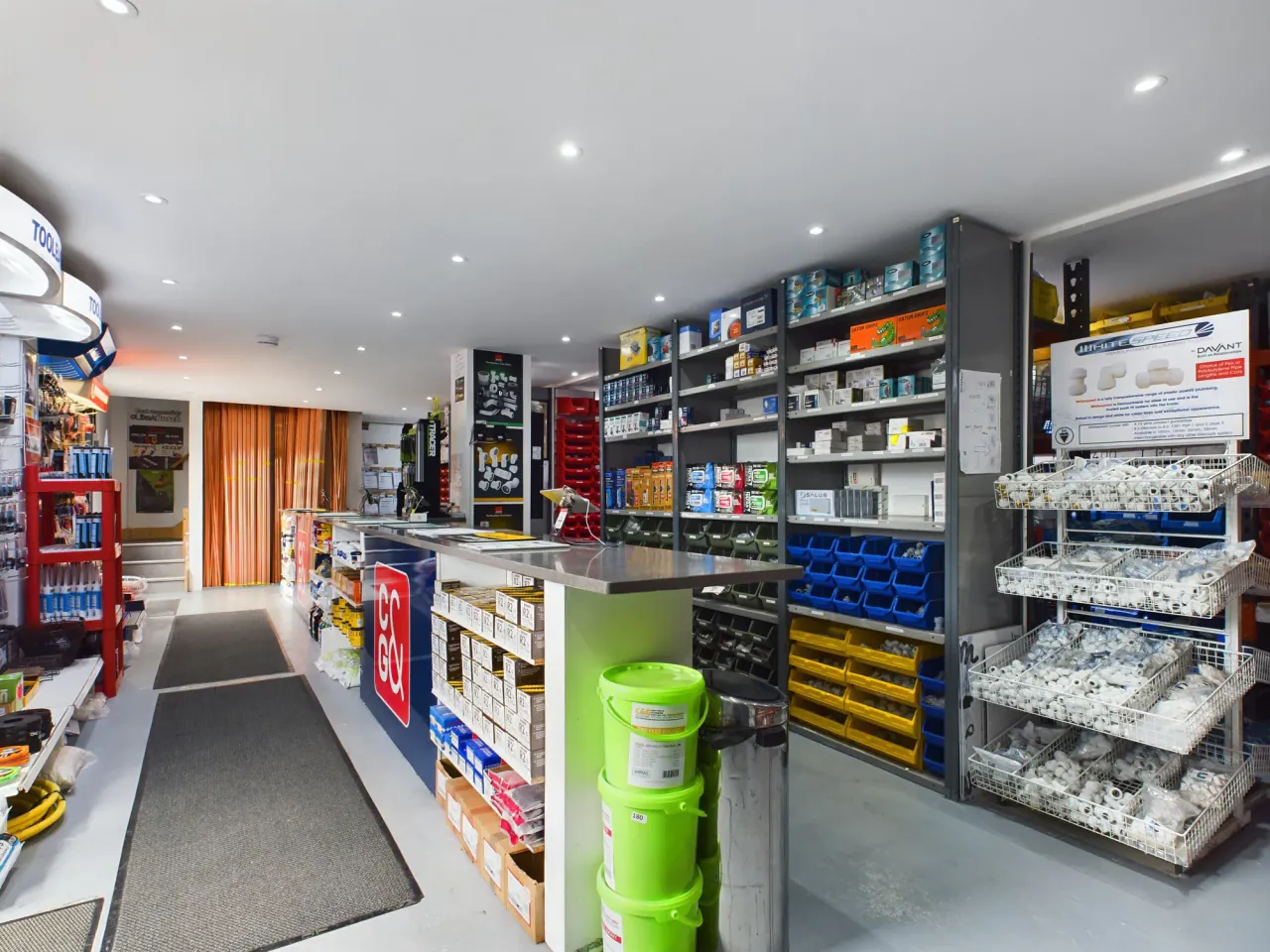
C&G Heating & Plumbing Supplies is a merchant in Erith, Kent, with a bespoke catalogue and tablet-counter system whose history dates to November 2017. Its case study reports 72,444 catalogue product records in a snapshot dated 3 September 2026.
As a purchasing workflow, a merchant or contractor raises an order from its product catalogue, records the delivery against it, and compares the supplier invoice with both records. That is the process this guide explains.
None of that is peculiar to a merchant. A contractor's stores is a merchant with one customer: goods arrive against orders, get booked in, sit at a cost, and go out to jobs instead of across a counter. The paperwork is the same; only the direction of the last movement changes. Stock control for a contractor follows the goods from that door to the van and the job.
Is it worth it for a small firm
The honest answer is that it depends on three things. Whether you buy on account at more than one merchant. Whether materials go to more than one job at a time. And whether the person who checks the invoices is somebody other than the person who ordered the goods.
If the answer to any of those is yes, the checking is already happening, badly, in somebody's head, and the goods received note is not extra paperwork. It is the same work done once at the door instead of three times in the office. If the answer to all three is no, a single buyer with a single job can hold it in their head for a while longer, and knows roughly when that will stop being true.
The order is raised, approved by a named person and sent to the supplier, and the committed cost lands on the job that day. Goods received, deliveries out and collections back run through one continuous stock ledger with a quantity held per bin, so the number on the screen is the number on the shelf. The supplier's invoice is matched to the order it was raised against rather than coded four weeks later to whichever project looks most likely, and a credit note comes back off the same order. The person at the door still looks at the pallet, because a GRN that copies the delivery note is a delivery note with extra steps.
Where to start, on Monday
Do not start by choosing software. For the next ten deliveries, whoever signs the delivery note writes the purchase order number on it, counts every line, and marks any difference before the driver leaves. Then compare those ten notes with the invoices when they arrive.
Most firms doing this for the first time find a difference on at least one of the ten, and it is almost never in their favour. That difference, multiplied by a year of deliveries, is the size of the problem, and it is also the number that tells you whether a goods received note is worth thirty seconds at the door.
Sources
Checked against the source rather than against commentary. Where a schedule, a rate or a threshold is definitive on a government site, read it there.
The follow-up questions.
The same discipline seen from the shelf rather than the door is in stock control for a contractor.
What is a goods received note?
What is the difference between a delivery note and a goods received note?
Who should sign for deliveries on site?
What should I do when a delivery is short or the wrong item has been substituted?
What do I do when the delivery exceeds the purchase order?
What is three-way matching?
What is GRNI and why does it matter at month end?
Does a small business need purchase orders?
Does a goods received note still matter if we use a purchase order system?
How long should goods received notes be kept?
Match the invoice to what actually arrived.
Bring the last supplier invoice that surprised you. Half an hour on the live system is usually enough to see where it would have been caught.
- Thirty minutes, weekdays, from tomorrow.
- Nothing to prepare. Bring a job number and we mock that job up.
- You drive it. There is no slide deck.
- You keep what you saw as a 14-day trial. No card.
More from Insights.
 Stock control for a contractor: the unit, the vans and the jobsMerchants count stock because stock is the business. Contractors rarely do, and pay in materials bought twice, fittings that never reached a job, and a year-end figure nobody believes.Read it →
 Materials went up after you quotedThe average tells you nothing. Structural steel rose 13.1% in the year to May 2026 while cement fell 5.0%. A quote is only exposed to what it is built from.Read it →
 Where spreadsheet job costing breaksNot when it gets complicated. When two people open it, when committed cost is not in it, and when the true position is a week old by the time anybody has assembled it.Read it →
All 6 articles on plant and assets.